The Arithmetic of Evasion: Why ₱8.8 Billion Is a Distraction From ₱266 Billion
By Louis “Barok” C Biraogo | November 14, 2026
SO this is the big reveal.
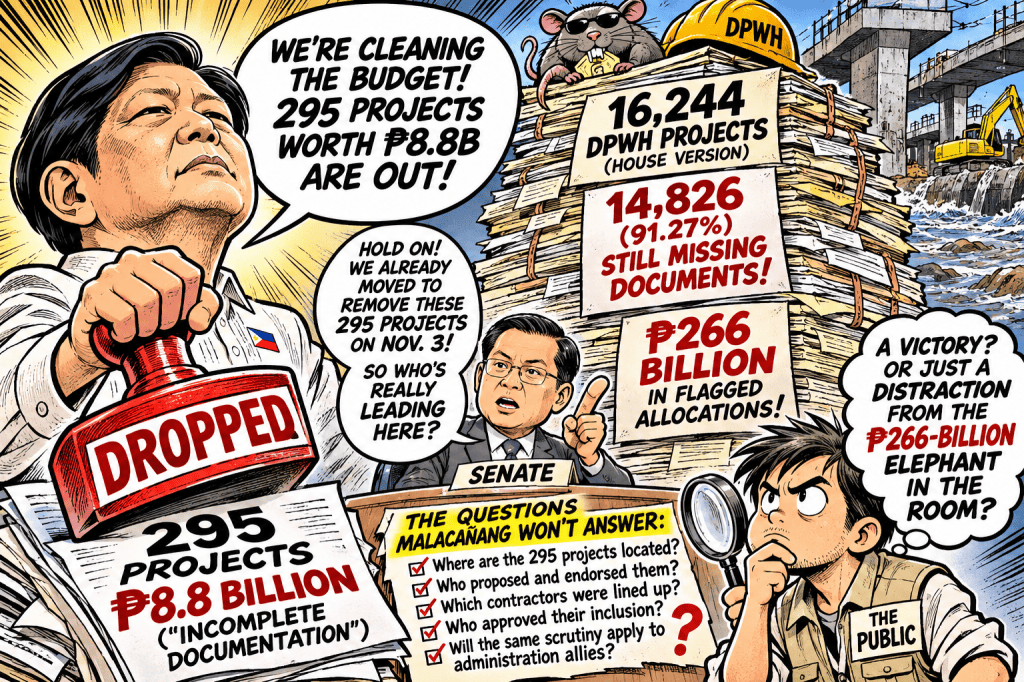
On November 13, 2026, President Ferdinand Marcos Jr. announced—with all the solemnity of a man who has just discovered fire—that 295 infrastructure projects worth ₱8.8 billion would be dropped from the proposed 2027 National Expenditure Program because their supporting documents were incomplete.
The Manila Times reported it. Communications Secretary Lino Cayetano went on radio to trumpet it. Department of Public Works and Highways (DPWH) Secretary Giovanni Lopez issued a memorandum warning his personnel not to push projects without the necessary paperwork. And somewhere in Malacañang, a speechwriter is probably drafting the next State of the Nation Address (SONA) line about how this administration “will not tolerate corruption.”
Cue the applause. Cue the collective amnesia.
Because here’s what the press release doesn’t say: Why were 295 infrastructure projects worth billions of pesos being considered for the national budget in the first place without complete documentation?
And more importantly: Why should we treat the removal of these projects as a victory when the Senate’s own findings suggest the problem is closer to 16,244 projects and ₱266 billion in flagged allocations?
The Arithmetic of Suspicion
Let’s do the math that Malacañang hopes you won’t.
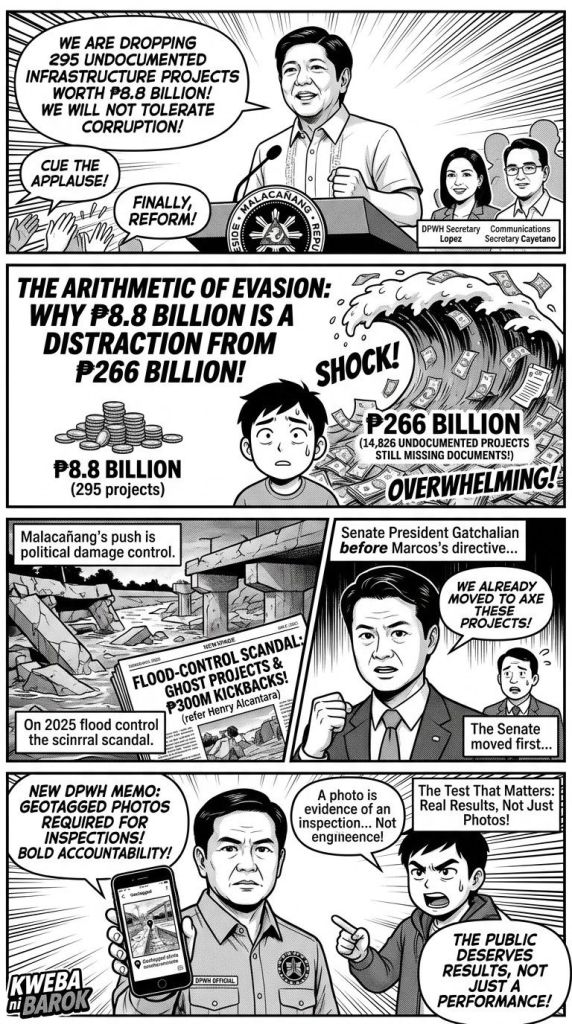
The ₱8.8 billion in dropped projects averages roughly ₱29.83 million per project. That’s not a rounding error. That’s the kind of money that could build hundreds of classrooms, equip dozens of rural health centers, or—depending on how creative your engineering is—pay for a lot of “ghost” flood-control structures that exist only in the imaginations of certain contractors.
But ₱8.8 billion is not “savings.” It’s not “money recovered.” It’s proposed budget exposure avoided—assuming the funds weren’t already obligated, disbursed, or funneled through the creative accounting that has made the DPWH the gift that keeps on giving.
And where, exactly, is the list of these 295 projects?
The public has been told they were removed. The public has been told they lacked documents. But the public has not been told: where these projects were located; who proposed them; which legislators endorsed them; which contractors were salivating at the prospect of building them; and, most crucially, who approved their inclusion in the first place.
That last question is the one that should keep Secretary Lopez up at night—assuming he isn’t already kept awake by the ghost of every flood-control project that turned out to be a photo op.
The 16,244-Project Elephant in the Room
On October 26, 2026, Senate Finance Committee Chairman JV Ejercito dropped a number that should have triggered a national emergency: 16,244 DPWH projects in the House-approved budget bill, up from 11,420 in the original NEP.
That’s an increase of 4,824 projects—a 42% jump.
And how many of those 16,244 projects had supporting documents submitted to the Senate at the time of its review?
1,418.
Out of 16,244 projects, only 1,418—roughly 8.7%—had documentation submitted to the Senate. The remaining 14,826 projects (91.27%) were, at least as of the Senate’s review, undocumented.
The Senate was asked to evaluate the technical necessity, location, scope, cost, and implementation readiness of more than 14,000 projects without the documents needed to perform that evaluation.
And now we’re supposed to celebrate because 295 projects were removed?
That’s like congratulating a hospital for removing 295 potentially infected bandages while ignoring the 14,826 patients still bleeding in the hallway.
The Senate Was First (And the Palace Won’t Admit It)
Here’s a detail Malacañang’s spin machine would prefer you forget: The Senate was already moving to remove these projects before Marcos issued his directive.
On November 3, 2026, Senate President Sherwin Gatchalian announced that 295 projects worth approximately ₱8.836 billion would be removed unless properly substantiated.
On November 13—ten days later—Marcos issued his directive.
So who’s following whom?
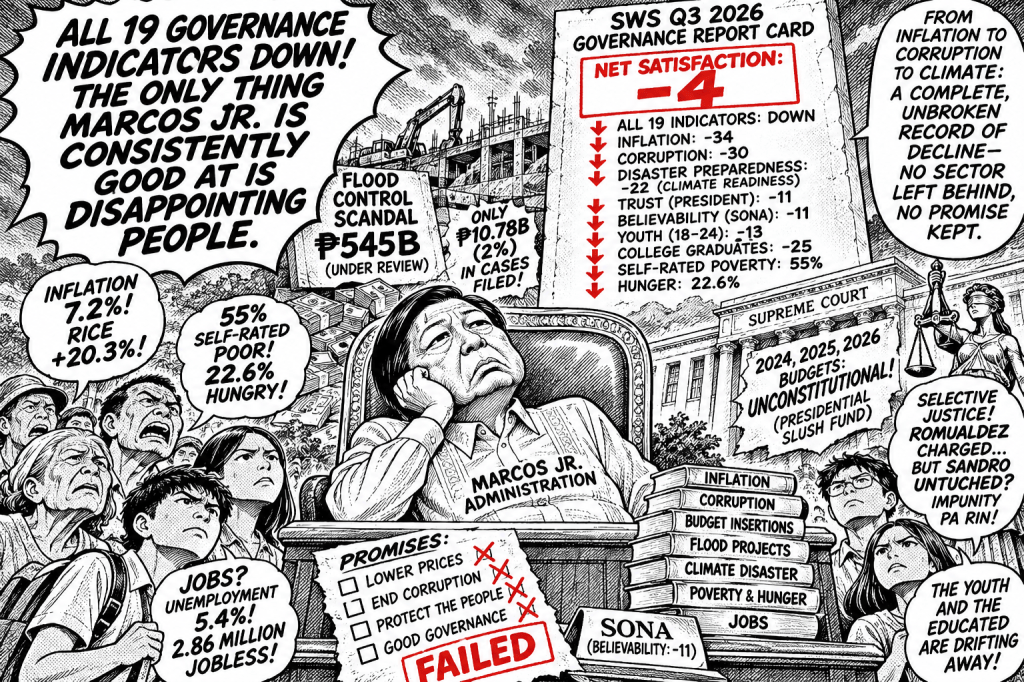
The chronology matters because it reveals the administration’s real motivation: political damage control. The flood-control scandal that broke in 2025 has become an existential threat to the Marcos presidency. Public trust has eroded. Approval ratings have declined. And the Senate—emboldened by public anger—was about to make the administration look weak on corruption.
The directive, in other words, was less a bold reform initiative and more a race to claim credit for work the Senate had already started.
The Flood-Control Scandal: The Context Malacañang Wants Buried
Let’s rewind to September 2025.
Reuters reported that an examination of ₱545 billion allocated to flood-control projects since 2022 revealed substandard infrastructure, poorly documented projects, projects that reportedly did not exist, identical project costs despite different locations, and a concentration of funding among a small number of contractors—15 out of more than 2,000 accredited contractors received approximately 20% of the total allocation.
By 2026, the Commission on Audit (COA) had submitted fraud audit reports to the Independent Commission for Infrastructure (ICI) concerning flood-control projects in Bulacan. The reports identified projects whose locations differed from their contracts, existing structures where new structures were supposedly constructed, missing supporting documentation, and potentially misrepresented accomplishments. COA warned that these circumstances could indicate double-counted accomplishments or falsified project completion claims.
And then there’s Henry Alcantara, the former Bulacan District Engineer who became a state witness and admitted to certifying ghost projects and receiving approximately ₱300 million in kickbacks.
₱300 million. From one district engineer. In one province.
And we’re supposed to believe that removing 295 undocumented projects is the solution?
The “Reform” That Isn’t
Secretary Lopez’s November 11 memorandum requires regional directors and district engineers to personally inspect infrastructure, document inspections through geotagged and time-stamped photographs, submit monthly reports, and face administrative or disciplinary consequences for noncompliance.
This is presented as a bold new accountability measure.
But let’s be clear: It’s the bare minimum.
Any functioning infrastructure agency should already be requiring its officials to inspect projects. Any competent district engineer should already be documenting construction progress. The fact that these requirements need to be spelled out in a memorandum—and that noncompliance requires the threat of disciplinary action—tells us something about the institutional culture that has prevailed at the DPWH.
And here’s the thing about geotagged photographs: They prove someone was at a location at a particular time. They do not prove whether the concrete has the required compressive strength, whether reinforcement specifications were followed, whether the contractor used substandard materials, or whether the photographed structure is actually the one identified in the contract.
A photograph is evidence of an inspection activity. It is not evidence of engineering compliance.
If the DPWH wants to restore public trust, it needs independent technical verification, material testing, random third-party inspections, and a public project dashboard. What it has offered instead is another layer of paperwork.
The Selective Enforcement Problem
Here’s the question that Malacañang refuses to answer: Will the same documentation standards be applied to projects requested by administration allies?
The public deserves to know whether the 295 removed projects were concentrated in the districts of opposition legislators—and whether projects endorsed by Malacañang’s own coalition were subject to the same scrutiny. The public deserves to know whether the directive is a genuine reform initiative or a weapon being used to punish political opponents while protecting political friends.
Senator Imee Marcos—the President’s own sister—questioned Vince Dizon’s lapsed appointment as DPWH Secretary. That intra-family tension suggests not everyone in the Marcos camp is comfortable with how the anti-corruption campaign is being conducted.
And with Ombudsman investigations pending against House Speaker Martin Romualdez—the President’s cousin—the selective enforcement question becomes even more pressing.
If the administration can investigate its own allies with the same vigor it applies to its opponents, then maybe the directive represents something more than political theater. But we’re not there yet.
The Legal Fine Print (Or: Why Nothing Has Changed)
The 1987 Constitution of the Republic of the Philippines (1987 Constitution), Article VII, Section 17, gives the President “control of all the executive departments, bureaus, and offices.” That’s the legal basis for the directive. It’s solid.
Republic Act No. 12009 (New Government Procurement Act) requires infrastructure projects to have completed detailed engineering before bidding and award. But here’s the catch: Section 8 regulates the conditions for bidding and awarding infrastructure contracts. It does not automatically mean every project appearing in the NEP must already have completed every procurement-stage document.
There’s a difference between documents required for project identification and budget evaluation, documents required for budget authorization, documents required before procurement, and documents required before contract award.
A project should not be declared illegal simply because it has not yet reached a stage at which particular documents become legally necessary.
The directive is legally defensible as an exercise of executive discretion in budget preparation. But it does not establish that the projects were fraudulent. It does not identify who was responsible for the deficiencies. It does not recover any money already spent. And it does not ensure that future projects will be properly prepared.
Cleaning the proposed budget is not the same as cleaning the institutions that prepare it.
The Limits of “I Didn’t Know”
The Supreme Court has addressed official liability in Arias v. Sandiganbayan (1989) and Office of the Ombudsman v. Santidad (2019).
Arias established that heads of offices may, to a reasonable extent, rely on the good faith of subordinates who prepare documents and transactions.
But Santidad clarified the limits of that doctrine: It cannot be used as a “magic cloak” to shield officials who ignore obvious irregularities.
Applied to the 295 projects: If regional directors, district engineers, or senior approving officials were confronted with missing geographical coordinates, duplicate project descriptions, or inconsistent engineering documents, they cannot automatically escape responsibility by blaming their subordinates.
The investigation must follow the evidence—not organizational rank. If only district engineers are punished while senior officials and political sponsors escape scrutiny, the directive becomes an exercise in scapegoating rather than accountability.
What the Public Deserves to Know (And Isn’t Being Told)
The government has announced that 295 projects were removed. It has not released the list.
The public deserves to know: the title, location, and cost of each removed project; the name of the legislator or official who proposed each project; the specific documentary deficiencies; whether any projects had already received appropriations or disbursements; whether any contractors had already been identified or engaged; whether any officials have been referred for investigation; and whether the same standards will be applied to projects endorsed by administration allies.
Without this information, the directive is an announcement, not a reform.
The Test That Matters
The success of Marcos’s directive should not be measured by the number of projects removed. It should be measured by the number of corrupt practices permanently eliminated, the amount of public money protected, the officials and contractors held accountable, and the infrastructure actually delivered to the Filipino people.
On all four metrics, the jury is still out.
The administration has taken a step—a small, cautious, politically calculated step—toward addressing the systemic corruption that has plagued the DPWH for decades.
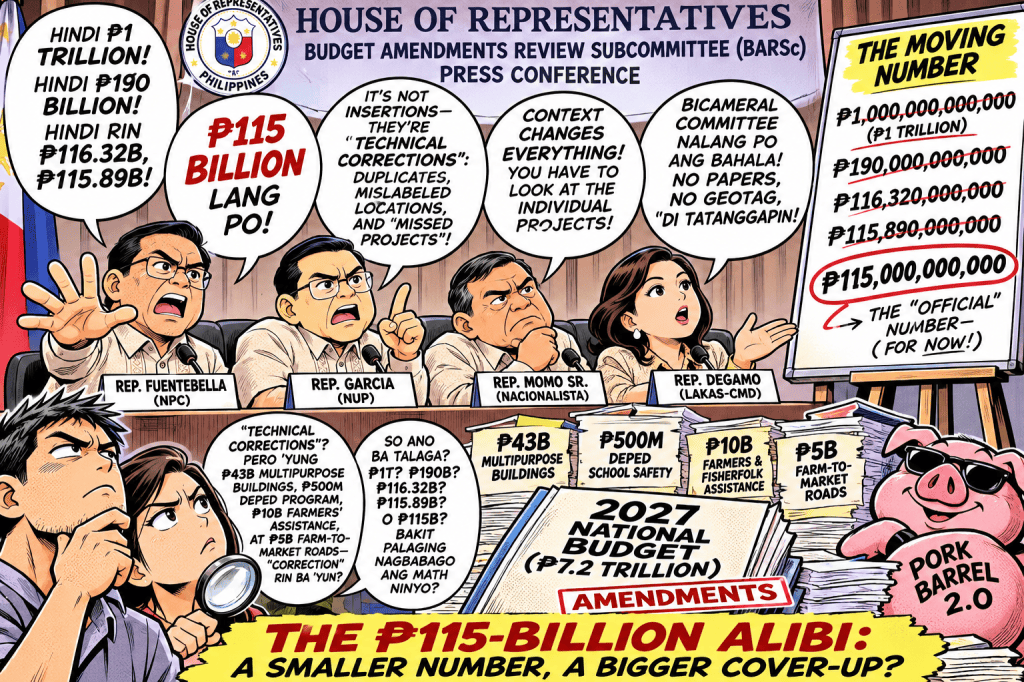
But until it releases the list of removed projects, until it investigates the 4,824 additional projects introduced during House deliberations, until it audits the ₱20.5 billion in lump-sum items, until it follows the money to contractors and political sponsors, and until it holds powerful officials accountable regardless of their political connections—the ₱8.8-billion purge will remain what it appears to be:
A performance.
And the Filipino people—who have watched their roads flood, their bridges crumble, and their tax pesos vanish into the pockets of the well-connected—deserve more than a performance.
They deserve results.
Key Citations
A. Legal & Official Sources
- Arias v. Sandiganbayan. Lawphil Project, Supreme Court of the Philippines, 19 Dec. 1989, lawphil.net/judjuris/juri1989/dec1989/gr_81563_1989.html.
- Office of the Ombudsman v. Santidad. Lawphil Project, Supreme Court of the Philippines, 5 Dec. 2019, lawphil.net/judjuris/juri2019/dec2019/gr_207154_2019.html.
- Republic Act No. 12009. New Government Procurement Act. 20 July 2024, http://www.officialgazette.gov.ph/2024/07/20/republic-act-no-12009/.
- The 1987 Constitution of the Republic of the Philippines. Official Gazette of the Republic of the Philippines, 1987, http://www.officialgazette.gov.ph/constitutions/the-1987-constitution-of-the-republic-of-the-philippines/.
B. News Reports
- Commission on Audit. “COA Files 4 Fraud Audit Reports with ICI on Bulacan Flood Projects.” INQUIRER.net, 26 Sept. 2025, newsinfo.inquirer.net/2115768/coa-files-4-fraud-audit-reports-with-ici-on-bulacan-flood-projects.
- Damicog, Jeffrey G. “DPWH Orders Weekly Inspections of Roads, Bridges Nationwide.” Daily Tribune, 12 Nov. 2026, tribune.net.ph/2026/11/12/dpwh-orders-weekly-inspections-of-roads-bridges-nationwide.
- Depasupil, William B., and Arlie O. Calalo. “295 Projects Worth P8.8B Dropped from NEP.” The Manila Times, 13 Nov. 2026, manilatimes.net/2026/11/13/news/national/295-projects-worth-p88b-dropped-from-nep/2468073.
- Ejercito, JV. “Senate Flags P266-B DPWH Projects for Further Scrutiny.” Philippine News Agency, 26 Oct. 2026, pna.gov.ph/article/1259794.
- Reuters. “Philippine Groups Demand Independent Investigation of ‘Excessive Corruption’ in Government Projects.” Reuters, 4 Sept. 2025, reuters.com/world/asia-pacific/philippine-groups-demand-independent-investigation-excessive-corruption-2025-09-04/.
- TV5 News. “Gatchalian: Senate to Axe 295 Infra Projects under 2027 Budget Bill.” News5, 3 Nov. 2026, news.tv5.com.ph/national/read/gatchalian-senate-to-axe-295-infra-projects-under-2027-budget-bill.
- Win Gatchalian. “Gatchalian: Senate to Purge P8.836B Worth of Unsupported Infra Projects from Proposed 2027 Budget.” Official Website of Senator Win Gatchalian, 3 Nov. 2026, wingatchalian.com/news/gatchalian-senate-to-purge-p8-836b-worth-of-unsupported-infra-projects-from-proposed-2027-budget/.

- “Ang Hirap Maging Mahirap”: The PAO Scandal That Proves Government Contempt Is Nothing New

- “Far-Off” My Axx: Malacañang’s Claire Castro Drowns in Her Own Legal Gaslighting
- “Forthwith” to Farce: How the Senate is Killing Impeachment—And Why Enrile’s Right (Even If You Can’t Trust Him)

- “HINDI AKO NAG-RESIGN!”

- “I Know Nothing”: Baste Duterte’s Amnesia Defense Meets ₱33M in GenCorp Contracts

- “I’m calling you from my new Globe SIM. Send load!”

- “Mahiya Naman Kayo!” Marcos’ Anti-Corruption Vow Faces a Flood of Doubt

- “Manageable” Debt, Unmanageable Corruption: The ₱19.66-Trillion Lie
- “Manageable” Debt, Unmanageable Lies: DBM’s ₱21 Trillion Fairy Tale

- “Meow, I’m calling you from my new Globe SIM!”

- “Natrabaho”: One Word, One Ombudsman, and a Judiciary on Trial

- “No Special Jail for Crooks!” Boying Remulla Slams VIP Perks for Flood Scammers





Leave a Reply