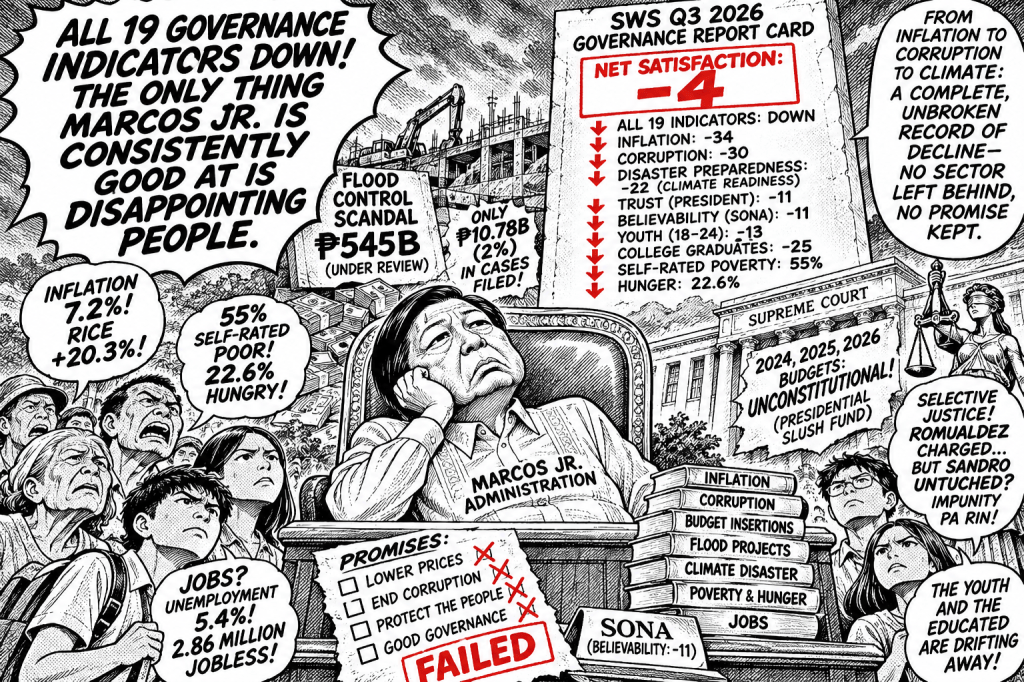
From Inflation to Corruption to Climate: A Complete, Unbroken Record of Decline—No Sector Left Behind, No Promise Kept
By Louis ‘Barok‘ C. Biraogo — November 15, 2026
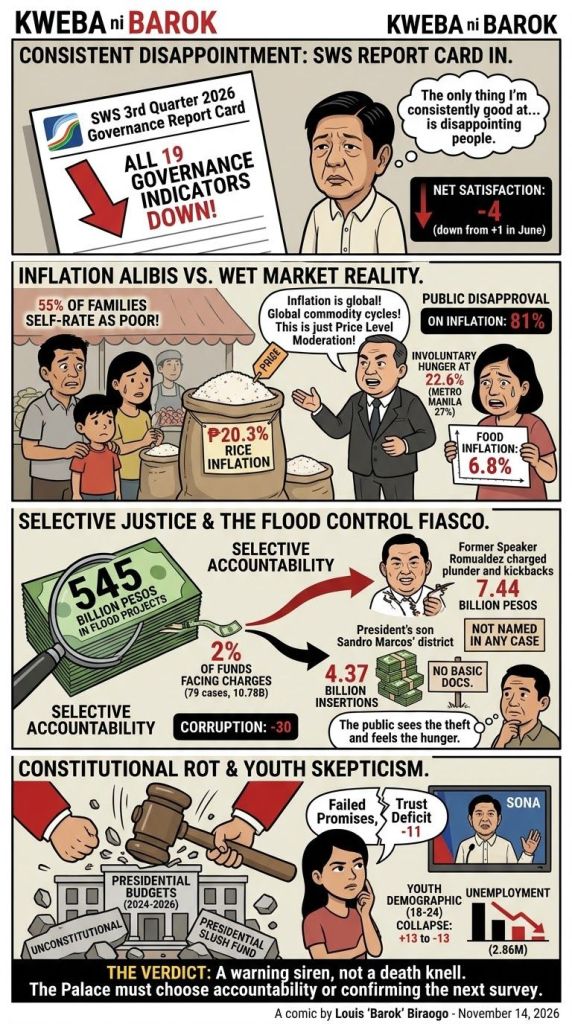
THE Social Weather Stations (SWS) Third Quarter 2026 Governance Report Card landed on November 13 with the dull thud of a verdict that everyone saw coming but no one in Malacañang wanted to read. A net satisfaction rating of -4—down from +1 in June—is not a catastrophic landslide. It is something potentially more corrosive: a quiet, statistically significant abandonment by the middle.
The administration’s defenders will cling to the “neutral” classification like a drowning man to a reed, but the architecture of this decline is what should terrify the Palace: all nineteen governance indicators fell. Every single one. Inflation sits at a putrid -34, corruption at -30, and the administration’s supposed strength—disaster preparedness—is bleeding out after a 22-point collapse in climate change readiness.
Let us be clear about what this survey actually measures. It does not measure whether the government has objectively failed at every task. It measures whether the Filipino public perceives failure. And perception, in a democracy, is the only currency that ultimately matters.
The Inflation Alibi and the Rice Problem
The administration’s reflexive defense is that inflation is a global phenomenon—oil prices, supply chains, geopolitical shocks. This is the kind of argument that sounds sophisticated in a briefing room and utterly absurd in a wet market in Metro Manila, where a kilo of rice has become a luxury item.
The data corroborates the public’s fury: September 2026 inflation hit 7.2%, with food inflation at 6.8% and rice inflation at a staggering 20.3%. Pulse Asia’s September survey found that 81% of Filipinos disapproved of the government’s handling of inflation, and 71% identified it as the most urgent national concern.
The Palace can lecture the public about monetary policy independence and global commodity cycles until the carabaos come home. But when 55% of Filipino families self-rate as poor—up from 49% in June—and 44% self-rate as food-poor, the esoteric distinction between “inflation moderation” and “price levels” is a semantic luxury no one can afford.
SWS found involuntary hunger at 22.6%, with Metro Manila spiking to 27%. This is not a public relations (PR) problem. It is a household survival problem that the administration has failed to solve, and the public knows it.
The Corruption Quagmire: Selective Accountability as a Governing Philosophy
The -30 on eradicating graft and corruption is where the administration’s credibility truly fractures, because it intersects with the most damning political scandal of the Marcos presidency: the flood control fiasco. The numbers are almost pornographic in their scale. Nearly 10,000 flood control projects worth 545 billion pesos have been under review.
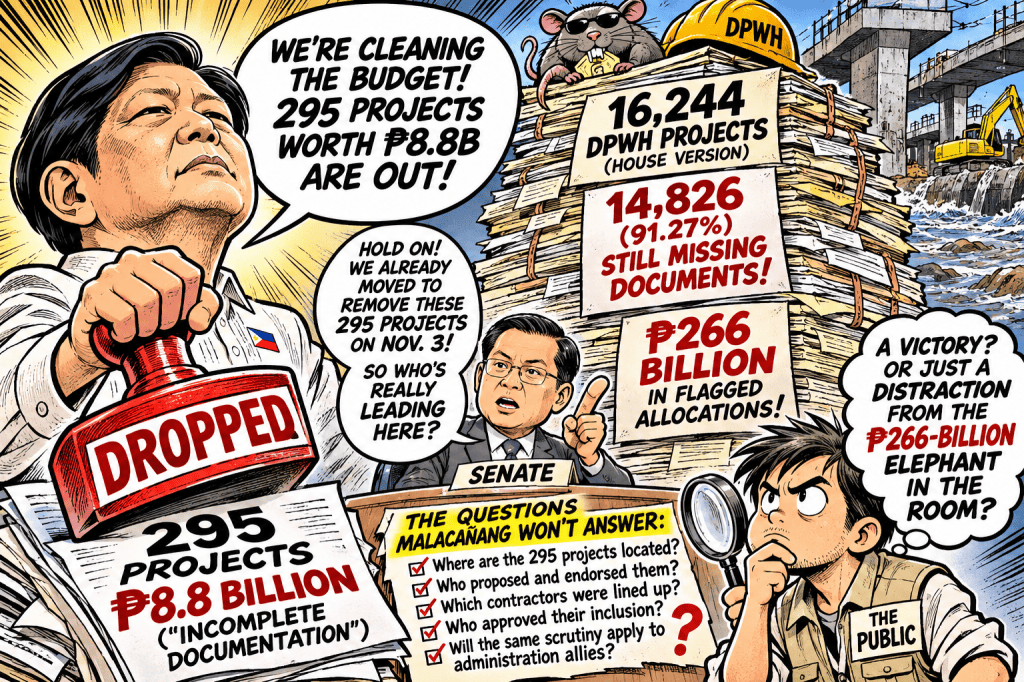
Yet as of November 6, the Ombudsman had filed only 79 criminal cases involving 10.78 billion pesos—a mere 2% of the funds under scrutiny. The public is not stupid. They can do arithmetic.
The Perception of Selective Justice
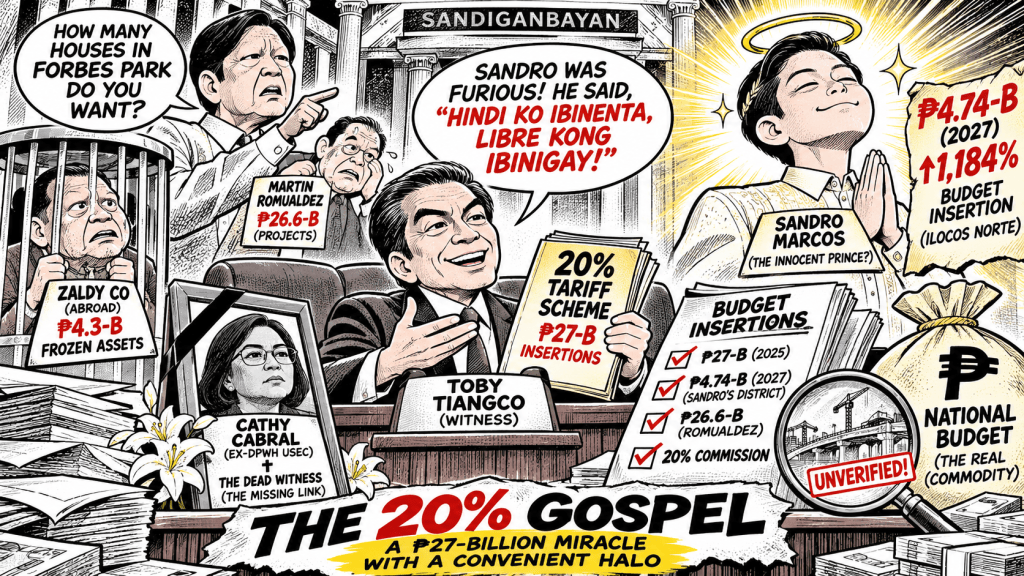
The deeper rot is the perception of selective justice. Former House Speaker Martin Romualdez—the President’s own cousin—was charged with plunder for allegedly receiving 7.44 billion pesos in kickbacks.
Meanwhile, the President’s son, Majority Leader Sandro Marcos, has not been named in any of the 79 criminal cases filed by the Ombudsman—though his district’s ₱4.37 billion in proposed 2027 public works insertions, a roughly twelve-fold increase over the executive’s original ₱369 million proposal, are now under Senate scrutiny for lacking basic documentation.
This perception of impunity is not merely a moral failure; it is an economic one. Every peso allegedly diverted to ghost flood control projects is a peso not spent on classrooms, hospitals, or rice subsidies.
The public understands the connection between the -30 on corruption and the -34 on inflation better than the technocrats in the Cabinet. They see the theft. They feel the hunger. They connect the dots.
The Supreme Court’s Bombshell and the Budget as a Crime Scene
If the SWS survey captured the public’s mood, the Supreme Court’s October 20 ruling captured the institutional rot beneath it. The Court declared key provisions of the 2024, 2025, and 2026 national budgets unconstitutional, finding that Congress illegally inflated unprogrammed appropriations by hundreds of billions of pesos—creating what the justices essentially described as a presidential slush fund.
The ruling was unprecedented: the first time since 1986 that the High Court had struck down a sitting president’s budget.
A Survey Taken Before the Ruling
The timing is devastating. The survey was conducted September 21–27, weeks before the ruling, but the controversy over budget insertions and unprogrammed funds was already simmering.
The public’s -30 on corruption did not emerge from a vacuum; it emerged from a political environment in which the mechanisms of public spending were being exposed as vehicles for patronage and plunder. The Court’s ruling validated what the public already suspected: that the budget process itself had been weaponized against them.
The Regional Divide: Mindanao’s Grudge and Metro Manila’s Misery
The regional breakdown is a Rorschach test for the administration’s political vulnerabilities. Metro Manila’s -21 is unsurprising: the urban poor bear the brunt of food inflation, transport costs, and flooding. But Mindanao’s -17—unchanged from June—is the more interesting number.
The Marcos-Duterte alliance is dead, buried under the impeachment of Vice President Sara Duterte and the International Criminal Court (ICC) arrest of her father. Mindanao’s persistent negativity is not merely economic; it is political, a regional rejection of a President who has abandoned the southern coalition that helped elect him.
Balance Luzon’s +7 is the only positive regional rating, and the Palace will trumpet it as evidence that the “core” remains loyal. But even here, self-rated poverty rose from 41% to 51% between June and September. The +7 is not a vote of confidence; it is a lagging indicator, a regional patience that may not survive another quarter of rising prices.
The Youth and the Educated: The Coalition Cracking
Perhaps the most alarming data point for the administration is the 26-point collapse among 18-to-24-year-olds, from +13 to -13. College graduates fell 15 points to -25. These are not the marginalized sectors that the administration might dismiss as perennial opposition. These are the children of the middle class, the digital natives, the future workforce.
Their dissatisfaction is rooted in a bleak employment landscape—unemployment at 5.4%, with 2.86 million jobless—and a profound skepticism toward a government that seems more interested in defending its allies than in securing their futures.
This is the demographic that the administration’s communication strategy was supposed to win. The State of the Nation Address (SONA), the social media presence, the youth-oriented programs—all of it has failed to penetrate the cynicism bred by rising prices and visible corruption. The Palace can dismiss the survey as a snapshot, but the youth are not a snapshot. They are a trend.
What the Palace Will Do (And Why It Won’t Work)
The administration’s response will follow a predictable script. The Palace will question the survey’s timing or methodology. It will point to education (+61) and housing (+40) as evidence of success.
It will promise “accelerated” interventions and perhaps reshuffle a Cabinet secretary or two. It will insist that the “real” economy is improving, that inflation is moderating, that the global situation is to blame.
None of this will address the fundamental problem: the public has stopped believing the government’s explanations. The -11 net believability on the SONA, the collapse in trust for the President personally (-11), the gap between the administration’s rating and Vice President Duterte’s (+21) all point to a credibility deficit that policy tweaks cannot fix.
The public does not need another dashboard or another interagency task force. It needs to see that the powerful are held accountable, that public money reaches its intended destination, and that the government understands the difference between a statistical recovery and a lived one.
The Verdict
The SWS survey is not a death knell. It is a warning siren. The Marcos administration retains pockets of genuine public support—education, social assistance, disaster response—and a national net rating of -4 is not a repudiation. But the trajectory is unmistakable.
- Inflation is eroding household purchasing power.
- Corruption is eroding institutional trust.
- The budget scandal is eroding the fiction of competent governance.
- And the youth, the educated, and the urban poor are all drifting away.
The administration can either treat this survey as a PR problem to be managed or as a governance crisis to be confronted. The former requires better spin. The latter requires prosecuting allies, opening the budget books, and delivering tangible relief to households that are skipping meals to afford rice.
The Palace has shown no appetite for the latter. Until it does, the next survey will not be a warning. It will be a confirmation.
Key Citations
A. Reports & Studies
- Philippine Statistics Authority. “Summary Inflation Report Consumer Price Index (2018=100): September 2026.” Philippine Statistics Authority, 6 Oct. 2026, psa.gov.ph/content/summary-inflation-report-consumer-price-index-2018100-september-2026.
- Philippine Statistics Authority. “Labor Force and Employment.” Philippine Statistics Authority V, 9 Nov. 2026, rsso05.psa.gov.ph/statistics/labor-force-employment/node/1684059843.
- Philippine Statistics Authority. “Highlights of the September 2026 Labor Force Survey.” Philippine Statistics Authority, Nov. 2026, psa.gov.ph/system/files/iesd/Press_Release_for_Sep_2026_LFS.pdf.
- Social Weather Stations. “Net Satisfaction with the National Administration Falls to -4 in September 2026 from +1 in June 2026.” Social Weather Stations, 13 Nov. 2026, sws.org.ph/social-weather-report-net-satisfaction-with-the-national-administration-falls-to-4-in-september-2026-from-1-in-june-2026/.
- Social Weather Stations. “Net Satisfaction with President Ferdinand Marcos, Jr. Falls to -11 in September 2026 from -7 in June 2026.” Social Weather Stations, 8 Oct. 2026, sws.org.ph/social-weather-report-net-satisfaction-with-president-ferdinand-marcos-jr-falls-to-11-in-september-2026-from-7-in-june-2026/.
- Social Weather Stations. “Self-Rated Poverty Rises by 6% to 55%, while Self-Rated Food Poverty Rises by 8%, between June and September 2026.” Social Weather Stations, 13 Oct. 2026, sws.org.ph/social-weather-report-self-rated-poverty-rises-by-6-to-55-while-self-rated-food-poverty-rises-by-8-between-june-and-september-2026/.
- Social Weather Stations. “Hunger Rises to 22.6% in September 2026 from 20.3% in June 2026.” Social Weather Stations, 14 Oct. 2026, sws.org.ph/social-weather-report-hunger-rises-to-22-6-in-september-2026-from-20-3-in-june-2026/.
B. News Articles
- “A Philippine Lawmaker Charged with Corruption in Flood Control Projects.” ABC News (Associated Press), 7 Sept. 2026, abcnews.com/amp/International/wireStory/philippine-lawmaker-charged-corruption-flood-control-projects-136250057.
- “ATOM Slams ‘Selective’ Graft Drive under Marcos.” Daily Tribune, 25 Oct. 2026, tribune.net.ph/2026/10/25/atom-slams-selective-graft-drive-under-marcos.
- De Vera-Ruiz, Ellalyn. “Satisfaction with Marcos Admin Drops to Second-Lowest Rating in Q3 2026 — SWS.” Manila Bulletin, 13 Nov. 2026, mb.com.ph/2026/11/13/satisfaction-with-marcos-admin-drops-to-second-lowest-rating-in-q3-2026-sws.
- GMA News. “Ombudsman: 79 Flood Control-Related Cases Filed in Courts.” GMA News Online, 6 Nov. 2026, www.gmanetwork.com/news/topstories/nation/1008545/ombudsman-79-flood-control-related-cases-filed-in-courts/story/.
- “SC Strikes Down 2024, 2025 Budgets, Sets Limits for Unprogrammed Appropriations.” GMA News Online, 20 Oct. 2026, www.gmanetwork.com/news/topstories/nation/1006575/sc-strikes-down-2024-2025-budgets-sets-limits-for-unprogrammed-appropriations/story/.
- “Marcos’ Net Satisfaction Rate Dips to ‘Poor’ in Q3 2026 — SWS.” Inquirer.net, 8 Oct. 2026.
- “Palace Defends P4.37-Billion Budget Insertion for Sandro Marcos’ District.” Daily Tribune, 27 Oct. 2026, tribune.net.ph/2026/10/27/palace-defends-p437-billion-budget-insertion-for-sandro-marcos-district.
- Pulse Asia. “81% Disapprove of Gov’t Handling of Inflation — Pulse Asia.” Daily Tribune, 15 Oct. 2026, tribune.net.ph/2026/10/15/81-disapprove-of-govt-handling-of-inflation-pulse-asia.
- “Romualdez Ordered Arrested in P7.44-B Flood-Control Plunder Case.” Philstar.com, 7 Sept. 2026, www.philstar.com/headlines/2026/09/07/2554656/romualdez-ordered-arrested-p744-b-flood-control-plunder-case.
- Laqui, Ian. “SC Declares Provisions of 2024, 2025, 2026 National Budgets Unconstitutional.” Philstar.com, 21 Oct. 2026, www.philstar.com/headlines/2026/10/21/2564572/sc-declares-provisions-2024-2025-2026-national-budgets-unconstitutional.

- “Ang Hirap Maging Mahirap”: The PAO Scandal That Proves Government Contempt Is Nothing New

- “Far-Off” My Axx: Malacañang’s Claire Castro Drowns in Her Own Legal Gaslighting
- “Forthwith” to Farce: How the Senate is Killing Impeachment—And Why Enrile’s Right (Even If You Can’t Trust Him)
- “HINDI AKO NAG-RESIGN!”

- “I Know Nothing”: Baste Duterte’s Amnesia Defense Meets ₱33M in GenCorp Contracts
- “I’m calling you from my new Globe SIM. Send load!”

- “Mahiya Naman Kayo!” Marcos’ Anti-Corruption Vow Faces a Flood of Doubt

- “Manageable” Debt, Unmanageable Corruption: The ₱19.66-Trillion Lie
- “Manageable” Debt, Unmanageable Lies: DBM’s ₱21 Trillion Fairy Tale
- “Meow, I’m calling you from my new Globe SIM!”

- “Natrabaho”: One Word, One Ombudsman, and a Judiciary on Trial
- “No Special Jail for Crooks!” Boying Remulla Slams VIP Perks for Flood Scammers




Leave a Reply