From ₱1 Trillion to ₱115 Billion: How Congress Turned a Budget Scandal into an Accounting Seminar
By Louis ‘Barok’ C. Biraogo — November 14, 2026
LADIES and gentlemen, the House is about to settle a trillion-peso question with a press conference.
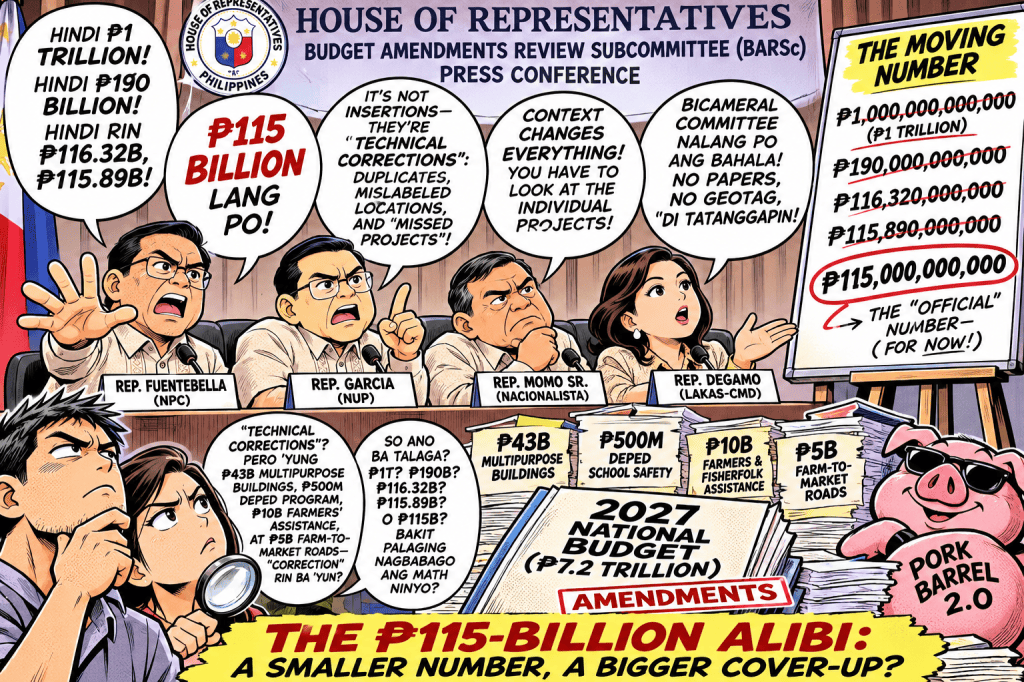
For weeks, budget watchdogs, civil society, and the Senate have said the House stuffed somewhere between ₱190 billion and ₱1 trillion in amendments into the proposed ₱7.2-trillion 2027 budget. The People’s Budget Coalition (PBC) flagged ₱1.017 trillion in “red flags”—”soft pork,” “hard pork,” “shadow pork”—complete with farm-to-market roads geolocated in waters off Brunei and a government building mapped to the Sahara. Thirty-five business groups called the insertions “deeply troubling.” The Supreme Court had just gutted the 2024, 2025, and 2026 budgets for precisely this chicanery.
The House’s response? A press conference. Four congressmen. One magic number.
₱115 billion. Trust us.
Reps. Arnie Fuentebella, Albert Garcia, Romeo Momo Sr., and Janice Degamo—spanning the Nationalist People’s Coalition (NPC), the National Unity Party (NUP), Nacionalista, and Lakas-CMD—declared that the Budget Amendments Review Subcommittee (BARSc) introduced “only ₱115 billion.” Not ₱1 trillion. Not even the ₱190 billion Garcia himself cited moments earlier before “consulting his colleagues” and correcting himself downward.
Context changes everything, Garcia intoned, as if delivering a sermon rather than damage control.
Here’s the thing about context: it also reveals when a number is being invented in real-time.
The Number That Ate Itself
The House’s own accounting has the consistency of adobo left out overnight.
On October 12, the House announced approximately ₱116 billion in amendments. On November 9, Garcia told reporters the figure was “about ₱190 billion” before revising it to ₱115 billion after a huddle with colleagues. By the time the press conference ended, the number had settled at ₱115 billion—which Fuentebella insisted was the real BARSc total, as if the ₱190 billion had been a fever dream.
Then there’s the ₱115.89 billion Garcia reportedly cited elsewhere, described as “more accurate” than the ₱116.32 billion originally reported. So we have ₱116.32 billion, ₱115.89 billion, ₱115 billion, and ₱190 billion—all supposedly describing the same amendments, from the same institution, within weeks.
This is not accounting. This is improvisation.
And the House expects the public to accept the lowest number as gospel because Fuentebella said “just to clarify lang po.” Just to clarify—the three most terrifying words in Philippine budget politics, usually preceding the exact opposite.
The “Technical Correction” Shell Game
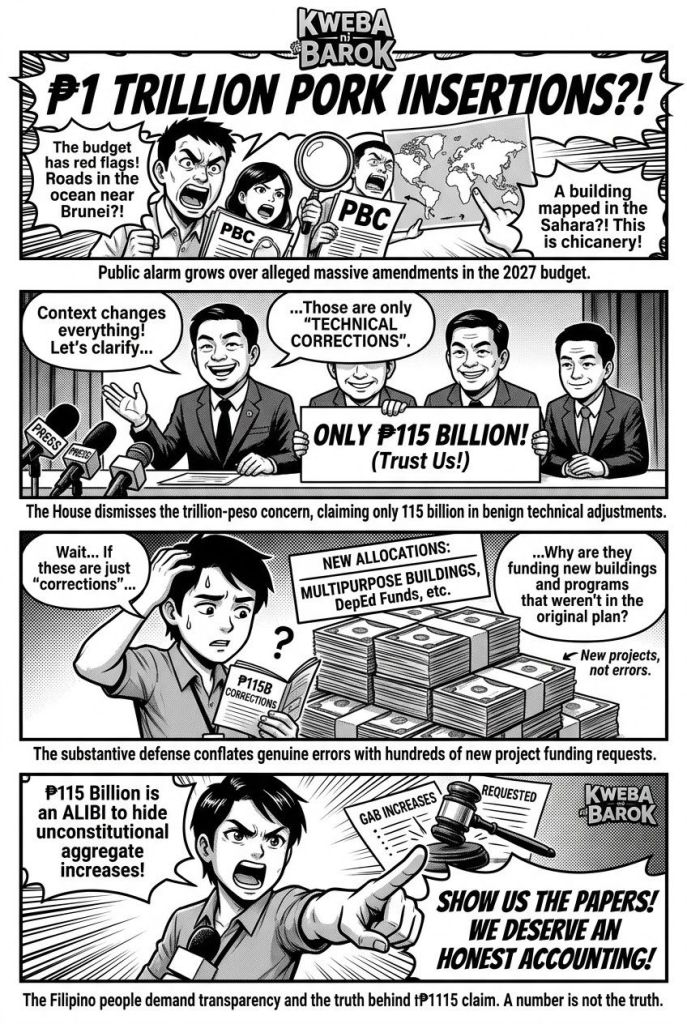
The substantive defense is that most amendments were not transfers between agencies but “corrections”—of duplicate entries, mislabeled locations, and projects “missed out” during bottom-up budgeting. Degamo offered three water projects in Negros Oriental mistakenly logged under Negros Occidental due to the creation of the Negros Island Region. Correcting the province, she argued, prevented the projects from being derailed.
Fine. A misplaced province is a legitimate technical correction. Let’s even grant that some of the ₱115 billion reflects genuine errors in the National Expenditure Program (NEP).
But the House is asking us to believe that most of the amendments are this benign—that the difference between ₱1 trillion and ₱115 billion is largely accounting methodology: gross versus net, corrections versus insertions, intra-agency versus inter-agency. This is a category error dressed up as a clarification.
A corrected province does not explain the ₱43 billion for 4,000 multipurpose buildings that Garcia and Degamo defended as necessary for barangays without covered courts or evacuation centers. It does not explain the ₱500-million addition for the Department of Education (DepEd)’s School Safety and Security Program that Fuentebella cited, or the ₱10 billion for “Presidential Assistance to Farmers and Fisherfolk,” or the nearly ₱5 billion for farm-to-market roads I have flagged as election-cycle currency.
Those are new projects. Worthy, perhaps. Necessary, perhaps. But not corrections. Conflating the two is not clarification—it is bait-and-switch.
Momo’s defense is more revealing still. He explained the amendments “did not necessarily involve funds being removed from one agency and transferred to another”—some were “corrections within the same agency, including duplicate project entries and errors in project descriptions.” Technically true. But an intra-agency amendment can still redirect ₱500 million from a nationally distributed program to a single congressional district without changing the agency’s total.
The agency’s budget stays the same. The beneficiaries change entirely. Momo’s accounting defense says nothing about whether that redistribution was justified, documented, or free from political favoritism.
Who gained and who lost? That is the question Momo carefully avoids.
The Garcia Doctrine: Blame the Critics
Garcia’s challenge to critics—”identify the specific projects involved instead of making sweeping allegations”—is a masterstroke of deflection. It is also precisely backwards.
The burden of transparency belongs to the institution that made the amendments, not the public trying to verify them. The House has the BARSc register, the project lists, the geotagging data, the agency endorsements, the technical justifications. Garcia asks civil society and journalists to reconstruct the House’s own accounting from press conferences and leaks, then criticizes them for imperfect information.
This is like a restaurant refusing to show you the kitchen, then demanding you prove the food is contaminated before you’re allowed to complain.
When Garcia says “context changes everything,” what he means is: stop looking at the aggregate number and start looking at individual projects, because individual projects are harder to aggregate into a scandal. He wants the debate to be about whether a particular farm-to-market road is legitimate, not whether the House’s entire amendment process is a constitutional shell game.
But the aggregate number is the scandal. The Supreme Court did not invalidate the 2024 and 2025 budgets because individual projects were defective. It invalidated them because Congress increased the President’s recommended appropriations by ₱449.5 billion and ₱17.99 billion respectively—aggregate increases violating Article VI, Section 25(1) of the Constitution. The Court did not care whether each peso was attached to a legitimate-sounding project. It cared that the ceiling had been breached.
If the House’s ₱115 billion represents a net increase over the President’s proposal, the aggregate number matters enormously. And the House has not provided the one document that would settle it: a reconciliation showing the House-approved General Appropriations Bill (GAB)’s total appropriations do not exceed the NEP’s.
Fuentebella says there are “no more insertions.” But “insertions” is not a legal term. The constitutional term is “increase.” And the House has not demonstrated that its amendments produced no increase.
Poe’s Geotag: The Reform That Isn’t
The most revealing moment came from neophyte Rep. Brian Poe: “No papers, no geotag or maling geotag.” Projects without proper documentation or accurate coordinates, he said, would not be accepted during bicameral deliberations.
This sounds like accountability. It is actually an admission.
Poe concedes that the House approved a budget containing projects that may lack proper papers and accurate geotags. His solution is not to fix the problem now, in the House, but to let the Senate and the bicameral conference committee catch it later. This is the same logic that gave us the “small committee” mechanism the Supreme Court found constitutionally suspect—the idea that legislators can insert projects during the legislative process and rely on post-enactment corrections to clean things up.
Worse, a project can have perfect papers and precise geotags and still be a wasteful, overpriced, politically motivated allocation. Documentation is necessary, not sufficient. The PBC’s geolocation anomalies—roads in the sea, buildings in the Sahara—are symptoms of a larger disease: a budget process in which individual legislators direct public money to projects of their choosing, with minimal technical scrutiny, then defend the allocations by pointing to paperwork they themselves control.
Poe’s rule would catch the most egregious errors. It would not catch the ₱43-billion multipurpose buildings, the ₱500-million school safety program, or thousands of other amendments that are technically documented but politically motivated.
The Senate Will Not Save Us
The congressmen’s repeated invocation of the Senate and bicameral committee as the proper venue is a tell. They know the numbers don’t add up. They know documentation is incomplete. They know the process was opaque. They are counting on the Senate to fix it—or, more likely, launder it.
I have written before about Senate President Sherwin Gatchalian’s promise to “fix the budget ourselves” without a House recall. That promise was already suspect. With the House’s accounting in disarray, it looks even more like a recipe for the same old bicameral alchemy: the House inserts, the Senate corrects just enough to avoid a Supreme Court smackdown, and the President signs a budget that is constitutionally defensible on paper but politically indistinguishable from the pork-barrel budgets the Court has repeatedly struck down.
The ₱115-billion figure is not a clarification. It is an alibi—small enough to be reassuring, vague enough to be unfalsifiable, technical enough to be boring. Nothing to see here, just corrections and agency requests. Meanwhile, the project list that would show who benefits, who requested what, and whether the ceiling was breached remains hidden.
Show Us the Papers
Speaker Faustino Dy III has promised a “transparency platform” giving the public access to project data. He says the House is “not hiding anything.” These are fine words. They are also precisely the words that have preceded every previous budget scandal.
The platform will launch. The data will be incomplete. The oversight review will produce no consequences. And the budget will pass.
If the House is serious, it should do three things immediately:
- Publish the complete BARSc amendment register, project by project, with original NEP amounts, revised amounts, requesting agencies, congressional sponsors, and technical justifications. Not a summary. Not a press release. The actual register.
- Provide a reconciliation showing the House-approved GAB’s total appropriations—programmed and unprogrammed, general fund and special accounts—do not exceed the President’s proposed appropriations. This is the constitutional test. If the House cannot meet it, the amendments are unconstitutional regardless of how many are “technical corrections.”
- Explain the ₱190-billion figure. Garcia said it. Then he unsaid it. Why? Was it the gross figure and ₱115 billion the net? If so, what accounts for the ₱75-billion difference? Or was ₱190 billion simply wrong? If the House cannot explain its own arithmetic, why should anyone trust its accounting?
The congressmen have challenged critics to “get our numbers right.” It is time for the House to get its own numbers right. All of them. In public. With documentation.
Until then, the ₱115-billion figure is not a clarification. It is a claim. And claims made behind podiums, without supporting documents, by legislators defending their own institution’s spending power, deserve exactly the credulity they are receiving: none.
The Filipino people are not asking for a perfect budget. They are asking for an honest accounting of the one they are being asked to pay for. The House has given them a number. It has not given them the truth.
Key Citations
A. News Articles
- BusinessMirror. “House on Budget Amendment Claims: Only P115-B, Not P1-T.” BusinessMirror, 9 Nov. 2026, businessmirror.com.ph/2026/11/09/house-on-budget-amendment-claims-only-p115-b-not-p1-t/.
- Cantos, Joy. “Kamara: P115 Bilyon Lang, Hindi P1 Trilyon!” Pilipino Star Ngayon, 10 Nov. 2026, www.philstar.com/pilipino-star-ngayon/bansa/2026/11/10/2569070/kamara-p115-bilyon-lang-hindi-p1-trilyon.
- Manila Bulletin. “What ₱1-T Ammendments? House Party Leaders Set Record Straight on 2027 GAB Changes.” Manila Bulletin, 10 Nov. 2026, mb.com.ph/2026/11/10/what-1-t-ammendments-house-party-leaders-set-record-straight-on-2027-gab-changes.
- Philippine News Agency. “House Disputes P1-T Budget Amendment Claims, Pegs Changes at P115B.” Philippine News Agency, 9 Nov. 2026, www.pna.gov.ph/article/house-disputes-p1-t-budget-amendment-claims-pegs-changes-at-p115b.
- Porcalla, Delon. “Congressmen: No P1 Trillion Budget Insertions.” The Philippine Star, 10 Nov. 2026, www.philstar.com/headlines/2026/11/10/2569105/congressmen-no-p1-trillion-budget-insertions.
- “Solon Says House Only Amended P115B in 2027 Budget Bill.” AsiaNet-Pakistan, 9 Nov. 2026, feeds.asianetpakistan.com/philippines-daily-inquirer/solon-says-house-only-amended-p115b-in-2027-budget-bill/.
B. Official Websites
- Supreme Court of the Philippines. Supreme Court of the Philippines, sc.judiciary.gov.ph.
- Senate of the Philippines. Senate of the Philippines, www.senate.gov.ph.
- The 1987 Constitution of the Republic of the Philippines. Chan Robles Virtual Law Library / LawPhil Project, lawphil.net/consti/cons1987.html.

- ₱9 Billion in ‘Savings’? DILG’s Fire Truck Deal Smells Like Smoke

- ₱8B BBM Pork: CCTV for Every Captain’s Kumpare?
- ₱8.9 Billion, 331 Ghost Police Stations: The TIKAS Scandal Explained

- ₱8.4 Billion, 42,000 Barangays, 1 Election: The “Bawat Barangay Makikinabang” Vote-Buying Masterclass

- ₱75 Million Heist: Cops Gone Full Bandit

- ₱63 to the Dollar: The Only Thing Falling Faster Than the Peso Is the Government’s Credibility

- ₱6.77B Ghost Haunts Duterte: RTC Dismisses Mans Carpio’s Desperate Plea
- ₱6.77 Billion and Zero Cash: The Sara Duterte SALN Math That Doesn’t Add Up

- ₱6.7-Trillion Temptation: The Great Pork Zombie Revival and the “Collegial” Vote-Buying Circus

- ₱58.53B, Zero Receipts: The LGSF Pork Barrel Nobody Wants to Name
- ₱53 Million Man Tells ₱695-a-Day Workers to Stop Being ‘Mayabang’: The Audacity of BSP’s Remolona
- ₱491-M Right-of-Way Scam: DPWH Paid for Ghost Land, Ombudsman Finally Notices



Leave a Reply