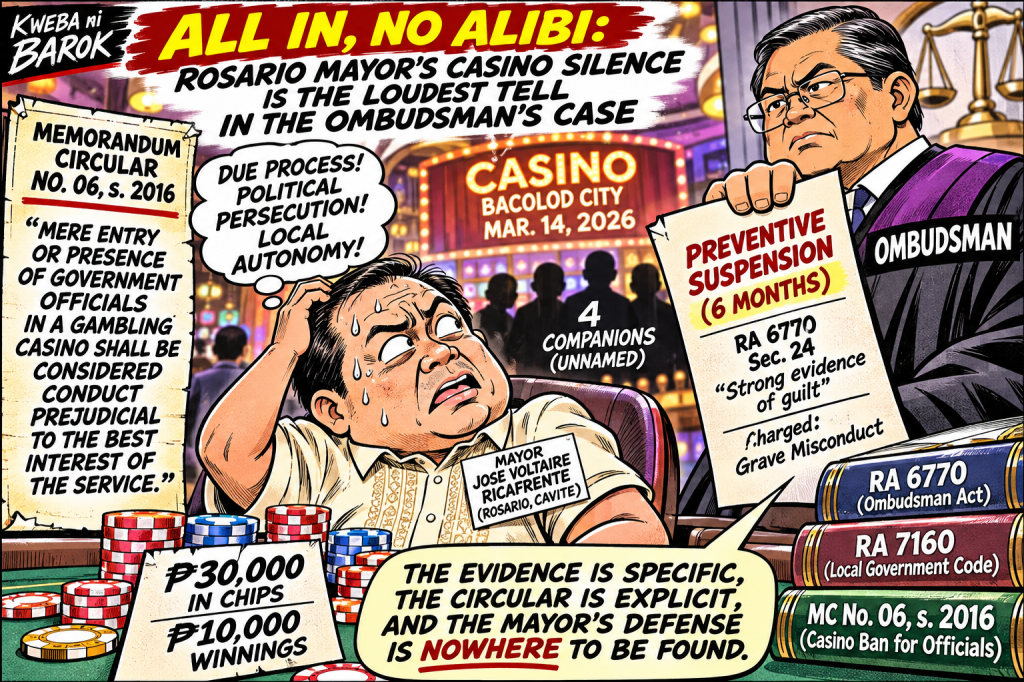
The Evidence Is Specific, the Circular Is Explicit, and the Mayor’s Defense Is Nowhere to Be Found
By Louis ‘Barok‘ C. Biraogo — November 15, 2026
LET’S just pause and admire the audacity for a moment.
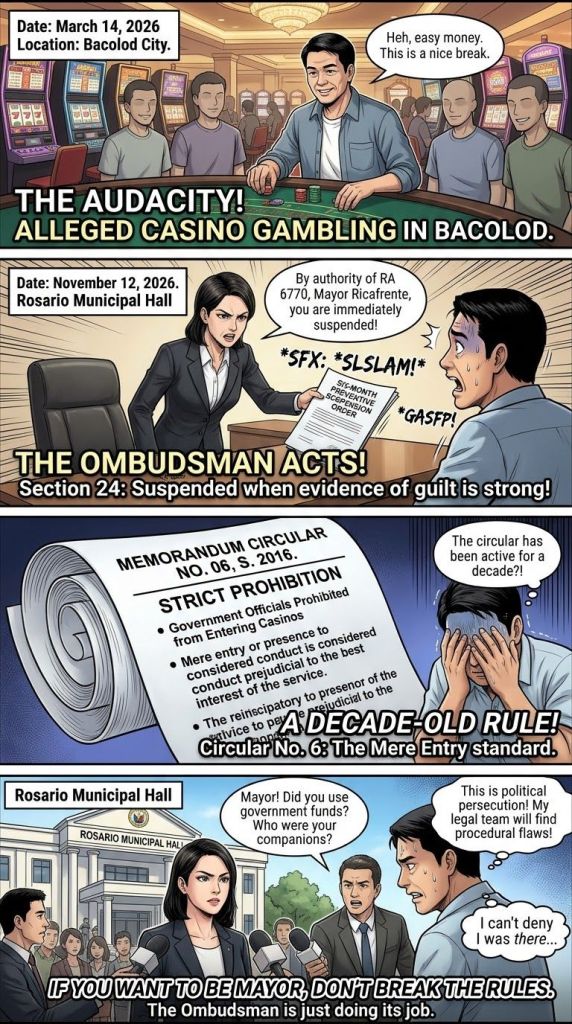
The Mayor of Rosario, Cavite—Jose Voltaire Ricafrente—allegedly walks into a hotel casino in Bacolod City on March 14, 2026, buys thirty thousand pesos’ worth of chips, plays a gaming table, wins ten thousand, and walks out with four unnamed companions. Eight months later, the Ombudsman drops a six-page preventive suspension order on his head, and suddenly the airwaves are filled with the usual lamentations about due process and political persecution.
Spare me.
This is not a close case. This is a mayor who apparently forgot that the Philippine government has had an explicit, categorical rule against public officials entering casinos since September 20, 2016. That’s nearly a decade. Ten years of Memorandum Circular No. 06, series of 2016 (Enjoining All Government Officials and Employees to Strictly Observe and Comply with the Prohibition Against Going to Gambling Casinos) sitting in the Official Gazette while some local executives apparently treated Philippine Amusement and Gaming Corporation (PAGCOR) floors as extensions of their private lounges.
And now the Ombudsman is the villain?
The “Strong Evidence” Standard Is Not a Suggestion
Section 24 of Republic Act No. 6770 (The Ombudsman Act of 1989) gives the Ombudsman power to preventively suspend an official when “the evidence of guilt is strong” and the charge involves grave misconduct or would warrant removal. The Ombudsman’s order invokes both. The evidence, according to the Field Investigation Office (FIO), includes the date, location, amount of chips, winnings, and the presence of four companions. That is not a vague rumor passed along at a cockfight. That is a specific, time-stamped, transaction-level allegation.
The mayor’s defenders will argue the evidence hasn’t been tested, that preventive suspension is not a penalty. True. The Ombudsman itself said the order “does not amount to a prejudgment of the merits of the case.” But preventive suspension exists precisely because the investigation is not yet complete, and because an incumbent mayor with access to municipal records and potential influence over witnesses poses a genuine risk to that investigation.
Is that risk speculative? Perhaps. But the Ombudsman is not required to wait until the mayor actually intimidates a witness before acting. The statute says “may prejudice the case filed against him.” A mayor who allegedly gambled with thirty grand in chips and has four unnamed companions—whose identities the public still does not know—has more than enough proximity to people and resources to muddy the waters. The Ombudsman’s reasoning is not paranoid. It is prudent.
The Circular Does Not Care About Your Feelings
Memorandum Circular No. 06, series of 2016, is brutally simple. Section 1 requires all government officials to “strictly observe and comply with all pertinent laws, issuances and policies prohibiting government personnel to enter, stay, or play in gambling casinos.” Then comes the killer sentence: “the mere entry or presence of government officials and employees in a gambling casino shall be considered as conduct prejudicial to the best interest of the service, unless the same was in the performance of official duties and functions.”
Mere entry. Not gambling. Not losing money. Entry.
Ricafrente allegedly didn’t just enter. He allegedly played. With chips. And won. If the Ombudsman’s evidence holds up, the mayor isn’t on the outer edge of this prohibition—he’s squarely in the middle of it.
The only escape hatch is the “official duties and functions” exception. Was the mayor of Rosario, Cavite, performing official duties at a hotel casino in Bacolod City on March 14, 2026? Was he inspecting the gaming floor for municipal compliance? Promoting tourism? The Ombudsman’s order does not mention any such justification, and the mayor’s public statements have not surfaced in the reporting. Until he produces a travel order, an official itinerary, or a single document placing him at that casino in an official capacity, the exception remains a fantasy.
The Local Government Code Is Not a Shield
Expect the mayor’s legal team to invoke Section 63 of the Local Government Code of 1991 (Republic Act No. 7160), which caps preventive suspension of local officials at sixty days. Expect them to argue that the Ombudsman’s six-month suspension is an illegal end-run around local autonomy.
This argument has been rejected before. The Ombudsman’s power under RA 6770 is independent, constitutional, and distinct from the disciplinary mechanisms in the Local Government Code. The Supreme Court has consistently upheld the Ombudsman’s authority to suspend local officials under Section 24 of RA 6770, separate from the LGC’s sixty-day limit. The LGC governs suspensions imposed by the President, governors, or sanggunians. The Ombudsman answers to a different statute and a different constitutional mandate.
Is six months a long time? Yes. Is it within the Ombudsman’s statutory authority? Also yes. The law says “not exceeding six months.” The Ombudsman asked for six. If the mayor believes the order is defective, he has remedies—motion for reconsideration, certiorari—but he does not get to pretend the Ombudsman lacks the power to act.
The Political Noise Is a Distraction
Cavite is a political province. Rosario is an industrial municipality. Mayors control permits, contracts, and patronage. A suspended mayor is a weakened mayor, and a weakened mayor creates opportunities for rivals. The vice mayor, Joanne Michelle Gonzales, now exercises mayoral powers during the suspension. That is not a conspiracy. That is the Local Government Code working as designed.
But the skepticism cuts both ways. The Ombudsman’s action may well have political consequences. It may even have been politically convenient for someone. But political convenience is not proof of political motivation. The Field Investigation Office initiated this complaint based on its own investigation. The circular has been in force since 2016. If the Ombudsman is now enforcing it aggressively, the correct response is not to whine about timing. The correct response is to ask why it took this long.
And let’s be clear about what the mayor’s defenders are implicitly arguing: that because other officials may have violated the same rule without consequence, Ricafrente should also escape accountability. That is not a legal defense. That is a plea for selective impunity. If the rule was underenforced before, the solution is more enforcement, not less.
The Unanswered Questions Are Not in the Mayor’s Favor
There are legitimate questions about the strength of the evidence. Who were the four companions? Were they government officials? Contractors? Did any of them pay for the chips? Was municipal money or a government vehicle involved? These questions should be answered through the administrative process, and the mayor will have his opportunity to contest the evidence.
But notice what the mayor’s defense has not been. It has not been: “I was not at the casino.” It has not been: “I was there on official business.” It has not been: “The chips were not mine.” The silence on the factual core of the allegation is telling. When a public official is accused of something this specific, and his response is procedural rather than factual, the presumption of regularity in the Ombudsman’s favor starts to look less like a presumption and more like a conclusion.
The Bottom Line
The Ombudsman’s order is six pages long. It cites a decade-old circular that says exactly what the Ombudsman says it says. It identifies a specific date, a specific location, a specific amount, and a specific act. It invokes a statutory standard that the Supreme Court has repeatedly upheld. And it imposes a suspension that is explicitly preventive, explicitly temporary, and explicitly capped at six months.
The mayor’s best case is that the evidence is weaker than the Ombudsman claims, or that the offense should be classified as simple misconduct rather than grave misconduct. Those are arguments for the administrative proceedings, not for public sympathy. They do not erase the fact that a mayor allegedly walked into a casino, bought thirty thousand pesos in chips, and played—in direct violation of a rule that has applied to every government official in the country since 2016.
If Ricafrente wants to be mayor of Rosario, he should have thought about that before he sat down at the table. The Ombudsman is not persecuting him. The Ombudsman is doing its job. The chips, apparently, were his.
Key Citations
A. Legal & Official Sources
- Memorandum Circular No. 6, s. 2016. Enjoining All Government Officials and Employees to Strictly Observe and Comply with the Prohibition Against Going to Gambling Casinos. Official Gazette of the Republic of the Philippines, 20 Sept. 2016, http://www.officialgazette.gov.ph/2016/09/20/memorandum-circular-no-6-s-2016/.
- Republic Act No. 6770. The Ombudsman Act of 1989. Lawphil Project, Arellano Law Foundation, 17 Nov. 1989, lawphil.net/statutes/repacts/ra1989/ra_6770_1989.html.
- Republic Act No. 7160. The Local Government Code of 1991. Official Gazette of the Republic of the Philippines, 10 Oct. 1991, http://www.officialgazette.gov.ph/1991/10/10/republic-act-no-7160/.
- Office of the Ombudsman. “OMB Orders Six-Month Preventive Suspension of Rosario, Cavite Mayor over Casino Gambling.” Office of the Ombudsman, 12 Nov. 2026, http://www.ombudsman.gov.ph/?p=136062.
B. News Reports
- Laqui, Ian. “Cavite Mayor Suspended Without Pay over Alleged Casino Gambling.” Philstar.com, 12 Nov. 2026, http://www.philstar.com/nation/2026/11/12/2569676/cavite-mayor-suspended-without-pay-over-alleged-casino-gambling.
- “Ombudsman Suspends Cavite Town Mayor over Gambling Allegation.” Inquirer.net, 12 Nov. 2026, newsinfo.inquirer.net/2340565/ombudsman-suspends-cavite-town-mayor-over-gambling-allegation.
- “Ombudsman Suspends Cavite Town Mayor amid Illegal Gambling Probe.” Inquirer.net, 12 Nov. 2026, newsinfo.inquirer.net/2340203/ombudsman-suspends-cavite-town-mayor-amid-illegal-gambling-probe.
- Orcullo, Jerod. “Ombudsman Suspends Cavite Mayor over Alleged Casino Gambling.” Daily Tribune, 12 Nov. 2026, tribune.net.ph/2026/11/12/ombudsman-suspends-cavite-mayor-over-alleged-casino-gambling.

- ₱9 Billion in ‘Savings’? DILG’s Fire Truck Deal Smells Like Smoke

- ₱8B BBM Pork: CCTV for Every Captain’s Kumpare?

- ₱8.9 Billion, 331 Ghost Police Stations: The TIKAS Scandal Explained

- ₱8.4 Billion, 42,000 Barangays, 1 Election: The “Bawat Barangay Makikinabang” Vote-Buying Masterclass

- ₱75 Million Heist: Cops Gone Full Bandit

- ₱63 to the Dollar: The Only Thing Falling Faster Than the Peso Is the Government’s Credibility

- ₱6.77B Ghost Haunts Duterte: RTC Dismisses Mans Carpio’s Desperate Plea

- ₱6.77 Billion and Zero Cash: The Sara Duterte SALN Math That Doesn’t Add Up

- ₱6.7-Trillion Temptation: The Great Pork Zombie Revival and the “Collegial” Vote-Buying Circus

- ₱58.53B, Zero Receipts: The LGSF Pork Barrel Nobody Wants to Name
- ₱53 Million Man Tells ₱695-a-Day Workers to Stop Being ‘Mayabang’: The Audacity of BSP’s Remolona

- ₱491-M Right-of-Way Scam: DPWH Paid for Ghost Land, Ombudsman Finally Notices




Leave a Reply