
Jonvic Remulla Found ₱50 Million in the Intelligence Fund—but Forgot to Bring the Law, the Evidence, and the Paperwork
By Louis “Barok” C. Biraogo — October 25, 2026
SOMEWHERE, a legal scholar is weeping into a Constitution.
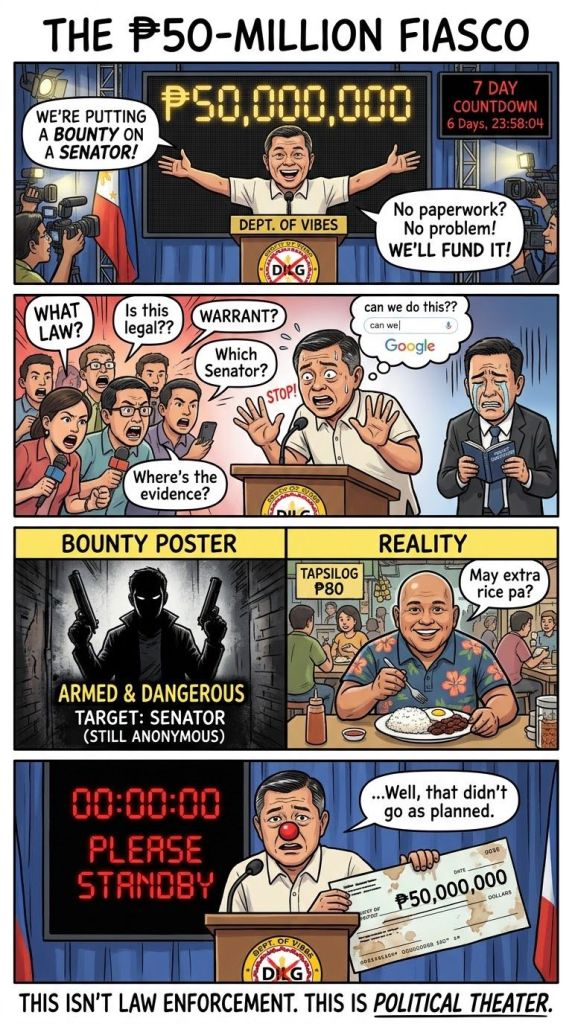
The Philippine government has announced a ₱50-million bounty for the capture of a sitting senator, given him one week to surrender, labeled him “armed and dangerous,” and sourced the whole thing from intelligence funds—all while apparently hoping nobody would ask the obvious question: Under what legal authority, exactly?
This is not law enforcement. This is performance art. And like most performances staged by this administration, it’s heavy on theatrics, light on substance, and completely unprepared for the curtain call.
The Bounty: A Masterclass in Putting the Cart Before the Warrant
Interior Secretary Jonvic Remulla—a man whose public role, at least by optics, has become synonymous with “let me explain what my brother didn’t say”—stood before cameras on October 23, 2026, and announced that the government would pay ₱50 million for information leading to Senator Ronald “Bato” Dela Rosa’s capture.
The money, we’re told, comes from the Department of the Interior and Local Government (DILG) and Philippine National Police (PNP) Intelligence Fund.
The legal basis? The government has referred all questions to its Department of Vibes.
The documentation? Still waiting.
The actual appropriations authority? Somewhere between “trust us” and “stop asking questions.”
Here’s the problem: You cannot simply declare a bounty on a human being and then figure out the legal paperwork later. This isn’t a GoFundMe campaign. This is the expenditure of public funds under Article VI, Section 29(1) of the 1987 Constitution, which requires that “no money shall be paid out of the Treasury except in pursuance of an appropriation made by law.”
The COA-DBM-DILG-GCG-DND Joint Circular No. 2015-01 (Rules and Regulations on the Granting, Utilization, and Liquidation of Confidential and Intelligence Funds) does permit rewards to informers under certain conditions. Section 4.8.5 requires approval by the appropriate head of agency, documentation showing the success of the information-gathering activity, and a direct connection to authorized confidential activities.
But here’s what the government hasn’t shown us:
- The specific appropriation that authorizes a ₱50-million reward for this particular target.
- The written approval from the DILG or PNP head authorizing this specific amount.
- The rules governing who qualifies, what result must be achieved, and how payment will be documented.
- The safeguards preventing fabrication, mistaken identity, or vigilante violence.
Instead, we got a press conference.
Torreon and Partners law firm correctly questioned whether a reward mechanism premised on Philippine warrants can simply be applied to a person whose warrant was issued by the International Criminal Court (ICC) rather than a Philippine judge. That’s not obstruction. That’s basic legal hygiene.
The government’s response? Essentially: “Trust us, we’re the good guys.”
The Ultimatum: Seven Days to… What, Exactly?
Remulla and PNP Chief Gen. Jose Melencio Nartatez Jr. have given Dela Rosa one week to surrender.
One week. Seven days. 168 hours.
To surrender to what? Under what legal process? To whom?
The government hasn’t identified a statute or court order that gives the DILG secretary authority to impose a seven-day legal deadline on a person subject to an ICC warrant. The deadline is not a law. It is not a court order. It is a public relations stunt dressed up as a legal demand.
And what happens if Dela Rosa doesn’t comply? What happens on Day Eight? Does the bounty double? Does the government declare him a “coward” and move on? Does the PNP conduct a raid that—given the “armed and dangerous” designation—could result in a firefight in a populated area?
The government hasn’t said.
Because they haven’t thought that far ahead.
This is what happens when you govern by press release: you announce the destination without mapping the route, and then you’re surprised when you drive into a ditch.
“Armed and Dangerous”: Evidence-Free Labeling at Its Finest
Speaking of labels the government can’t substantiate: the “armed and dangerous” designation.
Interior Secretary Remulla has publicly characterized Dela Rosa as armed and dangerous. This is a serious operational designation with real consequences—it authorizes police to prepare for armed resistance, to use force if necessary, and to treat the target as a threat rather than a suspect.
But where is the evidence?
Has the government produced specific, credible intelligence showing that Dela Rosa is currently armed? Has it documented threats, weapons caches, or armed protectors? Has it provided any evidentiary basis beyond the fact that Dela Rosa is a former PNP chief with security connections?
No.
The government seems to be operating on the theory that because Dela Rosa was once a police general, he must therefore be dangerous. This is guilt by résumé. It is also precisely the kind of prejudicial labeling that Article III, Section 14(2) of the 1987 Constitution—the presumption of innocence—was designed to prevent.
If the government has evidence, it should present it in court. If it doesn’t, it should retract the label and stop poisoning the jury pool before there’s even a trial.
The Senate “Protective Custody”: A Constitutional Crisis in Search of a Legal Basis
Let’s talk about the Senate’s role in this farce.
When authorities attempted to serve the ICC warrant, Dela Rosa was reportedly inside the Senate premises. Gunfire erupted. The Sergeant-at-Arms allegedly fired the first shot. Dela Rosa then left in Senator Robin Padilla’s vehicle and has been at large ever since.
Senate President Alan Peter Cayetano has claimed the Senate will only recognize warrants from Philippine courts—a position that directly contradicts Republic Act No. 9851 (RA 9851), the Philippine Act on Crimes Against International Humanitarian Law, which explicitly authorizes surrender to international tribunals.
Article VI, Section 11 of the Constitution grants legislators a limited privilege from arrest while Congress is in session—but only for offenses punishable by imprisonment of not more than six years. Crimes against humanity under RA 9851 are punishable by reclusion temporal to reclusion perpetua. The privilege does not apply.
The Supreme Court made this clear in People v. Jalosjos (2000): “The provision granting an exemption as a special privilege cannot be extended beyond the ordinary meaning of its terms.”
The Senate’s “protective custody” claim has no basis in the Rules of the Senate, no basis in statute, and no basis in the Constitution. It is an invented doctrine designed to shield a political ally from accountability.
And it may constitute obstruction of justice under Article 151 of the Revised Penal Code (Act No. 3815) and Presidential Decree No. 1829 (PD 1829).
The Remulla Family: A Modest Proposal for Ordinary Scrutiny
Two brothers. One discloses the ICC warrant. The other announces the ₱50-million bounty. Nothing to see here—except, perhaps, a family reunion that the Ombudsman’s own conflict-of-interest sermon might want to audit.
To be fair: no evidence of improper influence, no shared confidential files, no smoking gun. Just a remarkable coincidence of timing and bloodline. A family relationship is not a crime—Republic Act No. 6713 (Code of Conduct and Ethical Standards for Public Officials and Employees) requires “justness and sincerity,” not estrangement.
The fair conclusion is modest: ordinary conflict-of-interest review, documented boundaries, and perhaps a Remulla family dinner where work stays at the office. Insinuation beyond that outruns the evidence—and a critique demanding receipts from Malacañang should not forget its own.
The Political Theater: What This Is Really About
Let’s be clear about what’s happening here.
This isn’t primarily about justice for drug war victims. If it were, the government would have pursued Dela Rosa through proper legal channels months ago, rather than announcing a dramatic bounty and a seven-day deadline.
This is about:
- Marcos consolidating power against the Duterte dynasty. Dela Rosa is a Duterte loyalist. His arrest weakens the political opposition ahead of 2028.
- Jonvic Remulla positioning for a presidential run. What better way to demonstrate toughness than by putting a ₱50-million price on a senator’s head?
- The Philippines performing compliance for the international community. Look, world! We’re cooperating with the ICC! We’re not like those other countries!
- Theater for the masses. A bounty and a deadline make for better headlines than “government continues methodical legal process.”
Meanwhile, the actual legal questions remain unanswered:
- Does an ICC warrant have automatic enforceability in Philippine territory?
- Does the government need a Philippine judicial warrant to arrest Dela Rosa?
- What process governs his detention and potential transfer to The Hague?
- What are the legal consequences of the Senate’s obstruction?
The government hasn’t answered these questions because the government doesn’t have answers. It has a press strategy.
The ICC Withdrawal Argument: Weak, but Not Dead
Dela Rosa’s lawyers will argue that the Philippines’ withdrawal from the Rome Statute of the International Criminal Court (Rome Statute), effective March 17, 2019, extinguished ICC jurisdiction over all conduct predating withdrawal.
This argument is substantially weakened by the ICC Appeals Chamber’s April 22, 2026 ruling in Duterte’s case, which confirmed that withdrawal does not affect cooperation obligations connected with proceedings already commenced. The Court’s investigation into the Philippines drug war was authorized in September 2021, following preliminary examination activity that began before withdrawal.
The Philippine Supreme Court’s 2021 decision in Pangilinan v. Cayetano similarly recognized that ICC jurisdiction over alleged acts committed while the Philippines was a State Party survived withdrawal.
So Dela Rosa’s blanket withdrawal argument is unlikely to succeed.
But that doesn’t mean every legal question is resolved.
The strongest defense argument doesn’t depend on claiming the ICC has no jurisdiction whatsoever. It distinguishes international jurisdiction from the domestic legal mechanism needed to execute an arrest. The government must still identify a lawful basis under Philippine law for depriving a Filipino citizen of liberty—particularly if the proposed action includes transfer to a foreign tribunal.
That is a serious legal question that deserves a serious legal answer, not a press conference.
What the Government Should Do Instead
If this administration were serious about accountability—as opposed to appearing serious—it would:
- Publish the legal basis for the reward. Identify the applicable appropriation, reward authority, implementing issuance, and payment conditions. Sensitive operational information can be withheld, but the basic legal framework must be disclosed.
- Verify and document the warrant and arrest authority. Establish the authenticity of the ICC warrant and identify the domestic legal authority governing its execution, custody, and any transfer to the Court.
- Offer a formal, peaceful surrender channel. Communicate through Dela Rosa’s lawyers, establish secure arrangements, and avoid rhetoric that could unnecessarily provoke resistance.
- Separate intelligence assessments from political declarations. Document the basis for any “armed and dangerous” classification and review it as new information becomes available.
- Preserve judicial review. Allow the competent courts to decide the main legal questions. Neither the executive’s deadline nor the bounty should be presented as a substitute for judicial resolution.
- Audit the reward and the operation. The Commission on Audit (COA) should examine the expenditure under applicable rules, with due regard for legitimate confidentiality requirements.
The Verdict: A Government That Doesn’t Know What It’s Doing
My assessment is that the government has a substantial argument for pursuing Dela Rosa. The ICC’s continuing jurisdiction over alleged crimes committed during the Philippines’ membership in the Rome Statute is supported by significant legal authority.
But the legal case for pursuing a suspect is not the same as the legal case for using this particular arrest mechanism or spending ₱50 million from intelligence funds.
The most serious vulnerability in the government’s public posture is the possibility that it has announced a dramatic financial incentive and a hard deadline before adequately explaining the domestic legal and fiscal basis for both. That is a problem of legal accountability and public confidence, even if the ultimate objective of securing custody is legitimate.
The most serious vulnerability in the defense’s posture is the temptation to treat the Philippines’ withdrawal from the Rome Statute as a complete answer to every question about international jurisdiction and domestic cooperation. The legal authorities do not support such a simple conclusion.
The best outcome is neither a politically staged surrender nor a dangerous show of force. It is a peaceful, properly documented arrest if authorized by law, a transparent and auditable reward mechanism, and prompt judicial resolution of the contested legal issues.
The Final Word (For Now)
This administration has a habit of announcing solutions before identifying problems.
The ₱50-million bounty is the latest example. It’s a press release masquerading as policy, a headline masquerading as a strategy, a number masquerading as a plan.
If the government has a legal basis for the bounty, it should show it.
If it has evidence that Dela Rosa is armed and dangerous, it should present it.
If it has a coherent strategy for executing the warrant, it should explain it.
Otherwise, this isn’t law enforcement. It’s political theater.
And the Filipino people deserve better than a government that confuses the two.
Louis “Barok” C. Biraogo is a lawyer, blogger, and professional skeptic who has been criticizing bad governance since before it was cool. He writes at Kweba ni Barok, where he documents the absurdities of Philippine politics with the weary resignation of someone who has seen this movie before.
Key Citations
A. Legal & Official Sources
- Commission on Audit, Department of Budget and Management, Department of the Interior and Local Government, Governance Commission for Government-Owned or Controlled Corporations, and Department of National Defense. Joint Circular No. 2015-01: Guidelines on the Entitlement, Release, Use, Reporting and Audit of Confidential and/or Intelligence Funds. Commission on Audit, 8 Jan. 2015, coa.gov.ph/wpfd_file/coa-dbm-dilg-gcg-for-goccs-dnd-joint-circular-no-2015-01-january-8-2015/.
- International Criminal Court. “ICC Appeals Chamber Confirms Jurisdiction in Duterte Case.” ICC, 22 Apr. 2026, http://www.icc-cpi.int/news/icc-appeals-chamber-confirms-jurisdiction-duterte-case.
- Pangilinan v. Cayetano. G.R. Nos. 238875, 239483, and 240954, Supreme Court of the Philippines, 16 Mar. 2021, elibrary.judiciary.gov.ph/thebookshelf/showdocs/1/67374.
- People v. Jalosjos. G.R. Nos. 132875-76, Supreme Court of the Philippines, 3 Feb. 2000, lawphil.net/judjuris/juri2000/feb2000/gr_132875_2000.html.
- Presidential Decree No. 1829. Penalizing Obstruction of Apprehension and Prosecution of Criminal Offenders. 1981, lawphil.net/statutes/presdecs/pd1981/pd_1829_1981.html.
- Republic Act No. 6713. Code of Conduct and Ethical Standards for Public Officials and Employees. 1989, lawphil.net/statutes/repacts/ra1989/ra_6713_1989.html.
- Republic Act No. 9851. Philippine Act on Crimes Against International Humanitarian Law, Genocide, and Other Crimes Against Humanity. 2009, lawphil.net/statutes/repacts/ra2009/ra_9851_2009.html.
- Rome Statute of the International Criminal Court. 17 July 1998, http://www.icc-cpi.int/sites/default/files/RS-Eng.pdf.
- The 1987 Constitution of the Republic of the Philippines. LawPhil, lawphil.net/consti/cons1987.html.
- Act No. 3815: An Act Revising the Penal Code and Other Penal Laws. Official Gazette, 8 Dec. 1930, officialgazette.gov.ph/1930/12/08/act-no-3815-s-1930/.
B. News Reports
- “DILG Offers P50-Million Reward for Dela Rosa’s Arrest.” Daily Tribune, 23 Oct. 2026, tribune.net.ph/2026/10/23/dilg-offers-p50-million-reward-for-dela-rosas-arrest.
- “Hunt for Bato dela Rosa Sets 1-Week Ultimatum, P50-M Bounty.” Inquirer.net, 23 Oct. 2026, newsinfo.inquirer.net/2329182/hunt-for-bato-dela-rosa-sets-1-week-ultimatum-p50-m-bounty/amp.
- “Torreon Law Firm Questions P50M Reward for Arrest of Bato dela Rosa.” GMA News Online, GMA Network, 23 Oct. 2026, http://www.gmanetwork.com/news/topstories/nation/1006948/torreon-law-firm-questions-p50m-reward-for-arrest-of-bato-dela-rosa/story/.

- “Ang Hirap Maging Mahirap”: The PAO Scandal That Proves Government Contempt Is Nothing New

- “Far-Off” My Axx: Malacañang’s Claire Castro Drowns in Her Own Legal Gaslighting
- “Forthwith” to Farce: How the Senate is Killing Impeachment—And Why Enrile’s Right (Even If You Can’t Trust Him)
- “HINDI AKO NAG-RESIGN!”

- “I Know Nothing”: Baste Duterte’s Amnesia Defense Meets ₱33M in GenCorp Contracts

- “I’m calling you from my new Globe SIM. Send load!”

- “Mahiya Naman Kayo!” Marcos’ Anti-Corruption Vow Faces a Flood of Doubt

- “Manageable” Debt, Unmanageable Lies: DBM’s ₱21 Trillion Fairy Tale
- “Meow, I’m calling you from my new Globe SIM!”

- “Natrabaho”: One Word, One Ombudsman, and a Judiciary on Trial

- “No Special Jail for Crooks!” Boying Remulla Slams VIP Perks for Flood Scammers

- “Philippine-Controlled” or Yankee Gas Station? The Davao Fuel Depot Farce Exposed






Leave a Reply