A ₱7.2-Trillion Budget, a ₱1-Trillion Red Flag, and a Speaker Who Wants Us to Look Away
By Louis ‘Barok‘ C. Biraogo | November 10, 2026
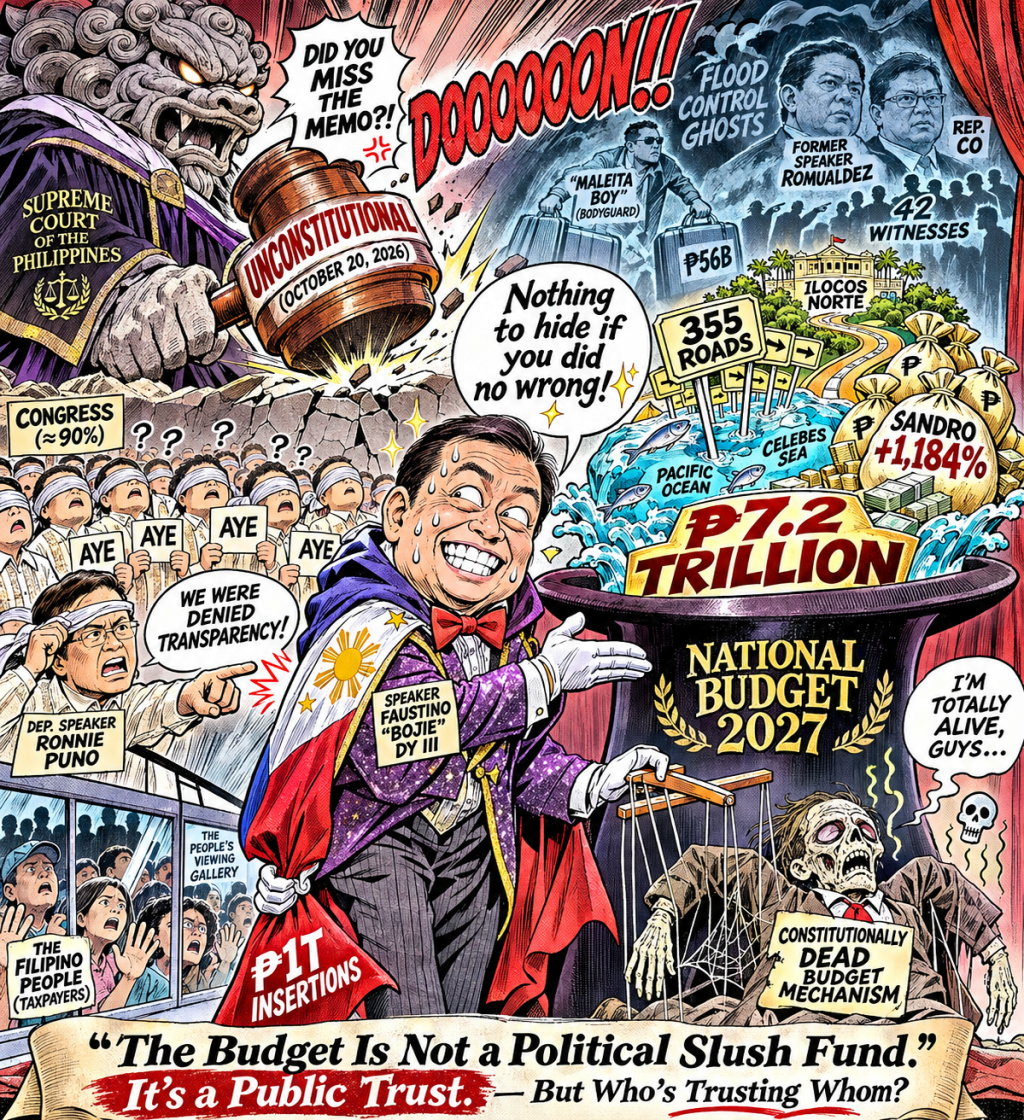
SO here’s the thing. Speaker Faustino “Bojie” Dy III wants us to believe that a ₱7.2-trillion national budget with over ₱1 trillion in suspicious congressional insertions—including 355 farm-to-market roads with coordinates pointing to the Pacific Ocean and the Celebes Sea—is just business as usual in the People’s House.
His defense? “There is nothing to hide if you did no wrong.”
That’s adorable. It’s also constitutionally illiterate and politically convenient. And if the Supreme Court’s October 20 ruling is any indication, it may be the setup for the most spectacular legislative self-own since the Priority Development Assistance Fund (PDAF) was declared unconstitutional in 2013.
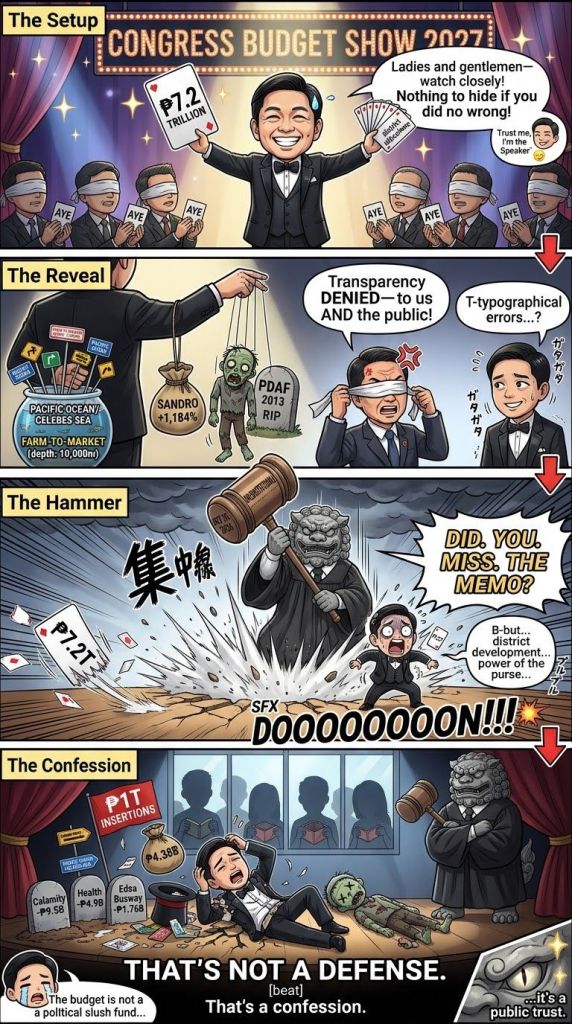
Speaker Dy has accomplished something remarkable: defending congressional budget insertions while presiding over a House whose members were allegedly kept in the dark about those same insertions. That’s not transparency—that’s a magic trick. And like all magic tricks, it depends on misdirection.
The Supreme Court Already Told You This Was Illegal. Did You Miss the Memo?
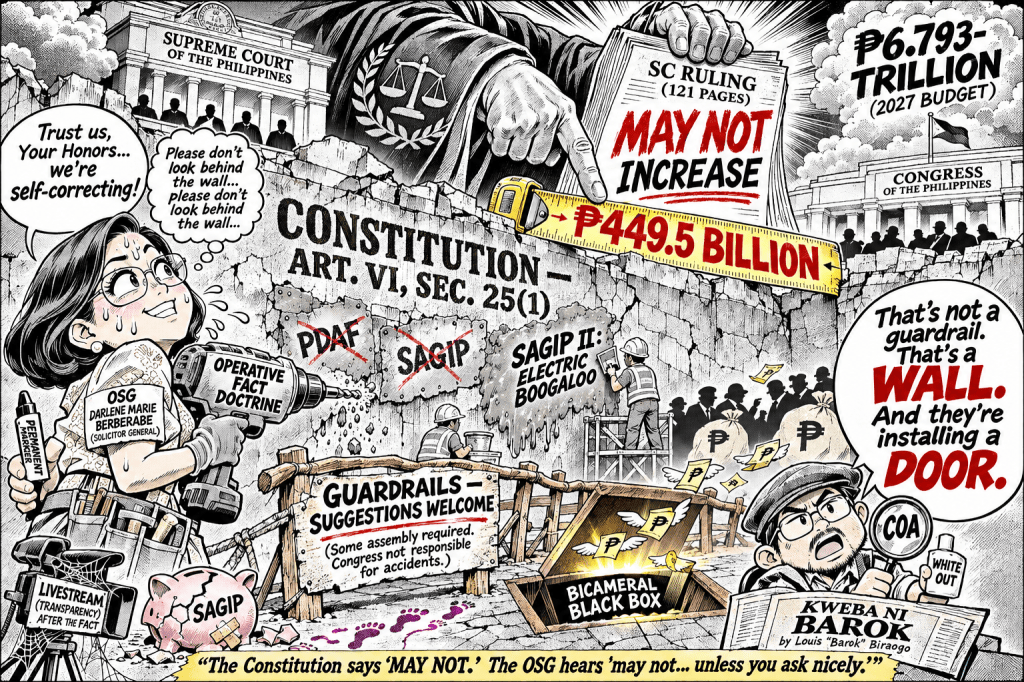
On October 20, 2026—seventeen days before Dy’s defiant statement—the Supreme Court En Banc, in a decision penned by Senior Associate Justice Marvic Leonen, declared that Congress cannot increase the President’s total recommended appropriations. The Court voided the entire 2024 General Appropriations Act (GAA) over ₱449.5 billion in added unprogrammed appropriations. It invalidated the 2025 GAA over a ₱17.99-billion increase in the Department of Public Works and Highways (DPWH) Special Road Fund. It struck down ₱12.75 billion in special account increases in the 2026 GAA.
The message was not subtle: Congress cannot bloat the President’s budget.
What did the House do in the 2027 budget? It inserted over ₱1 trillion in questionable allocations: ₱180 billion in additional DPWH projects (6,000 new projects, bringing the total from 10,000 to over 16,000), 355 farm-to-market roads with dubious coordinates, and a ₱4.38-billion allocation for Ilocos Norte’s 1st District—represented by none other than the President’s son, House Majority Leader Sandro Marcos.
That’s a 1,184 percent increase from the National Expenditure Program (NEP)’s original ₱369 million for that district. Apparently, Ilocos Norte developed a sudden, urgent infrastructure need that no one noticed until budget season.
Dy says there’s nothing to hide. Then why does this feel like a legislative “Weekend at Bernie’s”—propping up a constitutionally dead budget mechanism and pretending it’s alive?
The “Nothing to Hide” Doctrine: A Constitutional Analysis
Argument 1: “Congress has the constitutional power of the purse.”
Correct. Article VI, Section 24 of the 1987 Constitution of the Republic of the Philippines grants Congress the exclusive power to initiate appropriation bills. Article VI, Section 25(1) allows Congress to “reduce or reject” presidential proposals.
But here’s what Dy omits: Article VI, Section 25(1) explicitly prohibits Congress from increasing the President’s total recommended appropriations. The Supreme Court has already ruled that the House’s 2024, 2025, and 2026 budgets violated this provision. When Dy says “not all changes made by Congress to the budget are wrong,” he’s technically correct—but when those changes increase total appropriations beyond the President’s proposal, they’re not just “wrong.” They’re unconstitutional.
Argument 2: “It is the duty of congressmen to fight and defend the allocations for their districts.”
Ah, the constituency defense. But pork is still pork, even when you call it “district development.”
In Belgica v. Ochoa (2013), the Supreme Court declared PDAF unconstitutional because it allowed legislators to participate in post-enactment project identification, modification, and fund release—powers belonging to the Executive. The House’s current insertions exhibit the same constitutional disease. When legislators insert specific projects without technical validation, public disclosure, or documentation, they aren’t advocating for their districts. They’re exercising executive functions under the guise of legislative amendments.
The evidence is damning: 355 farm-to-market roads with coordinates in the ocean. If these were legitimate legislative advocacy, don’t you think someone would have noticed the roads are underwater?
The Department of Agriculture’s explanation? “Typographical errors.”
Of course. Because when I think of typographical errors, I think of 355 project locations simultaneously mis-encoded to point to the Pacific Ocean. That’s not a typo—that’s a systemic failure of project validation so egregious it suggests these projects were never meant to be real.
The Transparency Shell Game
Dy’s second line of defense is that transparency was “observed” and projects are “completely documented.”
Allow me to translate: “We followed the procedures we designed to make it look like we were being transparent.”
Here’s what Deputy Speaker Ronaldo Puno—a member of Dy’s own coalition—said: “Transparency has not only been denied by the House leadership to the general public. It has also denied this to its own members.”
More than 90 percent of congressmen were allegedly unaware of the insertions. The people voting on the budget did not know what was in it. That’s not transparency—that’s legislative malpractice wrapped in a procedural bow.
Dy’s response? On November 9, he announced an online project-data platform and ordered House committees to review 2026 spending. That’s the political equivalent of installing a security camera after the heist. Until we see whether that platform actually discloses the amendment history, project proponents, contractors, and implementation progress, it remains what it is: a press release masquerading as reform.
The Sandro Marcos Problem
House Majority Leader Sandro Marcos, the President’s son, represents Ilocos Norte’s 1st District. The NEP proposed ₱369 million for his district’s public works. The House-approved version allocated ₱4.38 billion.
That’s a 1,184 percent increase. That’s not “district development”—that’s a political inheritance disguised as an appropriation.
The Palace’s defense? “It’s legitimate.”
Of course it is. And I’m sure the 355 ocean-coordinate farm-to-market roads are also legitimate. And the ₱9.5 billion cut from calamity funds—during a period of intensifying climate disasters—is also legitimate. And the ₱4.9 billion cut from health programs is also legitimate. And the ₱1.76 billion cut from the Edsa Busway and ₱130 billion cut from foreign-assisted projects are also legitimate.
If everything is legitimate, then nothing is. And if nothing is, then “legitimate” has lost all meaning.
The Flood Control Ghost: What Dy Doesn’t Want to Talk About
Here’s the context Dy’s statement conveniently ignores: the biggest corruption scandal in recent Philippine history.
Since President Marcos Jr.’s 2025 State of the Nation Address (SONA) exposed massive corruption in flood control projects:
- ₱180 billion allegedly diverted to ghost projects since 2016 (Sen. Panfilo Lacson)
- ₱1.089 trillion potentially lost to corruption in climate-tagged expenditures since 2023 (Greenpeace)
- Former Speaker Martin Romualdez and former Rep. Elizaldy Co facing plunder, graft, and bribery complaints for allegedly amassing ₱56 billion in ill-gotten wealth
- At least 42 witnesses, including “maleta boys” (bodyguards who allegedly delivered cash in suitcases), cooperating with the Ombudsman
Against this backdrop, Dy’s defense of budget insertions is not just tone-deaf—it’s constitutionally negligent. The House knows what happens when insertions go unchecked. It knows “district allocations” can become vehicles for graft. It knows “transparency” can be a slogan rather than a practice.
And yet, faced with allegations that the 2027 budget contains over ₱1 trillion in questionable insertions, Dy’s response is: “There is nothing to hide if you did no wrong.”
That’s not a defense. That’s a dare. And it’s a dare the Supreme Court, the Ombudsman, and the Filipino public should accept.
The Law Is Not a Suggestion
Article VI, Section 25(1): “The Congress may not increase the appropriations recommended by the President for the operation of the Government as specified in the budget.” The House-approved 2027 budget contains over ₱1 trillion in insertions increasing the President’s total recommended appropriations—a systemic pattern the Supreme Court has already declared unconstitutional in three previous budgets.
Article VI, Section 25(5): “No law shall be passed authorizing any transfer of appropriations.” The House’s insertions effectively transfer appropriations from Executive-proposed programs (foreign-assisted projects, calamity funds, health programs, the Edsa Busway) to congressional insertions—a transfer by another name.
Article XI, Section 1: “Public office is a public trust.” When more than 90 percent of congressmen are unaware of budget insertions, when projects lack basic documentation, and when allocations are concentrated in the districts of political allies, the public trust is not being upheld—it is being weaponized.
Belgica v. Ochoa (2013): The Supreme Court declared PDAF unconstitutional because it allowed legislators to exercise executive functions in project identification, modification, and fund release. If the mechanism looks like PDAF, functions like PDAF, and distributes benefits like PDAF, calling it “district amendments” does not make it constitutional.
The Real Question: Why Fight So Hard for These Insertions?
If you’re a congressman, securing infrastructure funding for your district is good politics. It gives you something concrete to show voters. It builds political capital.
But there’s a difference between advocating for legitimate district needs and inserting projects that lack technical validation, public disclosure, or accountability mechanisms. The former is constitutionally protected. The latter is constitutionally suspect.
When the House inserts 6,000 additional DPWH projects without technical validation, adds 355 farm-to-market roads with coordinates in the ocean, and allocates ₱4.38 billion to the President’s son’s district—that’s not advocacy. That’s institutionalized patronage dressed up as legislative prerogative.
The Transparency Portal: Reform or Containment?
Dy’s November 9 announcement of an online project-data platform is positive—if it’s real.
The test: Will it disclose the amendment history of each project? Will it identify the legislator who proposed each insertion? Will it publish technical documentation? Will it reveal the contractors who win the bids?
If yes, Dy deserves credit for meaningful reform. If no, the initiative is not transparency. It’s containment.
But here’s the uncomfortable truth: transparency is not a substitute for constitutional compliance. Even if the House publishes every document, it cannot cure the constitutional defect of increasing the President’s total recommended appropriations. No amount of disclosure can change that fact.
What the Supreme Court’s Ruling Means for the 2027 Budget
The Court held that Congress cannot increase the President’s total recommended appropriations—including both programmed and unprogrammed appropriations. It also established strict requirements for unprogrammed appropriations: no lump sums, clear distinctions between programmed and unprogrammed expenditures, sufficient prioritization standards, and consistency with the national fiscal program.
The House-approved 2027 budget contains over ₱1 trillion in insertions—including ₱112 billion in unprogrammed appropriations. If these increase the President’s total recommended appropriations, they are unconstitutional under the Court’s ruling.
Dy’s defense does not address this legal reality. He says “not all changes are wrong”—but the Supreme Court has already determined that some changes are wrong. And the House’s insertions fall into that category.
This is not a matter of political opinion. It is a matter of constitutional law. And the Speaker of the House—sworn to uphold the Constitution—should know better.
The Path Forward: What the House Must Do
- Publish the complete amendment history for every project. Every insertion should have a paper trail: who proposed it, when, why, and with what technical documentation. If a project cannot survive this scrutiny, it should not be in the budget.
- Remove all insertions that increase the President’s total recommended appropriations. The Supreme Court has ruled this unconstitutional. Comply with the ruling rather than waiting for another constitutional challenge.
- Restore cuts to essential programs. The House cut ₱9.5 billion from calamity funds, ₱4.9 billion from health programs, ₱1.76 billion from the Edsa Busway, and ₱130 billion from foreign-assisted projects. Disaster preparedness, healthcare, and public transportation are not luxuries. Foreign-assisted projects often have better accountability mechanisms than domestically funded ones. Cutting them to fund questionable insertions is not just constitutionally suspect—it’s morally indefensible.
- Submit all infrastructure projects to independent technical validation. Before any project receives funding, it should be validated for location, engineering feasibility, cost estimates, environmental impact, and public need. If it cannot survive this scrutiny, it should not be funded.
- Require beneficial ownership disclosure for all contractors. The public has a right to know who benefits from government contracts. This is particularly important given the Philippine Center for Investigative Journalism (PCIJ)’s finding that 18 members of the 20th Congress have ownership or links to companies securing public works contracts.
- Refer any evidence of wrongdoing to the Ombudsman. If the House’s internal review of 2026 spending reveals evidence of corruption, refer it to the Ombudsman—not handle it internally. The House cannot be the sole judge of its own transparency.
- Open bicameral deliberations to public scrutiny. Senate President Sherwin Gatchalian and Senator JV Ejercito have both expressed support for opening bicameral deliberations to civil society observers. The House should support this. The budget is a public document, and reconciling House and Senate versions should be transparent.
The Verdict: Dy’s Defense Is Constitutionally Insufficient
Dy is correct about one thing: congressional participation in the budget process is not inherently corrupt. The Constitution grants Congress the power of the purse, and legislators have a legitimate role in advocating for their districts.
But that’s not the issue. The issue is whether the House’s specific insertions comply with constitutional limits, are supported by technical documentation, are transparent to the public, and are free from improper influence.
On all four counts, the House’s defense is insufficient.
The Supreme Court has already ruled that similar insertions in previous budgets were unconstitutional. The 2027 insertions appear to replicate the same constitutional defects. And Dy’s response—”there is nothing to hide if you did no wrong”—is not a legal argument. It is a political slogan.
Speaker Dy says there is nothing to hide. Then prove it.
Publish the documents. Disclose the proponents. Validate the projects. Refer the evidence. Comply with the Supreme Court’s ruling.
If the House has nothing to hide, it should have nothing to fear from transparency.
But if it does have something to hide—if the insertions are not legitimate district allocations but rather a new iteration of the pork barrel system the Supreme Court already declared unconstitutional—then no amount of political rhetoric can change that fact.
The ₱7.2-trillion question is not whether Congress has the power of the purse. It is whether Congress is using that power responsibly. And on that question, Dy’s defense is not just insufficient—it is a confession.
The Last Word: A Budget Is Not a Political Slush Fund
The national budget belongs to the Filipino people. Every peso appropriated represents a public trust. Every project funded represents a promise to the taxpayer. Every insertion represents a decision about priorities—and those decisions must be made transparently, constitutionally, and accountably.
Dy’s defense of budget insertions is not a defense of congressional prerogative. It is a defense of a system that has repeatedly violated the Constitution, undermined public trust, and facilitated corruption. The Supreme Court has already ruled this system unconstitutional. The Ombudsman is already investigating its consequences. The Filipino people are already paying the price.
The question is not whether Dy can defend the legality of insertions. The question is whether he can defend the legitimacy of a budget process the Supreme Court has already declared unconstitutional, that more than 90 percent of congressmen were allegedly unaware of, and that contains projects with coordinates in the ocean.
That’s not a defense. That’s a confession.
The budget is not a political slush fund. It is a public trust.
And Speaker Dy would do well to remember that.
Key Citations
A. Legal & Official Sources
- 1987 Constitution of the Republic of the Philippines. Official Gazette of the Republic of the Philippines, http://www.officialgazette.gov.ph/constitutions/1987-constitution/.
- Belgica v. Ochoa, Jr. G.R. No. 208566, 19 Nov. 2013. Supreme Court of the Philippines, lawphil.net/judjuris/juri2013/nov2013/gr_208566_2013.html.
- “SC Holds Unprogrammed Appropriations Subject to Guidelines, Voids Congressional Increases in 2024 and 2025 Budgets.” Supreme Court of the Philippines, 20 Oct. 2026, sc.judiciary.gov.ph/sc-holds-unprogrammed-appropriations-subject-to-guidelines-voids-congressional-increases-in-2024-and-2025-budgets/.
B. News Reports
- “Dy Assures House Commitment for Thorough Budget Review.” Daily Tribune, 5 Nov. 2026, tribune.net.ph/2026/11/05/dy-assures-house-commitment-for-thorough-budget-review.
- “Lawmakers Also ‘Denied’ Transparency in 2027 Budget Bill.” Philippine Daily Inquirer, 4 Nov. 2026, newsinfo.inquirer.net/2335596/lawmakers-also-denied-transparency-in-2027-budget-bill.
- Laqui, Ian. “SC Declares Provisions of 2024, 2025, 2026 National Budgets Unconstitutional.” Philstar.com, 21 Oct. 2026, http://www.philstar.com/headlines/2026/10/21/2564572/sc-declares-provisions-2024-2025-2026-national-budgets-unconstitutional.
- “Ombudsman Files Romualdez, Co Cases for Preliminary Investigation.” Daily Tribune, 24 July 2026, tribune.net.ph/2026/07/24/ombudsman-files-romualdez-co-cases-for-preliminary-investigation.
- “Ombudsman Says 42 Witnesses Back Case vs Romualdez.” Cebu Daily News, Inquirer.net, 28 Aug. 2026, cebudailynews.inquirer.net/761876/ombudsman-says-42-witnesses-back-case-vs-romualdez.
- “P4.74B for Sandro, P5.2M for Pulong.” Daily Tribune, 3 Nov. 2026, tribune.net.ph/2026/11/03/p474b-for-sandro-p52m-for-pulong.
- “Palace Defends P4.37-Billion Budget Insertion for Sandro Marcos’ District.” Daily Tribune, 27 Oct. 2026, tribune.net.ph/2026/10/27/palace-defends-p437-billion-budget-insertion-for-sandro-marcos-district.
- Porcalla, Delon. “Speaker Rejects Corruption Claims in Budget Process.” The Philippine Star, 6 Nov. 2026, http://www.philstar.com/headlines/2026/11/06/2568191/speaker-rejects-corruption-claims-budget-process.
- “SC Voids P449.5-B Unprogrammed Funds Hike.” Daily Tribune, 20 Oct. 2026, tribune.net.ph/2026/10/20/sc-voids-p4495-b-unprogrammed-funds-hike.
- Mangaluz, Jean. “P180 Billion Lost to Ghost Flood Control Projects Since 2016 — Lacson.” Philstar.com, 3 Dec. 2025, http://www.philstar.com/headlines/2025/12/03/2491635/p180-billion-lost-ghost-flood-control-projects-2016-lacson.
- Greenpeace Philippines. “Flood Control Corruption an Obscene Plunder of Much-Needed Climate Funds—Greenpeace.” Greenpeace Philippines, 9 Sept. 2025, https://www.greenpeace.org/philippines/press/68522/flood-control-corruption-an-obscene-plunder-of-much-needed-climate-funds/0//.
- “Ang Hirap Maging Mahirap”: The PAO Scandal That Proves Government Contempt Is Nothing New
- “Far-Off” My Axx: Malacañang’s Claire Castro Drowns in Her Own Legal Gaslighting
- “Forthwith” to Farce: How the Senate is Killing Impeachment—And Why Enrile’s Right (Even If You Can’t Trust Him)
- “HINDI AKO NAG-RESIGN!”

- “I Know Nothing”: Baste Duterte’s Amnesia Defense Meets ₱33M in GenCorp Contracts

- “I’m calling you from my new Globe SIM. Send load!”

- “Mahiya Naman Kayo!” Marcos’ Anti-Corruption Vow Faces a Flood of Doubt

- “Manageable” Debt, Unmanageable Lies: DBM’s ₱21 Trillion Fairy Tale
- “Meow, I’m calling you from my new Globe SIM!”

- “Natrabaho”: One Word, One Ombudsman, and a Judiciary on Trial
- “No Special Jail for Crooks!” Boying Remulla Slams VIP Perks for Flood Scammers

- “Philippine-Controlled” or Yankee Gas Station? The Davao Fuel Depot Farce Exposed





Leave a Reply