
Rendell Sopeña Spent a Whole Day on the Stand Proving That PhilGEPS Is Just a Filing Cabinet—And the Prosecution Called It a Smoking Gun
By Louis ‘Barok’ C. Biraogo — September 29, 2026
Mga ka-kweba, gather ‘round the flickering light of your screens. The circus is back in session, and this time the star witness is a man who testified, under oath, that he knows absolutely nothing about the thing he was called to testify about.
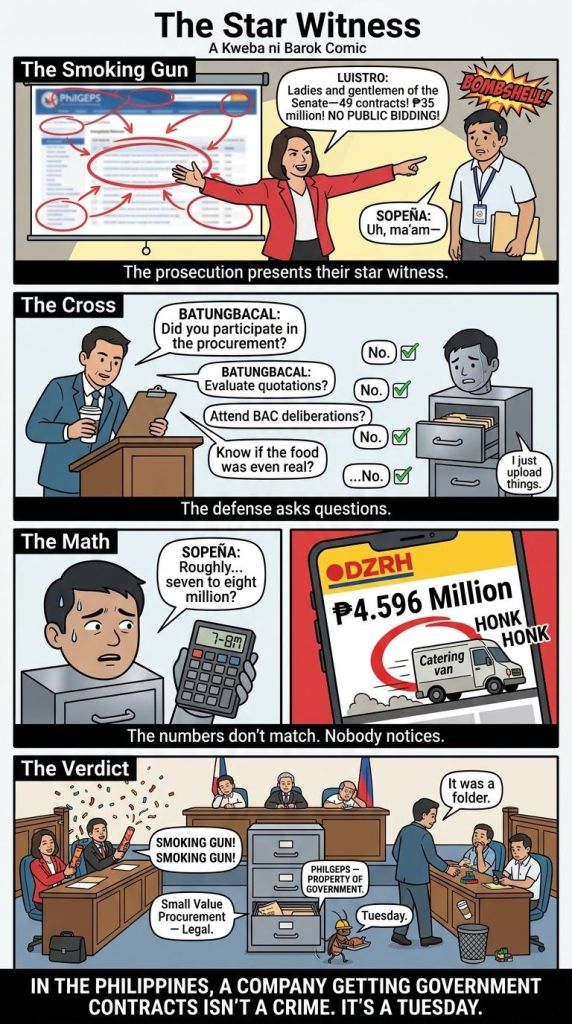
Let me say that again, because it bears repeating: Rendell Sopeña, Division Chief of the Philippine Government Electronic Procurement System (PhilGEPS), spent an entire day on the witness stand establishing that his office is a glorified filing cabinet. The prosecution called him to prove that GenCorp Industries got sweetheart deals from Davao City. What he actually proved is that PhilGEPS is where procurement documents go to be uploaded and forgotten, like your Tita’s Facebook photo albums from 2013.
And the prosecution thinks this is a win.
The Grand Illusion of “No Public Bidding”
Here’s the headline the prosecution wants you to swallow: 11 of 15 Davao City contracts with GenCorp did not undergo public bidding. Sounds damning, doesn’t it? A company linked to the Vice President, getting contracts from a city run by her brother, without competitive bidding. The stench of impropriety is enough to make a goat gag.
But here’s what the headline buries: Small Value Procurement is legal. Under Republic Act No. 9184 (Government Procurement Reform Act) and its successor Republic Act No. 12009 (New Government Procurement Act), government agencies can bypass competitive bidding for contracts below certain thresholds. For a first-class city like Davao, that threshold is reportedly ₱2 million. Sopeña himself admitted the 11 contracts were food and catering services, each individually below that ceiling.
So what we have is not evidence of corruption. What we have is evidence that Davao City used a procurement method that the law explicitly allows, for contracts that fit the legal criteria.
The prosecution’s entire narrative hinges on making “no public bidding” sound like “stole from the treasury.” But in procurement law, as in life, the absence of one thing does not automatically mean the presence of another. If I don’t eat breakfast, it doesn’t mean I’m starving. It means I skipped a meal. The prosecution is hoping the senator-judges conflate “skipped bidding” with “committed plunder.”
The Witness Who Couldn’t Witness
Let’s talk about the star of the show. Rendell Sopeña, the man who was called to deliver the prosecution’s smoking gun, spent his entire testimony explaining why the gun wasn’t actually smoking, wasn’t actually a gun, and wasn’t even in the same room as the crime scene.
Under cross-examination by defense counsel Roberto Batungbacal, Sopeña admitted—repeatedly, almost compulsively—that he had no personal knowledge of any of the 49 contracts.
- He didn’t participate in the procurement. He didn’t evaluate the quotations.
- He didn’t approve the awards.
- He didn’t attend the Bids and Awards Committee (BAC) deliberations.
- He didn’t inspect the catering services.
- He doesn’t know if the food was delivered. He doesn’t know if the events were real.
What he knows is what was uploaded to PhilGEPS by the procuring entities.
That’s not a witness. That’s a browser history.
When Senator Risa Hontiveros asked Sopeña whether PhilGEPS could determine if procurement rules were violated when a local government signs contracts with a company linked to the mayor’s sibling, Sopeña’s answer was essentially: “Ma’am, I just work here.”
“For the PhilGEPS system side, we have no personal knowledge pagdating sa ganyan.”
And when Senator Joel Villanueva asked whether PhilGEPS could detect suspicious patterns like repetitive awards to the same company, Sopeña admitted the current system cannot do that. The red-flagging features are still being developed.
So the prosecution called a witness from an agency that doesn’t audit, doesn’t investigate, doesn’t verify, and doesn’t flag anything—and treated his testimony as a cornerstone of their impeachment case.
This is like calling the mailman to testify about whether the letter he delivered contained evidence of a crime. He can confirm the envelope existed. He cannot tell you what was inside, whether it was true, or whether the sender was a criminal.
The Numbers That Don’t Add Up (Literally)
Now let’s do some arithmetic, because someone has to.
Sopeña testified that the 11 non-bid contracts were worth roughly ₱7 million to ₱8 million.
But DZRH published a breakdown of the 11 contracts that totals approximately ₱4.596 million.
That’s not a rounding error. That’s a discrepancy of nearly ₱3 million—a gap wide enough to fit several catering vans.
Is this a transcription error? A difference between ABC and contract price? Additional line items? Sopeña guessing on the stand? The prosecution has not explained it. They just let the number hang in the air, hoping nobody would notice that their star witness’s math doesn’t match their own evidence.
This is the level of precision the prosecution brings to an impeachment trial. They can’t even get the peso amounts straight, but they want the Senate to remove the Vice President of the Philippines from office.
The SEC and SALN Paradox
Here’s where the prosecution’s case gets genuinely interesting—and genuinely incoherent.
Vice President Sara Duterte declared GenCorp Industries as a business interest in her 2024 and 2025 Statements of Assets, Liabilities, and Net Worth (SALNs). Under oath, she said: “I own this.”
But when the Securities and Exchange Commission (SEC) presented its records, Duterte’s name was nowhere to be found—not as incorporator, not as director, not as shareholder.
So the prosecution now has a problem. They want to use the SALN to prove Duterte owned GenCorp and therefore violated the constitutional prohibition on business interests. But the SEC records undercut that claim. And if they pivot to the SEC records to show Duterte wasn’t actually an owner, they’ve just demolished their own theory that she had a prohibited financial interest.
House prosecutor Zia Alonto Adiong tried to thread this needle by saying: “The higher is the one declaring the asset… Believe her.” That’s a remarkable argument: The prosecution is asking the court to trust the respondent’s SALN over the government’s corporate records.
But here’s the thing about sworn declarations: they can be wrong. People make mistakes. People declare assets they thought they had. People list business interests that were never formally documented. The SALN is a disclosure requirement, not a certificate of title.
If Duterte declared a business interest she didn’t actually have, that’s a SALN accuracy issue. If she had a business interest that wasn’t in SEC records, that’s a beneficial ownership issue. Either way, the prosecution needs to prove actual financial interest during her tenure—not just a line item on a form.
And Sopeña, the records custodian from PhilGEPS, cannot help them do that.
The Fraternal Conflict of Interest (That Isn’t Automatically Illegal)
The prosecution’s emotional centerpiece is the sibling relationship: Sara Duterte is Vice President; her brother Sebastian “Baste” Duterte is Mayor of Davao City; GenCorp got contracts from Davao City.
The implication is obvious: Nepotism! Conflict of interest! Corruption!
But here’s what the law actually says: A sibling relationship between a national official and a local chief executive does not, by itself, make every contract awarded by that local government unit (LGU) to a company the national official is associated with illegal.
Article VII, Section 13 of the 1987 Constitution prohibits the Vice President from being “financially interested in any contract with… the Government.” The key word is financially interested. Not “related to someone who knows someone.” Not “located in a city run by a relative.” Not “listed in a SALN that may or may not reflect reality.”
The prosecution needs to prove that Sara Duterte had a direct or indirect financial stake in GenCorp during the period when GenCorp received government contracts. They need to prove that she benefited from those contracts. They need to prove that she participated in the business in a way that violates the constitutional prohibition.
Sopeña’s testimony proves none of that. It proves that contracts existed. It proves that some didn’t go through bidding. It proves that PhilGEPS is a passive repository. It does not prove that Sara Duterte was financially interested in any of them.
The prosecution is asking the Senate to leap from “contracts existed” to “constitutional violation” without proving the intervening facts. That’s not a legal argument. That’s a vibe.
The Real Problem: A System Designed to See Nothing
If there’s a villain in this story, it’s not Rendell Sopeña. He’s just a man doing his job—a job that, by his own admission, involves no verification, no auditing, no flagging, and no enforcement.
Sopeña testified that PhilGEPS is developing new tools to detect collusion and repetitive awards. Senator Villanueva’s response was telling: “So ang hirap po sabihin sa publiko na may maaasahan po kami na natukoy o maiwasan ‘yung anumang direct or indirect conflict of interest.”
Sopeña agreed.
This is the real scandal. Not that GenCorp got contracts. But that the government’s primary procurement monitoring system cannot detect the very patterns the prosecution is alleging. PhilGEPS is a database, not a watchdog. It records what procuring entities choose to upload. It doesn’t ask questions. It doesn’t cross-reference. It doesn’t flag conflicts.
If Sara Duterte wanted to hide a financial interest in a government contractor, PhilGEPS would not catch her. If Davao City wanted to favor a specific supplier, PhilGEPS would not notice. If contracts were split to avoid bidding thresholds, PhilGEPS would not care.
The prosecution is using a system that cannot see to prove that something was hidden.
What the Prosecution Actually Proved
Let’s be generous. Let’s assume every fact Sopeña testified to is true. Let’s assume the contracts exist, the values are accurate, the non-bidding is documented.
Here’s what the prosecution has established: A company that Vice President Sara Duterte declared as a business interest received 49 government contracts worth ₱35.88 million during her vice presidency, 11 of which were awarded through a legal procurement method that doesn’t require competitive bidding.
That’s it.
They have not established:
- That Duterte actually owned GenCorp (SEC records say she doesn’t)
- That she received any financial benefit from the contracts
- That she participated in the procurement decisions
- That the contracts were overpriced
- That the services were not delivered
- That the procurement method was abused
- That contract splitting occurred
- That any law was broken
They have established a pattern worth investigating. They have not established a constitutional violation worth impeaching.
And they’re asking the Senate to convict on the basis of a pattern.
The Defense Is Winning (And They Know It)
Batungbacal’s cross-examination was surgical. He didn’t need to shout. He didn’t need to grandstand. He just walked Sopeña through a series of admissions that reduced the prosecution’s star witness to a records custodian who couldn’t read the records.
No personal knowledge. No compliance determination. No audit authority. No red flags. No verification. Just uploads.
Senator Ping Lacson reportedly suggested the defense’s “nitpicking” strategy might not be working. But from where I sit, the defense isn’t nitpicking. They’re exposing the prosecution’s case for what it is: a pile of documents without a theory.
The prosecution has documents. They have contracts. They have PhilGEPS entries. They have SALN declarations. They have SEC records that contradict the SALN.
What they don’t have is a coherent story that connects all of it to an impeachable offense.
The Bottom Line (For Now)
Rendell Sopeña’s testimony was not a smoking gun. It was a fog machine—it created the appearance of damning evidence while obscuring the fact that nothing was actually proven.
The prosecution will call more witnesses. They will present more documents. They will try to fill the gaps that Sopeña left wide open. Maybe they’ll succeed. Maybe the Davao City BAC chair will testify that the contracts were split. Maybe the SEC will produce records showing Duterte’s beneficial ownership. Maybe Baste Duterte will crack under questioning and admit he knew about his sister’s interest.
But right now, on the basis of what Sopeña actually said, the prosecution has proven that a company got government contracts. In the Philippines, that’s not a crime. That’s a Tuesday.
The impeachment trial continues. The circus rolls on. And the Filipino people are left to wonder: if the prosecution’s star witness couldn’t identify a single irregularity, what are the other witnesses going to say?
Mga ka-kweba, keep your eyes open and your skepticism sharp. Because in this trial, the only thing being impeached so far is the prosecution’s credibility.
Louis ‘Barok’ C. Biraogo is a Davao-born writer, columnist for the Manila Standard and People’s Taliba, and the curator of Kweba ni Barok. He believes that in Philippine politics, the truth is often buried under an avalanche of press releases, and his job is to dig it out—or at least point at the avalanche and laugh.
Key Citations
A. Legal & Official Sources
- The 1987 Constitution of the Republic of the Philippines, art. VII, sec. 13. Official Gazette of the Republic of the Philippines, 1987, http://www.officialgazette.gov.ph/constitutions/the-1987-constitution-of-the-republic-of-the-philippines/the-1987-constitution-of-the-republic-of-the-philippines-article-vii/.
- Republic Act No. 9184. An Act Providing for the Modernization, Standardization and Regulation of the Procurement Activities of the Government and for Other Purposes (Government Procurement Reform Act). 10 Jan. 2003, http://www.officialgazette.gov.ph/2003/01/10/republic-act-no-9184/.
- Republic Act No. 12009. An Act Revising Republic Act No. 9184, Otherwise Known as the “Government Procurement Reform Act”, and for Other Purposes (New Government Procurement Act). 20 July 2024, lawphil.net/statutes/repacts/ra2024/ra_12009_2024.html.
- “The Basics: Statement of Assets, Liabilities, and Net Worth.” Official Gazette of the Republic of the Philippines, http://www.officialgazette.gov.ph/saln/.
- Philippine Government Electronic Procurement System. Procurement Service–PhilGEPS, philgeps.gov.ph/.
B. News Reports
- Servallos, Neil Jayson. “‘11 Contracts Won by GenCorp Had No Public Bidding.’” Philstar.com, The Philippine Star, 29 Sept. 2026, http://www.philstar.com/headlines/2026/09/29/2559722/11-contracts-won-gencorp-had-no-public-bidding.
- Casilao, Joahna Lei. “P35M in Gov’t Contracts Awarded to GenCorp during Sara Duterte’s VP Term — Witness.” GMA News Online, GMA Network, 22 Sept. 2026, http://www.gmanetwork.com/news/topstories/nation/1003277/p35m-in-gov-t-contracts-awarded-to-gencorp-during-sara-duterte-s-vp-term-witness/story/.
- Panti, Llanesca T. “Sara Duterte’s GenCorp SALN Disclosure ‘Admission against Interest’ — House Panel.” GMA News Online, GMA Network, 22 Sept. 2026, http://www.gmanetwork.com/news/topstories/nation/1003317/sara-duterte-s-gencorp-saln-disclosure-admission-against-interest-house-panel/story/.
- Divina, Thea. “Sopeña: 11 GenCorp Contracts Linked to VP Sara Did Not Undergo Public Bidding.” DZRH News, 28 Sept. 2026, http://www.dzrh.com.ph/post/sopena-11-gencorp-contracts-linked-to-vp-sara-did-not-undergo-public-bidding.
- Orcullo, Jerod. “Kapunan Says Baste ‘Confession’ Indicates Lack of ‘Due Diligence.’” Daily Tribune, 22 Sept. 2026, tribune.net.ph/2026/09/22/kapunan-says-baste-confession-indicates-lack-of-due-diligence.
- Reganit, Jose Cielito. “Davao City, PhilGEPS Figures Differ on GenCorp Deals.” Philippine News Agency, 28 Sept. 2026, http://www.pna.gov.ph/articles/1284963.

- ₱8B BBM Pork: CCTV for Every Captain’s Kumpare?

- ₱8.9 Billion, 331 Ghost Police Stations: The TIKAS Scandal Explained

- ₱8.4 Billion, 42,000 Barangays, 1 Election: The “Bawat Barangay Makikinabang” Vote-Buying Masterclass

- ₱75 Million Heist: Cops Gone Full Bandit

- ₱6.77B Ghost Haunts Duterte: RTC Dismisses Mans Carpio’s Desperate Plea
- ₱6.7-Trillion Temptation: The Great Pork Zombie Revival and the “Collegial” Vote-Buying Circus

- ₱53 Million Man Tells ₱695-a-Day Workers to Stop Being ‘Mayabang’: The Audacity of BSP’s Remolona

- ₱3.06 Billion for Evacuation Centers—But Nobody Knows Where They’ll Stand (Or If They’ll Exist)

- ₱10B Ghost in New Clark City: Matibag’s Haunted Séance for Cayetano

- ₱1.9 Billion for 382 Units and a Rooftop Pool: Poverty Solved, Next Problem Please

- ₱1.35 Trillion for Education: Bigger Budget, Same Old Thieves’ Banquet

- ₱1 Billion Congressional Seat? Sorry, Sold Out Na Raw — Si Bello Raw Ang Hindi Bumili








Leave a comment