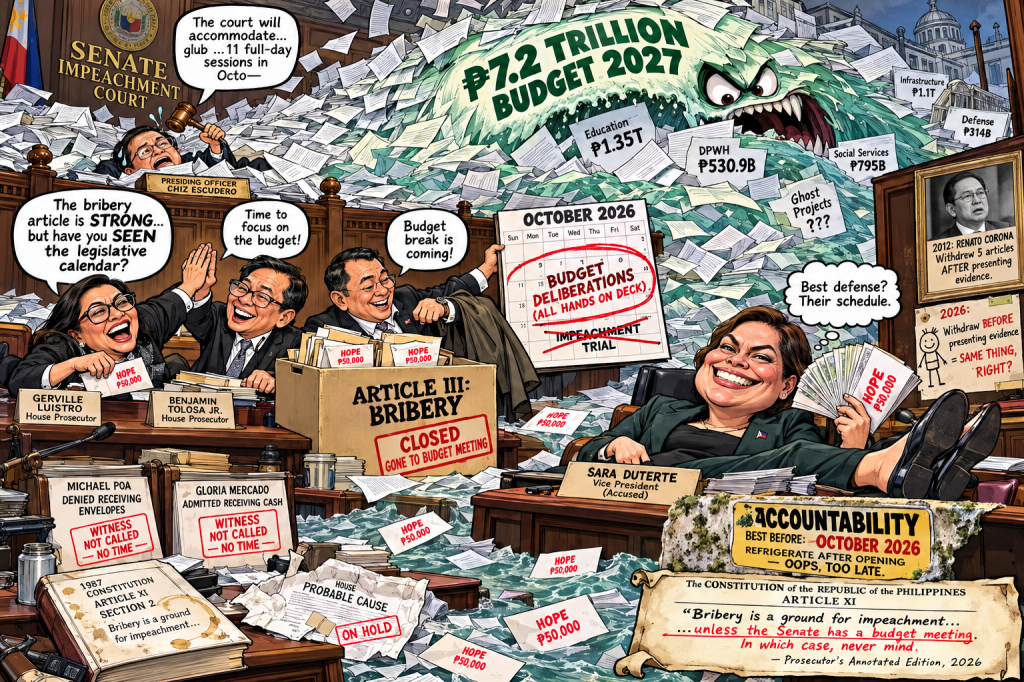
Accountability Has a Shelf Life, and Apparently It Expires in October
By Louis “Barok” C. Biraogo — September 29, 2026
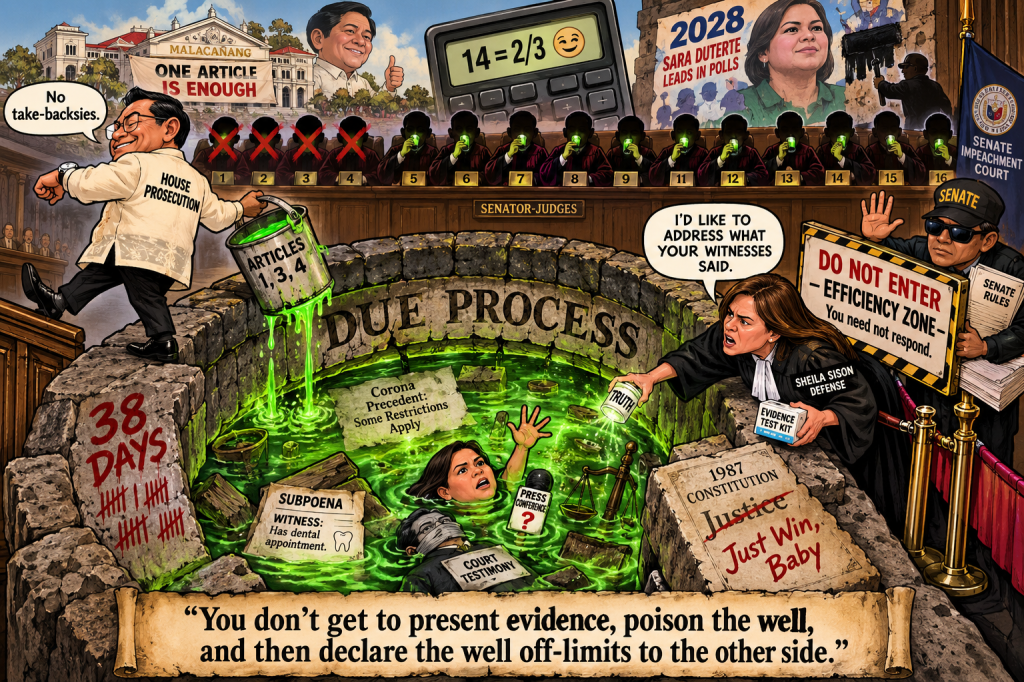
Let’s not pretend this smells like anything other than what it is: I am not here to defend Sara Duterte. The Vice President has, in my humble opinion, the ethical compass of a weather vane and the fiscal transparency of a casino.
But even I—a man who has has built a humble cottage industry mocking the powerful from the comfortable anonymity of my keyboard—cannot help but marvel at the sheer, breathtaking audacity of what the House prosecution panel is doing.
They are considering dropping the bribery charge against the Vice President. Not because they lack evidence. Not because the witnesses have recanted. Not because some court has ruled the allegation legally infirm. No, no, no. They might drop it because the Senate has to work on the budget.
Let that sink in for a moment. The 2027 national budget. ₱7.2 trillion. A legislative calendar.
The prosecution’s spokesperson, Benjamin Tolosa Jr., said it plainly: “Our goal is to wrap up our presentation of evidence before the break. So if there isn’t much time left … that could be a major factor for us not to present evidence with respect to bribery anymore.”
Translation: We might not prove the crime because we have other things to do.
I have covered many things in this blog—corruption, incompetence, the occasional senatorial temper tantrum. But this? This is something special. This is a constitutional accountability proceeding being managed like a corporate retreat with a hard checkout time.

The Corona Precedent: A Convenient Misreading
The prosecution has been quick to invoke the 2012 impeachment of Chief Justice Renato Corona, where the House panel withdrew five of eight articles mid-trial. Lead prosecutor Gerville Luistro has cited this as precedent for strategic narrowing.
But here’s the thing about the Corona precedent: the prosecutors dropped those articles because they had determined—after presenting evidence—that the remaining charges were stronger. It was a strategic decision based on evidentiary assessment. It was not, and I repeat, not a decision driven by the Senate’s legislative calendar.
In Corona’s case, the prosecution had already presented its evidence on the withdrawn articles. They made a judgment call. Here, the prosecution is contemplating not presenting evidence on bribery at all—not because they lack confidence in the evidence, but because they might run out of time.
Luistro has been careful to say the bribery article is “strong”—“I’m not saying that it is the weakest”—while simultaneously suggesting it might be unnecessary because it overlaps with the confidential funds article. Both involve the Department of Education (DepEd). Both involve the same agency. So why bother?
This is the prosecutorial equivalent of saying, “We have two murder charges against the same defendant, but the first one is already taking up so much time, so we might just skip the second one.” The logic is impeccable—if your goal is to finish early rather than to achieve full accountability.
The Budget as Deus Ex Machina
Let us examine this budget argument with the scrutiny it deserves.
Yes, the Senate has a constitutional duty to pass the national budget. Yes, the 2027 spending plan is ₱7.2 trillion. Yes, the Senate Committee on Finance needs time to deliberate. These are all true statements.
But here’s what is also true: the Senate has known about the impeachment trial for months. The trial calendar was set with full awareness of the budget season. The prosecution has been presenting evidence since the trial began. At no point did anyone discover, with surprise and alarm, that October is budget month.
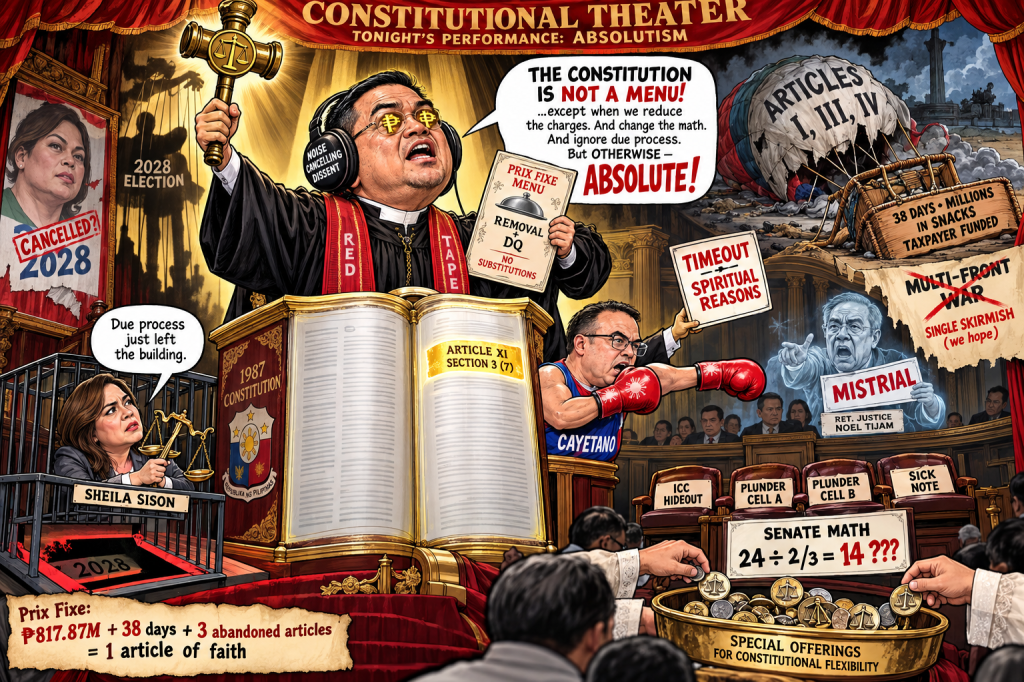
Presiding Officer Chiz Escudero has scheduled 11 full-day trial sessions in October—October 1-2, 5-9, and 12-15—specifically to accelerate the proceedings before the budget break. The court has been adjusting, accommodating, trying to make this work.
And the prosecution’s response? “If there isn’t much time left … that could be a major factor for us not to present evidence with respect to bribery anymore.”
The Senate is bending over backwards to give them time. The prosecution is looking for an exit.
What Exactly Is Being Abandoned
Let’s be precise about what’s at stake here.
Article III of the impeachment complaint alleges that Sara Duterte, as Education Secretary, distributed cash envelopes—reportedly ₱50,000 each, the so-called “HOPE” envelopes—to DepEd procurement officials to influence decisions and circumvent procurement rules.
The Ombudsman has separately received complaints alleging bribery, graft, and corruption involving ₱612 million in confidential funds, with allegations that Duterte bribed Office of the Vice President (OVP) and DepEd procurement officers through intermediaries.
This is not a minor allegation. This is not some technical charge that can be safely jettisoned. This is an accusation that the Vice President of the Philippines corrupted the officials responsible for procuring educational materials for Filipino children.
And the prosecution is considering dropping it because they have a scheduling conflict.
Luistro’s explanation is that Article I (confidential funds misuse) already covers both OVP and DepEd, so Article III is redundant. “All of them are strong,” she says. “But we have this confidential fund already pertaining to both the OVP and DepEd. Perhaps, we focus on something else.”
“Something else” being the unexplained wealth charge, which involves extensive bank records and financial documents. Because nothing says “efficient use of trial time” like pivoting from one complex evidentiary presentation to another.
The Witness Who Wasn’t There
Here’s where the story gets genuinely interesting—and by “interesting” I mean “potentially devastating for the prosecution’s bribery case.”
Michael Poa, Duterte’s former chief of staff at DepEd and now a member of her defense team, testified in early September as a hostile witness. Under questioning, he said he had no personal knowledge of how confidential funds were spent. He didn’t know about a vault. He didn’t know a security officer was handling the funds. He couldn’t verify when acknowledgment receipts were prepared.
More significantly, Poa has publicly denied ever receiving cash envelopes from Duterte. In a March 2026 interview, he said the impeachment complaint’s claim that he admitted receiving an envelope was “totally false.” He acknowledged that Duterte would sometimes reimburse him for expenses he had personally covered—Christmas parties, media events—but insisted these were “not anything significant.”
If Poa—a key figure in the alleged bribery scheme—is denying the envelope claims, the prosecution’s Article III case just got significantly harder.
Is this why they’re considering dropping bribery? Is the budget schedule a convenient excuse for abandoning a charge that has become evidentially problematic?
Luistro insists the bribery article is “strong.” But she also says they’re “evaluating” the witness list for all remaining articles. When a prosecutor starts publicly musing about which charges to drop and which witnesses to dispense with, the smart money says the case isn’t as strong as advertised.
The Defense’s Dilemma (and Opportunity)
Here’s the delicious irony: Sara Duterte’s defense team now has a strategic choice of its own.
Option A: Accept the withdrawal. Fewer charges, shorter trial, less damaging testimony. The defense can claim the prosecution abandoned bribery because it couldn’t prove it—a narrative of vindication without ever having to litigate the merits.
Option B: Demand that Article III be tried. Force the prosecution to present its evidence. Cross-examine the witnesses. Expose the weaknesses. Secure a formal acquittal on bribery rather than a procedural whimper.
The defense has already been pushing a “politically motivated” narrative. Demanding a full trial on bribery would be consistent with that positioning. “We want to confront every accusation,” they could say. “We have nothing to hide.”
But if the defense genuinely believes the bribery evidence is weak—if Poa’s denials and the questionable envelope claims suggest the prosecution’s case is built on sand—then forcing a trial on Article III could be a gift. A clean rejection of bribery would undermine the credibility of the entire impeachment effort.
On the other hand, if the defense fears what witnesses like Gloria Mercado might say under oath—Mercado reportedly admitted receiving cash envelopes at a House hearing—then accepting the withdrawal might be the safer play.
The prosecution’s decision to potentially drop bribery hands the defense a tactical choice it didn’t ask for. That’s not prosecutorial efficiency. That’s prosecutorial chaos.
The Constitutional Problem Nobody Wants to Discuss
Here’s the thing about impeachment that the budget-obsessed commentariat seems to have forgotten: it is a constitutional proceeding, not a legislative side hustle.
Article XI, Section 2 of the 1987 Constitution lists bribery as one of only six grounds for impeachment. It is not a minor charge. It is not a discretionary add-on. The framers of the Constitution specifically identified bribery as a basis for removing the second-highest official in the land.
When the House of Representatives transmitted four articles of impeachment to the Senate, it certified that probable cause existed for each one. The prosecution’s job is to prove those articles—or at least present the evidence and let the Senate decide.
The Senate’s impeachment rules, as the University of the Philippines (UP) College of Law’s primer explains, contemplate voting on each article separately. The rules do not say, “Prosecutors may abandon articles when they get busy.” They do not say, “Budget season trumps constitutional accountability.”
There is a legitimate question of whether the Senate should even accept a mid-trial abandonment of an article without formal vote or process. Rule XXI addresses voting on articles, not withdrawing them. The withdrawal of Article III—if it happens—would set a precedent that impeachment charges can be discarded like unwanted appetizers when the main course is running late.
The defense has already argued that a motion to dismiss is constitutionally impermissible. Would a prosecution motion to abandon be any different? If the House found probable cause, and the Senate is the sole court for impeachment, shouldn’t the Senate—not the prosecutors—decide the fate of the articles?
These are not academic questions. They go to the heart of whether impeachment remains a meaningful check on executive power or becomes a scheduling exercise subject to the whims of legislative calendars.
The Credibility Calculus
Let’s talk about what this actually looks like to the public.
The prosecution has presented witnesses on confidential funds. It has presented financial evidence on unexplained wealth. It has, by all accounts, been building a documentary record on the money questions.
But bribery? The charge that sounds most like a crime—cash envelopes, procurement officials, corruption—might simply be abandoned because time ran out.
The political narrative writes itself:
Prosecution version: “We focused on our strongest evidence. Unexplained wealth is document-driven and devastating. Bribery was redundant and time-consuming.”
Defense version: “They dropped bribery because they couldn’t prove it. Poa denied everything. The envelopes were a House committee fiction. This entire impeachment is a political circus.”
Public version: “Wait, so did she bribe people or not? We’re not going to find out?”
That last question is the one that should worry the prosecution most. An impeachment trial is not just a legal proceeding—it is a public reckoning. The Filipino people deserve to know whether their Vice President bribed education officials. The Senate deserves a complete evidentiary record. History deserves an answer.
If Article III simply evaporates because the budget calendar got tight, none of those things happen. The bribery allegation remains in limbo—neither proven nor disproven, neither adjudicated nor formally withdrawn. It becomes a Schrödinger’s charge, simultaneously alive and dead in the public imagination.
What Should Happen
The prosecution has options that don’t involve abandoning Article III.
They could present a truncated bribery case—call one or two key witnesses, submit the essential documents, and let the defense cross-examine. They could seek stipulations on uncontested facts. They could request a brief extension of trial hours. They could defer Article III until after the budget break and resume in November, when the Senate schedule allows.
Escudero has already indicated the trial may resume on November 9 and 16 before returning to a regular schedule on November 23. So there is time. It’s tight, but it exists.
The question is whether the prosecution has the will—and the confidence in its bribery evidence—to use it.
Luistro says the bribery article is “strong.” If that’s true, present it. If the witnesses are credible and the documents are solid, the Senate should hear them. The budget can wait a few extra days. The Constitution cannot.
But if the bribery evidence is weaker than advertised—if Poa’s denials and the questionable envelope claims have undermined the case—then the prosecution needs to say so honestly. It needs to formally withdraw the article, explain why, and accept the political consequences.
What it cannot do is let Article III quietly disappear into the budget-season ether, unadjudicated and unexplained, leaving the public with nothing but competing narratives and unanswered questions.
The Bottom Line
Sara Duterte may or may not be guilty of bribery. I have my suspicions—I have suspicions about everyone in Philippine politics, including myself on a bad day—but suspicions are not proof. The Senate impeachment court is the forum where proof is supposed to be presented.
If the prosecution abandons Article III because of the budget, it is not just dropping a charge. It is dropping the ball. It is telling the Filipino people that accountability has a shelf life and a meeting schedule. It is converting a constitutional proceeding into a project-management exercise.
The ₱7.2-trillion budget matters. It matters a great deal. But so does the question of whether the Vice President corrupted the Department of Education. The Constitution lists bribery as a ground for impeachment for a reason. It is not a technicality to be discarded when the calendar gets crowded.
Present the evidence. Let the Senate decide. Let the public know.
Or don’t—and admit that the bribery charge was never really about accountability in the first place. It was about making the impeachment complaint look tougher than it actually was. And when the going got tough—or the schedule got tight—it was the first thing to go.
Either way, the Filipino people deserve an answer. Not a scheduling note.
Louis “Barok” C. Biraogo is a recovering lawyer, a reluctant political analyst, and the proprietor of Kweba ni Barok, where he has been chronicling the absurdities of Philippine governance since before it was fashionable. He accepts no responsibility for the accuracy of his predictions, the sincerity of his outrage, or the sobriety of his conclusions.
Key Citations
A. Reports & Studies
- University of the Philippines College of Law. Impeachment Primer and Frequently Asked Questions. 2nd ed., 14 Feb. 2025, law.upd.edu.ph.
- Senate of the Philippines. Rules of Procedure on Impeachment Trials. Senate Resolution No. 39, 15th Cong., 23 Mar. 2011.
B. News Articles
- Bacelonia, Wilnard. “VP Sara Impeachment Trial Shifts to Full-Day Hearings in October.” Philippine News Agency, 8 Sept. 2026.
- Bolledo, Jairo. “Plunder Complaint Filed vs Sara Duterte over Confidential Funds Mess.” Rappler, 12 Dec. 2025.
- Flores, Dominique Nicole. “Ex-DepEd Official Claims VP Sara Gave Out P50,000 Cash Envelopes.” Philstar.com, 25 Sept. 2024.
- Inosante, Aubrey Rose. “Government Proposes P7.2 Trillion National Budget for 2027.” Philstar.com, 27 June 2026.
- “Bribery Rap vs VP May Be Dropped to Speed Up Trial.” Philippine Daily Inquirer, 4 Sept. 2026.
- “Poa Denies Receiving ‘Envelopes’ Linked to VP Sara Confidential Funds.” Bilyonaryo News Channel, 30 Mar. 2026.
- Panti, Llanesca T. “Ex-DepEd Official: Sara Duterte Showered Subordinates with Money.” GMA News Online, 25 Sept. 2024.
- “Prosecution Rests Case vs Corona.” Philippine Daily Inquirer, 29 Feb. 2012.
- Reganit, Jose Cielito. “Senate Impeachment Court Declares Poa Hostile Witness.” Philippine News Agency, 2 Sept. 2026.
- “Tolosa Admits Senate, Panels Talking about Changes to Trial Flow.” Philippine Daily Inquirer, 25 July 2026.
- Valente, Catherine S. “Escudero: Senate Eyes Whole-Day Impeachment Trial in October.” The Manila Times, 3 Sept. 2026.
C. Official Websites
- Office of the Vice President of the Philippines. Official Website. ovp.gov.ph.
- Official Gazette of the Republic of the Philippines. “The 1987 Constitution of the Republic of the Philippines – Article XI.” Official Gazette, officialgazette.gov.ph.
- ₱9 Billion in ‘Savings’? DILG’s Fire Truck Deal Smells Like Smoke

- ₱8B BBM Pork: CCTV for Every Captain’s Kumpare?

- ₱8.9 Billion, 331 Ghost Police Stations: The TIKAS Scandal Explained

- ₱8.4 Billion, 42,000 Barangays, 1 Election: The “Bawat Barangay Makikinabang” Vote-Buying Masterclass

- ₱75 Million Heist: Cops Gone Full Bandit

- ₱6.77B Ghost Haunts Duterte: RTC Dismisses Mans Carpio’s Desperate Plea

- ₱6.77 Billion and Zero Cash: The Sara Duterte SALN Math That Doesn’t Add Up

- ₱6.7-Trillion Temptation: The Great Pork Zombie Revival and the “Collegial” Vote-Buying Circus

- ₱58.53B, Zero Receipts: The LGSF Pork Barrel Nobody Wants to Name

- ₱53 Million Man Tells ₱695-a-Day Workers to Stop Being ‘Mayabang’: The Audacity of BSP’s Remolona
- ₱4.4 Billion and a Witness Who Can’t Explain It: The Duterte Impeachment’s Most Expensive Non-Answer
- ₱3.06 Billion for Evacuation Centers—But Nobody Knows Where They’ll Stand (Or If They’ll Exist)




Leave a Reply