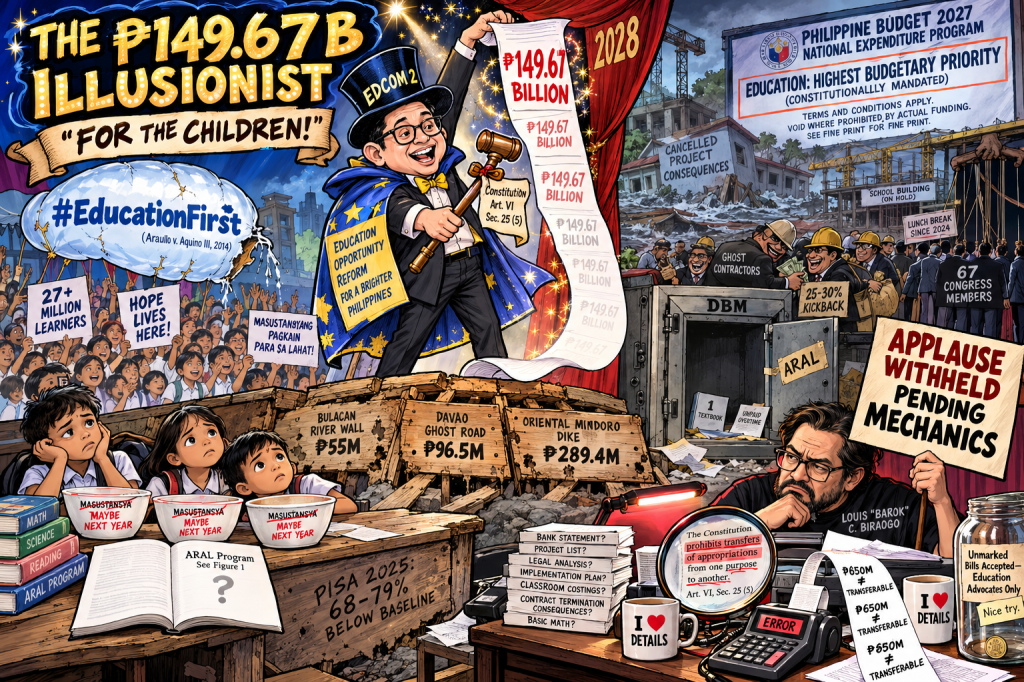
Everyone clapped for the education funding. Nobody asked where the money was coming from—or whether Congress can legally move it.
By Louis “Barok” C. Biraogo | October 19, 2026
LET me tell you about a magic trick. A senator stands up, waves a wand: “We shall take money from corrupt flood control projects and give it to education!” The crowd cheers. The hashtag trends.
But magic tricks only work if you don’t look too closely at the mechanics.
Senator Paolo Benigno “Bam” Aquino IV—yes, that Aquino, whose family name is now a brand so tarnished even a wand couldn’t polish it—has proposed redirecting funds from controversial infrastructure to education. Children get fed! Classrooms get built! Corrupt contractors get defunded! It’s the kind of proposal that makes you want to applaud—until you realize the fine print is where legislative fantasies go to die.
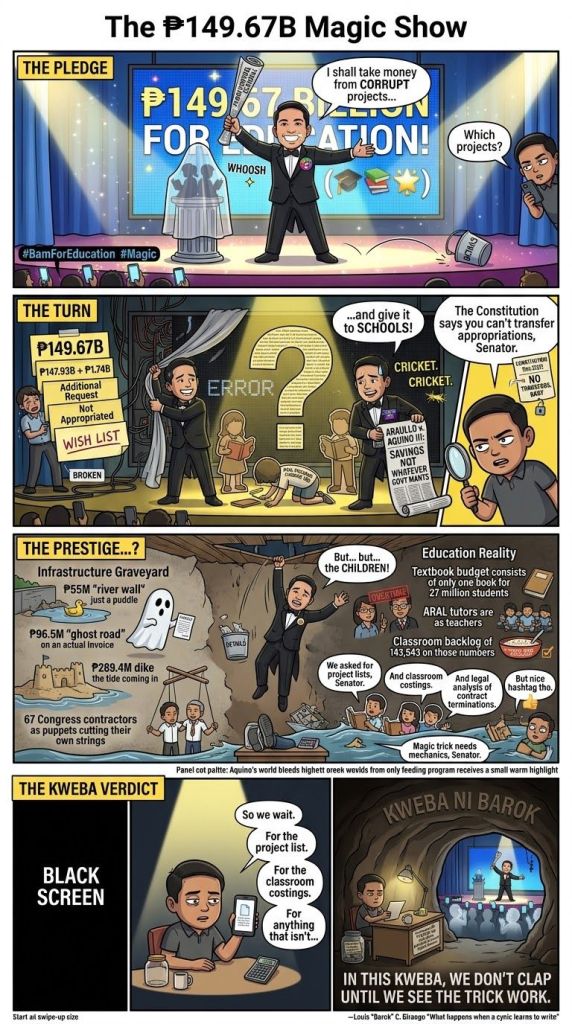
#KwebaNiBarok #Biraogo #EducationFunding #ConstitutionalLaw #DontApplaudYet
The Numbers Game: Creative Accounting
The senator’s proposal has the fiscal precision of a wet market haggler.
The Department of Education (DepEd) requested an additional ₱147.93 billion. Six attached agencies want ₱1.74 billion. Combined request: ₱149.67 billion. The House-approved education budget is ₱6.17 billion below the National Expenditure Program (NEP). And ARAL—the Academic Recovery and Accessible Learning Program, which exists as a law but apparently not as a budget line—needs ₱15.6 billion.
Here’s the catch: the report “does not specify a final list of projects, their individual appropriations, the amount that can lawfully be withdrawn, or the precise amount that would be redirected to each education program.”
Translation: The senator announced a spending plan without identifying where the money comes from or how much is actually available. That’s like announcing you’ll pay off your credit card by “cutting unnecessary expenses” without ever looking at your bank statement.
The ₱149.67 billion isn’t a commitment—it’s a wish list. The ₱15.6 billion for ARAL isn’t a guarantee—it’s a hope. The ₱6.17 billion difference? Not a shortfall; just a comparison. You might as well say the weather is 6.17 degrees cooler than yesterday and call it climate policy.
The ARAL Mystery: A Law Without a Budget
Republic Act No. 12028 (Academic Recovery and Accessible Learning Program Act) (October 2024) established a national learning intervention program. Wonderful! Except Section 21 says the amount necessary “shall be charged against the DepEd’s current appropriations, with the amount necessary for continuing implementation thereafter to be included in the annual General Appropriations Act.”
Read carefully: the law itself contemplated initial implementation from existing funds. It’s not “unfunded”—it’s funded through mechanisms that don’t require a dedicated line item.
But Department of Budget and Management (DBM) Director Vivien Labastilla says ARAL is funded through an allocation “attributed to the textbook budget”, with teachers compensated through overtime pay. So we’re funding learning recovery by raiding the textbook budget and paying teachers overtime—like funding your child’s college by skipping the electric bill and telling them to study by candlelight.
Is this legal? Perhaps. Transparent? Absolutely not. Adequate? The senator says no, and he’s probably right—but that doesn’t mean ₱15.6 billion appears from nowhere.
DepEd should produce an implementation plan: number of eligible learners, tutoring sessions, tutor recruitment and training, costs per subject, rural delivery, baseline and follow-up assessments. Without that, ₱15.6 billion is just a number attached to a good intention. The ARAL Act itself requires annual evaluation and an impact report to Congress. Accountability requires data, not press releases.
The Infrastructure Shuffle: Which Projects Are Actually Corrupt?
The flood control scandal is real: ₱42.3–118.5 billion lost annually to corruption since 2023. Sixty-seven Congress members were public works contractors for their own district projects. Kickback rates of 25-30% to lawmakers. Ghost projects: the ₱55-million nonexistent river wall in Bulacan, the ₱96.5-million “ghost” project in Davao Occidental, the ₱289.4-million road dike in Oriental Mindoro.
Legitimate targets. But “controversy is a reason to investigate. It is not, by itself, proof that a project should be cancelled.”
Flood prevention is itself a child-protection measure—it protects schools, prevents deaths, preserves roads used by students and teachers. Cutting necessary flood-control could undermine the very educational goals Aquino seeks.
The proposal doesn’t distinguish:
- Category A: Essential projects with credible implementation (protect)
- Category B: Projects with integrity concerns (review)
- Category C: Low-priority or poorly prepared projects (defer)
- Category D: Projects with evidence of serious illegality (investigate)
Instead we get a broad gesture toward “controversial infrastructure” without a project-by-project schedule showing what would be cut, how much is recoverable, and the legal consequences of cancellation. A cancelled project can cost more than a delayed one—termination can trigger compensation, claims, litigation, demobilization, and replacement procurement. Has the good senator accounted for this? The report doesn’t say.
The Constitutional Tightrope: Congress Can Appropriate, But Not Transfer
Article VI, Section 25(5) prohibits laws authorizing transfers of appropriations, subject to a limited exception allowing specified officials to augment items within their respective offices from savings. The exception is not a general power to transfer funds among departments.
So:
- Legally sound: Congress revises proposed appropriations during the legislative budget process, reducing infrastructure items and appropriating corresponding amounts for education in the enacted General Appropriations Act (GAA).
- Potentially unlawful: An official simply takes money already appropriated for one department and spends it on another without lawful basis.
The safest route is adjustment in the 2027 budget bill before enactment, not a broad interdepartmental transfer after appropriations become law.
The Araullo v. Aquino III ruling—yes, that Aquino, whose family name is now attached to a constitutional precedent about budget abuse—established that “savings” are not whatever government wishes to call savings. Unobligated appropriations do not automatically become lawful savings for unrelated spending.
The report notes that “a project may be controversial yet still deliver an essential service if completed.” The proposal needs to identify which projects can lawfully and practically be removed—not just which ones sound bad in a headline.
The Political Theater: Reformist Credentials and 2028
Bam Aquino is a former senator seeking political rehabilitation. He’s Senate Finance Subcommittee Chairman and Second Congressional Commission on Education (EDCOM 2) Co-Chair. He needs deliverables. The flood control scandal is at peak outrage. Education is a motherhood issue affecting 27+ million student families—a massive voting bloc.
The timing suggests electoral calculation, but the issue is genuine. The Programme for International Student Assessment (PISA 2025) shows 68-79% of Filipino students below baseline proficiency. The classroom backlog is 143,543. The bullying victimization rate is 47% (vs. 20% Organisation for Economic Co-operation and Development (OECD) average).
But announcing you’ll fund education by cutting “controversial” projects is easy. Navigating constitutional restrictions, contract termination costs, project selection criteria, and implementation capacity is hard. The report notes Aquino “can gain credibility by turning a broad demand for education funding into a technically sound budget proposal.” So far, we have a broad demand, not a technically sound proposal.
The Absorptive Capacity Problem: Money Doesn’t Build Classrooms
Even if ₱50 billion is redirected, can DepEd spend it effectively?
“Construction capacity is limited. Moving a large amount of money to DepEd does not automatically create additional classrooms. Land acquisition, engineering, permits, procurement, construction supervision, and contractor capacity can all constrain delivery.”
And: “An appropriation redirected from a questionable road or flood-control project is not automatically protected from ghost deliveries, overpriced supplies, weak monitoring, or political favoritism in school construction.”
DepEd is already improvising ARAL through the textbook budget and overtime pay. Adding ₱15.6 billion without a credible delivery plan risks a larger appropriation producing the same or worse outcomes. Additional funding must be tied to a credible delivery plan, not merely a large national appropriation.
The Missing Project List: Where’s the Beef?
What would make this credible: a project-by-project schedule naming each infrastructure project, its appropriation, status, contractor, implementing agency, audit history, and rationale for retention or removal.
We don’t have that. We have a gesture toward “controversial infrastructure” and a press release.
The report’s illustrative example: a hypothetical ₱1 billion project with ₱350 million in valid commitments leaves a “maximum apparent balance” of ₱650 million. But “even this ₱650 million is not automatically transferable. Its availability and lawful use depend on the project’s status, the applicable appropriation, contract obligations, and the legal budget process.”
That’s the detail the proposal needs. Instead, headlines about redirecting funds from “controversial” projects without specifying which ones, how much is available, or the legal consequences.
The ARAL Funding Mystery: What’s Really Going On?
Why was ARAL zero-funded in the 2027 NEP despite being a 2024 law? Theories: DBM fiscal constraint; executive-legislative tension (Marcos may want Congress to “own” the increase); programmatic skepticism about implementation capacity; political maneuvering to force DepEd to seek congressional allies; technical oversight (no line item, buried in textbook allocation).
Likely a combination of technical oversight and political calculation. ARAL lacks a line item, so it’s easy to zero-fund without appearing to cut education. Meanwhile the administration claims support for learning recovery while forcing Congress to find the money.
But: If ARAL is funded through the textbook budget and overtime, is that legally authorized? Does the GAA permit textbook appropriations for tutoring? Are textbook purchases being reduced to finance remediation? These questions need budget documents, obligation reports, procurement records, and appropriation provisions—not assumptions. The senator’s proposal should demand this transparency too.
The Feeding Program: A Rare Bright Spot
Here the proposal has clear merit. Republic Act No. 11037 (Masustansyang Pagkain para sa Batang Pilipino Act) institutionalizes a national feeding program for undernourished children.
- 2025 budget: ₱11.8 billion → 2026 projected: ₱25.6 billion
- Beneficiaries: 3.39 million → 4.63 million projected
- Feeding days: 120 → 200 projected
A hungry child struggles to concentrate. Feeding programs complement academic recovery rather than compete with it—a proven intervention with clear legal basis. But it needs safeguards: verified beneficiary lists, nutritional standards, food-safety requirements, transparent procurement, delivery monitoring, and documentation that meals reach children. On this point, at least, the proposal is on solid ground.
The School Safety Sideshow: Metal Detectors and “My Buddy”
The report connects the budget debate to campus violence, the “My Buddy” initiative, and training barangay tanods. Here the proposal risks becoming a grab-bag.
Metal detectors may be appropriate in particular circumstances but are no universal substitute for risk assessment. “My Buddy” may help early referral but should not turn students into substitute security officers or amateur mental-health practitioners—it needs referral pathways, adult supervision, confidentiality safeguards, and protection against coercion. Tanods should not be treated as police or given powers they don’t legally possess; training must clarify lawful authority, coordination with school heads and police, and rules on intervention, detention, searches, and referrals.
The principle is proportionate protection: secure schools without turning them into coercive environments.
The Bottom Line: Good Instincts, Bad Execution
Aquino’s proposal is legally sound in principle, constitutionally grounded in the education priority clause, and politically strategic—a rare convergence of constitutional mandate, legal obligation, anti-corruption imperative, evidence-based policy, and political opportunity.
But as announced it’s a slogan, not a budget plan. It lacks:
- A project-by-project list of cuts with amounts and legal consequences
- · A detailed ARAL implementation plan with costing and metrics
- A credible classroom construction delivery plan
- A mechanism ensuring reallocated funds are spent effectively
- A reconciliation of proposed appropriations vs. commitments vs. recoverable amounts
The report’s recommendation is sound: “The Senate should not protect questionable infrastructure merely because it is already in the spending pipeline. Nor should it cut necessary infrastructure simply because the sector has been tainted by scandal. It should demand evidence, identify lawful savings and reductions, and prioritize education interventions that can demonstrably improve children’s lives.”
The best approach combines:
- Targeted reallocation from low-priority or high-risk projects
- Guaranteed priority funding for ARAL and urgent school needs
- Rapid independent infrastructure review
- Strong transparency and performance safeguards
That’s the technically sound version. It’s also much harder than a press release.
The Deeper Challenge: Beyond the Budget Cycle
Even if fully adopted, the proposal addresses only symptoms. Root causes:
- Procurement corruption: revive blacklisting, strengthen Commission on Audit (COA) independence, criminalize the contractor-politician nexus
- Budget opacity: line-item specificity, public digital tracking, participatory budgeting
- Learning crisis: curriculum reform, teacher quality investment, early childhood intervention
- Infrastructure quality: independent engineering inspection, performance bonds, community monitoring
These require sustained political will, not a one-time reallocation. The senator’s proposal is a start, not a solution.
Final Verdict: A Magic Trick That Needs Mechanics
Bam Aquino identified a real problem (corrupt infrastructure) and a real solution (education funding) and proposed a mechanism (budget reallocation). But he hasn’t shown exactly how it would work, what it would cost, and what the legal and practical obstacles are.
The proposal is:
- Constitutionally grounded (Article XIV, Section 5(5): highest budgetary priority for education)
- egally complex (Article VI, Section 25(5) restricts transfers; Araullo limits “savings”)
- Politically strategic (peak outrage; motherhood issue)
- Technically incomplete (no project list, no implementation plan, no costed delivery)
He deserves credit for raising the issue and framing it around constitutional priorities. He also deserves scrutiny for announcing a spending plan without the details that make it credible.
The public deserves more than a choice between concrete and classrooms. It deserves a government that explains why each project is necessary, why each program is funded at its chosen level, and what citizens actually receive for the money spent.
A budget is not a trophy cabinet for political projects. It is a statement of public priorities—and those priorities must withstand constitutional scrutiny and the practical test of whether they serve the Filipino people.
So, Senator Aquino, we await the project-by-project schedule, the ARAL implementation plan, the classroom costings, and the legal analysis of contract terminations. Until then, your proposal remains a magic trick in search of mechanics.
And in this kweba, we don’t applaud until we see the trick actually work.
Louis “Barok” C. Biraogo is the author of Kweba ni Barok, described as “what happens when a cynic learns to write” and “the reason I stopped reading opinion pieces.” He accepts no responsibility for legislative careers damaged by his analysis, but does accept donations in unmarked bills—preferably from education advocates who actually know how budgets work.
Key Citations
A. Legal & Official Sources
- The 1987 Constitution of the Republic of the Philippines. Official Gazette of the Republic of the Philippines, 1987, https://www.officialgazette.gov.ph/constitutions/1987-constitution/.
- The 1987 Constitution of the Republic of the Philippines, Article XIV: Education, Science and Technology, Arts, Culture and Sports. Official Gazette of the Republic of the Philippines, 1987, https://mirror.officialgazette.gov.ph/constitutions/the-1987-constitution-of-the-republic-of-the-philippines/the-1987-constitution-of-the-republic-of-the-philippines-article-xiv/.
- Republic Act No. 12028. Academic Recovery and Accessible Learning Program Act. Official Gazette of the Republic of the Philippines, 2024, https://www.officialgazette.gov.ph/2024/10/16/republic-act-no-12028/.
- Republic Act No. 11037. Masustansyang Pagkain para sa Batang Pilipino Act. Official Gazette of the Republic of the Philippines, 2018, https://www.officialgazette.gov.ph/2018/06/20/republic-act-no-11037/.
- Republic Act No. 6713. Code of Conduct and Ethical Standards for Public Officials and Employees. Official Gazette of the Republic of the Philippines, 1989, https://www.officialgazette.gov.ph/1989/02/20/republic-act-no-06713/.
- Araullo v. Aquino III. G.R. No. 209287, Supreme Court of the Philippines, 1 July 2014, https://elibrary.judiciary.gov.ph/assets/pdf/philrep/2014/G.R.%20No.%20209287.pdf.
- Belgica v. Ochoa. G.R. No. 208566, Supreme Court of the Philippines, 19 Nov. 2013, https://elibrary.judiciary.gov.ph/assets/pdf/philrep_ebooks/Volume_721.pdf.
- Sanchez v. Commission on Audit. G.R. No. 127545, Supreme Court of the Philippines, https://elibrary.judiciary.gov.ph/thebookshelf/showdocs/1/45231.
- PISA 2025 Results (Volume I): Country Notes, Philippines. Organisation for Economic Co-operation and Development, 2025, https://www.oecd.org/en/publications/pisa-2025-results-volume-i-country-notes_2d4ff9ea-en/philippines_3699b9d5-en.html.
- “Lawmakers Call for Increased Funding for DepEd to Sustain Education Reforms.” EDCOM 2, Second Congressional Commission on Education, https://edcom2.gov.ph/lawmakers-call-for-increased-funding-for-deped-to-sustain-education-reforms/.
B. News Reports
- “Infrastructure Funds Eyed for Additional Education Budget.” The Philippine Star, 18 Oct. 2026, https://www.philstar.com/headlines/2026/10/18/2563975/infrastructure-funds-eyed-additional-education-budget.
- “Infra Funds Eyed for Additional Education Budget.” OneNews.PH, https://www.onenews.ph/articles/infra-funds-eyed-for-additional-education-budget.

- “Ang Hirap Maging Mahirap”: The PAO Scandal That Proves Government Contempt Is Nothing New
- “Far-Off” My Axx: Malacañang’s Claire Castro Drowns in Her Own Legal Gaslighting
- “Forthwith” to Farce: How the Senate is Killing Impeachment—And Why Enrile’s Right (Even If You Can’t Trust Him)

- “HINDI AKO NAG-RESIGN!”

- “I Know Nothing”: Baste Duterte’s Amnesia Defense Meets ₱33M in GenCorp Contracts
- “I’m calling you from my new Globe SIM. Send load!”

- “Mahiya Naman Kayo!” Marcos’ Anti-Corruption Vow Faces a Flood of Doubt

- “Manageable” Debt, Unmanageable Lies: DBM’s ₱21 Trillion Fairy Tale
- “Meow, I’m calling you from my new Globe SIM!”

- “Natrabaho”: One Word, One Ombudsman, and a Judiciary on Trial

- “No Special Jail for Crooks!” Boying Remulla Slams VIP Perks for Flood Scammers

- “Philippine-Controlled” or Yankee Gas Station? The Davao Fuel Depot Farce Exposed





Leave a Reply