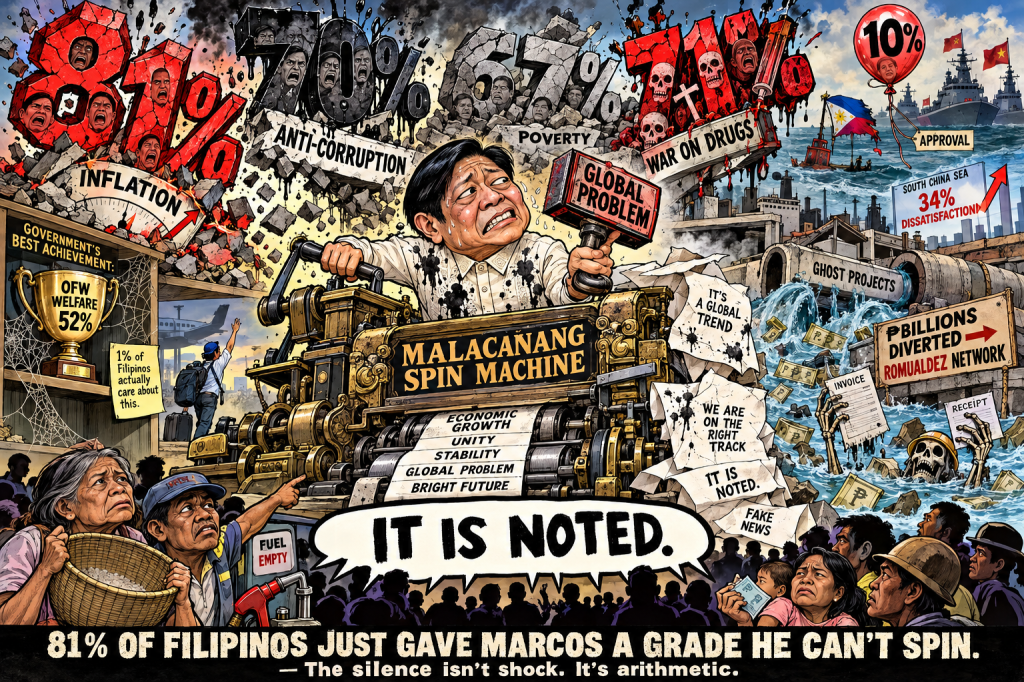
Inflation at 81%, corruption at 70%, poverty at 67%—the numbers are in, and the Palace’s spin machine just ran out of ink.
By Louis ‘Barok‘ C. Biraogo — October 19, 2026
THERE is a particular kind of silence that follows a survey like the one Pulse Asia dropped last week. It is not the silence of shock. It is the silence of a political class doing frantic arithmetic in its head, trying to figure out whether 81 percent disapproval on inflation is survivable, or whether it is the number that finally breaks the spell.
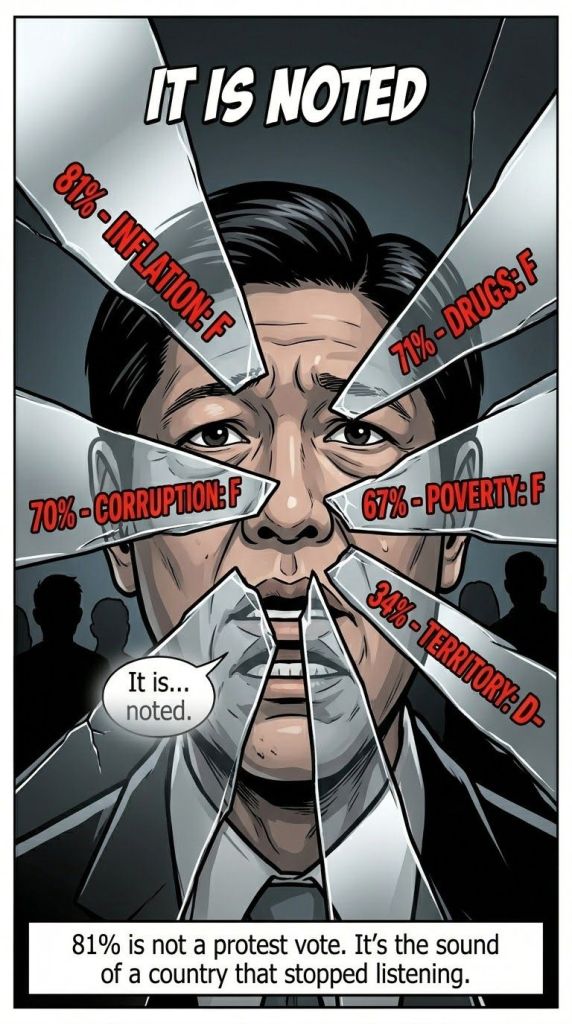
It’s the sound of a country that stopped listening.
And that sound?
It doesn’t go away.
It grows.
What the Pulse Asia Survey Found
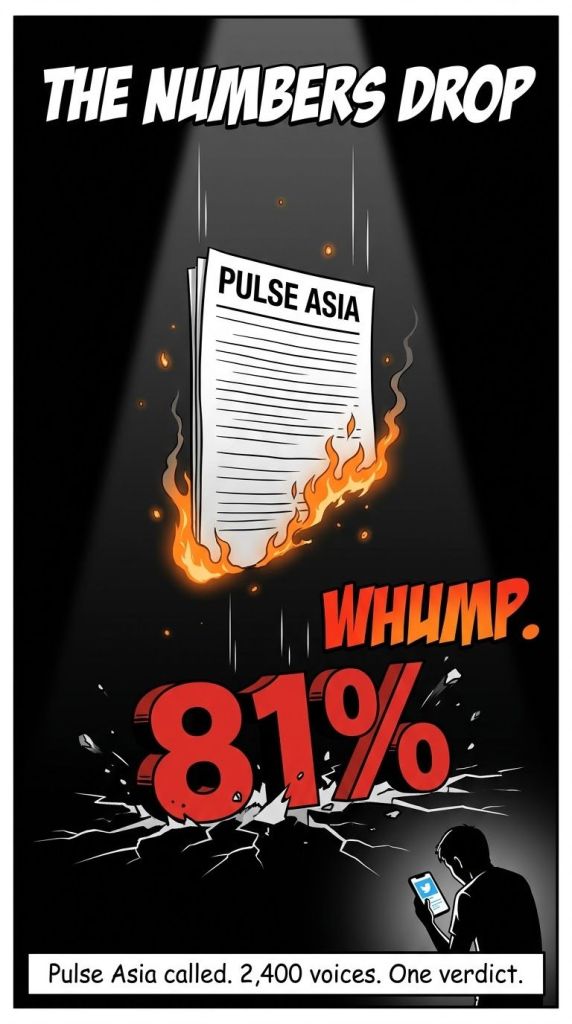
Let us be clear about what we are looking at. Pulse Asia interviewed 2,400 adults between September 17 and 24, and found that 81 percent of them disapprove of how this administration handles inflation. Only 10 percent approve. Ten. That is not a governing coalition. That is a rounding error.
But here is where the story becomes more interesting—and more damning—than the headline. The survey does not merely show dissatisfaction with prices. It shows a government that has lost the argument on virtually every front that matters to ordinary Filipinos.
Seventy-one percent disapprove on illegal drugs. Seventy percent on corruption. Sixty-seven percent on poverty. Fifty-seven percent on criminality, per the survey results.
The only issue where the administration manages majority approval is the welfare of overseas Filipino workers—at 52 percent—an issue that, as the Daily Tribune dryly notes, was cited as an urgent national concern by exactly 1 percent of respondents.
In other words, the government’s best-performing policy area is one that almost nobody is thinking about.
This is what a credibility collapse looks like. It is not a single scandal or a single failure. It is the slow, grinding realization among a majority of the population that the people in charge do not know what they are doing, or do not care, or both.
The Palace Defense vs. the Government’s Own Data
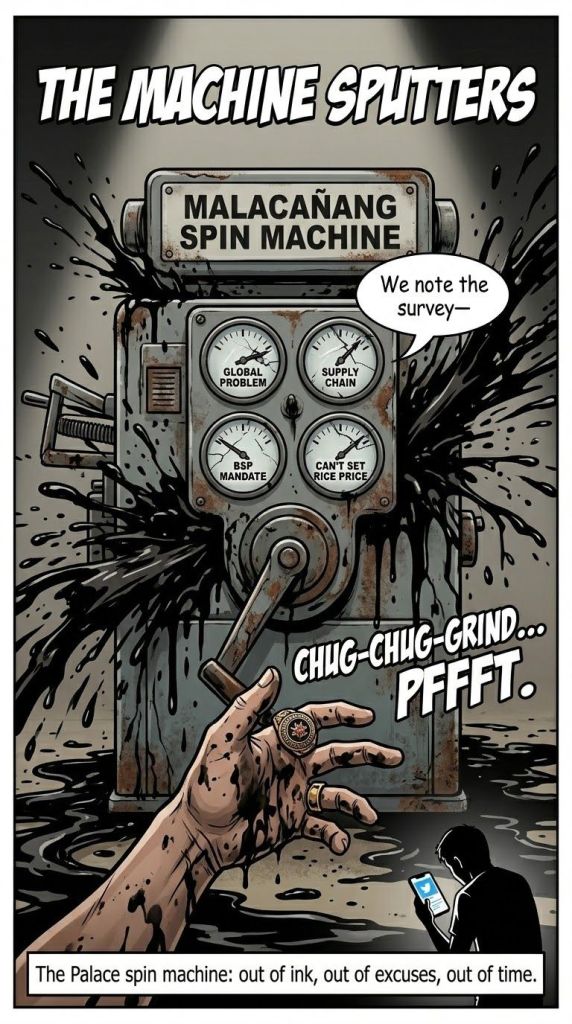
Now, the Palace will tell you—indeed, it already has, in various forms—that inflation is a global problem. That supply chains are disrupted. That the Bangko Sentral has its own mandate. That the President cannot personally set the price of rice. These are not lies. They are simply irrelevant to the question of whether the government has used the tools it actually has.
And here is where the numbers become genuinely damning. The Philippine Statistics Authority (PSA) reports that headline inflation hit 7.2 percent in September 2026, up from 1.7 percent a year earlier. Food inflation ran at 6.8 percent.
For the bottom 30 percent of households—the ones who spend most of their income on food and fuel—inflation was higher still. The government’s own data confirms the pain that the survey measures.
A Rice Crisis and Symbolic Governance
Yet the administration’s response has been a masterclass in the art of saying things that sound like action without actually being action. The President, who appointed himself Agriculture Secretary in a fit of symbolic governance, has presided over a rice crisis in which farmgate prices collapsed while retail prices soared.
The Department of Agriculture has distributed rice. The Kadiwa outlets have opened. The President has announced investigations into flood control corruption—corruption that, as my sources indicate, reaches into his own family’s political network.
Corruption and the Flood Control Scandal
This is the crux of the matter. The survey’s 70 percent disapproval on fighting graft is not an abstraction. It is a verdict on a government that promised to clean up the mess and instead found itself entangled in it.
The flood control scandal—ghost projects, billions diverted, a presidential cousin implicated—has done what years of opposition rhetoric could not: it has made the word “corruption” stick to this administration in a way that cannot be scrubbed off with press releases.
Territorial Defense: The Trend That Matters
And yet the most revealing number in the entire survey may be the one that is not about the economy at all. Dissatisfaction with the government’s handling of territorial defense rose from 24 percent to 34 percent. This is still a minority. But the trend matters.
The Filipino public, famously patient and famously forgiving, is beginning to notice that the South China Sea is not getting any less Chinese.
The Poverty Statistic and Its Limits
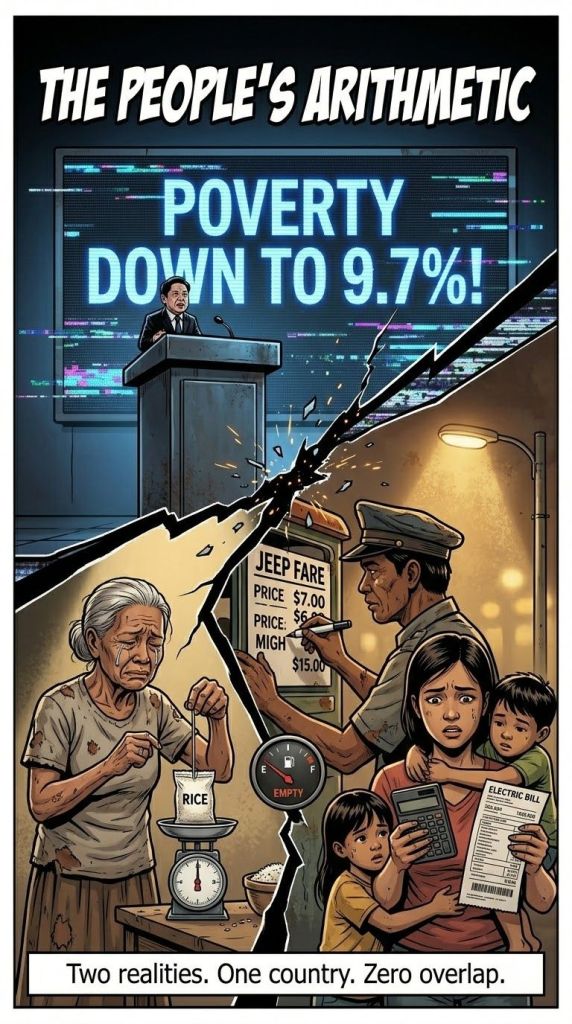
The administration’s defenders will point to the poverty statistics. And they have a point—or at least, they have a statistic. The PSA reported that poverty incidence fell to 9.7 percent in 2025, the lowest ever recorded. This is genuinely significant.
But here is the problem: the survey was conducted in September 2026. The poverty data is from 2025. In between, inflation doubled, growth slowed, and the cost of living became the dominant fact of daily life for millions of families.
A government that campaigns on its past statistics while its present collapses around it is a government that has run out of arguments.
Political Context: Duterte, Impeachment, and 2028
The political context makes this worse, not better. Vice President Sara Duterte’s approval rating sits at 54 percent, while the President’s is at 30 percent. The impeachment trial continues, with the prosecution narrowing its case to unexplained wealth—a strategic retreat that suggests even the opposition knows it needs a conviction, not a circus.
The President’s allies are quietly positioning themselves for 2028. The President’s critics are louder, but not necessarily stronger.
A Legitimacy Problem, Not a Communications Problem
What the survey reveals is not merely that the government is unpopular. It reveals that the government has lost the ability to persuade. When 81 percent of people disapprove of your handling of the single most important issue in their lives, you do not have a communications problem. You have a legitimacy problem.
The Palace’s response, predictably, has been to note the survey and move on. “It is noted,” a spokesman reportedly said. This is the language of a government that has stopped trying to convince and started trying to survive.
And perhaps that is the most honest thing they have said in months.
Warning or Verdict?
The question now is not whether this administration will recover. The arithmetic of Philippine politics suggests it will limp to 2028, diminished and defensive, while the opposition circles and the public seethes. The question is whether the institutions that are supposed to hold the government accountable—Congress, the courts, the media, the public itself—will treat this survey as a warning or as a verdict.
Because 81 percent is not a protest vote. It is not a partisan snapshot. It is not the product of a biased sample or a leading question. It is the sound of a country telling its government, in the clearest possible terms, that it is not working.
The government can ignore that sound. It has ignored worse. But the sound does not go away. It grows.
And eventually, it becomes something else entirely.
Key Citations
A. Reports & Studies
- Philippine Statistics Authority. “Consumer Price Index and Inflation Rate (September 2026).” Philippine Statistics Authority, 2026, psa.gov.ph/price-indices/cpi-ir.
- Philippine Statistics Authority. “GDP Grows by 2.3 Percent in the Second Quarter of 2026.” Philippine Statistics Authority, 2026, psa.gov.ph/content/gdp-grows-23-percent-second-quarter-2026.
- Philippine Statistics Authority. “2025 Official Poverty Statistics.” Philippine Statistics Authority, 2026, psa.gov.ph/statistics/poverty/node/1684084078.
- Anti-Money Laundering Council. “Press Release on Freeze Order (Flood Control Ghost Projects).” Anti-Money Laundering Council, Jan. 2026, amlc.gov.ph press release (PDF).
B. News Articles
- “81% Disapprove of Gov’t Handling of Inflation — Pulse Asia.” Daily Tribune, 15 Oct. 2026, tribune.net.ph.
- “Inflation Top Public Concern; 81% Disapprove of Marcos’ Handling of Prices, Survey Shows.” The Manila Times, 18 Oct. 2026, manilatimes.net.
- “NBI Recommends Criminal Raps vs DPWH, Private Firm Execs.” Philstar, 14 Oct. 2026, philstar.com.
- “Ombudsman Tags Martin Romualdez as ‘Mastermind’ of Flood Control Scam.” POLITIKO, 2026, politiko.com.ph.
- “The Week in Photos: October 10-16, 2026.” Rappler, 2026, rappler.com.
- “Week 15 Impeachment Wrap: Sara Trial Narrowed to 1 Charge, Defense Cries Foul.” VERA Files, 2026, verafiles.org.
- “Philippines Hits Back at Chinese Envoy Over ‘Thinly Veiled Threat’ of Force.” U.S. News & World Report, 15 Oct. 2026, usnews.com.
C. Official Websites
- Kweba ni Barok. kwebanibarok.com.
- Pulse Asia Research. pulseasia.ph.

- “Ang Hirap Maging Mahirap”: The PAO Scandal That Proves Government Contempt Is Nothing New

- “Far-Off” My Axx: Malacañang’s Claire Castro Drowns in Her Own Legal Gaslighting
- “Forthwith” to Farce: How the Senate is Killing Impeachment—And Why Enrile’s Right (Even If You Can’t Trust Him)
- “HINDI AKO NAG-RESIGN!”

- “I Know Nothing”: Baste Duterte’s Amnesia Defense Meets ₱33M in GenCorp Contracts

- “I’m calling you from my new Globe SIM. Send load!”

- “Mahiya Naman Kayo!” Marcos’ Anti-Corruption Vow Faces a Flood of Doubt

- “Manageable” Debt, Unmanageable Lies: DBM’s ₱21 Trillion Fairy Tale
- “Meow, I’m calling you from my new Globe SIM!”

- “Natrabaho”: One Word, One Ombudsman, and a Judiciary on Trial
- “No Special Jail for Crooks!” Boying Remulla Slams VIP Perks for Flood Scammers
- “Philippine-Controlled” or Yankee Gas Station? The Davao Fuel Depot Farce Exposed




Leave a Reply