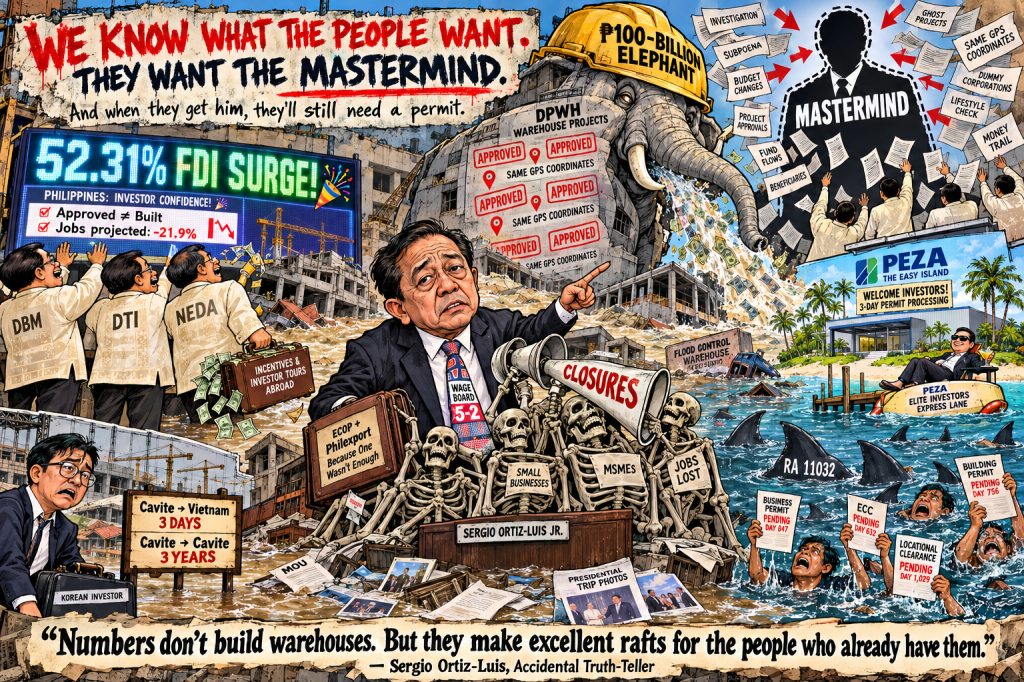
The Government Says Trust the Numbers. The Business Sector Says Numbers Don’t Build Warehouses.
By Louis ‘Barok’ C. Biraogo — October 19, 2026
IF YOU want to understand the Philippine investment climate in late 2026, you don’t need to read the Philippine Statistics Authority (PSA)’s FDI numbers or the Kearney Confidence Index or the World Bank’s growth projections.
You just need to listen to Sergio Ortiz-Luis Jr. describe what it feels like to wait for the government to do its job.
“We hear a lot of closures and a lot of issues with their operations,” the Employers Confederation of the Philippines (ECOP) president said in October, describing the state of micro and small businesses even before the latest wage hike. That’s bureaucratic euphemism for people are giving up.
Ortiz-Luis—who runs both ECOP and the Philippine Exporters Confederation, because apparently one organization representing the entire formal private sector wasn’t enough—has spent the better part of a year telling anyone who will listen that the Philippines is losing investors because the government can’t stop stepping on its own feet. It’s a simple thesis. It’s also almost certainly correct.
But here’s the thing about Ortiz-Luis: he’s not a disinterested observer. He’s the guy who, in the same October interview where he warned about business closures, also had to admit that ECOP “lost the wage board vote, 5-2” on the minimum wage increase. He’s a business lobbyist. His job is to complain about regulations, taxes, and labor costs. When he says the investment climate is terrible, you should ask: terrible for whom?
And yet.
The flood control scandal has made Ortiz-Luis’s complaints sound less like lobbying and more like prophecy. Which is a problem—not for him, but for the government that keeps insisting everything is fine.
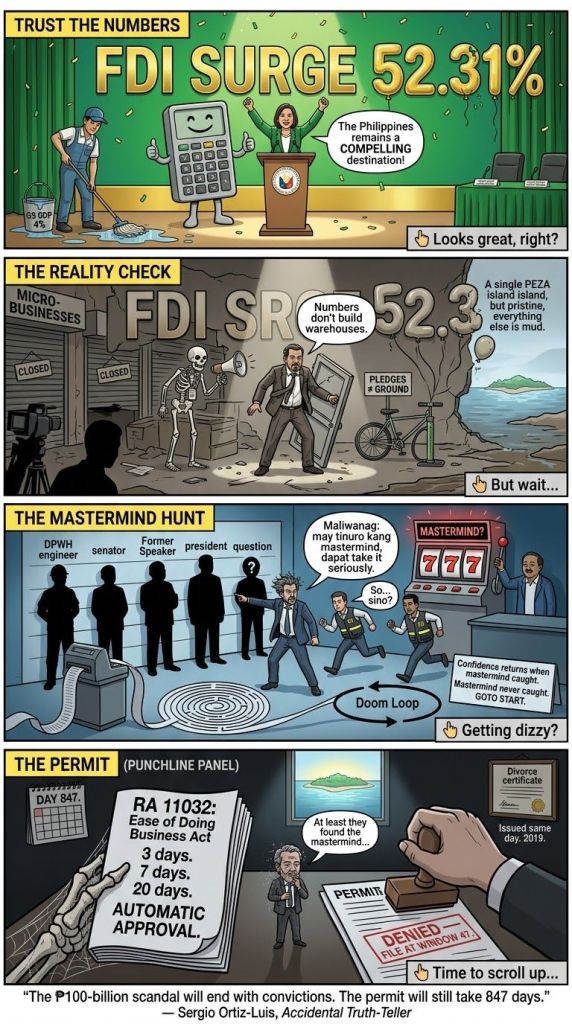
The ₱100-Billion Question Nobody Wants to Answer
Let’s review what we know. In October 2025, a joint statement from the Leaders Forum—ECOP, PCCI, Philexport, and three labor federations, which is basically the entire formal economy signing a letter—called the flood control scandal “the largest corruption scandal in the nation’s history”. That’s not a blog post. That’s a coalition of employers and workers agreeing that the government has a problem so severe it threatens the economic system.
By November, Ortiz-Luis was on radio saying the government should take Zaldy Co’s allegations seriously. Co, you’ll recall, is the former Ako Bicol representative who accused President Marcos and then-Speaker Romualdez of receiving suitcases of cash from budget insertions, then got used as a scapegoat. Ortiz-Luis’s response wasn’t to defend the administration. It was: we know what the people want. They want the mastermind.
“Maliwanag na ‘pag ikaw nagnakaw, may tinuro kang mga mastermind, dapat take it seriously,” he said in Filipino. Translation: if someone’s pointing fingers, you don’t get to ignore it just because the fingers are pointing up.
This is remarkable for a business leader in the Philippines, a country where the default position of the private sector toward political scandals is usually a carefully worded statement about “stability” and “confidence” that means absolutely nothing. Ortiz-Luis went further. He said the government’s deflection tactics—the widening of investigations to include other administrations, the political noise—were making the whole thing look partisan.
“Ang feeling tuloy ng iba, nagiging political o partisan,” he said. It’s starting to feel political and partisan. From the head of the Employers Confederation. About the administration’s anti-corruption drive. In an interview on a news channel that isn’t exactly known for radical leftism.
By December, ECOP was predicting sub-5% GDP growth for 2025, citing weak investor confidence. The third quarter had already come in at 4%, the slowest in over four years. Ortiz-Luis was openly calling for greater authority for the Independent Commission for Infrastructure (ICI), which the administration had created, presumably to demonstrate that it was doing something.
The pattern is hard to miss. Every time the government says “trust us, we’re handling it,” the business community says “actually, we’re not sure you are.” And every time the business community says that, the data gets a little worse.
The Audacity of ‘We’re Solving It’
Here’s where it gets interesting. Because the government has a counter-narrative, and it’s not entirely wrong.
The Philippine Statistics Authority (PSA) reported that approved foreign investments surged 52.31% in the first quarter of 2026, to ₱42.64 billion, with South Korea leading the charge. Trade Secretary Cristina Roque called it proof that the Philippines “remains a compelling destination for foreign investments.” Mitsubishi put an additional ₱44.5 billion into Ayala Corporation in October 2026, which the Department of Finance dutifully publicized as evidence of “continuing confidence in the Philippine economy.”
So which is it? Are investors fleeing or flocking?
The answer, as with most things in Philippine governance, is: both, depending on which number you cherry-pick. Approved investments are pledges, not money in the ground. The 21.9% year-on-year decline in projected jobs attached to Q2 2026 approvals is a cautionary signal. Mitsubishi’s investment is real, but it’s also a 52-year-old partnership with Ayala. It tells you that the largest conglomerates can still do deals. It tells you nothing about the mid-sized Korean manufacturer deciding between Cavite and Vietnam.
And Ortiz-Luis knows this. His distinction between “expressions of interest” and actual investment is the kind of thing you only say when you’ve watched too many presidential trips produce too many MOUs and too few factories.
The government’s response to the confidence problem has been, essentially, to point at the numbers and say “look, numbers.” Ortiz-Luis’s response has been: numbers don’t build warehouses.
The Mastermind Obsession
But here’s where I start to get suspicious. Not of Ortiz-Luis—of the entire discourse around the “mastermind.”
Ortiz-Luis has been consistent: the people want to know who’s behind the flood control scandal, and the government’s failure to identify a mastermind is itself a source of uncertainty. In November 2025, he said the business sector wanted “someone to be sued and jailed,” that Filipinos “need to see it addressed.”
It’s a reasonable position. It’s also a clever one. Because “find the mastermind” is a demand that can never be fully satisfied. If the government charges low-level DPWH engineers, it’s a whitewash. If it charges a senator, it’s political persecution. If it charges the president, well, we’re in a constitutional crisis. There is no mastermind identification that will make everyone happy, because the demand for a mastermind is really a demand for certainty—and certainty is the one thing Philippine politics never delivers.
Meanwhile, the actual governance problems that Ortiz-Luis identified in his October 2026 interview—permitting delays, policy unpredictability, the gap between RA 11032’s deadlines and actual practice—don’t get solved by finding a mastermind. They get solved by making the Anti-Red Tape Authority (ARTA) do its job. And nobody’s holding their breath on that.
So Ortiz-Luis is right that the mastermind question matters for confidence. But he’s also potentially creating a trap: if confidence depends on prosecuting the right person, and the right person is never prosecuted, then confidence never returns. That’s not a policy position. That’s a doom loop.
The PEZA Exception That Proves the Rule
Ortiz-Luis has praised PEZA as a model. He’s right to. PEZA-registered enterprises get one-stop shops, 3-7 day processing, and actual functioning systems. The problem is that PEZA is an island. Step outside the zone, and you’re back in the Philippines, where “easier to leave your wife than get a permit” is a joke that lands because it’s true.
The Ease of Doing Business Act—RA 11032—was supposed to fix this. It mandates 3-day processing for simple transactions, 7 for complex, 20 for highly technical. It has automatic approval mechanisms. It has ARTA. It has everything you need on paper.
And yet. Ortiz-Luis says implementation “remained problematic.” Which is the polite way of saying the law is a piece of paper and the bureaucracy is a machine that eats pieces of paper.
The Global Business Complexity Index ranks the Philippines 31st out of 81 jurisdictions—improved by five spots, but still the fifth most complex in East and Southeast Asia. That’s the country Ortiz-Luis is describing. Not a disaster. Not a miracle. A place where things are technically possible but practically exhausting.
The Suspicious Part
Here’s what I keep coming back to: why is a business lobbyist the most credible voice on governance in the Philippines right now?
Ortiz-Luis has no incentive to exaggerate the flood control scandal. ECOP’s members are the ones who have to deal with the consequences—the infrastructure failures, the policy uncertainty, the investors who don’t come. When he says “the business sector is prepared for the worst, hoping for the best,” that’s not a talking point. That’s a survival strategy.
But the fact that he’s credible doesn’t mean he’s right about everything. His wage position—regional boards over legislated increases, P50-60 over the board’s decision—is standard employer advocacy. His complaint about PhilHealth’s fund transfers reflects employer interest in keeping contribution costs down. He’s not an oracle. He’s a guy with a very specific set of interests, who happens to be saying things that happen to be true.
And that’s the real scandal here. Not that the business community is complaining. That the government has made it so easy for them to be right.
The flood control scandal is real. The Ombudsman has filed plunder and graft cases. The NBI has found projects funded five times under different titles with the same coordinates. A single contractor got ₱7 billion in flood control projects in one Davao district. These aren’t allegations from a blog. These are findings from the agencies that are supposed to be catching this stuff.
The policy unpredictability is real. The CREATE Act became CREATE MORE. Mining policies shift. POGO bans create stranded assets. Ortiz-Luis’s claim that the Philippines is “the only one in the region changing policies while investors are investing” is hyperbole, but it’s the kind of hyperbole that emerges when you’ve watched your competitors in Vietnam and Thailand eat your lunch for a decade.
The permitting delays are real. RA 11032 exists. The deadlines exist. The automatic approval mechanisms exist. And yet the joke about divorce lands.
The Uncomfortable Conclusion
Sergio Ortiz-Luis is not a revolutionary. He’s not a reformer. He’s a business lobbyist doing his job—which is to say, advocating for the interests of employers, sometimes against workers, sometimes against consumers, sometimes against the government.
But in 2026, his job has made him the accidental conscience of Philippine governance. Because the things he’s complaining about—the uncertainty, the corruption, the delays, the mastermind who never materializes—are things that hurt everyone. Workers. Consumers. Investors. Citizens. The only people who benefit are the ones who’ve figured out how to profit from the chaos.
The government’s response has been to point at the FDI numbers and say “look, growth.” The numbers are real. But so is the fact that GDP growth was 4% in Q3 2025. So is the fact that projected jobs attached to approved investments fell 31.9% year-on-year. So is the fact that the Philippines is still the fifth most complex jurisdiction for business in East and Southeast Asia.
The flood control scandal will eventually produce convictions. Someone will be found guilty. Maybe a senator. Maybe a former secretary. Maybe some engineers. The mastermind, if one exists, will either be charged or the case will fade into the long list of Philippine corruption scandals that were “investigated” and then forgotten.
And when that happens, the investors who left won’t come back because a court ruled. They’ll come back when the permit takes three days, not six months. When the policy doesn’t change every time a new administration takes office. When the infrastructure works.
Ortiz-Luis knows this. He’s been saying it for years. The fact that anyone is still surprised says less about him and more about us.
Key Citations
A. Reports & Studies
- Philippine Statistics Authority. “Approved Investment from Foreign and Filipino Nationals First Quarter 2026.” PSA.gov.ph, 2026, https://psa.gov.ph/statistics/foreign-investments.
- Philippine Statistics Authority. “Approved Investment Infographics Q1 2026.” PSA.gov.ph, 2026, https://psa.gov.ph/sites/default/files/infographics/Infographics%20Approved%20Investment%20Q1%202026.pdf.
- Kearney. “The 2026 Kearney Foreign Direct Investment Confidence Index.” Kearney, 2026, https://www.kearney.com/service/global-business-policy-council/foreign-direct-investment-confidence-index/2026-full-report.
- TMF Group. “Global Business Complexity Index 2026.” TMF Group, 2026, https://www.tmf-group.com/en/news-insights/publications/global-business-complexity/.
B. News Articles
- “ECOP warns corruption scandal hurting investor confidence.” Daily Tribune, 8 Nov. 2025, https://tribune.net.ph/2025/11/08/ecop-warns-corruption-scandal-hurting-investor-confidence.
- “ECOP: Take Zaldy Co seriously.” PressReader, Nov. 2025, http://www.pressdisplay.com/pressdisplay/iphone/dhn.aspx?zone=waarticle4dc36896-10bc-44c8-b15b-3ddfdadb5d98.
- Dacanay, Niko. “Biz group says gov’t should take Zaldy Co’s accusations seriously, identify mastermind.” News 5, 18 Nov. 2025, https://news.tv5.com.ph/breaking/read/biz-group-says-govt-should-take-zaldy-cos-accusations-seriously-identify-mastermind.
- “ECOP hopes for better new year after a ‘disappointing’ 2025.” Daily Tribune, 20 Dec. 2025, https://tribune.net.ph/2025/12/20/ecop-hopes-for-better-new-year-after-a-disappointing-2025.
- “34 business groups urge ‘swift’ investigation on flood control scandal.” Manila Shimbun, 21 Oct. 2025, https://manila-shimbun.com/ja/column/opinions/news291213.html.
- San Juan, Andrea E. “Swift conviction of culprits in flood control projects mess to ‘reverse’ slide.” BusinessMirror, 23 Nov. 2025, https://businessmirror.com.ph/2025/11/23/swift-conviction-of-culprits-in-fcp-mess-to-reverse-slide/.
- “Employers: Ditch Congress, let wage boards handle pay hikes.” Manila Bulletin, 21 June 2025, https://mb.com.ph/2025/06/21/employers-ditch-congress-let-wage-boards-handle-pay-hikes.
- “Business, labor groups press full accountability in flood control fund scandal.” Daily Tribune, 20 Sept. 2025, https://tribune.net.ph/2025/09/20/business-labor-groups-press-full-accountability-in-flood-control-fund-scandal.
- “Ombudsman: How the flood-control money reached Romualdez.” The Manila Times, 16 Sept. 2026, https://www.manilatimes.net/2026/09/16/opinion/columns/ombudsman-how-the-flood-control-money-reached-romualdez/2425746.
- “Employers group hopes for investor recovery in 2026.” BusinessWorld Online, 22 Dec. 2025, https://bworldonline.com/top-stories/2025/12/22/720253/employers-group-hopes-for-investor-recovery-in-2026/.
- “Employers group expresses hope for better economic growth in 2026.” Manila Standard, 20 Dec. 2025, https://manilastandard.net/business/314683241.
- “ECOP urges lawmakers: Stop passing damaging wage hike laws.” Daily Tribune, 3 Jan. 2026, https://tribune.net.ph/2026/01/03/ecop-urges-lawmakers-stop-passing-damaging-wage-hike-laws.
- “Former Philippine Rep Zaldy Co denies getting kickbacks, says funds only passed through him.” The Star, 24 Nov. 2025, https://www.thestar.com.my/aseanplus/aseanplus-news/2025/11/24/former-philippine-rep-zaldy-co-denies-getting-kickbacks-says-funds-only-passed-through-him.
- San Juan, Andrea E. “ICI must have full power to expose wrongdoing, say Leaders’ Forum.” BusinessMirror, 15 Sept. 2025, https://businessmirror.com.ph/2025/09/15/ici-must-have-full-power-to-expose-wrongdoing-say-leaders-forum/.
- “ECOP hopes PBBM veto proposed P200 daily wage hike.” Manila Standard, 4 June 2025, https://manilastandard.net/news/top-stories/314599122/ecop-hopes-pbbm-veto-proposed-p200-daily-wage-hike.html.
C. Legal & Official Sources
- Independent Commission for Infrastructure. “ICI Live Streaming Guidelines.” Official Gazette, 21 Nov. 2025, https://mirror.officialgazette.gov.ph/downloads/2025/10oct/20251121-ICI_Guidelines_for_Live_Streaming.pdf.
- Department of Public Works and Highways. “Department Memorandum Circular No. 064, s. 2025.” DPWH.gov.ph, 2 Oct. 2025, https://dpwh.gov.ph/dpwh/sites/default/files/issuances/dmc_064_s2025.pdf.
- Republic of the Philippines. “Republic Act No. 11032.” Official Gazette, 28 May 2018, https://www.officialgazette.gov.ph/2018/05/28/republic-act-no-11032/.
- Department of Finance. “Mitsubishi’s additional PHP44.5-billion in Ayala Corp. to strengthen PH industries, boost opportunities.” DOF.gov.ph, 11 Oct. 2026, https://www.dof.gov.ph/mitsubishis-additional-php44-5-billion-in-ayala-corp-to-strengthen-ph-industries-boost-opportunities/.
- Philippine Economic Zone Authority. PEZA, https://www.peza.gov.ph/.





Leave a Reply