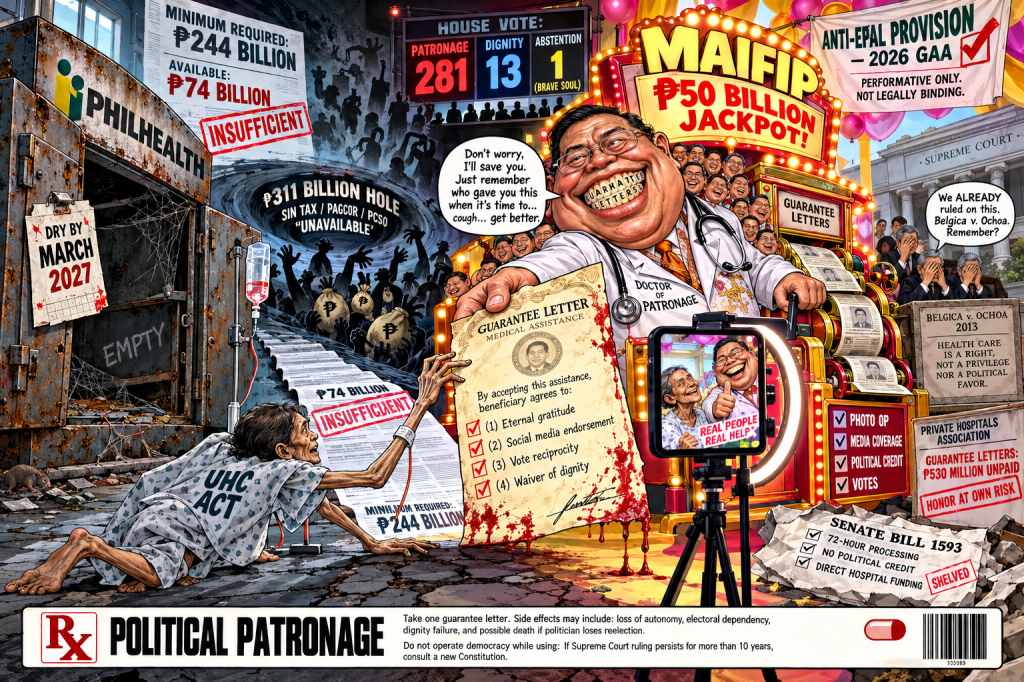
The House doubled the MAIFIP pork barrel to P50 billion while slashing PhilHealth to a level that runs dry by March 2027—because nothing says ‘universal healthcare’ like a guarantee letter and a politician’s selfie.
By Louis ‘Barok’ C. Biraogo — October 19, 2026
CALL me naive, but I thought healthcare funding was supposed to heal people, not politicians’ careers. The House of Representatives, in its infinite wisdom, by a vote of 281 to 13, with one brave soul abstaining, looked at the Philippine healthcare system and decided the solution was to double the budget for political favor-dispensing. At the same time, it slashed the actual health insurer to a level that will run dry by March 2027.
If that sounds like a satire of governance, congratulations. You’ve been paying attention.
The Medical Assistance for Indigent and Financially Incapacitated Patients (MAIFIP), for those who prefer their pork barrel with an acronym, has been quietly transformed from a modest safety net into a P50-billion patronage machine in the Fiscal Year (FY) 2027 budget.
Meanwhile, the Philippine Health Insurance Corporation (PhilHealth), the agency legally mandated by the Universal Health Care (UHC) Act to be the primary payer, gets P74 billion against a minimum requirement of P244 billion. That’s not a funding gap. That’s a P170-billion chasm deliberately engineered to keep patients begging at politicians’ doorsteps.
The “Epal Fund” by Any Other Name
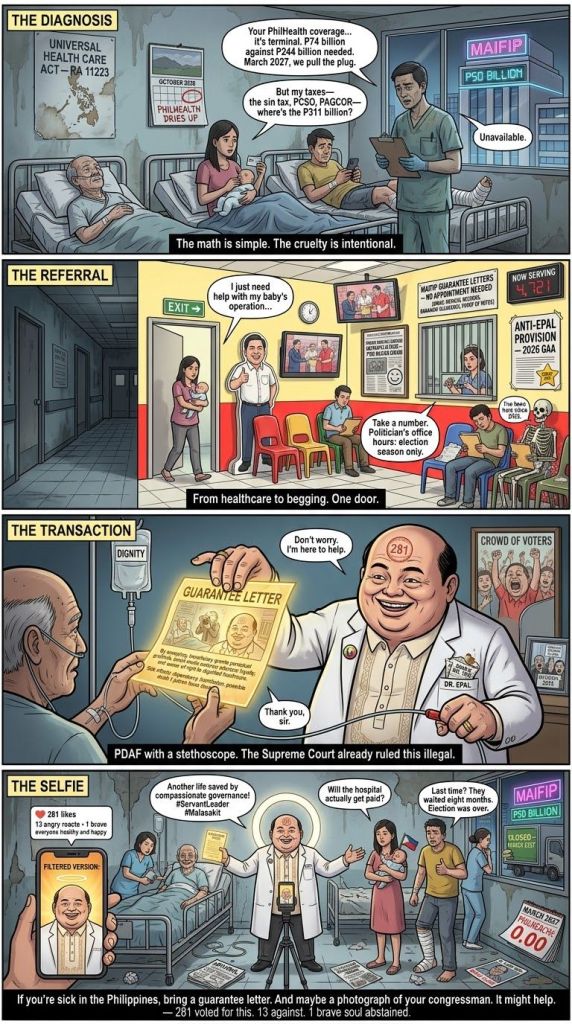
Dr. Antonio Dans, convenor of the Healthcare Professionals Alliance, called MAIFIP exactly what it is: an “epal fund”. For the uninitiated, “epal” is Filipino slang for someone who inserts themselves where they don’t belong. Think of the colleague who photobombs every group shot, or the neighbor who claims credit for your new fence. In this case, it’s the politician who hands you a guarantee letter for your chemotherapy and expects you to remember it come election time.
The mechanism is beautifully, grotesquely simple:You get sick. You need money. You go to a politician’s office. You beg. If you’re lucky, or connected, or related, or useful, you get a guarantee letter. You take it to the hospital. The hospital treats you, then waits months for reimbursement that may never come.
In July 2025, the Private Hospitals Association of the Philippines suspended honoring these letters entirely after unpaid balances hit P530 million. Hospitals were also wary of honoring letters from officials who lost the May midterm elections, because apparently your healthcare coverage depends on whether your patron still has a job.
Let that sink in. Your dialysis session is contingent on an election result.
The Supreme Court Already Said This Was Illegal
Here’s the part that should make your blood pressure spike: we’ve done this before. In Belgica v. Ochoa (2013), the Supreme Court struck down the Priority Development Assistance Fund (PDAF), the original pork barrel, because it allowed legislators to exercise post-enactment control over budget execution. Legislators were picking projects, directing funds, and claiming credit. The Court called it unconstitutional.
MAIFIP is PDAF with a stethoscope. The guarantee letter is the new project endorsement. The politician identifies the beneficiary, influences the release, and takes the credit. The Supreme Court’s language in Belgica applies with almost eerie precision: this system allows legislators “to wield, in varying gradations, non-oversight, post-enactment authority in key areas of budget execution.”
In December 2025, the Supreme Court, unanimously, no less, smacked down the government’s attempt to raid P89.9 billion from PhilHealth’s reserves. It declared that the transfer violated the UHC Act and the Sin Tax Law. The Court was explicit: PhilHealth’s reserves are “pooled resources for social health insurance,” not a slush fund for the National Treasury. Congress cannot use the General Appropriations Act (GAA) to repeal substantive law by stealth.
So what did Congress do? It found a different slush fund. If you can’t raid PhilHealth, starve it. If you can’t legally steal the reserves, redirect the earmarked revenues.
The P311 billion in sin tax, Philippine Amusement and Gaming Corporation (PAGCOR), and Philippine Charity Sweepstakes Office (PCSO) funds that should have flowed to PhilHealth since 2022? Withheld, unappropriated, or otherwise “unavailable”. The government has been gaslighting the public about “excess reserves” while failing to appropriate the legally mandated revenues that would have made those reserves unnecessary.
The Bong Go Problem (And It’s Not Just Him)
Senator Bong Go’s Malasakit Centers, institutionalized under Republic Act (RA) 11463, are his signature achievement, his political brand, and his face on every poster in every provincial hospital lobby. The centers do provide genuine assistance. They also provide genuine electoral infrastructure. Every patient who walks out with a guarantee letter knows exactly whose name is on the program.
But here’s the thing: Go isn’t the only beneficiary. The 281-13 vote in the House tells you everything you need to know about the breadth of the patronage network. Mayors, governors, congressmen, even barangay chairpersons have been issuing guarantee letters.
The system has metastasized beyond any single politician. It’s now institutionalized patronage: a bipartisan, bicameral, multi-level apparatus for converting public health money into political capital.
The 2026 GAA included an “anti-epal” provision supposedly banning political involvement in aid distribution. Then Health Secretary Teodoro Herbosa promised guarantee letters would no longer be necessary. And yet, here we are in October 2026, with the House voting to double the MAIFIP budget for 2027. The anti-epal provision was either ineffective, performative, or both. Color me shocked.
Senate Bill 1593: The Actual Solution Congress Is Ignoring
There is a bill sitting in the Senate—Senate Bill No. 1593, the Universal Health Care Medical Assistance Program Act, principally authored by Sen. Ping Lacson—that would actually fix this. It would consolidate MAIFIP into a rules-based system:
- Direct hospital funding
- Applications through medical social workers
- A 72-hour processing deadline
- An explicit prohibition on political involvement or credit-claiming
It has been backed by three Senate committees. Senator Risa Hontiveros is pushing for its passage. Senator Ping Lacson authored it.
It is, in other words, exactly what the 72 healthcare organizations have been demanding. And it is not what the House budget prioritizes.
The choice is stark. You can have a system where a patient walks into a hospital, applies to a social worker, and receives assistance within three days based on medical and financial criteria. Or you can have a system where the same patient must first secure the blessing of a politician whose willingness to help is calibrated to electoral advantage.
The House chose the latter. By a vote of 281 to 13.
The P311 Billion Question Nobody Wants to Answer
Let’s talk about the money that should be there. The Sin Tax Reform Law (RA 10351) and its amendments, including RA 11346, earmark specific revenues for health. The UHC Act mandates that premium subsidies for indirect contributors be “included annually in the GAA” and “released directly to PhilHealth.” These aren’t discretionary suggestions. They are legal obligations.
Yet approximately P311 billion in earmarked revenues remain withheld, unappropriated, or otherwise unaccounted for since 2022. The Department of Budget and Management, the Department of Finance, PhilHealth, PCSO, PAGCOR: all of them have the records. None of them have produced a clean, reconciled, fiscal-year-by-fiscal-year accounting of what was collected, what was legally due, what was appropriated, what was released, and what actually reached patients.
Instead, we get headlines about MAIFIP doubling. We get politicians posing with patients. We get hospitals refusing to honor guarantee letters because the government hasn’t paid its bills. And we get PhilHealth, the agency that is supposed to be the foundation of universal healthcare, being slowly asphyxiated.
The Supreme Court already ruled that budget riders cannot be used to gut the UHC Act. The Court already ordered the return of P60 billion in improperly transferred reserves. The legal architecture to fix this exists. What’s missing is the political will to stop feeding the patronage machine.
What Happens When PhilHealth Runs Out of Money?
Projections cited by the healthcare coalition suggest that the P74 billion allocation will be exhausted by March 2027. After that, what? Hospitals that haven’t already stopped accepting PhilHealth patients will face delayed reimbursements. Patients will be pushed further toward out-of-pocket spending, the exact catastrophic health expenditure that UHC was designed to eliminate.
The poor will do what they always do: borrow, sell assets, delay treatment, die.
And the politicians will be there, guarantee letters in hand, ready to help. For a price. Not a cash bribe, necessarily; nothing so crude. The price is gratitude. The price is visibility. The price is a vote.
Dr. Dans put it best: “This is not just a legal failure. It is a moral failure.” A system that requires a sick person to beg a politician for the money to stay alive is not a healthcare system. It is a feudal arrangement dressed up in budget language.
The 2027 Budget Battle Is Not Over
The House has passed its version. The Senate is now deliberating. The healthcare organizations have made their case. The Supreme Court has established the legal boundaries.
The question is whether the Senate will have the courage to do what the House refused:
- Restore PhilHealth’s funding to the P244 billion minimum
- Transfer MAIFIP’s functions to a rules-based program
- Release the P311 billion in withheld earmarked revenues
I’m not holding my breath.
The 281-13 vote tells you where the institutional incentives lie. The doubling of MAIFIP tells you what the majority actually values. And the silence on the P311 billion tells you that nobody in power wants to explain where the money went.
If you’re sick in the Philippines, bring a guarantee letter. And maybe a photograph of your congressman. It might help.
Key Citations
A. Legal & Official Sources
- Republic of the Philippines. Republic Act No. 11223, Universal Health Care Act. 20 Feb. 2019. Official Gazette, officialgazette.gov.ph/2019/02/20/republic-act-no-11223.
- Republic of the Philippines. Republic Act No. 10351, Sin Tax Reform Law. 2012. Official Gazette, officialgazette.gov.ph/2012/12/19/republic-act-no-10351.
- Republic of the Philippines. Republic Act No. 11346. 2019. Supreme Court E-Library, elibrary.judiciary.gov.ph/thebookshelf/showdocs/2/92803.
- Republic of the Philippines. Republic Act No. 11463, Malasakit Centers Act. 3 Dec. 2019. Supreme Court E-Library, elibrary.judiciary.gov.ph/thebookshelf/showdocs/2/92793.
- Philippines, Congress, Senate. Senate Bill No. 1593: An Act Establishing the Universal Healthcare Medical Assistance Program, Integrating Therewith the Medical Assistance to Indigent and Financially Incapacitated Persons Program, and Providing Funds Therefor. 20th Congress, 10 Dec. 2025. Senate of the Philippines, senate.gov.ph/legislative-documents/bills/612917?congress=20th%20Congress.
- Supreme Court of the Philippines. Belgica v. Ochoa. G.R. No. 208566, 19 Nov. 2013. LawPhil, lawphil.net/judjuris/juri2013/nov2013/gr_208566_2013.html.
- Caguioa, Alfredo Benjamin S. Separate Opinion. G.R. No. 274778, Dec. 2025. Supreme Court of the Philippines, sc.judiciary.gov.ph/wp-content/uploads/2025/12/274778-CAGUIOA.pdf.
B. News Articles
- “Groups Hit Proposed MAIFIP Increase, Seek Bigger PhilHealth Budget.” Inquirer.net, 5 Oct. 2026, newsinfo.inquirer.net/2318720/groups-hit-proposed-maifip-increase-seek-bigger-philhealth-budget/amp.
- “Health Groups to Lawmakers: Increase PhilHealth Budget, Not MAIFIP Funding.” Rappler, 5 Oct. 2026, rappler.com/philippines/health-groups-ask-lawmakers-increase-philhealth-2027-budget.
- “Sin Tax Coalition Bares MAIFIP’s Hike from PhP24 Billion to PhP49 Billion.” Mabuhay News, 6 Oct. 2026, mabuhaynews.net/sin-tax-coalition-bares-maifips-hike-fromfrom-php24-billion-to-php49-billion.
- “72 Medical Groups Want Health ‘Pork’ Scrapped.” Philstar.com, 17 Dec. 2025, philstar.com/headlines/2025/12/17/2494856/72-medical-groups-want-health-pork-scrapped.
- “Lacson Welcomes 2026 Budget Safeguards.” Metro News Central, 18 Dec. 2025, pasig.metronewscentral.net/in-and-around-the-metro/lacson-welcomes-2026-budget-safeguards.
- “Resolusyong Naglalayong Paigting ang Pagbabawal sa Pagtanggap ng Guarantee Letter mula sa Politiko, Inihain sa Senado.” Brigada.ph, brigada.ph/articles/read/resolusyong-naglalayong-paigting-ang-pagbabawal-sa-pagtanggap-ng-guarantee-letter-mula-sa-politiko-i_18773.html.

- ₱9 Billion in ‘Savings’? DILG’s Fire Truck Deal Smells Like Smoke
- ₱8B BBM Pork: CCTV for Every Captain’s Kumpare?
- ₱8.9 Billion, 331 Ghost Police Stations: The TIKAS Scandal Explained

- ₱8.4 Billion, 42,000 Barangays, 1 Election: The “Bawat Barangay Makikinabang” Vote-Buying Masterclass

- ₱75 Million Heist: Cops Gone Full Bandit

- ₱6.77B Ghost Haunts Duterte: RTC Dismisses Mans Carpio’s Desperate Plea
- ₱6.77 Billion and Zero Cash: The Sara Duterte SALN Math That Doesn’t Add Up

- ₱6.7-Trillion Temptation: The Great Pork Zombie Revival and the “Collegial” Vote-Buying Circus

- ₱58.53B, Zero Receipts: The LGSF Pork Barrel Nobody Wants to Name
- ₱53 Million Man Tells ₱695-a-Day Workers to Stop Being ‘Mayabang’: The Audacity of BSP’s Remolona
- ₱4.4 Billion and a Witness Who Can’t Explain It: The Duterte Impeachment’s Most Expensive Non-Answer
- ₱3.06 Billion for Evacuation Centers—But Nobody Knows Where They’ll Stand (Or If They’ll Exist)




Leave a Reply