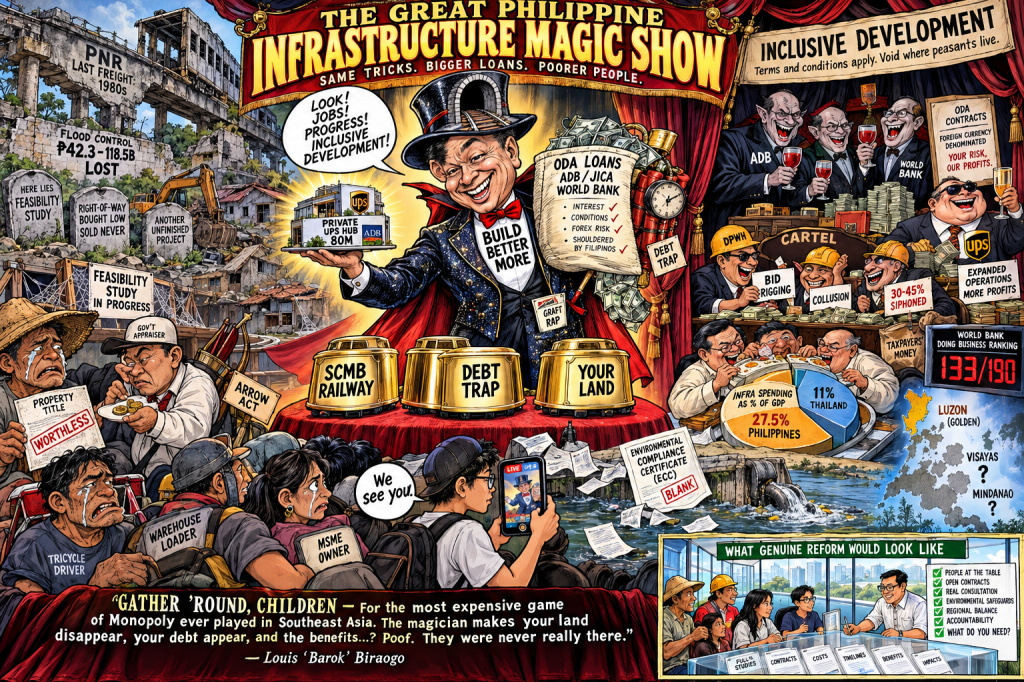
The DPWH Has a Corruption Problem, the DOTr Has a Graft Rap, and You Have a Property Title
By Louis “Barok” C. Biraogo | October 20, 2026
GATHER ’round, children, and let me tell you a story about the most expensive game of Monopoly ever played in Southeast Asia. The government has announced—with the requisite fanfare, ribbon-cutting, and photo opportunities—that it will finally tackle the Philippines’ logistics costs, currently sitting at a breathtaking 27.5% of Gross Domestic Product (GDP).
That’s not a typo. That’s not a rounding error. That’s nearly a third of everything this country produces being burned on the altar of moving things from Point A to Point B. Thailand does it at 11%, per the World Bank Logistics Performance Index. Thailand. The country that gave us pad thai and political coups but apparently also functional freight rail.
And how, you ask, will our intrepid officials solve this? Why, by building a railway, of course! The Subic-Clark-Manila-Batangas (SCMB) Railway, no less—a freight corridor so ambitious it requires a Swedish grant just to study it. Because nothing says “fiscal responsibility” like needing foreign aid to figure out if your train set makes economic sense.
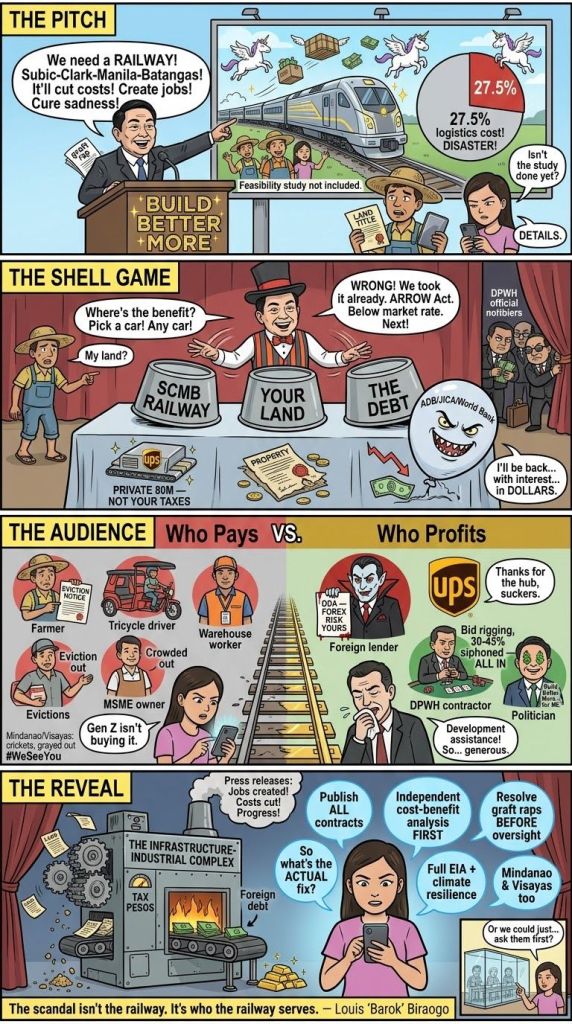
The UPS Hub: A Masterclass in Misdirection
Let’s start with the good news, shall we? The United Parcel Service (UPS) opened its expanded Clark International Air Hub on October 15, 2026. It’s an $80 million private investment—mark that, private, as in not your tax pesos—covering 30,000 square meters, processing 46,000 packages daily, and creating nearly 600 jobs.
Now, dear reader, here’s the sleight of hand. The government has been more than happy to attach itself to this announcement like a remora to a shark, presenting it as evidence of their logistics strategy bearing fruit. But UPS built this hub. UPS paid for it. UPS operates it. The government’s contribution appears to be showing up for the inauguration and taking credit.
Meanwhile, the same government that’s celebrating 600 UPS jobs has yet to explain how many of those positions are full-time, benefited, union-protected roles versus the kind of “flexible” employment arrangements that make human resources (HR) departments giggle with delight. The press release says “jobs created.” It doesn’t say “living wage jobs.” These are very different things.
And here’s the question nobody in the room seems to be asking: If UPS can build a world-class cargo facility with private capital, why does the government need to borrow billions from foreign lenders for the SCMB Railway? What exactly is the market failure here that requires public intervention? Is it the railway itself, or is it the opportunity for certain well-connected individuals to benefit from a ₱multi-billion procurement exercise?
I’m just asking questions. That’s what journalists do.
The Railway: A Study in How to Study Things
The SCMB Railway is described as the “backbone” of the Luzon Economic Corridor. It will connect Subic, Clark, Manila, and Batangas. It will reduce logistics costs. It will attract investment. It will create jobs. It will probably also cure cancer and bring about world peace, if the government’s promotional materials are to be believed.
But here’s the thing about railways: they cost money. A lot of money. And then they cost more money. And when you’re done spending money, you need to spend more money to keep them running.
The Philippines has no current commercial freight rail industry—a distinction unique among Association of Southeast Asian Nations (ASEAN) members—and the government wants us to believe they’ll get this right on the first try. Never mind that the country’s last freight operations sputtered out decades ago, that the PNR system is passenger-oriented and chronically underfunded, and that the proposed SCMB Railway is a 198–250 km leap into territory no Philippine administration has successfully navigated. Call me skeptical. Call me cynical. Call me someone who’s watched too many Philippine infrastructure projects devolve from “nation-building” to “come-back-next-year-building.”
The feasibility study isn’t even done yet. Let me repeat that for the people in the back: The feasibility study isn’t done yet. The government is promoting a project it hasn’t finished evaluating. This is like announcing your wedding date before you’ve met the bride.
The project update from July 2026 mentions that “right-of-way work” is continuing. Translation: they’re already acquiring land for a railway that may or may not make economic sense. If that doesn’t give you a warm, fuzzy feeling about due process, I don’t know what will.
Right-of-Way: Or, How to Take My Land at Below-Market Rates
Speaking of right-of-way, let’s talk about Republic Act No. 12289, the ARROW Act (not to be confused with the 2016 Right-of-Way Act it amended, because we apparently need a new acronym every five years to keep the lawyers employed). Critics have described it as a “take-it-or-leave-it” approach that weakens property rights.
The Constitution is clear: “Private property shall not be taken for public use without just compensation.” The Supreme Court has repeatedly emphasized that just compensation must be “real, substantial, full, and ample”—language found in cases such as Land Bank of the Philippines v. Spouses Orilla and National Power Corporation (NPC) v. YCLA Sugar Development Corporation. In Secretary of the Department of Public Works and Highways (DPWH) v. Spouses Tecson, the Court went further, holding that when the government takes property without initiating expropriation proceedings, it must pay not only the value at the time of taking but also legal interest of six percent per annum from the time of taking until full payment.
And yet, landowners along the proposed corridor are being offered valuations that would make a barangay assessor blush. If they refuse, they’re forced to litigate—a process that can take years and cost more than the compensation they’re fighting for. This isn’t expropriation with just compensation; it’s extortion with legal window dressing.
But hey, at least the government is consistent. They consistently undervalue your property whether it’s for a railway, a road, or a flood control project that will be washed away in the next typhoon anyway.
The DPWH: An Institution with a Reputation
It is an open secret—the kind of secret that everyone knows but nobody wants to say on the record—that the Department of Public Works and Highways (DPWH) has “consistently suffered from a poor public image” as one of the most corrupt agencies in the country. A recent flood control scandal involved ₱42.3–118.5 billion in annual losses. That’s not a typo either. That’s not even a rounding error. That’s a scandal on a scale that would topple governments in any other country.
The World Bank’s National Road Improvement and Management Program Phase 1 (NRIMP-1) cartel case saw 30-45 million of a 150 million loan siphoned off through “institutionalized cartel” behavior—collusive tendering, bid rigging, price fixing. This isn’t speculation; this is documented history.
And this is the agency that will be handling procurement for the SCMB Railway’s supporting infrastructure, land acquisition, and construction oversight, under the New Government Procurement Act.
If you’re feeling confident about this arrangement, you’re probably also confident that the Philippine customs service will clear your shipment in under five days (it averages eight to nine, versus Thailand’s one to five). And that local government units (LGUs) won’t impose arbitrary pass-through fees. And that the Bureau of Customs won’t find new and creative ways to delay your cargo.
But wait, there’s more!
Meet Your Transportation Secretary: A Man Under Investigation
Department of Transportation (DOTr) Secretary Giovanni Lopez is currently facing a graft rap over Land Transportation Office (LTO) “computer fees” that have allegedly accumulated ₱2-3 billion annually since 2013. He’s been reinstated under the current administration and is now the face of the logistics cost-cutting initiative. Nothing says “good governance” like a cabinet secretary under investigation for corruption overseeing multi-billion peso infrastructure projects.
It’s like putting a fox in charge of the henhouse, but the fox has also been accused of stealing eggs, and the eggs are made of money, and the henhouse is on fire.
Now, in fairness, Secretary Lopez has not been convicted of anything. He is presumed innocent. But the presumption of innocence is different from the presumption of competence, and it’s certainly different from the presumption of good judgment.
If I were the President, I might have thought twice before giving this particular portfolio to someone with this particular legal cloud hanging over his head. But I’m not the President, and the President apparently doesn’t think twice about these things.
Or he does think twice, and then does it anyway, which is worse.
The Beneficiaries: Who Exactly Is This For?
Let’s play a game. For every promised benefit of the logistics initiative, I’ll tell you who actually benefits.
Claim: “Reduce logistics costs for businesses.”
Reality: Large manufacturers in CALABARZON (Cavite, Laguna, Batangas, Rizal, Quezon) get faster, cheaper transport to ports. UPS and foreign logistics giants expand their market dominance.
Local logistics micro, small, and medium enterprises (MSMEs)—the ones who actually employ the driver, the loader, the warehouse worker—get crowded out. The “efficiency gains” flow to shareholders in Atlanta, not to the sari-sari store owner in Batangas.
Claim: “Create jobs.”
Reality: 600 jobs at UPS. The press release doesn’t mention how many are contractual, how many are minimum wage, how many are for outsourced functions that could be relocated at a moment’s notice.
The global logistics industry is known for precarious work arrangements. UPS’s own operations in the United States (US) have faced labor disputes. What makes anyone think the Philippine operation will be different?
Claim: “Benefit farmers.”
Reality: Better market access—if the farmers can afford to use the infrastructure. If they have cold storage facilities. If they have trucks that can navigate the farm-to-market roads. If they have the bargaining power to negotiate fair prices with traders.
The railway will move freight efficiently. It won’t address the structural inequities that keep farmers poor.
Claim: “Make the Philippines a regional transshipment hub.”
Reality: Singapore, Malaysia, Thailand, and Vietnam are already there. They have better port efficiency, lower costs, more reliable regulatory environments, and—crucially—political stability that doesn’t send investors running for the hills every election cycle.
The Philippines ranks 133 out of 190 in the World Bank’s Doing Business index for a reason. A railway won’t fix that reason.
The Debt Trap: Why Foreign Lenders Love This Project
The SCMB Railway will be financed through official development assistance (ODA) loans from the Asian Development Bank (ADB), the Japan International Cooperation Agency (JICA), and the World Bank. This sounds benign—development assistance! how nice!—but ODA loans are still loans. They must be repaid, with interest, in foreign currency.
When the peso depreciates against the dollar (and it always does), the repayment burden increases. When the project experiences cost overruns (and it always does), the loan amount increases. When the revenue projections fail to materialize (and they often do), the government must divert funds from other priorities—healthcare, education, social services—to service the debt.
This isn’t development assistance. It’s a debt-fueled infrastructure play dressed up in development language. The lenders know this. The government knows this. The only people who don’t know this are the taxpayers who will be stuck with the bill.
But hey, at least the loan conditionalities will require “bankable project designs that serve foreign capital.” That’s not imperialism. That’s just… strategic partnership. With terms. And conditions. And structural adjustment disguised as infrastructure planning.
The Environmental Question Nobody’s Asking
The news report on the logistics initiative doesn’t mention Environmental Compliance Certificates (ECCs). It doesn’t mention climate resilience assessments. It doesn’t mention the environmental impact of construction, operation, or associated land-use changes.
For a major infrastructure project traversing multiple ecosystems—coastal areas, agricultural lands, urban zones—this is a glaring omission. The Philippines is one of the most climate-vulnerable countries in the world. Its infrastructure should be built to withstand typhoons, floods, and sea-level rise.
The SCMB Railway’s alignment will affect communities and ecosystems that are already on the front lines of climate change. But sure, let’s fast-track it through the approval process and worry about the environment later. What could possibly go wrong?
The “Inclusive Development” Fiction
The Inklusibo analysis cited in the research materials puts it bluntly: “The urban and rural poor bear the immediate costs of recurrent flooding and disruptive, frequently delayed projects, yet are structurally excluded from planning and oversight.”
This is the fundamental problem with infrastructure planning in the Philippines. The people who bear the costs—displaced communities, affected landowners, workers in the informal economy—have no seat at the table. The people who reap the benefits—large corporations, foreign investors, politically connected contractors—have reserved seating and personal waiters.
The government’s “Build Better More” program concentrates infrastructure spending in already-developed regions: National Capital Region (NCR), CALABARZON, Central Luzon. The “farm-to-market roads” are useless without complementary support: irrigation, affordable inputs, cooperative organization.
The ₱880 billion DPWH budget for 2026 includes ₱251 billion for flood control—projects that have been plagued by corruption and whose effectiveness is questionable even when they’re built as designed (assuming they’re built as designed).
This isn’t inclusive development. It’s development for the already-included. The rest of us get to pay for it and maybe, if we’re lucky, get a few crumbs.
The Gen Z Problem: They See Through the Bullshit
Here’s something the older generation of political analysts doesn’t seem to understand: Gen Z Filipinos aren’t buying the narrative.
Recent surveys suggest that young Filipinos view the US-led Luzon Economic Corridor as “more exploitative than beneficial.” They’ve watched their parents pay for infrastructure projects that never materialized. They’ve watched corruption scandals unfold in real-time on social media. They’ve watched politicians promise the moon and deliver a pothole.
They’re not impressed by the ribbon-cutting. They’re not moved by the press release. They’re asking the questions that older generations were too polite—or too compromised—to ask.
Good for them. Somebody needs to.
The Path Forward: What Genuine Reform Would Look Like
I’m not here to just complain. I’m here to offer solutions. Here’s what actual reform would look like:
- Transparency. Publish every SCMB Railway contract, environmental assessment, and ODA loan agreement. Not a summary. Not a press release. The actual documents, in full, accessible to anyone who wants to read them. If the project is as good as the government claims, they should have nothing to hide.
- Independent appraisal. Before committing to the full investment, require an independent cost-benefit analysis that compares the railway against alternative interventions. Maybe smaller, targeted investments would deliver bigger benefits faster. Maybe the railway is the right choice. But we don’t know, and the government hasn’t bothered to find out.
- Accountability. Resolve Secretary Lopez’s graft rap before allowing him to oversee additional multi-billion peso projects. This isn’t about presumption of innocence—it’s about the appearance of impropriety and the principle that public officials should be above suspicion. If he’s cleared, great. If not, he should step aside.
- Equity. Mandate that a significant percentage of SCMB capacity be reserved for MSMEs at regulated rates. Otherwise, the railway will become a private playground for large shippers who can negotiate volume discounts and priority scheduling.
- Environmental protection. Require full Environmental Impact Assessment (EIA) with climate resilience assessment. Commit to renewable energy for rail operations. Protect affected communities through genuine consultation and adequate compensation. The environment isn’t a footnote; it’s the foundation on which everything else rests.
- Anti-corruption. Apply the “three-strike” policy consistently. Blacklist contractors with any graft involvement. Strengthen the Commission on Audit (COA), the Ombudsman, and the Independent Commission for Infrastructure. Make corruption too costly to pursue.
- Regional balance. Ensure that the benefits of logistics improvement reach Mindanao and the Visayas, not just Luzon. Develop domestic shipping and inter-island connectivity. The Philippines is an archipelago; a Luzon-centric strategy will leave most of the country behind.
The Verdict
The government’s move to cut logistics costs is not inherently scandalous. The 27.5% logistics cost-to-GDP ratio is a genuine economic emergency. If the initiative succeeds—if it actually reduces costs, improves reliability, and benefits the broader economy—it will be a significant achievement.
But the structural conditions under which this initiative is being implemented are deeply troubling: the DPWH’s corruption-ridden history, the DOTr leadership’s own legal troubles, the “take-it-or-leave-it” expropriation framework, the concentration of benefits in already-developed regions, and the heavy reliance on foreign debt.
The “scandal” is that infrastructure in the Philippines has become a primary site of capital accumulation for political and economic elites, rather than a genuine public good. Until the governance framework is fundamentally reformed—through transparency, accountability, participation, and equitable distribution—the benefits of logistics cost reduction will flow disproportionately to large corporations, foreign investors, and politically connected contractors.
The costs will be borne by displaced communities, future taxpayers servicing foreign debt, and MSMEs excluded from the new infrastructure networks. The path forward requires not just building railways and ports, but rebuilding the social contract that makes infrastructure genuinely serve the public interest.
And maybe—just maybe—we should ask why we need a Swedish grant to figure out that 27.5% of GDP is too much to spend on moving a mango.
Louis “Barok” C. Biraogo is the author of the Kweba ni Barok blog, where he writes about Philippine politics, economics, and the occasional absurdity of daily life.
Key Citations
A. Reports & Studies
- World Bank. “World Bank Releases Logistics Performance Index 2023.” World Bank, 21 Apr. 2023, www.worldbank.org/en/news/press-release/2023/04/21/world-bank-releases-logistics-performance-index-2023.
- World Bank. Container Port Performance Index 2024. World Bank, www.worldbank.org/en/topic/transport/publication/cppi-2024.
- World Bank. “Doing Business Rankings.” Doing Business Archive, archive.doingbusiness.org/en/rankings.
B. News Articles
- “Gov’t Moves to Cut Logistics Costs.” Daily Tribune, 17 Oct. 2026, tribune.net.ph/2026/10/17/govt-moves-to-cut-logistics-costs.
- Philippine Information Agency. “Bulacan Segment ng Luzon Economic Corridor Cargo Rail Project, Idadaan sa Ilalim ng NSCR Viaducts.” Philippine Information Agency, 28 Jul. 2026, pia.gov.ph/news/bulacan-segment-ng-luzon-economic-corridor-cargo-rail-project-idadaan-sa-ilalim-ng-nscr-viaducts.
- United Parcel Service. “UPS Boosts Service on Over 1,100 Global Trade Lanes with Opening.” UPS Newsroom, 15 Oct. 2026, about.ups.com/ae/en/newsroom/press-releases/customer-first/ups-boosts-service-on-over-1-100-global-trade-lanes-with-opening.html.
C. Legal Sources
- Philippines. Constitution of the Republic of the Philippines (1987). The Lawphil Project, lawphil.net/consti/cons1987.html.
- Philippines. Republic Act No. 12009, New Government Procurement Act. Supreme Court E-Library, elibrary.judiciary.gov.ph/thebookshelf/showdocs/2/97750.
- Philippines, Congress. Republic Act No. 12289: An Act Instituting Reforms in the Acquisition of Right-of-Way for Infrastructure Projects by the National Government and by Public Service Providers, Amending for the Purpose Republic Act No. 10752, Otherwise Known as “The Right-of-Way Act”. 12 Sept. 2025. Supreme Court E-Library, elibrary.judiciary.gov.ph/thebookshelf/showdocs/2/99855.
- Philippines. Republic Act No. 6713, Code of Conduct and Ethical Standards for Public Officials and Employees. LawPhil Project, 1989, lawphil.net/statutes/repacts/ra1989/ra_6713_1989.html.
- Philippines. Republic Act No. 11032, Ease of Doing Business and Efficient Government Service Delivery Act. LawPhil Project, 2018, lawphil.net/statutes/repacts/ra2018/ra_11032_2018.html.
- Land Bank of the Philippines v. Spouses Orilla. G.R. No. 157206, Supreme Court of the Philippines, 27 June 2008. ChanRobles Virtual Law Library, chanrobles.com/scdecisions/jurisprudence2008/jun2008/gr_157206_2008.php.
- National Power Corporation v. YCLA Sugar Development Corporation. G.R. No. 193936, Supreme Court of the Philippines, 11 Dec. 2013. Supreme Court E-Library, elibrary.judiciary.gov.ph/thebookshelf/showdocs/4/56466.
- Secretary of the Department of Public Works and Highways v. Spouses Tecson. G.R. No. 179334, Supreme Court of the Philippines, 1 July 2013. The Lawphil Project, lawphil.net/judjuris/juri2013/jul2013/gr_179334_2013.html.
D. Official Websites
- Luzon Economic Corridor. Philippine Government, lec.philippines.business.
- Supreme Court E-Library. Supreme Court of the Philippines, elibrary.judiciary.gov.ph.
- Department of Public Works and Highways. Government of the Philippines, www.dpwh.gov.ph.
- Asian Development Bank. www.adb.org.
- Japan International Cooperation Agency. www.jica.go.jp/english.
- ASEAN. Association of Southeast Asian Nations, asean.org.
- “Gross Domestic Product (GDP).” Encyclopaedia Britannica, www.britannica.com/topic/gross-domestic-product.

- ₱9 Billion in ‘Savings’? DILG’s Fire Truck Deal Smells Like Smoke

- ₱8B BBM Pork: CCTV for Every Captain’s Kumpare?

- ₱8.9 Billion, 331 Ghost Police Stations: The TIKAS Scandal Explained

- ₱8.4 Billion, 42,000 Barangays, 1 Election: The “Bawat Barangay Makikinabang” Vote-Buying Masterclass

- ₱75 Million Heist: Cops Gone Full Bandit

- ₱6.77B Ghost Haunts Duterte: RTC Dismisses Mans Carpio’s Desperate Plea

- ₱6.77 Billion and Zero Cash: The Sara Duterte SALN Math That Doesn’t Add Up

- ₱6.7-Trillion Temptation: The Great Pork Zombie Revival and the “Collegial” Vote-Buying Circus

- ₱58.53B, Zero Receipts: The LGSF Pork Barrel Nobody Wants to Name
- ₱53 Million Man Tells ₱695-a-Day Workers to Stop Being ‘Mayabang’: The Audacity of BSP’s Remolona

- ₱4.4 Billion and a Witness Who Can’t Explain It: The Duterte Impeachment’s Most Expensive Non-Answer

- ₱3.06 Billion for Evacuation Centers—But Nobody Knows Where They’ll Stand (Or If They’ll Exist)





Leave a Reply