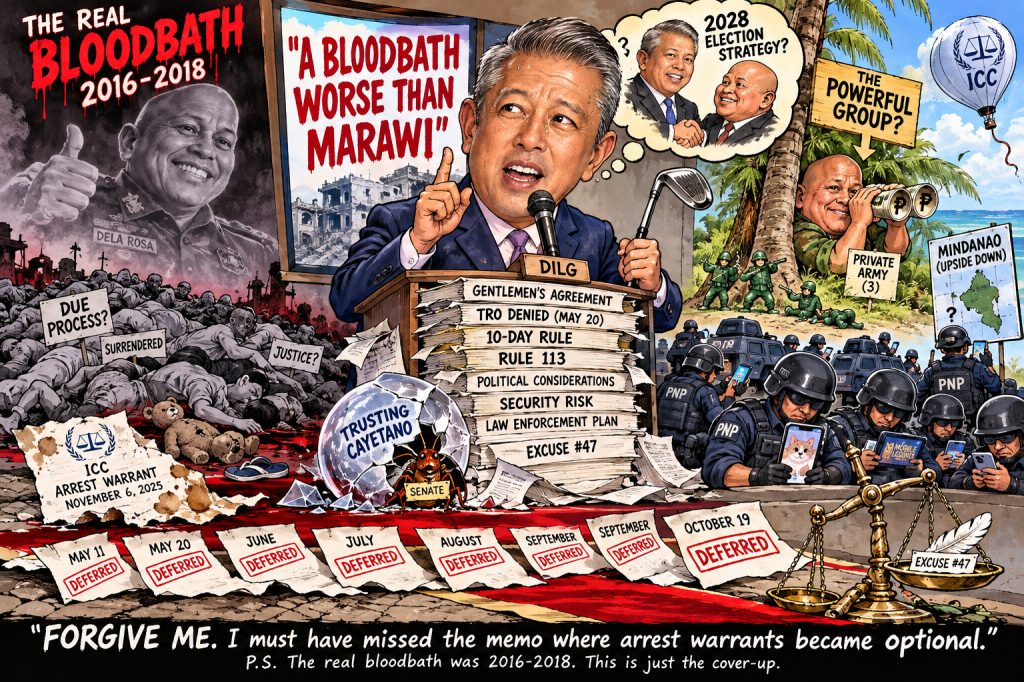
Or: How the Interior Secretary Learned to Stop Enforcing Warrants and Love the Excuse
By Louis “Barok” C Biraogo | October 20, 2026
FORGIVE me. I must have missed the memo where arrest warrants became optional.
The Secretary of the Interior and Local Government (DILG)—the man tasked with supervising the Philippine National Police (PNP), the agency whose entire raison d’être is to enforce the law and arrest criminals—went on national television to announce that arresting a fugitive senator might result in a “bloodbath worse than Marawi.”
And we’re supposed to accept this as competent governance?
Welcome to the Philippines, where arrest warrants are now mere suggestions and armed resistance is a valid excuse for indefinite procrastination. Where the Interior Secretary admits he “dropped the ball” on capturing a man with a standing International Criminal Court (ICC) warrant, then—instead of resigning in shame—issues dire warnings about the consequences of actually doing his job.
Jonvic Remulla has achieved something remarkable: he has simultaneously admitted incompetence and preemptively blamed the consequences of his own failures on the person he was supposed to arrest.
This is not law enforcement. This is performance art.

The Gentlemen’s Agreement That Wasn’t
November 6, 2025: The ICC issues a sealed arrest warrant against Senator Ronald “Bato” dela Rosa for crimes against humanity. The man who built his political career on extrajudicial killings now faces international justice.
May 11, 2026: The warrant is unsealed. Dela Rosa appears at the Senate, where then-Senate President Alan Peter Cayetano grants him “protective custody.” National Bureau of Investigation (NBI) agents attempt to arrest him. They fail. Dela Rosa vanishes.
May 20, 2026: The Supreme Court denies Dela Rosa’s petition for a Temporary Restraining Order (TRO). The path is clear for arrest.
October 19, 2026: Remulla announces that arresting Dela Rosa might trigger “a bloodbath worse than Marawi” because the senator is allegedly hiding in Mindanao under the protection of a “powerful group with armed men.”
Five months.
For five months, the government of Ferdinand “I Will Not Cooperate with the ICC” Marcos Jr.—which conveniently reversed its position on ICC cooperation once the Marcos-Duterte feud escalated—could not locate and arrest a 62-year-old former police general who apparently travels with a private army.
And now we’re told that the reason for this prolonged failure is that arresting him would be too dangerous.
Remulla’s admission that he “dropped the ball” by trusting Cayetano’s assurance reveals a government operating on handshakes and verbal promises rather than written directives and institutional accountability.
“There will be no more gentlemen’s agreements,” Remulla declared, as if the lesson was about the dangers of politeness rather than the dangers of incompetence.
Here’s a thought, Secretary: the problem wasn’t that you were too gentlemanly. The problem was that you treated a fugitive from international justice as a matter to be negotiated between political allies rather than a law enforcement priority.
The Marawi Comparison: When Hyperbole Becomes Policy
The 2017 Siege of Marawi was a five-month urban conflict involving hundreds of Islamic State of Iraq and Syria (ISIS)-linked militants, sustained military operations, thousands of casualties, and the near-total destruction of a city. It remains the most significant security crisis in recent Philippine history.
And Remulla wants us to believe that arresting one senator—even one with armed protectors—could exceed this?
Where is the evidence? What is the size of this “powerful group”? How many armed men? What weapons? Do they have fortified positions? The capacity to sustain prolonged resistance against the full force of the Philippine state?
Remulla provided nothing. No intelligence briefing. No threat assessment. Just a vague, ominous warning that conveniently justifies his continued inaction.
This is not security policy. This is rhetorical terrorism—using fear to manufacture consent for the non-enforcement of a valid judicial warrant.
If the threat is genuine, Remulla has revealed a catastrophic security failure: armed groups in Mindanao possess capabilities approaching those of a major insurgent force, and the government has done nothing. If the threat is exaggerated—or fabricated—then Remulla has deliberately misled the public to justify his own failure.
Either scenario should disqualify him from public office.
The Legal Charade
Article VII, Section 17 of the 1987 Constitution states that the President “shall ensure that the laws be faithfully executed.” The President’s control over executive departments—including the DILG—is mandatory, not discretionary.
Remulla’s warning effectively announces that the Executive Branch will not enforce a judicial warrant because it is too difficult. This is not discretion. This is abdication.
Rule 113 of the Revised Rules of Criminal Procedure requires the arresting officer to execute the warrant within ten days and report the reasons for any failure. The rules contemplate obstacles—they do not contemplate surrender. If Dela Rosa is protected by armed men, the proper response is to deploy sufficient force to overcome that resistance, with appropriate tactical planning. The PNP Revised Operational Procedures explicitly address high-risk arrests—the “maximum firepower and armor assets” approach Remulla apparently forgot exists.
Republic Act No. 9851 (Philippine Act on Crimes Against International Humanitarian Law, Genocide, and Other Crimes Against Humanity), Section 17 explicitly contemplates Philippine authorities “dispensing with the conduct of a preliminary investigation” and filing charges based on “the certification, preliminary findings, or indictment by the ICC.”
The legal basis exists. The Court has declined to block enforcement. What remains is the political will—or, apparently, the lack thereof.
Selective Enforcement: The Hypocrisy Test
While Remulla warns of bloodbaths and negotiates with Dela Rosa’s alleged protectors, the government is actively pursuing other fugitives:
- Zaldy Co (plunder charges, allegedly in France): International Criminal Police Organization (Interpol) Red Notice requested.
- Atong Ang (kidnapping charges, allegedly in Cambodia): P20 million bounty, Interpol Red Notice.
- Gerald Bantag (murder charges, allegedly in Cordillera): Active manhunt.
For these fugitives, the government issues bounties and conducts active operations. For Dela Rosa—a former police chief with direct connections to the Duterte political machine—the government issues warnings about bloodbaths and negotiates for voluntary surrender.
The difference is not legal. The difference is political.
Dela Rosa is not just any fugitive. He is a political ally of the Dutertes, a man with deep connections to the current Vice President, and a potential witness whose testimony could implicate others.
This is not justice. This is the instrumentalization of international justice for domestic political purposes.
The Senate’s Complicity
When Dela Rosa appeared at the Senate in May 2026, Cayetano granted him “protective custody”—a concept that exists in parliamentary practice for witnesses and resource persons, not for fugitives from arrest warrants.
The Senate’s cooperation with Dela Rosa’s evasion was arguably a violation of its constitutional role. Article VI, Section 21 grants the Senate investigative powers “in aid of legislation.” It does not grant the power to harbor criminals.
If Dela Rosa was present at the Senate, the NBI should have arrested him. If Cayetano physically obstructed the arrest, he should face legal consequences. If Remulla instructed the NBI to stand down based on a verbal promise, he should be investigated for dereliction of duty.
Instead, we have a blame game with no accountability.
The “Staged Shootout” and Other Mysteries
Reports suggest that the shooting incident at the Senate in May 2026—during which NBI agents allegedly attempted to arrest Dela Rosa—may have been staged. If true, this suggests sophisticated evasion planning.
The Senate security personnel who facilitated Dela Rosa’s departure, the individuals who arranged his transport to Mindanao, and the “powerful group” now protecting him all participated in the obstruction of justice. They are not bystanders. They are accomplices.
Yet Remulla speaks of this group not as criminals to be pursued but as a threat to be respected.
The Political Calculus
The Marcos-Duterte alliance has collapsed. The ICC cases against Rodrigo Duterte and Bato dela Rosa serve the Marcos administration’s political interests by weakening the Duterte political machine. But aggressive enforcement carries risks: the Duterte base in Mindanao remains substantial, and Dela Rosa is a sympathetic figure to many police officers.
Remulla’s “bloodbath” warning may be less about actual security concerns and more about preparing the public for a scenario in which Dela Rosa is never arrested. It provides political cover for the administration’s inability—or unwillingness—to enforce the warrant.
If Dela Rosa remains free, Remulla can say: “We tried, but the risk was too great.” If Dela Rosa is eventually arrested after prolonged negotiations, Remulla can say: “We handled it peacefully.” Either way, Remulla escapes accountability for the five-month failure and the original sin of letting Dela Rosa walk out of the Senate.
What Should Happen
- Release the Intelligence. If the “powerful group” threat is genuine, Remulla should provide a non-sensitive summary to Congress and the Supreme Court. If he cannot, his claim should be treated with skepticism.
- Establish a Deadline. The government should announce a clear deadline for Dela Rosa’s voluntary surrender. If he does not surrender, lawful enforcement should proceed with all necessary force and tactical preparation.
- Investigate the Senate Escape. A congressional inquiry should examine the circumstances of Dela Rosa’s departure. Cayetano, Remulla, and NBI officials should testify under oath. Any evidence of obstruction should be referred to the Ombudsman.
- Clarify the Legal Framework. The Supreme Court should issue a definitive ruling on the domestic enforceability of ICC warrants.
- Apply Consistent Standards. The government should develop a public framework for high-profile fugitives that applies equally regardless of political affiliation.
The Deeper Crisis
When the Interior Secretary publicly warns that enforcing a warrant might result in a “bloodbath,” he is announcing that the state has lost its monopoly on the legitimate use of violence. Armed groups—whether political warlords, private armies, or criminal syndicates—can effectively veto law enforcement through the threat of resistance.
This is not a new problem. The Maguindanao Massacre of 2009, in which 58 people were killed by the Ampatuan private army, is a grim reminder of what happens when local political power trumps the rule of law.
Remulla’s warning suggests that this pattern is being accepted rather than confronted. Instead of deploying the full force of the state to overcome armed resistance, the government is negotiating with it.
If this becomes the standard, the implications are terrifying. Any fugitive with enough money to hire bodyguards can escape arrest. Any political warlord can shield allies from justice. The law becomes a tool of the powerful, not a shield for the weak.
The Hypocrisy of “Due Process”
Where was this concern for due process during the drug war, when Dela Rosa himself oversaw the killing of thousands of suspected drug users—many of whom were denied any process at all?
Dela Rosa is entitled to due process under Philippine and international law. He is entitled to a fair trial and the presumption of innocence. But he is not entitled to evade that trial indefinitely while the government makes excuses about bloodbaths.
The victims of the drug war were denied due process. They were denied their lives. Dela Rosa deserves better than they received, but he does not deserve exemption from the justice he denied to others.
The Final Verdict
Jonvic Remulla’s “bloodbath” warning is a confession masquerading as a caution.
It is a confession that the government has failed to execute a valid arrest warrant for five months. It is a confession that the government is unprepared to conduct a high-risk police operation despite having one of the largest police forces in Southeast Asia. It is a confession that the government is willing to let a fugitive from international justice remain free rather than risk the political consequences of enforcement.
The “bloodbath worse than Marawi” is a fantasy—a convenient nightmare that justifies inaction. The real bloodbath has already happened: thousands of Filipinos killed in the drug war, their families still waiting for justice, their killers still walking free.
Dela Rosa should be arrested. If he resists with force, that resistance should be overcome with lawful force. If armed groups protect him, those groups should be treated as what they are: criminals, not negotiating partners.
The government’s job is not to avoid confrontation. It is to enforce the law—even when enforcement is difficult, dangerous, or politically inconvenient.
Anything less is a betrayal of the public trust.
Louis “Barok” C. Biraogo writes satire and political commentary from a cave of his own making. Critics have called his work “unnecessarily aggressive”; his lawyer has called it “a full-time job.” Neither has slowed him down. Find him on X/Twitter @LouisBiraogo for more opinions nobody asked for.
Key Citations
A. Legal & Official Sources
- The 1987 Constitution of the Republic of the Philippines. Official Gazette of the Republic of the Philippines, 1987, http://www.officialgazette.gov.ph/constitutions/1987-constitution/.
- Republic Act No. 6975. An Act Establishing the Philippine National Police under a Reorganized Department of the Interior and Local Government. 1990, elibrary.judiciary.gov.ph/thebookshelf/showdocsfriendly/2/21922.
- Republic Act No. 9851. An Act Defining and Penalizing Crimes Against International Humanitarian Law, Genocide and Other Crimes Against Humanity. 2009, lawphil.net/statutes/repacts/ra2009/ra_9851_2009.html.
- 2000 Revised Rules of Criminal Procedure, Rule 113 (Arrest). Supreme Court of the Philippines, 2000, lawphil.net/courts/rules/rc_110-127_crim.html.
- International Criminal Court. “Situation in the Philippines: ICC Judges Unseal Arrest Warrant against Ronald Marapon Dela Rosa.” ICC, International Criminal Court, 2026, http://www.icc-cpi.int/news/situation-philippines-icc-judges-unseal-arrest-warrant-against-ronald-marapon-dela-rosa.
- Supreme Court of the Philippines. Press Briefer. 20 May 2026, sc.judiciary.gov.ph/wp-content/uploads/2026/05/PRESS-BRIEFER-May-20-2026.pdf.
B. News Reports
- “Remulla Warns of Bloodbath If Authorities Try to Arrest Dela Rosa.” ABS-CBN News, ABS-CBN Corporation, 19 Oct. 2026, http://www.abs-cbn.com/news/nation/2026/10/19/remulla-warns-of-bloodbath-if-authorities-try-to-arrest-dela-rosa-1337.

- ₱9 Billion in ‘Savings’? DILG’s Fire Truck Deal Smells Like Smoke

- ₱8B BBM Pork: CCTV for Every Captain’s Kumpare?

- ₱8.9 Billion, 331 Ghost Police Stations: The TIKAS Scandal Explained

- ₱8.4 Billion, 42,000 Barangays, 1 Election: The “Bawat Barangay Makikinabang” Vote-Buying Masterclass

- ₱75 Million Heist: Cops Gone Full Bandit

- ₱6.77B Ghost Haunts Duterte: RTC Dismisses Mans Carpio’s Desperate Plea
- ₱6.77 Billion and Zero Cash: The Sara Duterte SALN Math That Doesn’t Add Up

- ₱6.7-Trillion Temptation: The Great Pork Zombie Revival and the “Collegial” Vote-Buying Circus

- ₱58.53B, Zero Receipts: The LGSF Pork Barrel Nobody Wants to Name
- ₱53 Million Man Tells ₱695-a-Day Workers to Stop Being ‘Mayabang’: The Audacity of BSP’s Remolona
- ₱4.4 Billion and a Witness Who Can’t Explain It: The Duterte Impeachment’s Most Expensive Non-Answer
- ₱3.06 Billion for Evacuation Centers—But Nobody Knows Where They’ll Stand (Or If They’ll Exist)





Leave a Reply