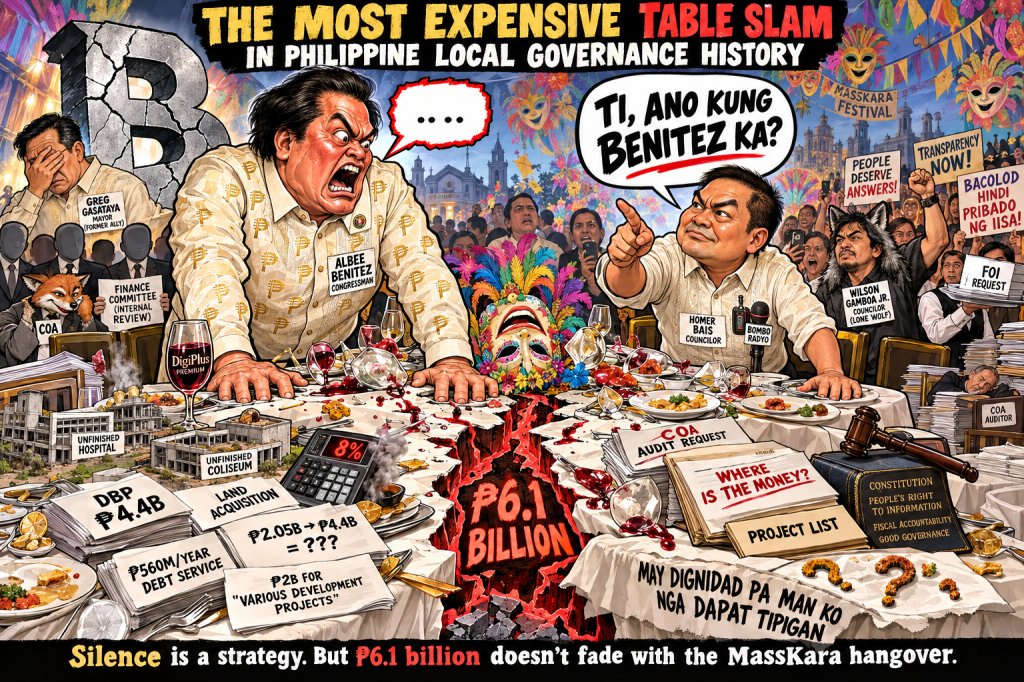
Inside the dinner-party confrontation that turned a routine audit request into a ₱6.1 billion war—and why the congressman still won’t answer a single question.
By Louis ‘Barok‘ C. Biraogo — October 20, 2026
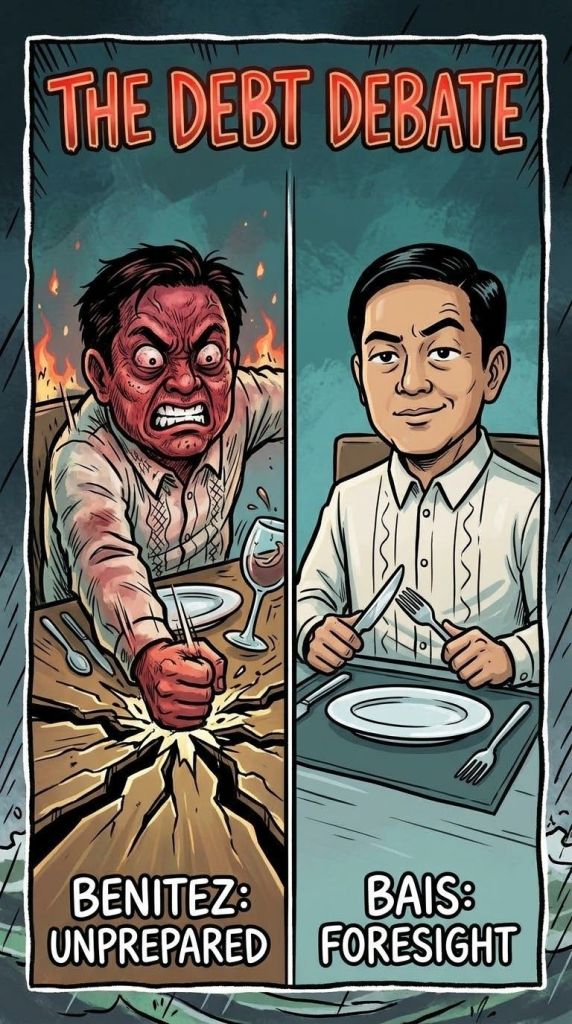
LET ME tell you about the most expensive table slam in Philippine local governance history. On October 16, during a MassKara Festival dinner party—because nothing says “fiscal accountability” like confrontation over canapés—Bacolod Representative Albee Benitez allegedly walked up to Councilor Homer Bais and slammed a table. Bais slammed back.
Then came the line that will haunt Benitez’s political obituary for years: “Ti, ano kung Benitez ka?”
So, what if you’re a Benitez?
Let’s find out.

The Arithmetic of Amnesia
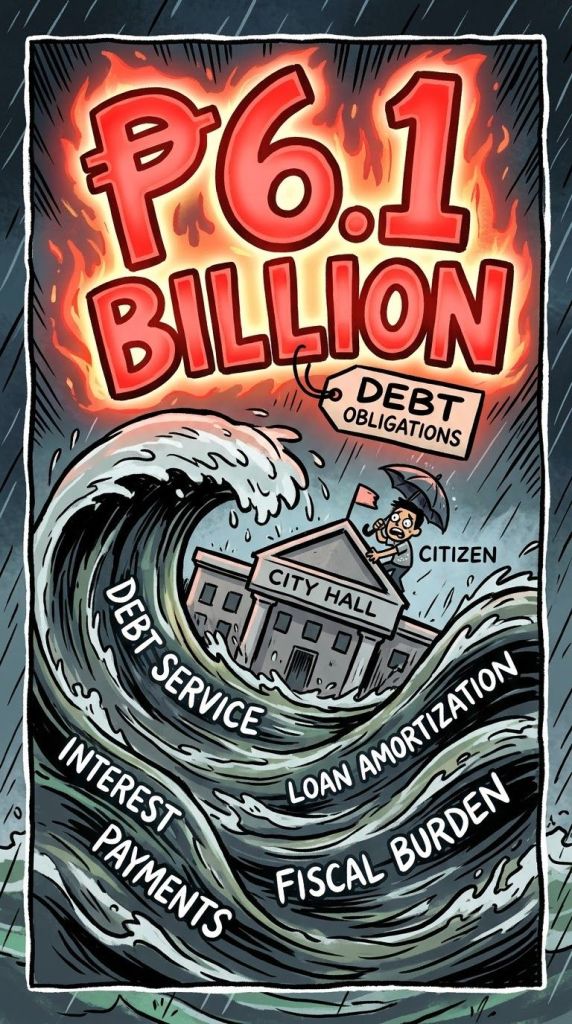
Here’s what we know. Bacolod City has ₱6.1 billion in loans. ₱1.7 billion from the Leonardia era. ₱4.4 billion from Benitez’s tenure as mayor from 2022 to 2025, as reported by Rappler.
The city is reportedly allocating ₱560 million next year just to service debt—roughly ₱46 million a month. That’s not chump change. That’s not even billionaire chump change. That’s real money that could have gone to, say, hospitals that aren’t mini, or drainage systems that actually drain.
But here’s where it gets deliciously absurd. In March 2025, Benitez—then still mayor—publicly stated that the city had only availed of ₱2.05 billion of the ₱4.1 billion loan line. By October 2026, the figure being debated is ₱4.4 billion.
That’s a gap of ₱2.35 billion, or roughly the Gross Domestic Product (GDP) of a small island nation, appearing in the space of nineteen months. Where did the rest come from? Was it disbursed? Was it approved? Was it imagined?
The Project List
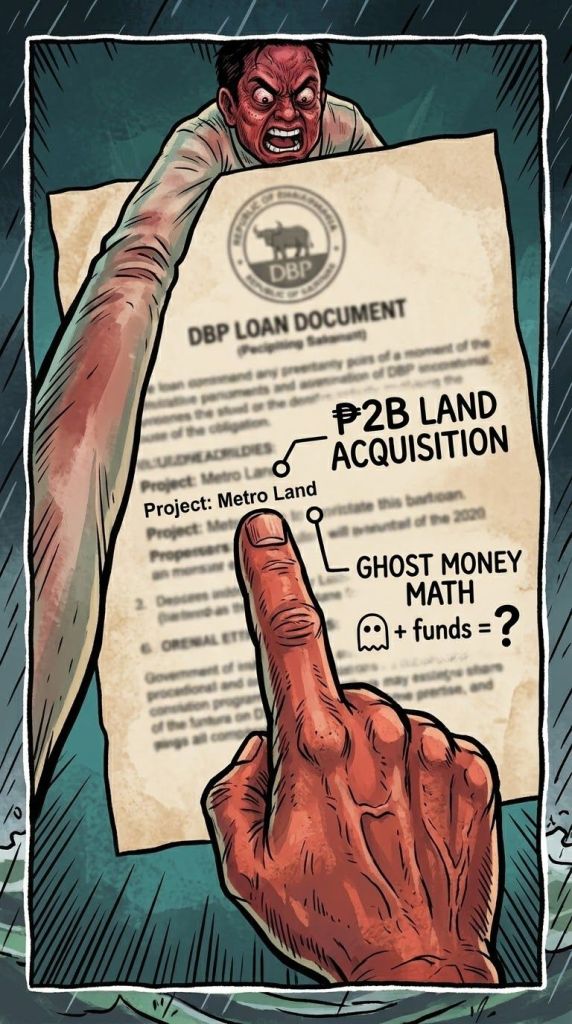
The Development Bank of the Philippines (DBP) project list is a masterpiece of vague ambition. ₱2 billion for “land acquisition for various development projects.” Two billion pesos for land. Which land? From whom? At what price? For what purpose?
The document says “various development projects,” which is bureaucratic speak for “we’ll tell you later.” That’s the single largest line item in the entire portfolio, and it’s about as specific as a campaign promise.
Then there’s ₱515 million for a legislative building. Because nothing says “the people’s priorities” like a new palace for the councilors who are supposed to be auditing the loans.
- ₱184 million for a central archives facility
- ₱300 million for underground cabling
- ₱100 million for solar power systems
- ₱25 million for traffic signals
It reads less like a development plan and more like a billionaire’s wishlist scribbled on a napkin at a Bingo parlor.
The Audit That Wasn’t
Councilor Wilson Gamboa Jr.—the council’s self-described “lone wolf”—proposed a Commission on Audit (COA) audit resolution back in May 2026. In August, he tried again. The council majority shot it down and instead referred the matter to the finance committee, which is composed of the City Treasurer, City Accountant, and City Budget Office.
That’s like asking the fox to audit the henhouse and report back on whether the hens were delicious.
Gamboa wanted COA. He got a committee of the same bureaucrats whose offices would be under scrutiny. This is the Bacolod version of “we’ll investigate ourselves and let you know if we find anything embarrassing.” Spoiler: they won’t.
Bais supported Gamboa’s call. Then Bais made his manifestation on October 14 during a council session about the MassKara Coliseum—a Leonardia-era project, conveniently. He suggested that if the council was going to look at the ₱1.7 billion in old loans, it should also look at the ₱4.4 billion in new ones.
Fairness, transparency, accountability. The audacity.
Two days later, Benitez allegedly confronted him at a dinner party. In front of officials and guests. During the city’s biggest tourism event. And slammed a table.
The Silence That Speaks Volumes
As of this writing, Benitez has not commented. Rappler tried. Brigada tried. PhilNews tried. Nothing.
The congressman who once told Bacolodnons that the loan was “only ₱2.05 billion” and that debt service was “only eight percent” of the 2025 budget now has nothing to say when a councilor asks for a comprehensive accounting.
Silence is a strategy. When you’re a billionaire with legal resources that could bankrupt a small city, silence is often the cheapest option. Let the news cycle move on. Let the MassKara hangover fade. Let the councilor who dared to ask questions become a footnote.
But Bais’s question won’t go away. Neither will the ₱6.1 billion.
The COA Problem
Here’s what the Benitez camp would have you believe: the loans were legally authorized. The DBP agreement was signed. The Monetary Board approved it. The projects are listed. Everything is above board. Move along.
And they’re partially right. The procedural boxes appear to have been checked: Bureau of Local Government Finance (BLGF) certification for debt capacity, Sangguniang authorization, and a Bangko Sentral ng Pilipinas (BSP) Monetary Board opinion, which SunStar Bacolod reported as approving the loan. The loan exists. The projects have names. The paperwork exists.
But procedure is not the same as performance. A loan can be legally obtained and still be economically disastrous. A project can be authorized and still be overpriced, delayed, or useless. A debt service ceiling can be technically met while still crowding out essential services.
The 20% debt service ceiling under Section 324(b) of the Local Government Code is not a suggestion; it’s a statutory limit. Benitez claimed in 2025 that the city was paying only 8% of its budget—₱352 million out of ₱4.4 billion. By 2026, the figure being thrown around is ₱560 million.
That’s a 59% increase in debt service in one year. Either the earlier figure was wrong, or the debt has grown dramatically, or someone is doing math with a calculator that only counts in one direction.
The BLGF certification that allowed the loan in the first place is based on projected revenues. If those projections were optimistic, if the city’s income has declined, or if the regular income figures were inflated to make the debt ceiling appear compliant, then the entire foundation of the borrowing becomes suspect.
This is not a hypothetical. It’s the exact scenario that Local Finance Circular 1-2012 was designed to prevent.
The Land Question
Two billion pesos. Land acquisition. This is the nuclear option of local government scandals waiting to happen.
Land is opaque. Unlike a road, which you can drive on and see whether it connects Point A to Point B, land transactions involve title histories, valuations, classifications, and the ever-present possibility that someone with the right surname bought agricultural land at development prices and sold it to the city at a markup that would make a hedge fund manager blush.
There is already a reported graft complaint involving a ₱971.86 million land transaction under the Benitez administration. The complaint alleges issues with agricultural classification and legality of acquisition. The existence of a complaint is not proof of guilt. But it is a flashing red light on the largest single line item in the entire loan portfolio.
If the city borrowed ₱2 billion to buy land, Bacolodnons deserve to know: which parcels, from whom, at what price per square meter, and what is being built on them now. Anything less than full disclosure is an insult to every taxpayer whose money is being used to service that debt.
The Political Mathematics
Let’s be clear about what’s happening here. Team Asenso—the coalition that swept Bacolod in 2025—is fracturing. Benitez won the congressional seat. Greg Gasataya won the mayoralty. Bais won a council seat as the #11 councilor on the Team Asenso slate. They were supposed to be allies.
But alliances built on convenience dissolve on contact with accountability. Bais, a former Bombo Radyo anchorman, knows how to communicate. He knows how to land a soundbite.
And “Ti, ano kung Benitez ka?” is the soundbite of the year—a direct challenge to the politics of deference that has defined Bacolod’s relationship with its wealthiest son.
Benitez is not just a politician. He’s a billionaire businessman with substantial holdings in DigiPlus, the online gaming firm he founded. He is one of the wealthiest lawmakers in the country. His family name carries weight that transcends political office.
When he walks into a room, people stand up. When he slams a table, people flinch.
Bais didn’t flinch. Or rather, he flinched, then slammed back.
The social media reaction has been telling. Commenters praised Bais for “standing his ground.” The phrase “Ti, ano kung Benitez ka?” has become a rallying cry. This is what happens when a politician who has spent decades being treated as untouchable suddenly encounters someone who doesn’t care about the surname.
What COA Should Do (But Probably Won’t)
The Commission on Audit has the constitutional authority to examine, audit, and settle all government accounts. It doesn’t need the city council’s permission. It doesn’t need the mayor’s blessing. It can initiate a special audit on its own volition or upon request from the council.
Gamboa’s resolution asked COA to audit both administrations’ loans. The council majority buried it. The finance committee is supposedly reviewing it. But COA has the power to act independently.
Will it? COA is notoriously under-resourced and politically cautious. A special audit of Bacolod’s ₱6.1 billion loan portfolio would require forensic accountants, engineering inspectors, land valuation experts, and months of work. It would generate findings that could disallow expenditures, recommend criminal referrals, and end political careers.
The question is whether COA has the appetite. The answer, historically, is: not unless someone forces its hand.
The Real Scandal
The real scandal is not the table slam. Table slams happen. Politicians are theatrical creatures.
The real scandal is that ₱6.1 billion in public money has been borrowed, listed against a set of projects that range from the necessary (drainage) to the questionable (legislative building) to the opaque (land acquisition), and the public has no clear accounting of what has been delivered.
The MassKara Coliseum is still ongoing. It was supposed to be finished. The museum-auditorium is still ongoing. The mini-hospitals—five of them, ₱135 million—where are they? Are they staffed? Are they equipped? Are they serving patients, or are they empty shells with dedication plaques gathering dust?
These are not rhetorical questions. They are questions that a COA audit would answer. They are questions that the City Council could answer if it subpoenaed the documents. They are questions that Benitez could answer voluntarily if he wanted to clear his name.
He hasn’t. He won’t.
The Dignity Defense
Bais said something important after the confrontation: “May dignidad pa man ko nga dapat tipigan.” I still have my dignity to protect.
This is not about politics. It’s about personhood. The implication of Benitez’s alleged table slam is that Bais—a councilor, an elected official, a representative of the people—should have known his place. Should have deferred. Should have remembered who he was talking to.
“Ti, ano kung Benitez ka?” is the rejection of that implication. It is the assertion that in a democracy, no surname is worth more than the oath of office. No billionaire’s ego is worth more than a councilor’s duty to ask questions. No political alliance is worth more than the public’s right to know where its money went.
Benitez may be a Benitez. But Bais is a councilor. And the last time I checked, the Constitution doesn’t have a special clause for billionaires.
The Bottom Line
Bacolod’s ₱6.1 billion debt is not inherently evil. Borrowing for infrastructure is a legitimate function of local government. Roads need to be built. Drainage needs to be improved. Hospitals need to be constructed. If the money was spent well, the city will benefit for decades.
But “if” is doing a lot of work in that sentence. And the burden of proof falls on those who borrowed, spent, and implemented. Not on the councilor who asked for an accounting. Not on the independent councilor who filed the audit resolution. Not on the public that wants to know why its city is paying ₱46 million a month for projects it can’t see, use, or verify.
Benitez’s silence is not a defense. It’s an admission that he’d rather let the story fade than answer the question. Bais’s outburst is not a scandal. It’s the sound of a political culture cracking.
The table slam heard around Bacolod was not about a dinner party. It was about whether a city can borrow billions and refuse to explain. It was about whether a billionaire can intimidate a councilor into silence. It was about whether “Benitez” is a name that commands deference or a name that commands scrutiny.
The answer, for now, is both. The question is which one will prevail.
Kweba ni Barok will continue monitoring this story. If the Commission on Audit does not act, we will publish the project list with status inquiries. If the city government does not disclose, we will file the Freedom of Information (FOI) requests. If the congressman does not answer, we will keep asking.
Ti, ano kung Benitez ka? You still owe the people of Bacolod an explanation.
Key Citations
A. Legal Authorities
- Philippines. 1987 Constitution of the Republic of the Philippines. Articles II, III, IX-D, and XI. Lawphil, lawphil.net/consti/cons1987.html.
- Philippines. Republic Act No. 7160. Local Government Code of 1991. Sections 296–297, 305, 324, and 344. E-Library, Supreme Court of the Philippines, elibrary.judiciary.gov.ph/thebookshelf/showdocs/11/53542.
- Philippines. Republic Act No. 6713. Code of Conduct and Ethical Standards for Public Officials and Employees. 1989. Lawphil, lawphil.net/statutes/repacts/ra1989/ra_6713_1989.html.
- Philippines. Republic Act No. 12009. New Government Procurement Act. 2024. Lawphil, lawphil.net/statutes/repacts/ra2024/ra_12009_2024.html.
B. News Articles
- Delilan, Ambo”‘Ti, Ano Kung Benitez Ka?’: Bacolod Allies Nearly Come to Blows Over City’s Debts.” Rappler, 2026, http://www.rappler.com/philippines/visayas/bacolod-allies-albee-benitiez-nearly-come-blows-city-debt/
- “Bacolod City Obtains ₱4.4-B Loan from DBP for 17 Development Projects.” Philippine News Agency, 27 Apr. 2023, pna.gov.ph/articles/1200312.
- “4.4 B Worth of ‘Infra Projects’ to Be Implemented by the City.” Bacolod City Government, 28 Apr. 2023, bacolodcity.gov.ph/4-4-b-worth-of-infra-projects-to-be-implemented-by-the-city/.
- “BSP Monetary Board Approves ₱4.4-B Loan of Bacolod.” SunStar Bacolod, 13 July 2023, sunstar.com.ph/bacolod/local-news/bsp-monetary-board-approves-p44-b-loan-of-bacolod.
- “₱971M Land Deal Sparks Graft Complaints against Benitez and Other Respondents.” Daily Guardian, dailyguardian.com.ph/blog/php971m-land-deal-sparks-graft-complaints-against-benitez-19-others.
C. Official Websites
- Commission on Audit. COA Official Website, coa.gov.ph.
- Development Bank of the Philippines. DBP Official Website, dbp.ph.
- Bangko Sentral ng Pilipinas. BSP Official Website, bsp.gov.ph.
- Bureau of Local Government Finance. BLGF Official Website, blgf.gov.ph.
- “Ang Hirap Maging Mahirap”: The PAO Scandal That Proves Government Contempt Is Nothing New

- “Far-Off” My Axx: Malacañang’s Claire Castro Drowns in Her Own Legal Gaslighting
- “Forthwith” to Farce: How the Senate is Killing Impeachment—And Why Enrile’s Right (Even If You Can’t Trust Him)

- “HINDI AKO NAG-RESIGN!”

- “I Know Nothing”: Baste Duterte’s Amnesia Defense Meets ₱33M in GenCorp Contracts

- “I’m calling you from my new Globe SIM. Send load!”

- “Mahiya Naman Kayo!” Marcos’ Anti-Corruption Vow Faces a Flood of Doubt

- “Manageable” Debt, Unmanageable Lies: DBM’s ₱21 Trillion Fairy Tale

- “Meow, I’m calling you from my new Globe SIM!”

- “Natrabaho”: One Word, One Ombudsman, and a Judiciary on Trial

- “No Special Jail for Crooks!” Boying Remulla Slams VIP Perks for Flood Scammers

- “Philippine-Controlled” or Yankee Gas Station? The Davao Fuel Depot Farce Exposed







Leave a Reply