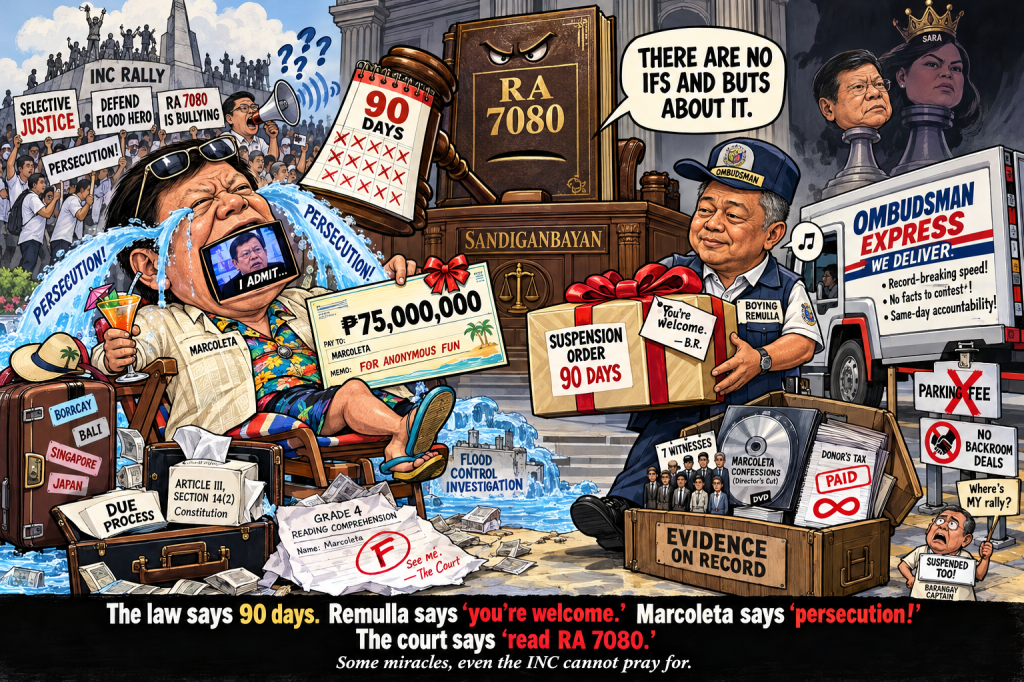
The law says 90 days. Remulla says “you’re welcome.” Marcoleta says “persecution!” The court says “read RA 7080.”
By Louis ‘Barok‘ C. Biraogo — October 21, 2026
Let us begin with the only fact that matters, the one buried beneath the avalanche of Iglesia ni Cristo (INC) prayer rallies, Remulla conspiracy theories, and Marcoleta’s televised tears: On October 19, 2026, the Sandiganbayan Third Division did something almost revolutionary in this country. It applied the law as written.
No drama. No backroom deal. No “parking fee.” Just a straightforward reading of Republic Act No. 7080 (Anti-Plunder Act) and Republic Act No. 3019 (Anti-Graft and Corrupt Practices Act), both of which say, in language a Grade 4 pupil could parse, that preventive suspension is mandatory once a valid Information is filed. The court even spelled it out for the slow learners: “The Court has neither the discretion nor duty to determine whether or not a preventive suspension is required. There are no ifs and buts about it.”
Translation for the INC faithful who spent three days camped out on EDSA: Your senator is suspended because the law says so. Not because Malacañang hates him. Not because Ombudsman Remulla is a secret Illuminati operative. Not because the deep state finally got its act together. Because the statute is clear, and the Sandiganbayan, unlike most institutions in this republic, can still read.
Now, I have been critical of many things in this benighted archipelago. I have mocked the Supreme Court’s leisurely approach to constitutional crises. I have questioned the Ombudsman’s historical capacity for actually finishing cases. I have suggested, perhaps uncharitably, that Philippine politics is a kabuki theater performed for the benefit of the same twelve families who have been swapping power since the Spanish friars packed their bags.
But I will say this plainly: Remulla is doing his job. And the fact that this is newsworthy, the fact that an Ombudsman filing a case based on the accused’s own televised admissions is treated as some kind of coup, tells you everything about the baseline of accountability in this country.
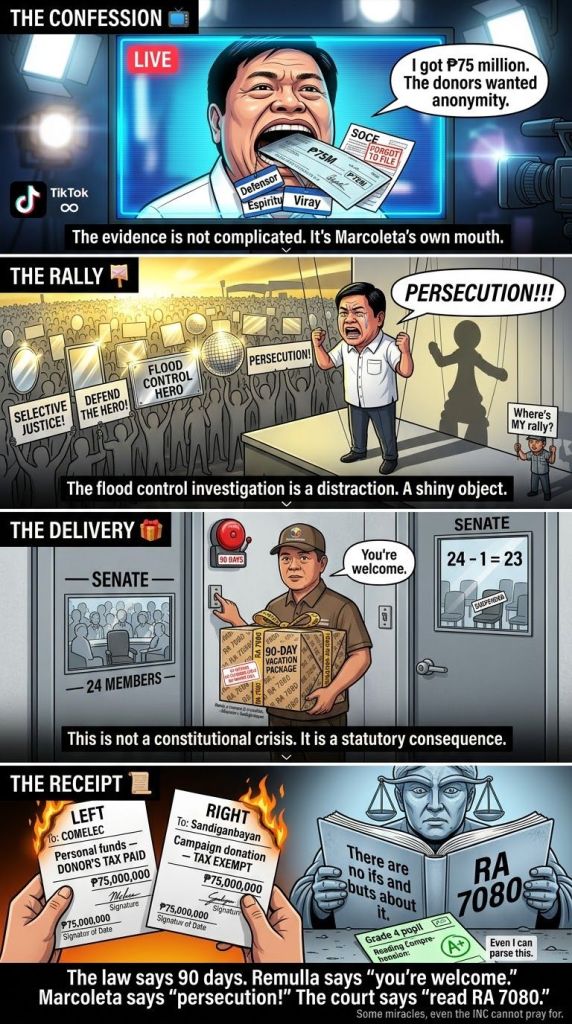
The Evidence Is Not Complicated. It’s Marcoleta’s Own Mouth.
Let us review, for the benefit of those whose attention spans have been eroded by TikTok and INC propaganda.
Marcoleta admitted, on television, that he received ₱75 million from Mike Defensor, Joseph Espiritu, and Aristotle Viray. He admitted he didn’t declare it in his Statement of Contributions and Expenditures (SOCE). His explanation? The donors wanted anonymity.
This is not a whodunit. This is not a complex plunder scheme involving offshore accounts, shell corporations, and coded text messages. This is a man who went on camera, said “I got ₱75 million,” and then acted surprised when the Ombudsman noticed.
The prosecution’s case, as Remulla himself noted, is built on the principle that you don’t need to prove what the accused already confessed to a national television audience. Seven witnesses. Two months. Prosecution rests. This is not “record-breaking” speed because Remulla is a wizard. It’s record-breaking because the defense has no facts to contest. They have only a narrative: persecution.
And what a narrative it is. The INC, bless their organized hearts, staged a rally claiming Marcoleta is being persecuted for investigating flood control anomalies. This is a lovely story. It has heroes and villains and a clear moral arc. There is just one problem: Marcoleta is not on trial for investigating flood control. He is on trial for receiving ₱75 million and not declaring it. The flood control investigation is a distraction, a shiny object waved in front of a public that desperately wants to believe someone is fighting the good fight.
The Iglesia ni Cristo’s statement that Marcoleta is being charged because he investigated corruption is not a legal argument. It is a theological assertion dressed up as political commentary. And the Sandiganbayan, to its eternal credit, did not entertain it. It looked at the Information, found it valid, and issued the suspension. The court did not ask whether Marcoleta is a good man. It did not ask whether his donors are his friends. It did not ask whether the INC voting bloc would be upset. It asked one question: Does the law require suspension? Answer: yes.
The “Due Process” Defense Is an Insult to Actual Due Process
Marcoleta’s lawyers will tell you, with straight faces, that suspending a senator before conviction violates due process. They will invoke the presumption of innocence. They will cite Article III, Section 14(2) of the 1987 Constitution. They will sound very serious and very aggrieved.
They are wrong, and they know they are wrong.
Preventive suspension is not punishment. It is a precautionary measure designed to prevent an accused public officer from using their office to tamper with evidence, intimidate witnesses, or otherwise frustrate the prosecution. The Supreme Court has said this repeatedly—most explicitly in Villaseñor v. Sandiganbayan, quoting Quimbo v. Gervacio in holding that preventive suspension “is not a penalty in itself” but “merely a measure of precaution”—in cases Marcoleta’s lawyers have surely read and chosen to ignore. The Sandiganbayan did not convict Marcoleta. It did not find him guilty. It did not impose a penalty. It said: for 90 days, while this case proceeds, you will not sit in the Senate, because the law says that is what happens when you are charged with plunder.
The due process clause does not guarantee that a senator gets to keep his committee assignments while facing a non-bailable offense. It guarantees that he gets a fair trial, that he can present evidence, that he can confront witnesses. Marcoleta will get all of that. His defense begins October 22. He will have his day in court. What he will not have, for 90 days, is the Senate floor.
This is not a constitutional crisis. It is a statutory consequence.
The Separation of Powers Argument Is a Red Herring Wrapped in a Euphemism
The Senate, we are told, is an independent constitutional body. Its members are elected by the people. The judiciary cannot interfere with its internal affairs.
This is true. It is also irrelevant.
The Sandiganbayan did not dissolve the Senate. It did not nullify an election. It did not tell the Senate how to conduct its business. It suspended one member for 90 days under a law that applies to all public officers, including senators. The court even helpfully noted that the Senate, “a collegial body composed of 24 Senators, can still perform its functions even during the preventive suspension of a member.”
This is not a judicial coup. It is arithmetic.
The real question, the one no one wants to ask, is why Marcoleta’s allies believe that being a senator should exempt him from a law that applies to every other public official in the country. Why is it that when a barangay captain is suspended pending graft charges, no one stages a rally on EDSA? Why is it that when a mayor is preventively suspended, the INC does not issue a statement about “selective justice”?
The answer is uncomfortable: because Marcoleta is useful to a political project that extends beyond his own fate. He is a Duterte ally. He is a member of a powerful religious bloc. He is, for the moment, a piece on a chessboard being played by people who care far more about the impeachment trial of Sara Duterte than they do about whether ₱75 million was properly declared.
And Remulla, to his immense credit, has refused to play along. “There’s no selective justice in this country when it comes to the Ombudsman,” he said, before the INC rally even happened. “We will still push through with the filing of the case.” He did. The Sandiganbayan then did its part. The system, against all odds, worked.
The COMELEC Confusion Is Either Ignorance or Deliberate Obfuscation
Marcoleta’s defenders have seized on the Commission on Elections (COMELEC)’s earlier fact-finding inquiry, which reportedly found insufficient evidence of an election offense, as proof that the Ombudsman’s case is redundant or malicious. This is a misunderstanding so basic it would be embarrassing if it weren’t so clearly strategic.
COMELEC investigates election offenses. The Ombudsman investigates graft and corruption. These are different crimes with different elements, different standards, and different jurisdictional bases. The Sandiganbayan explicitly addressed this, noting that cases filed before COMELEC and the Sandiganbayan “may proceed independently” because they involve distinct offenses.
But here is the detail that should trouble Marcoleta’s supporters more than it apparently does: the prosecution has introduced evidence that Marcoleta’s own submission to COMELEC included donor’s tax payments on the ₱75 million. Under the final paragraph of Section 13 of Republic Act No. 7166 (Synchronized National and Local Elections and Electoral Reforms Law of 1991), duly reported campaign contributions are exempt from donor’s tax—confirmed by Bureau of Internal Revenue (BIR) Regulations No. 7-2011 (Policies in the Tax Treatment of Campaign Contributions and Expenditures). The fact that donor’s tax was paid is not a minor technicality. It is evidence that the money was treated, at the time, as something other than a campaign contribution.
Marcoleta cannot have it both ways. He cannot tell COMELEC the money was personal funds subject to tax, and then tell the Sandiganbayan it was campaign donations exempt from tax, and then tell the public he is being persecuted for a clerical error. The law does not work that way. And the Sandiganbayan, mercifully, is not stupid.
What This Case Is Really About
Strip away the noise, and the Marcoleta suspension is a test of whether the Philippines can still do something that most mature democracies take for granted: hold an elected official accountable through ordinary legal process.
The Sandiganbayan passed the test. It issued a reasoned resolution, cited the applicable statutes and jurisprudence, addressed the jurisdictional arguments, and imposed the suspension that the law requires. It did not grandstand. It did not leak to the press. It did not consult with Malacañang or the INC. It read the law and applied it.
Remulla passed the test. He filed a case based on evidence that the accused himself provided, on national television, and refused to be intimidated by mass rallies or congressional dog whistles or the prospect of political retaliation. He has his flaws. His brother is in the Cabinet. The Ombudsman’s office has a backlog that would make a hoarder weep. But on this case, he is right.
The people who failed the test are the ones who should be asked to explain themselves. The INC, which has every right to support its members but no right to demand that the criminal justice system bend to its preferences. The senators who have remained conspicuously silent about whether they will comply with the suspension order. The pundits and bloggers who have framed this as a political persecution without engaging with a single fact of the case. And Marcoleta himself, who has offered the public nothing but grievance and deflection in response to serious allegations that his own words substantiated.
The 90-day suspension will expire. The trial will continue. The defense will present its evidence. Maybe Marcoleta will be acquitted. Maybe he will be convicted. Maybe the Supreme Court will intervene and overturn the suspension on some technical ground that will be debated for years.
But for now, for this brief moment, the system did what it is supposed to do.
Do not let anyone tell you this is a crisis. It is the opposite. It is the law, finally, working.
And if that makes the INC uncomfortable, perhaps they should ask themselves why they have placed their faith in a man who cannot explain where ₱75 million came from without contradicting himself.
Louis ‘Barok’ C. Biraogo is the author of Kweba ni Barok. He has been accused of being many things, but never of defending Marcoleta’s ₱75 million arithmetic. Some miracles, even the INC cannot pray for.
Key Citations
A. Legal & Official Sources
- The 1987 Constitution of the Republic of the Philippines. Official Gazette of the Republic of the Philippines, 1987, http://www.officialgazette.gov.ph/constitutions/1987-constitution/.
- Republic Act No. 7080. An Act Defining and Penalizing the Crime of Plunder. 1991, lawphil.net/statutes/repacts/ra1991/ra_7080_1991.html.
- Republic Act No. 3019. Anti-Graft and Corrupt Practices Act. 1960, lawphil.net/statutes/repacts/ra1960/ra_3019_1960.html.
- Republic Act No. 7166. An Act Providing for Synchronized National and Local Elections and for Electoral Reforms, Authorizing Appropriations Therefor, and for Other Purposes. 1991, lawphil.net/statutes/repacts/ra1991/ra_7166_1991.html.
- Bureau of Internal Revenue. Revenue Regulations No. 7-2011. Policies in the Tax Treatment of Campaign Contributions and Expenditures. 16 Feb. 2011, dev.lawyerly.ph/laws/56797.
- Talaga v. Sandiganbayan (4th Division). G.R. No. 169888, 11 Nov. 2008. ChanRobles Virtual Law Library, chanrobles.com/scdecisions/jurisprudence2008/nov2008/gr_169888_2008.php.
- Quimbo v. Gervacio, G.R. No. 155620, Supreme Court of the Philippines, 9 Aug. 2005. Lawphil, Arellano Law Foundation, https://lawphil.net/judjuris/juri2005/aug2005/gr_155620_2005.html.
- Villaseñor v. Sandiganbayan (5th Division). G.R. No. 180700, Supreme Court of the Philippines, 4 Mar. 2008. Supreme Court E-Library, elibrary.judiciary.gov.ph/thebookshelf/showdocs/1/44779.
B. News Reports
- Ong, Ghio. “Sandigan to Marcoleta: Explain Why You Shouldn’t Be Suspended.” The Philippine Star, 25 July 2026, philstar.com/headlines/2026/07/25/2544521/sandigan-marcoleta-explain-why-you-shouldnt-be-suspended.
- Mendoza, John Eric. “Marcoleta Suspended Due to Plunder Case.” INQUIRER.net, 20 Oct. 2026, https://newsinfo.inquirer.net/2326693/marcoleta-suspended-due-to-plunder-case/amp.
- Orcullo, Jerod. “Court Orders Marcoleta’s 90-Day Suspension.” Daily Tribune, 19 Oct. 2026, https://tribune.net.ph/2026/10/19/court-orders-marcoletas-90-day-suspension.
- “INC Gathers at EDSA for Marcoleta.” The Philippine Star, 1 July 2026, http://www.philstar.com/headlines/2026/07/01/2539015/inc-gathers-edsa-marcoleta.
- “His Own Doing.” Philippine Daily Inquirer, 9 July 2026, opinion.inquirer.net/?p=192979.
- Biraogo, Louis “Barok” C. “Utang na Loob: P75 Million – Marcoleta’s Own Words Might Be His Best Evidence for the Prosecution.” Kweba ni Barok, 16 Sept. 2026, kwebanibarok.com/2026/09/16/utang-na-loob-p75-million-marcoletas-own-words-might-be-his-best-evidence-for-the-prosecution/.
- Biraogo, Louis “Barok” C. “DOJ’s Plunder Gambit: Private Cash or Political Hit on Marcoleta?” Kweba ni Barok, 11 July 2026, kwebanibarok.com/2026/07/11/dojs-plunder-gambit-private-cash-or-political-hit-on-marcoleta/.
- Salonga, Kaxandra. “Prosecution: Donor’s Tax Payment Contradicts Marcoleta’s Claim P75 Million Donations Were Campaign Funds.” ABS-CBN News, 29 Sept. 2026, https://www.abs-cbn.com/news/nation/2026/9/29/prosecution-donor-s-tax-payment-contradicts-marcoleta-claim-p75-m-donations-were-campaign-funds-1245.
- “Ang Hirap Maging Mahirap”: The PAO Scandal That Proves Government Contempt Is Nothing New
- “Far-Off” My Axx: Malacañang’s Claire Castro Drowns in Her Own Legal Gaslighting
- “Forthwith” to Farce: How the Senate is Killing Impeachment—And Why Enrile’s Right (Even If You Can’t Trust Him)
- “HINDI AKO NAG-RESIGN!”

- “I Know Nothing”: Baste Duterte’s Amnesia Defense Meets ₱33M in GenCorp Contracts

- “I’m calling you from my new Globe SIM. Send load!”

- “Mahiya Naman Kayo!” Marcos’ Anti-Corruption Vow Faces a Flood of Doubt

- “Manageable” Debt, Unmanageable Lies: DBM’s ₱21 Trillion Fairy Tale
- “Meow, I’m calling you from my new Globe SIM!”

- “Natrabaho”: One Word, One Ombudsman, and a Judiciary on Trial
- “No Special Jail for Crooks!” Boying Remulla Slams VIP Perks for Flood Scammers

- “Philippine-Controlled” or Yankee Gas Station? The Davao Fuel Depot Farce Exposed





Leave a Reply