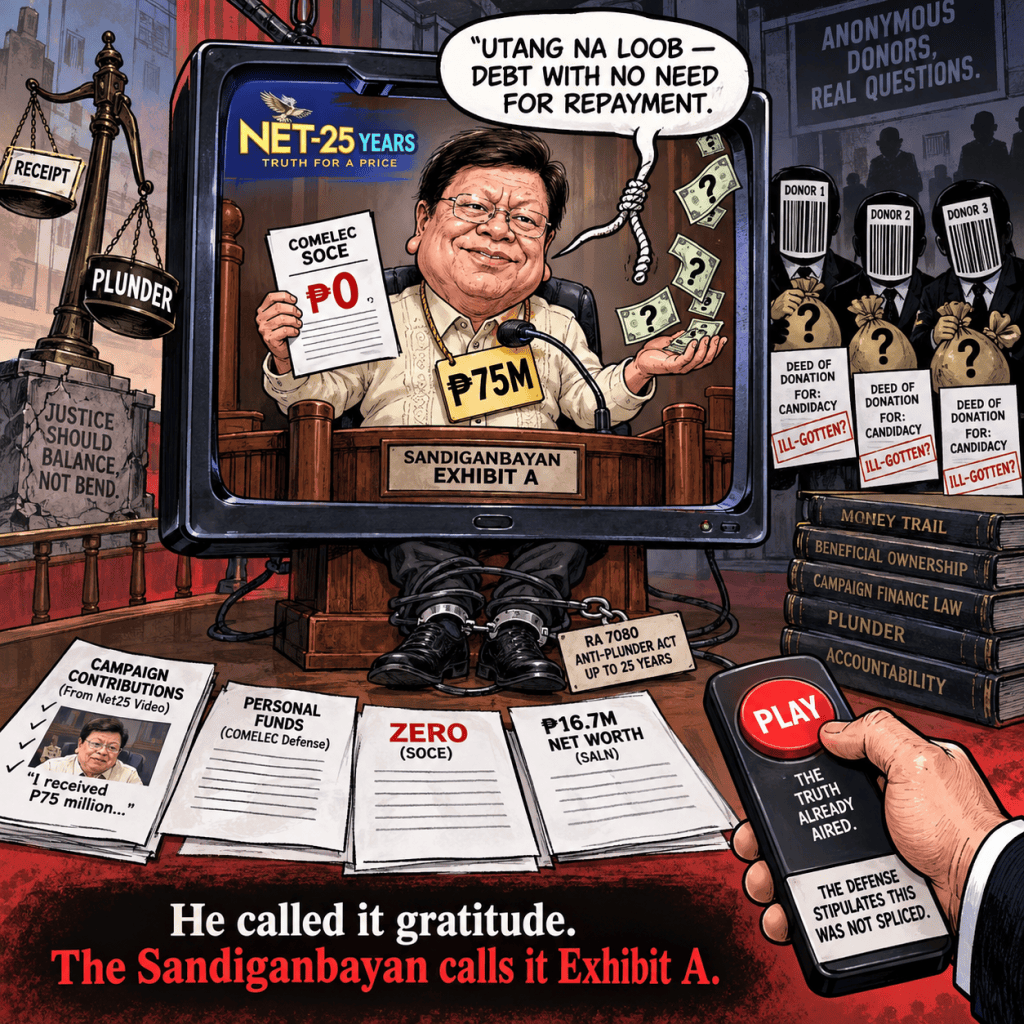
He Called It Gratitude. The Sandiganbayan May Call It Plunder.
By Louis ‘Barok‘ C. Biraogo — September 16, 2026
LET me see if I’ve got this right.
A sitting congressman goes on his own television network, admits to receiving P75 million from anonymous “friends,” explains that he deliberately declared zero contributions in his official campaign documents to protect their identities, and calls the whole thing “utang na loob”—a debt of gratitude with no repayment required.
And his defense strategy is… what, exactly?
That this is all perfectly legal because the money came from private citizens?
That’s not a defense. That’s a confession with a legal citation.
The Video That Launched a Thousand Bail Hearings
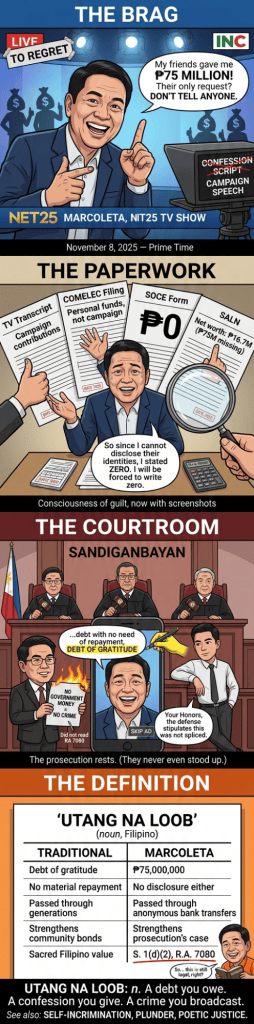
The video, from his November 8, 2025 program on Iglesia ni Cristo (INC)-owned Net25, contains the kind of admission prosecutors usually extract through months of witness testimony and forensic accounting.
Marcoleta said it himself, unprompted, on air:
“My friends really gave me contributions. Do you know what their only request was? Just one: ‘Please accept our help’—I was a congressman then—’Cong, we believe you deserve to reach the Senate, please accept this amount.’ There were many of them. They only had one request of me: that I would not disclose their identities.”
That’s not a soundbite. That’s a prima facie case, delivered in prime time.
The defense stipulated that the person in the video was Marcoleta and that it was not spliced. That’s not a tactical concession—that’s a strategic surrender on authentication, leaving them fighting on much more hostile terrain.
The Legal Architecture of a Very Expensive “Gift”
Let’s dispense with the defense’s most popular talking point: “There was no government money involved.”
Under Republic Act No. 7080 (Anti-Plunder Act), Section 1(d)(2), “ill-gotten wealth” includes funds acquired:
“By receiving, directly or indirectly, any commission, gift, share, percentage, kickbacks or any other form of pecuniary benefit from any person and/or entity in connection with any government contract or project or by reason of the office or position of the public officer concerned.”
Notice what’s missing: the word “government.”
The statute expressly contemplates private money as the source of ill-gotten wealth. The threshold is P50 million under current jurisprudence—though the law’s text, as amended by Republic Act No. 7659 (Death Penalty Law), retains the P75 million figure, and Marcoleta’s alleged haul sits right at that number.
So when Mike Defensor argues that plunder requires stolen public funds, he’s either lying or he hasn’t read the statute he’s being prosecuted under.
P75 million from private “friends” is not a defense. It’s the predicate act.
The “Utang na Loob” Defense: A Cultural Value or a Criminal Admission?
Marcoleta’s own words paint a picture prosecutors couldn’t have scripted better.
He explained that his donors told him: “Treat it as debt… debt with no need for repayment, debt of gratitude.”
He then explained why he declared zero contributions:
“So since I cannot disclose their identities, I stated zero contributions. I will be forced to write zero.”
He’s not saying he forgot to disclose. He’s not saying he misunderstood the form. He’s saying he made a deliberate choice to conceal the money because disclosure would require naming the donors.
That’s not a clerical error. That’s consciousness of guilt, captured on video, voluntarily broadcast to the entire country.
The defense will argue that anonymity is not itself illegal. True—donors can want privacy for legitimate reasons.
But here’s the question the Sandiganbayan must answer:
Why would three individuals hand P75 million to a sitting congressman and insist on anonymity?
The prosecution’s answer: because the money wasn’t legitimate, and they knew it.
The defense’s answer: because privacy is a virtue.
One of these explanations is more plausible than the other.
The “Personal Funds” Houdini Act
Commission on Elections (COMELEC) witness Victoria Kadeja Besinio testified that Marcoleta’s verified position paper characterized the P75 million as “personal funds”—received in his personal capacity, not earmarked for campaign purposes, and received before the campaign period.
But wait.
The video shows Marcoleta calling it “campaign contributions” and explaining he spent it on his Senate bid.
His Statement of Contributions and Expenditures (SOCE) shows P112.9 million in campaign expenditures—with P75 million in contributions declared as zero.
His December 2025 Statement of Assets, Liabilities and Net Worth (SALN) shows a net worth of only P16.7 million, with the P75 million conspicuously absent.
So let me get this straight:
- On TV: “campaign contributions”
- To COMELEC: “personal funds, not campaign-related”
- In SOCE: zero
- In SALN: also zero
- In actual campaign spending: P112.9 million
The money was real. The spending was real. The disclosure was… creative.
Besinio’s cross-examination revelation that COMELEC “did not determine if it is an election contribution or personal funds” is the defense’s best fact. But that qualification means COMELEC didn’t decide. It doesn’t mean COMELEC decided the money was personal. It means the election body punted.
The Ombudsman picked up the ball.
The “COMELEC Cleared Me” Canard
The defense pushes a narrative that COMELEC already investigated and found no election offense.
COMELEC’s jurisdiction concerns election law. Plunder under RA 7080 and gift prohibition under Presidential Decree No. 46 (PD 46) are criminal statutes within the Ombudsman’s mandate.
A COMELEC dismissal doesn’t bar criminal prosecution for plunder. The legal standards are different, the elements are different, the institutional mandates are different.
The defense’s argument is essentially: “The traffic cop said I wasn’t speeding, so the murder charge should be dismissed.”
It’s a category error dressed up as a jurisdictional challenge.
What the Video Actually Proves (And What It Doesn’t)
What the video establishes:
- Identity: Marcoleta was the speaker. Conceded by defense.
- Authenticity: The video was not spliced. Conceded by defense.
- Receipt: Marcoleta admitted receiving P75 million.
- Purpose: He called it campaign contributions.
- Concealment: He admitted declaring zero because of the anonymity condition.
What the video does not automatically establish:
- That the money was given “by reason of his office”—the statutory nexus under Section 1(d)(2).
- That the three transactions constituted a “series or combination” of criminal acts rather than three gifts.
- That the donors conspired with Marcoleta—the res inter alios acta rule protects co-accused from Marcoleta’s statements unless independent conspiracy evidence exists.
- That the money was “ill-gotten” in the legal sense, rather than merely undisclosed.
The video is devastating on receipt and concealment. It is merely suggestive on criminal characterization.
The prosecution’s job is to bridge that gap with financial records, donor testimonies, tax filings, and evidence of the official nexus.
The defense’s job is to argue that the video proves receipt and nothing more.
The Conspiracy Problem
Marcoleta’s admission is powerful against Marcoleta. It is not automatically powerful against Defensor, Espiritu, and Viray.
Under Rule 130, Section 31 of the Rules of Court, as amended, the admission of a conspirator is admissible against co-conspirators only after the conspiracy is shown by evidence other than such admission.
The prosecution needs independent evidence that the three donors coordinated, that they knew Marcoleta would conceal the money, and that they participated in a common criminal scheme.
What might that look like?
- Bank records showing coordinated transfers
- Communications between the donors
- Evidence that the donors had government transactions involving Marcoleta
- Proof that the timing was not coincidental
- The deeds of donation themselves, which reportedly stated the money was for Marcoleta’s candidacy
The deeds are a start. But deeds are documents, not conspiracy.
The prosecution needs to show these three men didn’t just independently decide to give money—they acted together, with a common understanding of what the money was for and how it would be concealed.
That’s a higher evidentiary bar than the video alone can clear.
The Official Nexus: The Bridge the Prosecution Must Cross
Section 1(d)(2) of Republic Act No. 7080 (Anti-Plunder Act) requires that the gift be received “by reason of the office or position of the public officer concerned.”
This is the bridge.
Marcoleta’s defense will argue: “They gave me money because they believed in my candidacy, not because I was a congressman.”
But here’s the problem: he was a sitting congressman when he received the money. He said so himself on television.
The donors weren’t supporting a private citizen running for office. They were supporting an incumbent lawmaker with existing government influence and future legislative power.
The prosecution can argue that the “debt of gratitude” Marcoleta acknowledged is precisely the kind of ongoing obligation the plunder law criminalizes. A P75 million “debt” from private businessmen to a sitting congressman is not a favor. It’s a lien on his future official acts.
The defense will counter: “But there was no quid pro quo. No contract. No favor requested.”
They’re right—there’s no evidence of a specific transaction.
But Section 1(d)(2) doesn’t require a quid pro quo. It requires that the gift be received “by reason of” the office. The statute criminalizes the creation of the obligation, not just its fulfillment.
That’s the theory. The question is whether the Sandiganbayan will buy it.
The Bail Hearing: Where “Strong Evidence” Meets “Reasonable Doubt”
For plunder, bail is not a matter of right when evidence of guilt is strong. The prosecution bears the burden of showing the evidence would likely result in conviction if uncontroverted.
The video is the prosecution’s anchor—the accused’s own words, voluntarily broadcast, establishing the fact of receipt and the fact of concealment.
That’s powerful at the bail stage, where the standard is probable cause, not proof beyond reasonable doubt.
But the defense doesn’t need to prove innocence. It needs to create reasonable doubt about the statutory elements—specifically, whether the money was given “by reason of office” and whether the transactions constituted a “series of criminal acts” rather than three isolated gifts.
The defense’s strongest argument: the video proves receipt but not plunder. That’s legally correct. Receipt of P75 million from private citizens is not, by itself, a crime. The crime requires that the money be “ill-gotten” through a statutory predicate act.
The prosecution must connect the dots.
The Political Dimension: INC, Impeachment, and the 2028 Chessboard
Marcoleta is the first INC senator in Philippine history. INC staged a three-day protest at EDSA when charges were filed. The bloc’s political weight is not a legal fact, but it’s a political reality every institution in the case is navigating.
Marcoleta himself has framed the prosecution as retaliation for his flood-control investigations and his potential role as a senator-judge in Vice President Sara Duterte’s impeachment trial.
The timeline is… suggestive.
July 3, 2026: Plunder case filed.
July 6, 2026: Impeachment trial begins.
July 6, 2026: Arrest warrant issued.
If Marcoleta is detained during the impeachment trial, he cannot serve as a senator-judge. That’s a political fact with institutional consequences.
But here’s the thing: political motivation doesn’t make the evidence go away.
The video exists. Marcoleta said what he said. The SOCE shows what it shows.
The defense can argue selective prosecution until they’re blue in the face. The prosecution can respond that the evidence came from Marcoleta’s own mouth—not from investigators’ speculation, not from political opponents, but from the accused himself.
That’s the prosecution’s narrative advantage: “We didn’t have to build a case. He gave us one.”
The PD 46 Problem: The Charge Nobody’s Talking About
While the plunder case dominates headlines, Marcoleta and his co-accused also face separate charges under PD 46, which prohibits public officials from receiving gifts by reason of their office.
PD 46 is broadly drafted. It doesn’t require a quid pro quo. It doesn’t require government funds. It simply criminalizes the receipt of gifts “by reason of official position.”
Marcoleta has already posted bail on the PD 46 charges. But those charges provide an independent legal basis for liability even if the plunder case fails.
The defense’s “no government money” argument doesn’t defeat PD 46. The “no quid pro quo” argument doesn’t defeat PD 46. The “utang na loob” argument definitely doesn’t defeat PD 46.
A P75 million “gift” to a sitting congressman is not a birthday present. It’s exactly what PD 46 was written to prohibit.
The Bottom Line: A Confession in Search of a Crime (Or a Crime in Search of a Defense)
The Marcoleta video is the most important piece of evidence in this case. It’s also not enough by itself.
It establishes receipt, concealment, and consciousness of guilt. It does not establish official nexus, conspiracy, or criminal series—the elements the prosecution must prove beyond reasonable doubt at trial.
But at the bail stage, where the standard is probable cause, the video is devastating.
The defense’s best argument is not that the video is fake—they’ve conceded authenticity. Their best argument is that receipt is not plunder.
That’s legally correct. Receiving P75 million from private citizens is not, by itself, a crime.
But receiving P75 million from private citizens, concealing it from both COMELEC and the public, calling it “campaign contributions” on television while calling it “personal funds” to regulators, and describing it as a “debt of gratitude” owed to anonymous donors who insisted on secrecy?
That’s not just receipt. That’s a pattern. And patterns are what plunder prosecutions are made of.
The video has spoken. The defense has conceded.
Now the Sandiganbayan must decide: is this a man who received gifts, or a public officer who sold his office?
And if the answer is the latter, the only question left is how much time he has.
Key Citations
A. Legal & Official Sources
- Republic Act No. 7080. An Act Defining and Penalizing the Crime of Plunder. 12 July 1991, http://www.officialgazette.gov.ph/1991/07/12/republic-act-no-7080/.
- Republic Act No. 7659. An Act to Impose the Death Penalty on Certain Heinous Crimes, Amending for that Purpose the Revised Penal Laws, as Amended, Other Special Penal Laws, and for Other Purposes. 13 Dec. 1993, http://www.officialgazette.gov.ph/1993/12/13/republic-act-no-7659/.
- Presidential Decree No. 46. Making it Punishable for Public Officials and Employees to Receive, and for Private Persons to Give, Gifts on any Occasion, including Christmas. 10 Nov. 1972, lawphil.net/statutes/presdecs/pd1972/pd_46_1972.html.
- The 1987 Constitution of the Republic of the Philippines. Official Gazette of the Republic of the Philippines, 1987, http://www.officialgazette.gov.ph/constitutions/1987-constitution/.
- Supreme Court of the Philippines. 2019 Amendments to the 1989 Revised Rules on Evidence. A.M. No. 19-08-15-SC, 8 Oct. 2019 (eff. 1 May 2020), Rule 130, sec. 31, http://www.lawphil.net/courts/rules/am_19-08-15-sc_2019.html.
- Commission on Elections. Statement of Contributions and Expenditures (SOCE). http://www.comelec.gov.ph/?r=CampaignFinance/SOCE.
B. News Reports
- Mendoza, J. E. “Marcoleta’s Remarks on Television Shown during Plunder Bail Hearing.” Inquirer.net, 14 Sept. 2026, newsinfo.inquirer.net/2304651/marcoletas-remarks-on-television-shown-during-plunder-bail-hearing.
- “Ombudsman Files Plunder Raps vs Marcoleta, 3 Others over Alleged P75-M Undeclared Donations.” Manila Bulletin, 3 July 2026, mb.com.ph/2026/07/03/ombudsman-files-plunder-raps-vs-marcoleta-3-others-over-alleged-p75-m-undeclared-donations.
- Cantos, Joy. “Video ni Marcoleta, Iprinisinta ng Ombudsman.” Philstar.com / Pang-Masa, 15 Sept. 2026, http://www.philstar.com/pang-masa/police-metro/2026/09/15/2556400/video-ni-marcoleta-iprinisinta-ng-ombudsman.
- ₱9 Billion in ‘Savings’? DILG’s Fire Truck Deal Smells Like Smoke

- ₱8B BBM Pork: CCTV for Every Captain’s Kumpare?

- ₱8.9 Billion, 331 Ghost Police Stations: The TIKAS Scandal Explained

- ₱8.4 Billion, 42,000 Barangays, 1 Election: The “Bawat Barangay Makikinabang” Vote-Buying Masterclass

- ₱75 Million Heist: Cops Gone Full Bandit

- ₱63 to the Dollar: The Only Thing Falling Faster Than the Peso Is the Government’s Credibility

- ₱6.77B Ghost Haunts Duterte: RTC Dismisses Mans Carpio’s Desperate Plea
- ₱6.77 Billion and Zero Cash: The Sara Duterte SALN Math That Doesn’t Add Up

- ₱6.7-Trillion Temptation: The Great Pork Zombie Revival and the “Collegial” Vote-Buying Circus

- ₱58.53B, Zero Receipts: The LGSF Pork Barrel Nobody Wants to Name
- ₱53 Million Man Tells ₱695-a-Day Workers to Stop Being ‘Mayabang’: The Audacity of BSP’s Remolona
- ₱4.4 Billion and a Witness Who Can’t Explain It: The Duterte Impeachment’s Most Expensive Non-Answer






Leave a Reply