
She Declared It. She Denied It. Davao City Paid It. Welcome to the Philippines’ Favorite New Game Show: ‘Whose Company Is It Anyway?’
By Louis ‘Barok’ C. Biraogo — September 16, 2026
LET’S start with a simple question: If you swear under oath that you own something, do you own it? Or does the Securities and Exchange Commission (SEC) get to decide you’re wrong?
Welcome to the latest episode of “Philippine Constitutional Law: Choose Your Own Adventure,” where Vice President Sara Duterte has somehow managed to be simultaneously a shareholder and not a shareholder of Gencorp Industries Inc., depending on which government document you happen to be reading at the moment. It’s Schrödinger’s Portfolio. The quantum superposition of Statements of Assets, Liabilities, and Net Worth (SALN) declarations.
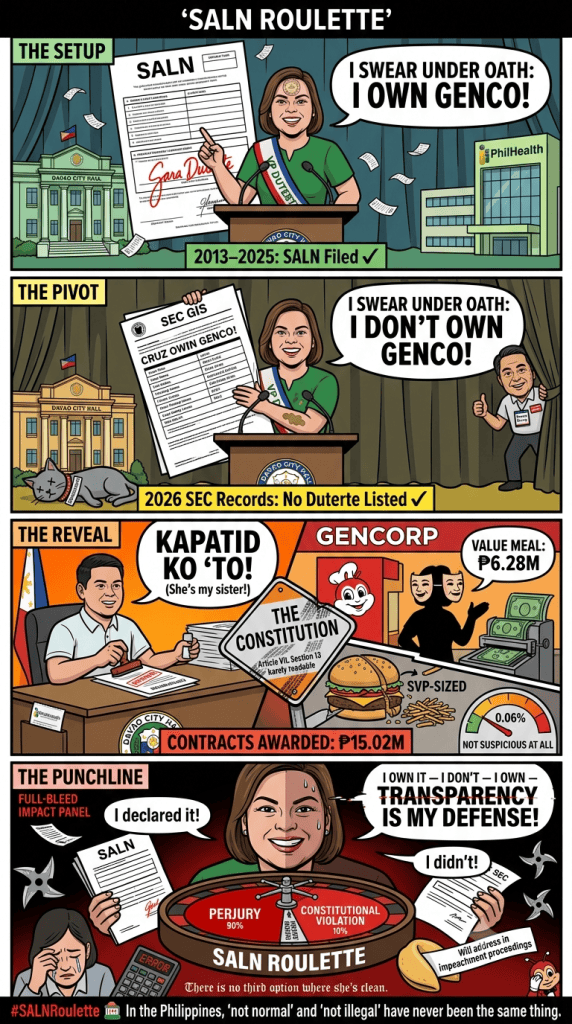
The Rappler report dropped a grenade last week: Gencorp Industries Inc., a company Sara Duterte has repeatedly listed as a business interest in her SALNs, received approximately ₱15.02 million in government food and catering contracts from 2022 to 2025—₱14.32 million from Davao City Hall and ₱696,829 from the Philippine Health Insurance Corporation (PhilHealth)’s Davao regional office. The contracts were awarded while Sara was Vice President. The Davao City contracts were awarded while her brother, Sebastian “Baste” Duterte, was Mayor.
Nothing to see here, folks. Just a completely normal business arrangement between a family-owned catering company and a local government run by the same family. The Philippine equivalent of a lemonade stand, if the lemonade stand had a ₱6.28 million single contract and the local health insurance office as a repeat customer.
The Constitutional Problem You Can’t Spin Away
Let’s get the boring legal stuff out of the way first, because the Duterte defense team is already furiously drafting the “no, you see, it’s actually fine” memo.
Article VII, Section 13 of the 1987 Constitution of the Republic of the Philippines (1987 Constitution) is unusually clear for a document drafted by people who generally preferred ambiguity. It says the President, Vice President, Cabinet members, and their deputies “shall not, during said tenure, directly or indirectly, practice any other profession, participate in any business, or be financially interested in any contract with, or in any franchise, or special privilege granted by the Government or any subdivision, agency, or instrumentality thereof.”
Read that again. “Directly or indirectly.” “Be financially interested in any contract.” Not “intervene in.” Not “use influence to steer.” Not “personally sign the purchase order.” The 1987 Constitution doesn’t care whether you were hands-on. It cares whether you had a financial interest. Full stop.
The Supreme Court in Civil Liberties Union v. Executive Secretary emphasized that these restrictions on the President and official family are “deliberately sweeping” and stricter than those imposed on ordinary officials. The rationale is simple: with great power comes greater temptation, and the 1987 Constitution decided to foreclose the temptation entirely rather than trust in the personal virtue of politicians. A bold choice, admittedly, but there you have it.
Now, Sara’s SALNs—her own sworn declarations—list Gencorp as a business interest from 2013 onward. Her 2024 and 2025 filings identify her as a stockholder, with the helpful notation that Gencorp was formerly Timesquare Bee Foods Corp., which was formerly Great Jolly Times Food Corp.. She swore to this. Repeatedly. Under penalty of law.
But here’s the twist: SEC corporate records reportedly do not list Sara Duterte as a shareholder or corporate officer of Gencorp. The 2026 General Information Sheet (GIS) identifies the shareholders as Jaime T. Cruz, Kimberly Justine Y. Cruz, Ricci Evette L. Cruz, Nathan Zachary L. Cruz, Gerlie S. Cruz, and JTC Group of Companies. The Cruz family. Not the Dutertes.
So either:
- Sara Duterte perjured herself in her SALN by claiming an interest she didn’t have, or
- Gencorp perjured itself in its SEC filings by omitting a shareholder who actually existed, or
- We’re dealing with a nominee arrangement so obvious that it practically has a neon sign reading “BENEFICIAL OWNERSHIP, DO NOT QUESTION.”
Representative Terry Ridon put it bluntly:
“Either the Vice President perjured herself in this particular statement in the SALN or GenCorp Industries perjured themselves when they submitted the list of stockholders’ names hindi po kasama si Vice President Sara Duterte.”
The Duterte camp’s response? Spokesperson Paolo Panelo denied she used her position to secure contracts and said the issues would be addressed in impeachment proceedings. Translation: “We’ll get back to you when we’ve figured out a narrative that doesn’t involve our client being caught in a sworn-statement contradiction.”
The Jaime Cruz Nexus: When Your Business Partner Is Also Your Special Envoy
Let’s talk about Jaime T. Cruz, because this is where the plot thickens from “unfortunate coincidence” to “forensic accountants, start your engines.”
Cruz is listed as a Gencorp shareholder and a member of the JTC Group of Companies, which reportedly shares an address with Gencorp. He was also appointed by Rodrigo Duterte as Special Envoy to China for Trade and Investments in 2019. One of the Gencorp officers, Kimberly Cruz, reportedly accompanied Jaime Cruz on a Japan business delegation with then-President Duterte. Rodrigo Duterte reportedly offered Cruz top PhilHealth posts in 2019.
And Gencorp’s franchise? Jollibee Bolton—the Duterte family’s reportedly favorite hangout. A receipt from the establishment shows it’s owned by Gencorp. The same building houses Gencorp’s offices.
This is the part where the defense says “association is not proof of conspiracy,” and they’re technically correct. But when the same family that receives government contracts is also the family that appointed the business partner to a diplomatic post, and the business partner’s company shares an address with the contracting company, and the contracting company’s franchise is the First Family’s preferred fried chicken venue, you don’t need a conspiracy charge to raise an eyebrow. You need a forensic audit and a very large spreadsheet.
Ridon noted that Gencorp’s revenue reportedly grew from nearly ₱30 million in 2021 to between ₱300 million and ₱400 million by 2024—a tenfold increase—while maintaining profit margins of 0.06% to 0.08%, far below industry standards of 4% to 6% for fast-food restaurants. A company that generates hundreds of millions in revenue but barely turns a profit is either spectacularly bad at business or doing something other than maximizing shareholder value. Like, say, serving as a conduit for something else.
The SALN Contradiction: Sworn Statements and the “Honest Mistake” Defense
At the impeachment trial, Ombudsman records officer Karen Batu testified that Sara Duterte declared business interests in numerous corporations over the years but consistently failed to declare the value of her shares of stock. Senator Sherwin Gatchalian raised the possibility that her net worth was underdeclared as a result.
Here’s the funny thing about SALN forms: they have a “personal property” section that requires acquisition cost. Stocks are personal property. The prosecution argues that Sara should have listed the acquisition cost of her shares there. The defense argues that the form doesn’t have a specific column for business acquisition cost. Presiding Officer Chiz Escudero, displaying the kind of legal acumen that makes you wonder why he wasn’t on the Supreme Court, noted that he personally lists his law firm shares under personal property. So it’s apparently possible.
More interesting: Sara declared zero cash on hand or in bank from 2019 onward. A public official with multiple business interests, a husband who’s a lawyer, and a net worth that rose from ₱7.25 million in 2007 to ₱98.66 million in 2025 apparently had no cash. None. Zero. Either she’s been living on air and political donations, or the cash is somewhere the SALN doesn’t capture—which is, coincidentally, exactly where the 1987 Constitution says it shouldn’t be.
The Procurement Question: Small-Value Procurement and the Magic of Contract Splitting
The ₱6.28 million single contract in September 2023 is the one that should keep procurement officials up at night. Under Republic Act No. 9184 (Government Procurement Reform Act), the small-value procurement (SVP) threshold for first-class cities was ₱1 million. Under the newer Republic Act No. 12009 (New Government Procurement Act), it’s ₱2 million. A ₱6.28 million contract cannot legally be a single SVP award. So either it was aggregated from multiple smaller purchases—which raises the contract-splitting question—or it was procured through a different modality that the reports haven’t clarified.
The Supreme Court has repeatedly treated contract splitting as a serious procurement irregularity, particularly when the same supplier receives repeated awards for the same purpose divided into smaller amounts to stay below thresholds. The Avanceña v. Commission on Audit case is instructive: the Court found liability where procurement officials resorted to SVP inappropriately and split contracts.
Deputy Speaker Paolo Ortega called it a “red flag,” describing schemes where “one supplier, one local government unit (LGU)” operate under rotating corporate names while the same person pulls the strings. He didn’t provide specific documents proving that pattern in Gencorp’s case, but the description fits the timeline uncomfortably well.
Of course, SVP is not inherently corrupt. It’s a lawful modality designed for efficiency. A catering company can legitimately win repeated contracts because it’s convenient, capable, and competitive. But when the catering company is owned by people connected to the local chief executive’s family, and the local chief executive’s sister is the Vice President with a declared interest in the company, “competitive” starts to look a lot like “predetermined.”
The Beneficial Ownership Elephant in the Room
Here’s the thing about the SEC discrepancy that the Duterte camp is probably counting on: the absence of Sara’s name from corporate records doesn’t automatically exonerate her. It might actually make things worse.
RA 12009, the New Government Procurement Act, introduced beneficial ownership disclosure requirements precisely because corporate records can be structured to conceal true control. The law defines a beneficial owner as a natural person who ultimately owns the corporation, dominantly influences management or policies, or exercises ultimate effective control. The Government Procurement Policy Board (GPPB) has noted that 71.6% of bidders in a 2023 survey were related to government officials. The law exists because nominee arrangements are a known problem.
If Sara Duterte had a beneficial ownership interest in Gencorp—meaning she controlled it, influenced it, or economically benefited from it—then the absence of her name from a GIS is not a defense. It’s evidence of concealment. The question isn’t whether she’s listed as a shareholder. The question is whether she was, in substance, a shareholder. And her own SALN says she was.
The defense can argue: “She declared it! That’s transparency!” But transparency in a SALN about a business interest you’re constitutionally prohibited from having while in office is not a defense. It’s a confession with better penmanship.
What Would Actually Settle This
The Senate impeachment court doesn’t need to rely on political narratives or Rappler reports. It has subpoena power. Here’s what would actually answer the central question:
From Gencorp: The complete stock and transfer book. Historical GIS filings. Beneficial ownership declarations. Audited financial statements. Bank statements. Dividend records. Shareholder loan agreements. Any document showing who actually received money from the company.
From Sara Duterte: Personal bank statements. Income tax returns. Capital gains declarations. Stock transfer documents. Evidence of divestment, if any. Communications with Baste, procurement officials, or Gencorp management regarding contracts.
From Davao City: Every purchase request, Bids and Awards Committee (BAC) resolution, abstract of quotations, notice of award, purchase order, delivery receipt, inspection report, disbursement voucher, and check related to Gencorp from 2022 to 2025. The complete Philippine Government Electronic Procurement System (PhilGEPS) posting history. The procurement plan for each relevant year.
From PhilHealth Davao: Same documentation for the ₱696,829 in contracts.
If Sara genuinely divested before becoming Vice President, there should be share transfer documents, tax filings, and bank records showing the sale. If she retained beneficial ownership through nominees, the money trail will eventually show where the economic benefit flowed. Corporate records can be structured. Bank records are harder to fake at scale.
What the Money Trail Will Eventually Confess
The Gencorp controversy is not complicated at its core. The 1987 Constitution prohibits the Vice President from having a financial interest in government contracts. Sara Duterte’s own SALN says she had a financial interest in Gencorp. Gencorp received government contracts during her vice presidency. Either her SALN is accurate, in which case she violated the 1987 Constitution, or her SALN is false, in which case she committed perjury. There is no third option where she’s clean.
The defense’s best hope is that the Senate decides the SALN was simply an outdated declaration of a historical interest that was properly divested at some unspecified point, documented in records that somehow never made it to the SEC, and that the ₱15 million in contracts were awarded through pristine procurement processes that just happened to favor a company connected to the First Family of Davao.
Stranger things have happened in Philippine politics. But not many.
The impeachment trial continues. The SEC director is scheduled to testify. The money trail, if it’s ever fully reconstructed, will tell the story that political statements cannot. Until then, we’re left with a Vice President who swears she owned something that the SEC says she didn’t, collecting contracts from a city government run by her brother, while insisting it’s all perfectly normal.
It’s not. But in the Philippines, “not normal” and “not illegal” have never been the same thing.
Key Citations
A. Legal & Official Sources
- The 1987 Constitution of the Republic of the Philippines. Official Gazette of the Republic of the Philippines, 1987, http://www.officialgazette.gov.ph/constitutions/1987-constitution/.
- Article VII, Section 13. The 1987 Constitution of the Republic of the Philippines. Official Gazette of the Republic of the Philippines, http://www.officialgazette.gov.ph/constitutions/the-1987-constitution-of-the-republic-of-the-philippines/the-1987-constitution-of-the-republic-of-the-philippines-article-vii/.
- Civil Liberties Union v. Executive Secretary, G.R. Nos. 83896 & 83815. Supreme Court of the Philippines, 22 Feb. 1991, lawphil.net/judjuris/juri1991/feb1991/gr_83896_1991.html.
- Republic Act No. 9184. An Act Providing for the Modernization, Standardization and Regulation of the Procurement Activities of the Government and for Other Purposes (Government Procurement Reform Act). 10 Jan. 2003, lawphil.net/statutes/repacts/ra2003/ra_9184_2003.html.
- Republic Act No. 12009. An Act Revising Republic Act No. 9184, Otherwise Known as the “Government Procurement Reform Act”, and for Other Purposes (New Government Procurement Act). 20 July 2024, lawphil.net/statutes/repacts/ra2024/ra_12009_2024.html.
- Avanceña v. Commission on Audit, G.R. No. 254337. Supreme Court of the Philippines, 18 June 2024, lawphil.net/judjuris/juri2024/jun2024/gr_254337_2024.html.
B. News Reports
- Cruz, James Patrick. “Sara Duterte’s Company Won Millions’ Worth of Contracts from Davao City Hall.” Rappler, 15 Sept. 2026, http://www.rappler.com/newsbreak/investigative/sara-duterte-company-food-contractor-davao-city/.
- De Leon, Dwight. “Sara Duterte Trial: Can a VP Have Business Interests?” Rappler, 15 Sept. 2026, http://www.rappler.com/philippines/sara-duterte-trial-can-vice-president-have-business-interests/.
- Begas, Billy. “May Discrepancy? Ridon Says Company Records Don’t Match Sara Duterte’s SALN.” Politiko, 21 Apr. 2026, https://politiko.com.ph/2026/04/21/may-discrepancy-ridon-says-company-records-dont-match-sara-dutertes-saln/headlines/and. Accessed 16 Sept. 2026.
- de Leon, Dwight. “Sara Duterte Declared Businesses, Not Stocks’ Value.” Rappler, Day Month Year, http://www.rappler.com/philippines/sara-duterte-trial-declared-busineses-not-stocks-value/. Accessed 16 Sept. 2026.
- ₱8B BBM Pork: CCTV for Every Captain’s Kumpare?

- ₱8.9 Billion, 331 Ghost Police Stations: The TIKAS Scandal Explained

- ₱8.4 Billion, 42,000 Barangays, 1 Election: The “Bawat Barangay Makikinabang” Vote-Buying Masterclass

- ₱75 Million Heist: Cops Gone Full Bandit

- ₱6.77B Ghost Haunts Duterte: RTC Dismisses Mans Carpio’s Desperate Plea
- ₱6.7-Trillion Temptation: The Great Pork Zombie Revival and the “Collegial” Vote-Buying Circus

- ₱53 Million Man Tells ₱695-a-Day Workers to Stop Being ‘Mayabang’: The Audacity of BSP’s Remolona

- ₱3.06 Billion for Evacuation Centers—But Nobody Knows Where They’ll Stand (Or If They’ll Exist)

- ₱10B Ghost in New Clark City: Matibag’s Haunted Séance for Cayetano

- ₱1.9 Billion for 382 Units and a Rooftop Pool: Poverty Solved, Next Problem Please

- ₱1.35 Trillion for Education: Bigger Budget, Same Old Thieves’ Banquet

- ₱1 Billion Congressional Seat? Sorry, Sold Out Na Raw — Si Bello Raw Ang Hindi Bumili









Leave a comment