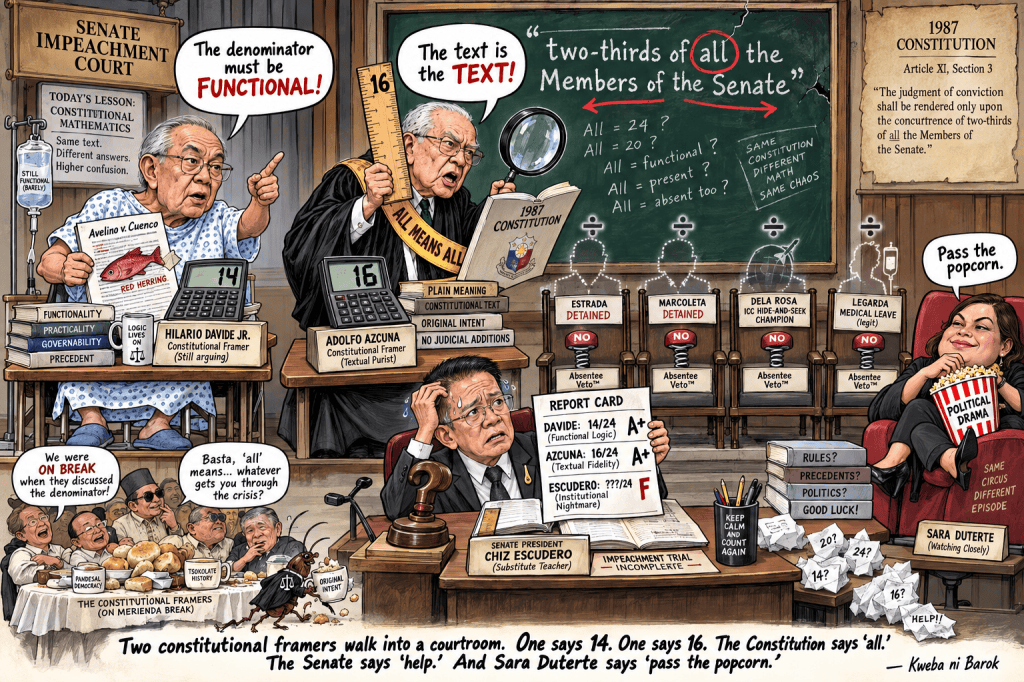
Two men. One Constitution. Two irreconcilable math problems. The Senate is now taking oral arguments on a question the framers apparently forgot to settle over merienda.
By Louis ‘Barok‘ C. Biraogo | September 16, 2026
So let me get this absolutely clear: the Philippine Senate is currently engaged in a constitutional debate over whether “all the Members of the Senate” actually means all the Members of the Senate. This is apparently a difficult question. Former Chief Justice Hilario Davide Jr., a man who literally helped write the 1987 Constitution of the Republic of the Philippines (1987 Constitution), says no. Retired Associate Justice Adolfo Azcuna, who also helped write it, says yes. Both men were in the room. Both men presumably read the same text. And yet here we are.
This is what happens when you let constitutional framers testify as amici curiae: you get the judicial equivalent of two parents disagreeing about what they meant when they told the kids “clean your room.”
The Math Is Easy. The Logic Is Not.
Let’s start with the arithmetic, because that’s the only part anyone agrees on.
Article XI, Section 3(6) of the 1987 Constitution says:
“No person shall be convicted without the concurrence of two-thirds of all the Members of the Senate.”
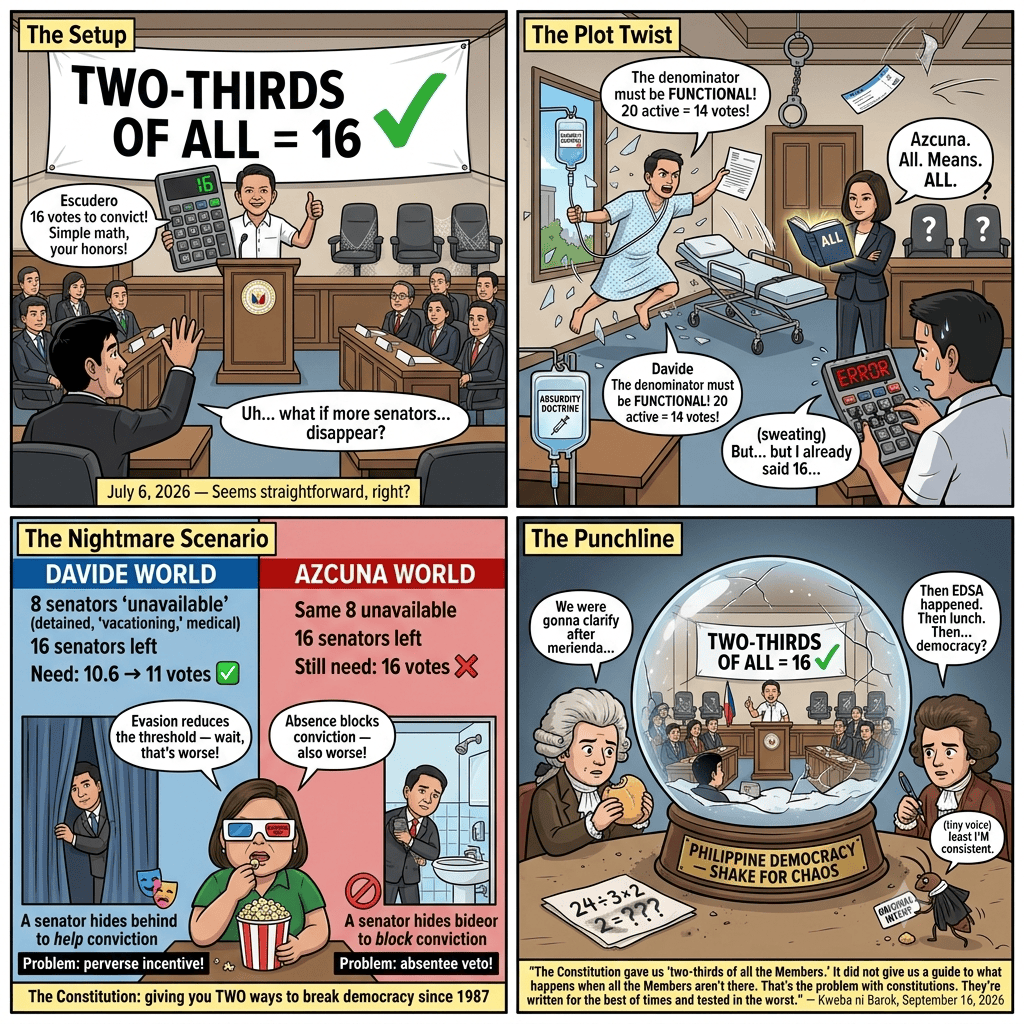
The Senate has 24 members. Two-thirds of 24 is 16. Senate President Chiz Escudero ruled as much on July 6. Case closed, right?
Except: four senator-judges are currently unable to participate in the impeachment trial of Vice President Sara Duterte. Jinggoy Estrada and Rodante Marcoleta are in detention on plunder charges. Ronald “Bato” dela Rosa is somewhere not in the Philippines, apparently avoiding an International Criminal Court (ICC) arrest warrant. Loren Legarda is abroad on medical leave. That leaves 20 active senators.
Davide’s position, submitted via memorandum because he’s recovering from a medical procedure (which, ironically, makes him a living example of the incapacity principle he’s advocating), is that the denominator should be the number of senators “qualified to vote,” not the full 24.
If he’s right, and all four are excluded, the math becomes: 20 × 2/3 = 13.33 → 14 votes to convict.
If he’s wrong, it’s 16 votes regardless of whether only 15 senators show up.
This matters. A lot.
The Specter of the Absentee Veto
Let’s play out the worst-case scenario, because that’s what constitutional interpretation is for.
Suppose eight senators become unavailable. Not through any dramatic constitutional crisis—just the ordinary chaos of Philippine politics. Detentions, medical emergencies, sudden foreign “vacations.” Under the fixed-24 interpretation, you now need 16 votes from a maximum of 16 available senators. Every single one must vote to convict. Miss one, and the respondent walks.
Suppose nine become unavailable. Fifteen senators remain. Two-thirds of 24 is still 16. Conviction is mathematically impossible. The Senate still has jurisdiction. The evidence could be overwhelming. The respondent could be caught on video stealing the treasury while kicking a puppy. Doesn’t matter. Acquittal by arithmetic.
Senator Erwin Tulfo, who raised the appeal, called this an “acquittal by default.” He’s right, though the more precise legal term is “failure to satisfy the constitutionally prescribed supermajority.” The practical effect is identical: absence becomes a functional veto.
Davide’s response is essentially: that’s absurd, and the Constitution should not be interpreted to produce absurd results. Fair enough. The absurdity doctrine is real. Courts invoke it.
But here’s the problem: absurdity is in the eye of the beholder. Azcuna looked at the same scenario and saw not absurdity, but deliberate constitutional design.
Azcuna’s Counterargument: The Supermajority as Safeguard
Azcuna’s position is refreshingly straightforward: “All means all.” The Constitution says “two-thirds of all the Members of the Senate,” not “two-thirds of all Members who bother to show up” or “two-thirds of all Members not currently detained or hiding abroad.”
The supermajority requirement, he argues, is not an accident. It’s a protection. Impeachment conviction removes a democratically elected official from office and disqualifies them from future public service. That’s a profound exercise of power. The framers wanted it to be difficult. They wanted a “higher proof of consensus” than routine legislative business.
This is not a crazy argument. It’s actually the more textually faithful one. The Constitution says what it says. If the framers wanted “two-thirds of those present” or “two-thirds of participating senator-judges,” they knew how to write those words. They used similar formulations elsewhere. Article VI, Section 16 uses “majority of each House” for quorum—a participation-based concept. Article XI, Section 3(6) deliberately uses “all the Members.” That distinction is not nothing.
Azcuna also made a subtle point about Avelino v. Cuenco, the 1949 case Davide relies on. That case involved quorum under the 1935 Constitution, which used different language (“majority of the Senate,” not “all the Members”). Extending its functional logic to the impeachment conviction threshold is, Azcuna suggests, a category error.
The Avelino Problem
Speaking of Avelino, Davide’s reliance on it is instructive—and instructive in the way that a magician’s misdirection is instructive.
Avelino involved two senators who couldn’t attend a session: one hospitalized, one in the United States. The Court held that 12 of the remaining 22 constituted a valid quorum to elect a Senate President. Davide says this supports excluding functionally incapable senators from the denominator.
But here’s the thing: quorum and conviction threshold are not the same constitutional animal. Quorum determines whether the body can conduct business. The conviction threshold determines whether the body can remove an official from office. One is procedural. The other is substantive and consequential.
The DivinaLaw analysis put it well: “Whether legal principles governing one calculation can alter the other” is precisely the question. The answer is not obviously yes.
Davide himself acknowledged this limitation, conceding that Avelino was “not directly controlling” but had “persuasive value.” Translation: “My strongest precedent doesn’t quite fit, but it’s the best I’ve got.”
The Trillanes Red Herring
Davide also invoked Trillanes IV v. Pimentel, the 2008 case where the Supreme Court refused to let detained Senator Antonio Trillanes leave prison to perform his senatorial duties.
This proves… what exactly?
Trillanes established that being elected to the Senate does not automatically free you from detention. It did not establish that detention causes you to cease being a Senator. In fact, it assumed the opposite: Trillanes was a Senator. He just couldn’t exercise all the functions of the office while in jail.
If anything, Trillanes cuts against Davide’s broader theory. If Trillanes remained a “Member of the Senate” while detained—and he did, constitutionally speaking—then why should Estrada or Marcoleta suddenly cease being Members for purposes of Article XI, Section 3(6)?
Davide’s answer appears to be: they don’t cease being Members, but they cease being qualified Members for this particular constitutional purpose. That’s a subtle distinction, and it may be legally sound. But it’s not what the text says. It’s what Davide thinks the text should say to avoid absurdity.
The Carpio Intervention: Detained Senators Can’t Hold Office
Former Supreme Court Senior Associate Justice Antonio Carpio waded into this debate with a characteristically blunt statement: “A senator who is a detention prisoner cannot hold public office… Necessarily, he cannot be included in determining any quorum or majority vote.”
Carpio cited People v. Maceda (2000), which held that prisoners—whether under preventive detention or serving sentence—cannot practice their profession, engage in business, or hold office.
This is a strong argument, but it proves too much. If detained senators “cannot hold public office,” then they’re not just excluded from the impeachment denominator—they’ve effectively vacated their seats. Is that the position? If so, the Senate should declare vacancies and call special elections. If not, then they remain Members for all constitutional purposes, including Article XI, Section 3(6).
You can’t have it both ways. Either detention terminates membership, or it doesn’t. Carpio’s formulation suggests the former but doesn’t follow through on the implications.
The Dela Rosa Problem: When Absence Is Strategic
Here’s where Davide’s theory gets genuinely uncomfortable.
Ronald dela Rosa is not detained. He’s not hospitalized. He’s reportedly evading an ICC arrest warrant. He’s making himself unavailable.
Under Davide’s framework, Dela Rosa should be excluded from the denominator because he’s “outside Philippine jurisdiction” or his “whereabouts are unknown.” Fine. But consider the incentive structure this creates.
If absence reduces the denominator, then more absences make conviction easier. A senator who wants to avoid conviction for an ally could… stay away. A senator who wants to ensure conviction could… encourage absences among the opposition.
Now flip it: if the fixed-24 interpretation holds, absence makes conviction harder. A senator who wants to protect an ally could… stay away. A senator who wants to protect themselves could… encourage allies to stay away.
Neither rule is immune to strategic manipulation. The question is which manipulation is more tolerable.
Davide’s rule rewards evasion by reducing the threshold for conviction, which seems perverse. The fixed-24 rule allows evasion to frustrate accountability, which is also perverse.
There is no clean answer here. There is only constitutional text and the institutional incentives it creates.
The “Changing the Rules Mid-Trial” Objection
Escudero’s initial ruling established 16 votes as the threshold. The trial has been proceeding on that basis. Now, after four senators have become unavailable, the court is reconsidering.
The defense will inevitably argue—if it hasn’t already—that changing the denominator mid-trial is procedurally unfair. They’re right, in a narrow sense. The rules of the game shouldn’t change after the game has started.
But the counterargument is equally strong: if the initial interpretation was constitutionally wrong, continuing to apply it merely because proceedings began under it perpetuates the error. Courts correct erroneous interlocutory rulings all the time. Stare decisis doesn’t apply to a Senate presiding officer’s procedural ruling.
What the Supreme Court Will Probably Do (If It Gets the Chance)
The 2026 Generillo decision held that the Senate, as a co-equal constitutional body, cannot be controlled by mandamus absent grave abuse of discretion. The Court emphasized the Senate’s autonomy in impeachment matters.
This suggests the Supreme Court will be reluctant to intervene. But “reluctant” is not “never.” If the Senate adopts a threshold that produces a constitutionally questionable conviction—or acquittal—the Court may feel compelled to act. The expanded judicial review under Article VIII, Section 1 allows review for grave abuse of discretion. Constitutional interpretation can qualify.
The most likely scenario: the Senate resolves the issue itself, one way or another, and the Supreme Court declines to second-guess unless the outcome is egregiously wrong.
The Real Question Nobody Wants to Ask
Here’s what this debate is really about, stripped of the constitutional theory and the amicus briefs and the procedural arcana:
Should a senator who has done nothing—who has not heard the evidence, examined the witnesses, or participated in the deliberations—be able to determine the outcome of an impeachment trial?
Azcuna says yes, at least in the sense that such a senator counts toward the denominator. The senator’s absence makes conviction harder, which is a consequence of the supermajority requirement, not a flaw in it.
Davide says no. A senator who never participated cannot meaningfully adjudicate. Counting them toward the threshold gives their absence the weight of a vote—an uninformed, default “no.”
Both positions have logic. Both have problems.
Azcuna’s logic preserves the text but can produce paralysis. Davide’s logic preserves functionality but requires reading words into the Constitution that aren’t there.
The Framers’ Intent: A Note of Caution
Davide’s strongest rhetorical card is his status as a framer. He was there. He knows what they meant.
But constitutional interpretation does not reduce to one framer’s recollection. The Constitution derives its authority from ratification by the people, not from the private understandings of the men who drafted it. If the text says “all the Members,” and the ratifying public understood that to mean what it says, then Davide’s intent—however sincere—doesn’t override the text.
This is not to dismiss his perspective. It’s to contextualize it. Framers’ intent is evidence. It’s not a trump card.
Bottom Line
The Senate impeachment court is scheduled to vote on this threshold question after oral arguments on September 23. The likely outcome, based on institutional incentives and the procedural difficulty of reversing a standing ruling mid-trial, is that Escudero’s 16-vote threshold survives.
But the debate has exposed a genuine constitutional tension: between fixed institutional structures and functional governance. The Constitution says “all the Members.” It doesn’t say what to do when some Members cannot function.
Davide has forced the Senate to confront that gap. Azcuna has reminded it that the text is the text. The senator-judges will have to choose.
Whatever they choose, one thing is certain: the number that emerges will not be neutral. It will determine not just whether Sara Duterte is convicted, but what “impeachment” means in the Philippine constitutional order going forward. A rule designed to protect accountability could become a mechanism for evading it. A rule designed to ensure deliberation could become an instrument of paralysis.
The Constitution gave us “two-thirds of all the Members.” It did not give us a guide to what happens when all the Members aren’t there.
That’s the problem with constitutions. They’re written for the best of times and tested in the worst.
Louis ‘Barok’ C Biraogo is not a lawyer, which he considers a feature and not a bug. He writes from the Kweba, where the only thing thinner than the constitutional text is the ice.
Key Citations
A. Legal & Official Sources
- The 1987 Constitution of the Republic of the Philippines. Official Gazette of the Republic of the Philippines, 1987, http://www.officialgazette.gov.ph/constitutions/1987-constitution/.
- The 1987 Constitution of the Republic of the Philippines, Article VI. Official Gazette of the Republic of the Philippines, http://www.officialgazette.gov.ph/constitutions/the-1987-constitution-of-the-republic-of-the-philippines/the-1987-constitution-of-the-republic-of-the-philippines-article-vi/.
- The 1987 Constitution of the Republic of the Philippines, Article VIII. Official Gazette of the Republic of the Philippines, http://www.officialgazette.gov.ph/constitutions/the-1987-constitution-of-the-republic-of-the-philippines/the-1987-constitution-of-the-republic-of-the-philippines-article-viii/.
- The 1987 Constitution of the Republic of the Philippines, Article XI. Official Gazette of the Republic of the Philippines, http://www.officialgazette.gov.ph/constitutions/the-1987-constitution-of-the-republic-of-the-philippines/the-1987-constitution-of-the-republic-of-the-philippines-article-xi/.
- Avelino v. Cuenco. G.R. No. L-2821, Supreme Court of the Philippines, 4 Mar. 1949, lawphil.net/judjuris/juri1949/mar1949/gr_l-2821_1949.html.
- People v. Maceda. G.R. Nos. 89591-96, Supreme Court of the Philippines, 24 Jan. 2000, lawphil.net/judjuris/juri2000/jan2000/gr_89591_2000.html.
- Trillanes IV v. Pimentel. G.R. No. 179817, Supreme Court of the Philippines, 27 June 2008, lawphil.net/judjuris/juri2008/jun2008/gr_179817_2008.html.
- Generillo, Jr. v. Senate of the Philippines. G.R. No. 278311, Supreme Court of the Philippines, 29 Apr. 2026, sc.judiciary.gov.ph/wp-content/uploads/2026/04/20250429-Press-Briefer-GR-No-278311-Generillo-v-Senate-updated-as-of-Apr-29-2026-530pm.pdf.
B. News Reports
- Bacelonia, Wilnard, and Jose Cielito Reganit. “Davide: Impeachment Vote Base Should Only Count Qualified Senators.” Philippine News Agency, 16 Sept. 2026, https://www.pna.gov.ph/articles/1284139. Accessed 16 Sept. 2026.
- “Azcuna: Convicting VP Needs 16 Votes, Unless…” Philstar.com, 22 June 2026, http://www.philstar.com/headlines/2026/06/22/2536901/azcuna-convicting-vp-needs-16-votes-unless.
- “Detained Senator Can’t Hold Public Office – Carpio.” Philstar.com, 8 June 2026, http://www.philstar.com/headlines/2026/06/08/2533563/detained-senator-cant-hold-public-office-carpio.
- “For Davide, 16 Votes Not Necessarily Required to Convict Sara Duterte.” Philstar.com, 16 Sept. 2026, http://www.philstar.com/headlines/2026/09/16/2556685/davide-16-votes-not-necessarily-required-convict-sara-duterte.
- “LIVE UPDATES: Sara Duterte Impeachment Trial | Sept. 16, 2026.” Inquirer.net, 16 Sept. 2026, http://www.inquirer.net/489663/live-updates-sara-duterte-impeachment-trial-sept-16-2026/.
- Mordeno, H. Marcos C. “Senator Erwin Tulfo Asks Court to Resolve Vote Threshold Issue.” MindaNews, 8 Sept. 2026, mindanews.com/top-stories/2026/09/senator-erwin-tulfo-asks-court-to-resolve-vote-threshold-issue/.
- “Very Powerful Protectors.” Philippine Daily Inquirer, 15 Sept. 2026, opinion.inquirer.net/194439/very-powerful-protectors.
- ₱9 Billion in ‘Savings’? DILG’s Fire Truck Deal Smells Like Smoke

- ₱8B BBM Pork: CCTV for Every Captain’s Kumpare?

- ₱8.9 Billion, 331 Ghost Police Stations: The TIKAS Scandal Explained

- ₱8.4 Billion, 42,000 Barangays, 1 Election: The “Bawat Barangay Makikinabang” Vote-Buying Masterclass

- ₱75 Million Heist: Cops Gone Full Bandit

- ₱63 to the Dollar: The Only Thing Falling Faster Than the Peso Is the Government’s Credibility

- ₱6.77B Ghost Haunts Duterte: RTC Dismisses Mans Carpio’s Desperate Plea

- ₱6.77 Billion and Zero Cash: The Sara Duterte SALN Math That Doesn’t Add Up

- ₱6.7-Trillion Temptation: The Great Pork Zombie Revival and the “Collegial” Vote-Buying Circus

- ₱58.53B, Zero Receipts: The LGSF Pork Barrel Nobody Wants to Name

- ₱53 Million Man Tells ₱695-a-Day Workers to Stop Being ‘Mayabang’: The Audacity of BSP’s Remolona

- ₱4.4 Billion and a Witness Who Can’t Explain It: The Duterte Impeachment’s Most Expensive Non-Answer









Leave a Reply