Malacañang Swears the Money Is Real—Just Like Those 14 Flood-Control Projects the DOJ Confirmed Were Never Built
By Louis “Barok” C. Biraogo — August 25, 2026
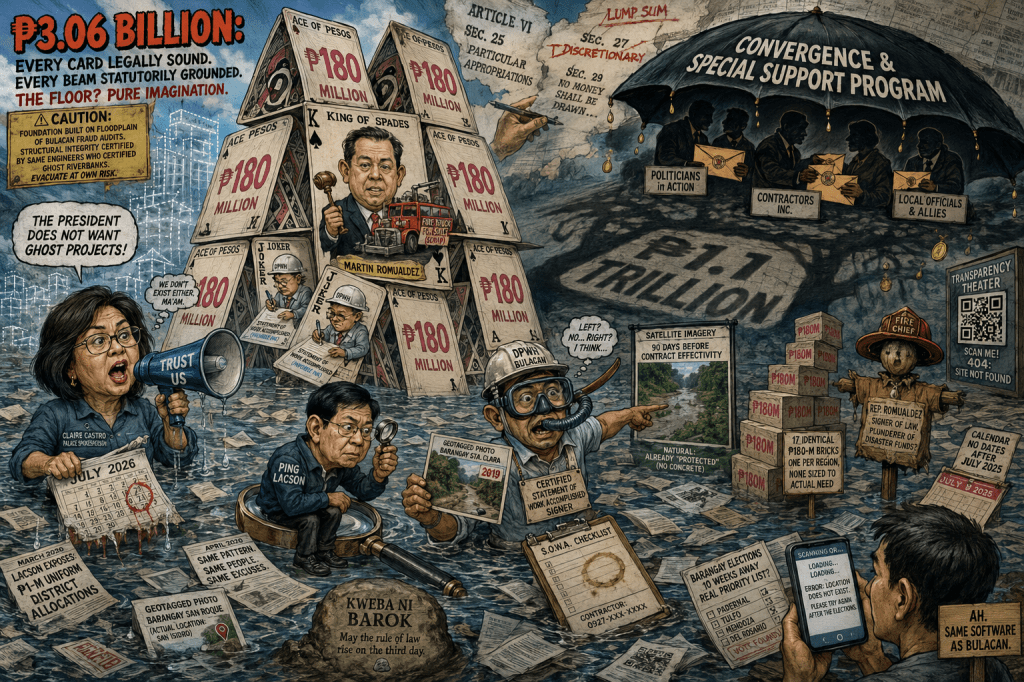
THERE is a species of lie, favored by politicians worldwide, that is technically not a lie at all. It is an architectural falsehood—a structure built from true materials that, when assembled, creates something fundamentally deceptive. The ₱3.06-billion Ligtas Pinoy Centers allocation in the proposed 2027 National Expenditure Program is precisely such a structure. Every brick is legally sound. Every beam is statutorily grounded. And yet, standing before it, any Filipino who has watched the flood-control scandal unfold over the past twenty months can see the building for what it truly is: a house of cards constructed on a floodplain, defended by a Palace spokesperson who insists—with a straight face—that the water will never rise.

He Wrote the Law; They Wrote the Indictment
Republic Act No. 12076, the Ligtas Pinoy Centers Act, was signed on December 6, 2024. On paper, it is genuinely commendable. Every city and municipality is to receive a permanent, storm-resilient evacuation center. Structures must withstand 300 kph winds and magnitude-8.0 earthquakes. The National Disaster Risk Reduction and Management Council (NDRRMC) is designated lead implementer, with the Department of Public Works and Highways (DPWH) as construction arm.
The law contains its own internal clock: Section 11 requires implementing rules within ninety days. Section 8 requires a priority list of Local Government Units (LGUs), complete with timelines and budgetary requirements, within six months. These deadlines passed in April and July of 2025, respectively.
They were not met.
The Implementing Rules and Regulations (IRR) drafts circulated as late as June 2025. The Office of Civil Defense (OCD)’s regional rollouts of site-selection criteria were still being introduced region by region as late as July 2026—nearly a full year behind the statutory schedule. This is not implementation; this is an afterthought. And an afterthought is precisely what a corrupt bureaucracy produces when forced to pretend to care about a law it never intended to honor.
Now, here is where our story turns macabre. The enrolled bill that became RA 12076 bears the signature of then-Speaker Ferdinand Martin G. Romualdez. Twenty months later, the Office of the Ombudsman describes that same Romualdez as its “central figure” and “purported mastermind” in a plunder scheme that allegedly diverted ₱56 billion in kickbacks from flood-control projects between 2022 and 2025.
Read that again. The signature on RA 12076 belongs to a man who now faces serious allegations concerning the flood-control appropriations that preceded it. Whether those allegations prove true or not, the optics are uncomfortable: the lawmaker who championed disaster-resilient infrastructure now stands accused of undermining the very system he helped create.
The Uniform ₱180 Million: Lacson’s Signature Red Flag
On August 18, 2026, Senator Panfilo “Ping” Lacson—the Senate’s most credible budget auditor, a man who has spent two decades learning to spot the fingerprints of corruption on appropriations—flagged something peculiar about the ₱3.06-billion allocation.
Every region gets exactly ₱180 million. Not ₱179.8 million based on population density. Not ₱215 million based on typhoon frequency. Not ₱145 million based on existing evacuation capacity. Exactly. ₱180 million. Per region. Uniform.
A reasonable person might ask: what are the odds that all seventeen regions—from typhoon-battered Bicol to relatively sheltered Davao—require precisely identical disaster-preparedness investments? What are the odds that construction costs are exactly the same in Ifugao’s mountains and Manila’s reclaimed land?
The answer is zero. Uniformity at this scale is not a planning outcome; it is a political outcome. It is the signature of formula-based allocation designed to distribute money evenly across political territories—not according to need, but according to patronage potential. Lacson recognized this signature because he has seen it before. In 2020, he uncovered a uniform ₱1-million allocation across 42 congressional districts that turned out to be insertions dressed up as neutral formula funding. The pattern repeats because the incentives repeat.
The Constitutional Problem Nobody in Malacañang Wants to Discuss
Article VI, Section 25(2) of the 1987 Constitution requires appropriations to relate specifically to particular appropriations. Section 27(2) grants the President item-veto power—a power that presupposes items exist to be vetoed. Section 29(1) prohibits payment from the Treasury except pursuant to an appropriation made by law.
The ₱3.06-billion allocation is, by the Department of Budget and Management (DBM)’s own admission, a program with no disclosed sites. The OCD has not published the Section 8 priority list required by law. The DPWH formally requested the site list from OCD on August 10, 2026—six days before Lacson’s criticism, which is supposed to reassure us that implementation was already moving. But what it actually reveals is that, as of ten weeks before the Barangay and Sangguniang Kabataan Elections, the government still had not identified where these evacuation centers would be built.
This is not a technicality. It is the difference between an appropriation and a slush fund.
The Supreme Court’s jurisprudence in Belgica v. Ochoa (2013) struck down the congressional Priority Development Assistance Fund because legislators were identifying projects after enactment—a violation of separation of powers. Araullo v. Aquino III (2014), the DAP case, went further: the Court held that savings must be actual and existing, and that cross-border augmentation between branches is unconstitutional regardless of good intentions.
Malacañang’s defenders will argue—correctly, in the narrowest sense—that the Ligtas Pinoy allocation is executive-originated, not legislator-earmarked. No congressman has been caught slipping a specific site into the National Expenditure Program (NEP).
But this defense misses the forest for the trees—or, more precisely, the floodplain for the flood.
The question is not whether the allocation is legally distinguishable from the Priority Development Assistance Fund (PDAF). The question is whether an executive lump sum, with no disclosed sites, no published priority list, and a statutory deadline missed by a full year, is being administered with the kind of rigor that makes corruption structurally difficult. The answer, based on DPWH’s own recent history, is no.
The Bulacan Ghost: A Precedent Written in Concrete (or the Absence Thereof)
The Commission on Audit (COA) has already documented what the Bulacan First District Engineering Office did with flood-control funds. Well over ₱800 million across at least a dozen “riverbank protection” contracts. Some built at the wrong site. Some not built at all. Some falsely certified as accomplished via statements of work signed by DPWH engineers who, presumably, knew that no work had been accomplished.
This is not hypothetical. This is a documented, audited, prosecuted pattern of fraud. The Independent Commission for Infrastructure’s third interim report stated it bluntly: “The plunder of public funds happened right under [former Secretary Bonoan’s] nose.”
And now, the same DPWH regional and district engineering-office apparatus—the same offices, the same procurement rules, much of the same rank-and-file structure—is being asked to build evacuation centers under a law already a year behind its own deadlines.
Secretary Vince Dizon has replaced individual officials and imposed show-cause orders. Commendable. But replacing a few bad actors does not reform a system. It merely changes the cast. The script remains the same, and the ending is already written in the Bulacan fraud audit reports.
The CSSP Shadow: Where the Money Actually Goes
Here is a detail that will not appear in Malacañang’s press briefings:
The DPWH’s proposed ₱644-billion 2027 budget includes a ₱157.3-billion “Convergence and Special Support Program” (CSSP)—a catch-all category that funds access roads, tourism infrastructure, indigenous-community facilities, quarantine facilities, water systems, and, explicitly, evacuation centers, all under one umbrella.
This is the same category structure that former DPWH Secretary Rogelio “Babes” Singson flagged on August 17, 2026, as the vehicle for a previously undisclosed ₱1.1-trillion CSSP “shadow budget” running 2022–2024 alongside the ₱1.166-trillion flood-control appropriation of the same period.
Let that sink in. The government spent ₱1.1 trillion through a “special support program” that was not fully disclosed to the public, during the same period when—according to the Ombudsman—₱56 billion in kickbacks was being extracted from flood-control contracts.
And now, the same category structure is positioned to absorb the ₱3.06-billion Ligtas Pinoy allocation. Is the money ring-fenced under RA 12076’s site-selection process? Or is it fungible within the CSSP catch-all, the way the 2022–2024 funds allegedly were?
The NEP documents currently public do not answer this question. That is not an oversight. It is a feature.
Castro’s “Trust Us” Defense: The Weakest Argument in Philippine Fiscal History
Presidential Communications Office Undersecretary Claire Castro has offered what she considers a defense. It consists, essentially, of three assertions.
First, the allocation is legitimate and legally grounded. True, in the narrow sense. RA 12076 exists.
Second, the Marcos administration will not permit the funds to become ghost projects. This is a political assurance, not proof. Given that the same administration is currently investigating a scandal in which ghost projects have been independently established by the Department of Justice (DOJ), COA, and Ombudsman, the assurance carries approximately as much weight as a sandbag made of tissue paper.
Third, existing government mechanisms are sufficient to detect projects that are funded but not actually implemented. This is the proposition that most deserves scrutiny—and falls apart fastest under examination.
The Supreme Court’s ruling in Seville v. COA is devastating to any defense based on documentary completeness. The Court emphasized that government officers cannot simply rely on paperwork when circumstances require verification. A complete documentary file can itself be part of a fraudulent scheme.
The Bulacan ghost projects had documentation. They had statements of work accomplished. They had engineering certifications. They had all the paper a bureaucracy needs to justify payment. What they did not have was actual riverbank protection structures.
Castro’s assurance that “government has ways to see if a project was funded but not built” is technically true. The government has COA. It has the Ombudsman. It has the National Bureau of Investigation (NBI). It has the DOJ. What it apparently lacks is the political will to use these mechanisms before the money disappears.
The Political Economy of Discretionary Disaster Relief
Lacson has also raised the timing issue: 2027 is immediately before the 2028 national elections. But there is a more immediate concern. The allocation lands roughly ten weeks before the November 2, 2026 Barangay and Sangguniang Kabataan Elections.
This is not a coincidence. It is a pattern.
An infrastructure program with discretionary site selection, geographically dispersed projects, large contracts, politically influential local officials, government contractors, and highly visible ribbon-cutting opportunities is not merely a disaster-preparedness program. It is an electoral instrument waiting to be deployed. The fact that it is authorized by statute does not make it less vulnerable to political manipulation. It makes it more dangerous, because the legal framework provides cover.
What Would Actual Accountability Look Like?
It is not complicated. Before construction begins on any Ligtas Pinoy Center, the government should publicly disclose: the exact location, the hazard-risk assessment, the population served, the existing evacuation capacity, the land ownership, the detailed engineering design, the approved budget, the procurement mode, all bidders, the winning contractor, the beneficial owners, the contract price, and the inspection reports.
Each facility should have a permanent QR code containing all of this information, accessible to any Filipino with a smartphone. RA 12009, the New Government Procurement Act, emphasizes electronic procurement, transparency, and beneficial ownership disclosure. The technology exists. The law supports it. The only missing ingredient is the willingness to implement it.
And that is precisely what Malacañang is refusing to do.
The Bottom Line
The Palace is right on the narrow legal question. RA 12076 exists. The ₱3.06-billion allocation is not, in the strictest constitutional sense, a pork barrel. It is an executive-originated program with a statutory framework and administrative criteria.
But that is not the question that matters.
The question that matters is whether the Filipino people should trust the same DPWH bureaucracy that allegedly stole ₱56 billion from flood-control projects to now build evacuation centers under a law that is a year behind its own deadlines, with no disclosed sites, no published priority list, and a catch-all CSSP category already implicated in a trillion-peso shadow budget.
The answer is obvious. It is written in the Bulacan fraud audit reports. It is written in the Ombudsman’s plunder complaint against the man who signed the very law in question. It is written in the uniform ₱180-million allocation that bears no relationship to any actual disaster-risk assessment.
Claire Castro asks the public to trust that “the President does not want ghost projects to happen anymore.” But wanting is not the same as preventing. The evidence suggests that the ghost projects happened because the system was designed to let them happen—and that system has not fundamentally changed.
The best possible resolution is not complicated. Publish the sites. Publish the engineering studies. Publish the contractors. Publish the beneficial owners. Publish every peso. Independently inspect every structure. Let COA audit it. Let the Ombudsman investigate anomalies. Let courts determine guilt where evidence exists.
If the administration does that, Lacson’s challenge could become a mechanism for strengthening the Ligtas Pinoy program.
If it refuses, then the uniform ₱180-million allocations will continue to look less like a disaster-resilience strategy and more like an invitation to ask the question that haunted the flood-control scandal:
Where, exactly, did the money go?
And this time, the answer will not be found in a press release from Malacañang. It will be found in the silence of the sites that were never built, in the contracts that were never bid, and in the lives that were never saved.
The rule of law does not rise on assurances. It rises on evidence. And the evidence, so far, suggests that the only thing being constructed with confidence is another monument to impunity.
KWEBA NI BAROK
May the rule of law rise on the third day. 🪨
Key Citations
A. Reports & Studies
- Commission on Audit. Fraud Audit Reports on Bulacan Flood Control Projects. 2025–2026. https://www.bworldonline.com/spotlight/2026/02/16/730771/coa-files-4-fraud-audit-reports-worth-over-p275-million-for-bulacan-flood-control-projects-flags-ghost-projects-unauthorized-relocations-and-questionable-accomplishments/.
- Independent Commission for Infrastructure. Third Interim Report. 2026.
- Office of Civil Defense. Implementing Rules and Regulations of Republic Act No. 12076 or the “Ligtas Pinoy Centers Act.” Draft version, 6 June 2025, http://www.scribd.com/document/1000544776/20250606-IRR-RA-12076-FRM.
B. News Articles
- Ayeng, Raffy, and Lisa Marie Apacible. “Ghost Floodprojects Haunt ’27 Evac Funds.” Daily Tribune, 21 Aug. 2026, https://tribune.net.ph/2026/08/20/ghost-floodprojects-haunt-27-evac-funds. Accessed 25 Aug. 2026.
- “Ombudsman Special Panel Files Supplemental Complaint in Alleged ₱56-B Romualdez Case.” Manila Bulletin, 24 July 2026, https://mb.com.ph/2026/07/24/ombudsman-special-panel-files-supplemental-complaint-in-alleged-56-b-romualdez-case.
- Delgado, Raul. “Evacuation Center Law Hindered as IRR Draft Misses Six-Month Deadline.” Rappler, 14 June 2025, https://www.rappler.com/nation/ligtas-pinoy-centers-act-irr-draft-status-delay/. Accessed 25 Aug. 2026.
- Tamayo, Bernadette E. “Sites for Evacuation Centers Being Identified.” The Manila Times, 21 Aug. 2026, https://www.manilatimes.net/2026/08/21/news/national/sites-for-evacuation-centers-being-identified/2409510.
- Panti, Llanesca T. “COA Finds P344-M Bulacan Flood Control Projects as Ghost, Mismatched.” GMA News Online, 12 Nov. 2025, http://www.gmanetwork.com/news/topstories/nation/965797/coa-finds-p344-m-bulacan-flood-control-projects-as-ghost-mismatched/story/.
- “Palace Defends Uniform P180-Million Evacuation Center Allocation per Region.” The Filipino Times, 21 Aug. 2026, https://filipinotimes.net/latest-news/2026/08/21/palace-defends-uniform-p180-million-evacuation-center-allocation-per-region/.
C. Official Websites & Jurisprudence
- Republic Act No. 12076. 6 Dec. 2024. Supreme Court E-Library, https://elibrary.judiciary.gov.ph/thebookshelf/showdocsfriendly/2/98122.
- Philippines. The 1987 Constitution of the Republic of the Philippines. Official Gazette of the Republic of the Philippines, https://www.officialgazette.gov.ph/constitutions/1987-constitution/. Accessed 25 Aug. 2026.
- Belgica v. Ochoa. G.R. No. 208566, 19 Nov. 2013. Lawphil, https://lawphil.net/judjuris/juri2013/nov2013/gr_208566_2013.html.
- Araullo v. Aquino III. G.R. No. 209287, 1 July 2014. Lawphil, https://lawphil.net/judjuris/juri2014/jul2014/gr_209287_2014.html.
- Seville v. Commission on Audit. G.R. No. 177657, 20 Nov. 2012. Supreme Court E-Library, https://elibrary.judiciary.gov.ph/thebookshelf/showdocs/1/55368.
- Republic Act No. 12009. New Government Procurement Act. Government Procurement Policy Board, https://www.gppb.gov.ph/new-government-procurement-act-or-republic-act-no-12009/.
- ₱9 Billion in ‘Savings’? DILG’s Fire Truck Deal Smells Like Smoke

- ₱8B BBM Pork: CCTV for Every Captain’s Kumpare?

- ₱8.9 Billion, 331 Ghost Police Stations: The TIKAS Scandal Explained

- ₱8.4 Billion, 42,000 Barangays, 1 Election: The “Bawat Barangay Makikinabang” Vote-Buying Masterclass

- ₱75 Million Heist: Cops Gone Full Bandit

- ₱6.77B Ghost Haunts Duterte: RTC Dismisses Mans Carpio’s Desperate Plea

- ₱6.77 Billion and Zero Cash: The Sara Duterte SALN Math That Doesn’t Add Up

- ₱6.7-Trillion Temptation: The Great Pork Zombie Revival and the “Collegial” Vote-Buying Circus

- ₱58.53B, Zero Receipts: The LGSF Pork Barrel Nobody Wants to Name
- ₱53 Million Man Tells ₱695-a-Day Workers to Stop Being ‘Mayabang’: The Audacity of BSP’s Remolona

- ₱4.4 Billion and a Witness Who Can’t Explain It: The Duterte Impeachment’s Most Expensive Non-Answer
- ₱3.06 Billion for Evacuation Centers—But Nobody Knows Where They’ll Stand (Or If They’ll Exist)






Leave a Reply