Where Floodwaters Rise and Kickbacks Sink: Barok’s Guide to Subterranean Governance
By Louis ‘Barok‘ C. Biraogo — August 25, 2026
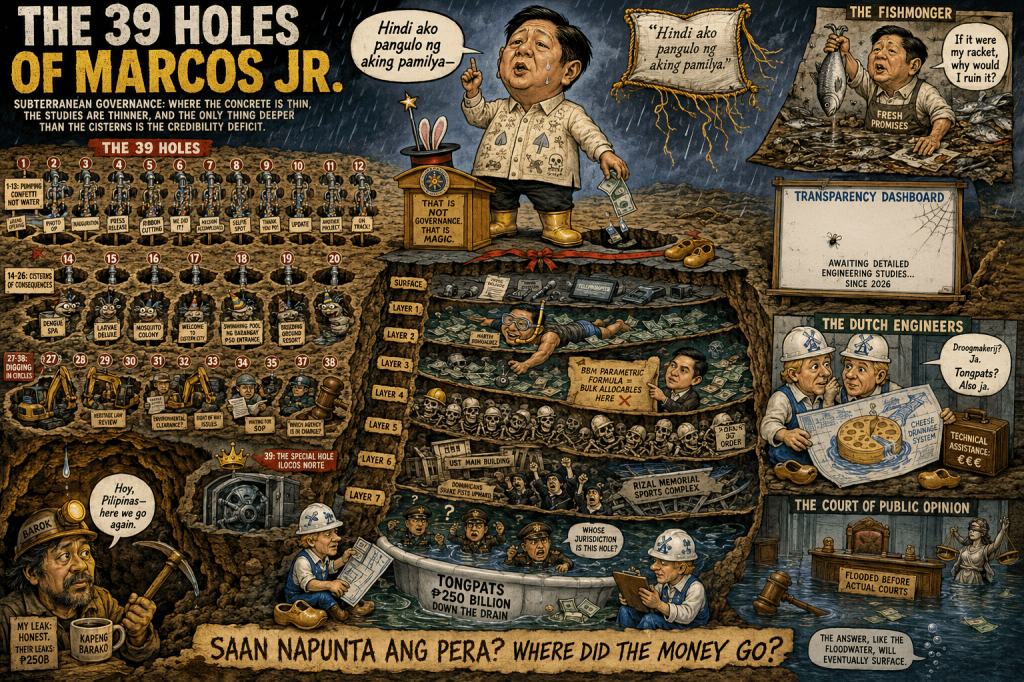
THE rain fell like a confession: heavy, relentless, impossible to ignore. In the flooded streets of Metro Manila, water reached the knees and despair reached the neck. Then our President emerged with a plan. Thirty-nine sites. Underground cisterns. Dutch engineers. Finally, we thought, a government that will make the water disappear—just like the P250 billion flood-control budget that vanished before our eyes.
I watched the announcement from my kweba, where the leaks are modest but the cynicism runs deep. And I thought: Hoy, Pilipinas, here we go again.
But here is the thing about holes. They reveal what is underneath. And as I dug into the 39 sites, I found not just hydrological engineering but the political archaeology of a presidency drowning in its own contradictions.
So sit down, pour yourself a cup of kapeng barako, and let us go spelunking into the sinkholes of power.

I. The Announcement: “Trust Me, I Am Not President of My Family”
President Ferdinand R. Marcos Jr. stood before the nation and declared, with a voice thick with sincerity:
It is a beautiful sentence. It would look lovely embroidered on a pillow, perhaps beside a picture of the flood-control scandal that has implicated his own cousin and former House Speaker Martin Romualdez. Or next to the P1 billion that his longtime aide, Undersecretary Jojo Cadiz, allegedly received on Romualdez’s instructions. Or framed above the district of his son, Sandro Marcos, which investigative reports say received the “bulk of allocable funds” under the now-infamous BBM Parametric Formula.
Hindi ako pangulo ng aking pamilya. True. He is the president of the family’s disappointed expectations. He discovered that those close to him allegedly swam in kickbacks, and now he must act shocked. It is the political equivalent of a fishmonger saying, “If it were my racket, why would I ruin it?” while standing ankle-deep in rotting bangus.
Mr. President, that is a logical fallacy. Self-interest in exposing corruption does not preclude earlier involvement, different forms of corruption, or the sudden realization that the racket got too loud to ignore.
II. The Legal Swamp: Announcing Without Authority
The President says the 39 sites include parks, sports complexes, military camps, and universities. Underground storage beneath existing facilities. Technical assistance from the Netherlands. Detailed engineering studies—wait, not yet. The studies are, in his own words, “awaiting detailed engineering studies.”
So let me get this straight: we have identified 39 holes before we know whether the holes can hold water. That is not engineering. That is wishful thinking with a Dutch accent.
But there is a deeper legal sinkhole. In MMDA v. Diamond Motor Corporation, the Supreme Court told the Metropolitan Manila Development Authority that it has no power of eminent domain. None. Zero. The MMDA cannot impose easements for flood control, cannot expropriate private property, cannot do much beyond coordinating, regulating, and issuing traffic advisories.
The President’s plan, however, does not require legal authority at the announcement stage. It only requires a podium and a functioning microphone. Later, when the bulldozers arrive at Camp Aguinaldo or the University of Santo Tomas, someone will have to explain which law allows the government to dig a giant cistern under a military headquarters without the AFP losing its mind, or under a 400-year-old university without the Dominicans losing theirs.
Perhaps the President believes that flooding is an act of God, and therefore eminent domain is unnecessary—God will just move the property lines.
III. Heritage Holes: UST, Rizal Memorial, and the Ghosts of Art Deco
Consider the University of Santo Tomas. Founded in 1611, it is older than Harvard, older than the United States, older than the idea that a President’s relative should be Speaker. And now UST might host an underground floodwater storage facility.
The National Cultural Heritage Act (RA 10066) requires prior written permission from the National Historical Commission before modifying, altering, or destroying the original features of any historic structure. Rizal Memorial Sports Complex, built in 1934, is an Art Deco jewel. Digging beneath it without permission could land someone in prison for ten years and cost a fine of at least P200,000. That is, coincidentally, roughly the cost of one ghost project’s ghost.
The President will likely respond: “We are not modifying the structure; we are merely excavating underneath it.” This is like saying you are not stealing a car, you are merely relocating its engine while the owner is at Mass. The law will not be fooled by geological gymnastics.
IV. The Corruption Archaeology: Ghost Projects and Missing Billions
Why should we be suspicious? Because the flood-control scandal is not a whisper in the rain. It is a thunderclap.
The Independent Commission for Infrastructure, created by the President himself, found what many of us suspected: ghost projects, substandard construction, inflated costs, and contractor concentration. Senator Panfilo Lacson estimates P180 billion was diverted to ghost projects. Greenpeace puts the potential total graft at P1 trillion. The AFP-PNP inspections uncovered 252 ghost projects. Thirty-plus individuals have been charged, including DPWH officials, Senator Jinggoy Estrada, and former Senator Bong Revilla.
And then there is the awkward matter of the President’s own circle. Allegations swirl around those close to him, though the cases remain under investigation. The President says he exposed the corruption himself. “No previous president acted on flood-control corruption,” he boasts. Factually, that may be true. But knowing about corruption and being part of the system that enabled it are not mutually exclusive.
Hindi ako pangulo ng aking pamilya. Perhaps not. But the family seems to have been running a very profitable flood-control franchise under his administration.
V. The Dutch Connection: Wooden Shoes and Tongpats
The Netherlands is sending technical assistance. This is, on its face, encouraging. The Dutch know water the way we know traffic. If anyone can design underground cisterns under a basketball court, it is the Dutch.
But let us not confuse technical assistance with moral absolution. The presence of Dutch engineers does not mean the project cannot be corrupted. It means the corruption will have better CAD drawings.
The Dutch have a word, droogmakerij, for reclaiming land from the sea. The Philippines has a word, tongpats, for the reason projects get overpriced. The two words are not interchangeable, but they often travel together in the same government contract.
The President says the 39 sites include wetlands, green corridors, river renaturation, bioretention, and mangrove rehabilitation. That is actually a good idea. The best modern flood management does not try to make water disappear; it asks, “Where can the water safely go, and how long can we keep it there?” That is a philosophical question worthy of a Dutch thesis. It is also a question that, if answered honestly, might reveal that some of the 39 sites are politically selected, hydrologically useless, or simply too expensive.
But the President does not want to answer that question yet. He wants to announce. He wants to cut ribbons. He wants to stand in the rain and look presidential while the water rises to his knees.
VI. What Could Possibly Go Wrong?
Let me count the ways the 39-site plan could become the next chapter in the flood-control scandal.
- White Elephant Cisterns. Expensive underground tanks that store insufficient water to make a meaningful difference. Or worse, they become underground swimming pools for mosquitoes and dengue.
- Maintenance Failure. A technically excellent facility becomes useless because pumps, gates, or sediment-management systems are neglected. We cannot even maintain our existing drainage canals; what makes us think we can maintain underground cisterns?
- Contractor Capture. The same network of politically connected contractors obtains the new projects. The President investigates the old contractors while handing new contracts to their cousins. The fish rotates, but the pond remains murky.
- Fragmented Planning. Each LGU builds something locally rational but collectively counterproductive. This is Metro Manila, where traffic is a metaphor for governance.
- Political Site Selection. Projects chosen for visibility or political advantage rather than hydrological value. The President’s son’s district suddenly becomes a flood-control priority. What a coincidence.
- Climate Under-Design. Infrastructure based on outdated rainfall assumptions. The President says rainfall intensity is increasing. So why design for yesterday’s storms?
- Accountability Displacement. The administration emphasizes new projects while the older corruption cases languish. The 252 ghost projects become ghosts indeed—unprosecuted, unexplained, unforgotten.
The last failure scenario is the most politically dangerous. It means the 39 sites are not a solution; they are a distraction.
VII. The Real Test: Transparency Above Ground
Barok would tell you, from the damp comfort of his kweba, that the measure of a society is not how it treats its rich, but how it treats its poor when the water rises to their necks. He would also tell you that the best investigative blogging is not about catching the liar—though that is always a satisfying hobby—but about asking the question the liar hopes you will not ask. Preferably while sipping something strong enough to wash away the stench of unaccounted billions.
So here is the question the President hopes we will not ask: Who will benefit from the 39 sites?
Not hydrologically. Politically. Financially.
Because if the answer is “the people of Metro Manila,” then the President should have no problem publishing the following for every one of the 39 sites: exact location, catchment area, storage capacity, design storm, expected reduction in peak flow, construction cost, lifecycle cost, maintenance cost, environmental assessment, heritage permits, procurement plan, implementation timetable, and independent engineering validation.
He should create a public dashboard showing:

That would transform the program from a presidential promise into an empirical public-policy experiment. It would also make it harder for the next ghost project to hide.
But the President has not done that. He has not even finished the engineering studies. He has given us a list of 39 sites and a Dutch accent. He has given us a press release and a cousin in legal trouble.
That is not governance. That is magic.
VIII. The Kweba Verdict
So what do we make of the 39 holes of Marcos Jr.?
On the substance, the idea of distributed floodwater storage is probably right. Metro Manila does need more retention, detention, wetlands, and green corridors. The old mentality of “pump it away as fast as possible” has reached its physical limit. Climate change is making rainfall more intense. The President is correct about that.
On the politics, however, he faces a credibility deficit so deep that no Dutch cistern can fill it. His administration exposed a massive corruption scandal in flood-control projects—and is now proposing another major generation of flood-control infrastructure. The contradiction is not proof of corruption, but it is an invitation to scrutiny. And scrutiny is not obstruction; it is the price of public trust.
On the law, the government has broad authority to act, but not unlimited discretion. The MMDA cannot expropriate. Heritage sites require permission. Procurement must be transparent. Anti-graft laws apply. Environmental impact assessments are mandatory. The President cannot simply announce 39 sites and expect the Constitution to genuflect.
On the corruption issue, the greatest danger is not that the 39-site concept is fraudulent. It is that a sound engineering concept becomes embedded in the same institutional ecosystem that allegedly produced ghost projects, defective works, and inflated contracts. The flood-control industrial complex is real. Every typhoon produces damage, public anger, emergency spending, new projects, contracts, contractors, political pressure, another flood, and more projects. If governance is weak, flooding becomes an enormous recurring market with perverse incentives. The proper metric is not ₱X billion spent; it is ₱X billion spent divided by measurable reduction in flood risk. By that metric, the Philippines has been flushing money down the drain for decades.
And there is a particular irony: the success of the 39-site program may ultimately depend less on how much concrete Marcos puts underground than on how much transparency he puts above ground. That is the real test. Not the Dutch engineers. Not the ribbon cuttings. Not the presidential inspections in a raincoat. But open data, competitive bidding, independent audits, functioning infrastructure, and measurable reductions in flood depth and duration.
The President said, “I am not president of my family.” Fine. Then prove it by prosecuting those responsible—fully, publicly, without backroom deals. Prove it by not awarding new flood-control contracts to the same network. Prove it by publishing the engineering studies before the groundbreaking. Prove it by treating the 39 sites as a public trust, not a family business.
Otherwise, the water will rise again. And we will drown—not in rain, but in the familiar stench of promises unkept and money unaccounted for.
From my kweba, I will watch the water rise and the announcements flow. And I will keep asking the question the President hopes we will not ask: Saan napunta ang pera? Where did the money go?
Because the answer, like the floodwater, will eventually surface.
— Barok out.
This blog is an analytical commentary based on public reports, legal documents, and current events. Allegations mentioned are allegations unless proven in court. But in the Philippines, the court of public opinion often floods before the actual court does.
Key Citations
A. Reports & Studies
- Lacson, Panfilo. “P180 billion lost to ghost flood control projects since 2016.” The Philippine Star, 3 Dec. 2025, https://www.philstar.com/headlines/2025/12/03/2491635/p180-billion-lost-ghost-flood-control-projects-2016-lacson.
- Greenpeace Philippines. “Flood control corruption an obscene plunder of much-needed climate funds.” Greenpeace, 28 July 2026, https://www.greenpeace.org/philippines/press/68522/flood-control-corruption-an-obscene-plunder-of-much-needed-climate-funds/.
- Philippine Center for Investigative Journalism. “One Year After the Flood-Control Speech: Probes, Protests, and the President’s Possible Culpability.” PCIJ.org, 26 July 2026, https://pcij.org/2026/07/26/one-year-after-the-flood-control-speech/.
B. News Articles
- “Marcos Jr: 13 more Metro pumping stations coming.” The Philippine Star, 21 Aug. 2026, https://www.philstar.com/headlines/2026/08/21/2550742/marcos-jr-13-more-metro-pumping-stations-coming.
- “Government picks 39 flood catchments as Manila braces for bigger downpours.” BusinessWorld Online, 20 Aug. 2026, https://bworldonline.com/the-nation/2026/08/20/771603/government-picks-39-flood-catchments-as-manila-braces-for-bigger-downpours/.
- Latoza, Guinevere. “‘Allocables’ Are the New Pork and Sandro Marcos and Martin Romualdez Are the Pork Barrel Kings.” Philippine Center for Investigative Journalism, 29 Nov. 2025, https://pcij.org/2025/11/29/allocables-are-the-new-pork/?hl=en-US.
- Chi, Cristina. “Zaldy Co Says He Personally Delivered P1 Billion in Kickbacks for Marcos.” Philstar.com, 24 Nov. 2025, https://www.philstar.com/headlines/2025/11/24/2489580/zaldy-co-says-he-personally-delivered-p1-billion-kickbacks-marcos. Accessed 25 Aug. 2026.
- “SC: MMDA has no power to expropriate private property.” Inquirer.net, 1 Mar. 2024, https://newsinfo.inquirer.net/1912341/sc-mmda-has-no-power-to-expropriate-private-property.
- “AFP flags 252 ‘ghost projects’ in joint inspection of flood control infra with PNP.” Manila Bulletin, 2 Dec. 2025, https://mb.com.ph/2025/12/02/afp-flags-252-ghost-projects-in-joint-inspection-of-flood-control-infra-with-pnp.
- Lalu, Gabriel Pabico. “Sona 2026: Marcos Says Cases vs Romualdez to Proceed.” INQUIRER.net, 27 July 2026, newsinfo.inquirer.net/2271595/sona-2026-marcos-says-cases-vs-romualdez-to-proceed.
C. Official Websites & Legal Documents
- Republic Act No. 10066. National Cultural Heritage Act of 2009. Lawphil.net, https://lawphil.net/statutes/repacts/ra2010/ra_10066_2010.html.
- Metropolitan Manila Development Authority v. Diamond Motor Corp. G.R. No. 203386, Supreme Court of the Philippines, 11 Oct. 2023. Lawphil Legal Resources.
- University of Santo Tomas. “History.” UST.edu.ph, https://www.ust.edu.ph/university-history/.
- “Rizal Memorial Sports Complex.” Wikipedia, https://en.wikipedia.org/wiki/Rizal_Memorial_Sports_Complex.
- “Flood control projects scandal in the Philippines.” Wikipedia, https://en.wikipedia.org/wiki/Flood_control_projects_scandal_in_the_Philippines.
- ₱9 Billion in ‘Savings’? DILG’s Fire Truck Deal Smells Like Smoke

- ₱8B BBM Pork: CCTV for Every Captain’s Kumpare?

- ₱8.9 Billion, 331 Ghost Police Stations: The TIKAS Scandal Explained

- ₱8.4 Billion, 42,000 Barangays, 1 Election: The “Bawat Barangay Makikinabang” Vote-Buying Masterclass

- ₱75 Million Heist: Cops Gone Full Bandit

- ₱63 to the Dollar: The Only Thing Falling Faster Than the Peso Is the Government’s Credibility

- ₱6.77B Ghost Haunts Duterte: RTC Dismisses Mans Carpio’s Desperate Plea
- ₱6.77 Billion and Zero Cash: The Sara Duterte SALN Math That Doesn’t Add Up

- ₱6.7-Trillion Temptation: The Great Pork Zombie Revival and the “Collegial” Vote-Buying Circus

- ₱58.53B, Zero Receipts: The LGSF Pork Barrel Nobody Wants to Name
- ₱53 Million Man Tells ₱695-a-Day Workers to Stop Being ‘Mayabang’: The Audacity of BSP’s Remolona
- ₱4.4 Billion and a Witness Who Can’t Explain It: The Duterte Impeachment’s Most Expensive Non-Answer








Leave a Reply