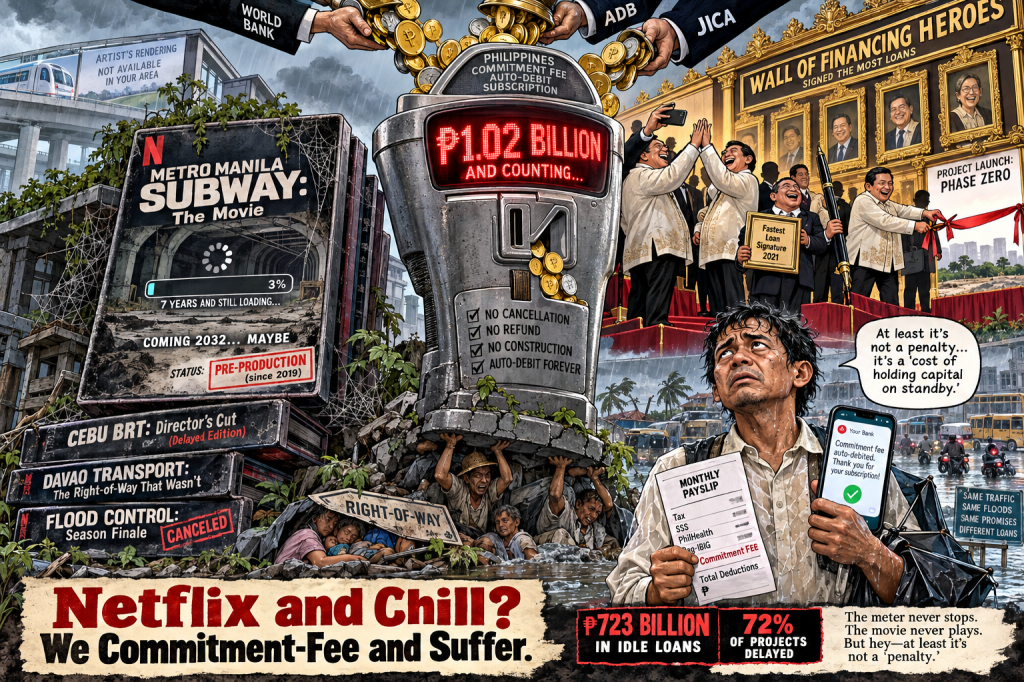
₱723 Billion in Idle Loans, 72% of Projects Delayed, and a Meter That Never Stops Running
By Louis ‘Barok’ C. Biraogo — October 6, 2026
The Philippine government paid about ₱1.02 billion in commitment fees in 2024 on foreign loans it had not drawn, including more than ₱202 million for projects that had not started. The charge is contractual, not a legal penalty, but idle balances, right-of-way delays, and deprogrammed counterpart funds leave taxpayers paying for infrastructure that is not being built.
MGA ka-kweba, countrymen, and fellow taxpayers who still have the audacity to expect functioning infrastructure—welcome back to the Cave.
Today we’re going to talk about a financial product so elegant, so wonderfully absurd, that it could only exist in the Philippines. It’s called a “commitment fee.” In the real world, it’s a small charge lenders impose on undrawn loan balances—a modest compensation for keeping money on standby. In the Philippines, it has evolved into something far more creative: a subscription service where we pay foreign banks for trains, subways, and flood control projects that we haven’t actually built.
Think of it as Netflix, except instead of movies, you’re paying for the right to maybe watch a movie at some indeterminate future date. Except the movie is a metro system. And the subscription fee is ₱1.02 billion. And the movie might never arrive.
Let’s dig into this glorious mess.
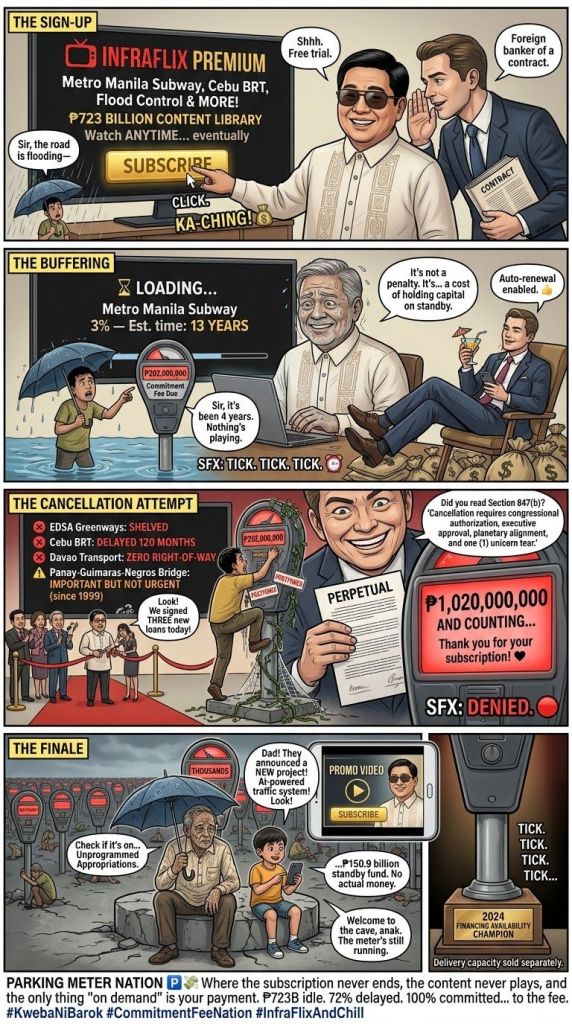
The Philippines is paying foreign banks ₱1.02B/year for projects that don’t exist. It’s not corruption. It’s a “subscription.” 📺💀
The Headline Numbers, or: How to Pay for Nothing and Like It
According to the Commission on Audit’s (COA) 2024 Official Development Assistance (ODA) Consolidated Audit Report, the Philippine government paid approximately ₱1.02 billion in commitment fees in 2024 alone—charges imposed on undisbursed foreign loan balances. Of that, more than ₱202 million was paid for projects that reportedly never even started.
Let that sink in. We paid foreign lenders hundreds of millions of pesos for the privilege of borrowing money we didn’t use on projects we didn’t begin.
The Department of Economy, Planning, and Development (DepDev) confirmed in its 2024 ODA Portfolio Review that commitment fees hit $16.8 million last year, a 21 percent increase from 2023’s $13.87 million. Cumulative commitment fees since 2015: $59.74 million.
But here’s the kicker—the number that separates the Facebook outrage from the boring reality. DepDev’s own report states that only about $1.57 million of the 2024 commitment fees was actually attributable to project delays. The rest? That’s “structural”—fees on undrawn balances that exist simply because the loans are active and the money hasn’t been pulled down yet.
So the viral framing that “44 delayed projects caused ₱16.8 million in penalties” is technically imprecise. The commitment fee is not a penalty. It’s a contractual charge. A cost of holding capital on standby.
But here’s what the defenders of this system won’t tell you: the distinction between “delay-related” and “structural” commitment fees is a distinction without a difference for the taxpayer. Whether the money was undrawn because of bureaucratic incompetence or because the loan was simply structured that way, the result is identical: the government is paying for financing it isn’t using.
And the scale of the unused financing is staggering.
The 94-Loan Problem
COA’s audit found 94 ODA loans with unavailed balances—26 completely untouched, 68 partially utilized, totaling roughly ₱723.58 billion. Nearly a trillion pesos in borrowed money sitting idle. Meanwhile, commitment fees accrue like a parking meter that never stops running.
The Senate, to its credit, has noticed. In September 2026, Senate President Sherwin Gatchalian flagged ₱295 million in commitment fees for major transport projects alone—the South Commuter Railway (₱91 million), the Davao Public Transport Modernization Project (₱85 million), and four other projects that collectively incurred ₱139 million in fees despite never availing a single peso of their loans.
The EDSA Greenways Project: ₱49 million in commitment fees, zero loan availments, delayed 45 months. The Department of Transportation (DOTr) has now decided to simply shelf it.
The Cebu Bus Rapid Transit: ₱69 million in penalties from two separate lenders, first approved in 2014, delayed by a decade.
The Davao Public Transport Modernization Project: delayed by 56 months—over four years—because, as DOTr Undersecretary Mark Pastor admitted to the Senate, “when we started in 2025, we still had zero right-of-way”.
Zero right-of-way. In 2025. On a project approved in 2021.
The EDSA Greenways Project. The Cebu BRT. The Davao transport modernization. These are not obscure irrigation canals in the hinterlands. These are flagship urban mobility projects in the country’s most visible cities. And the government couldn’t acquire the land.
The Real Scandal: Financing Outpaced Implementation
Here’s the structural failure that no amount of apologetics can obscure: the Philippine government has become exceptionally good at signing loan agreements and exceptionally bad at converting those loans into actual infrastructure.
The 2024 ODA Portfolio Review found that of 61 ongoing Investment Coordination Committee (ICC)-approved ODA projects, only 17 were on schedule. The other 44—72 percent—were behind, with average delays of up to 39 months. The Department of Public Works and Highways (DPWH) and DOTr accounted for 27 of the 44 delayed projects.
DepDev itself acknowledged the gap: “While overall resource levels remained high, implementation challenges, particularly in large infrastructure projects, highlighted the gap between financing availability and delivery capacity”.
Financing availability. Delivery capacity. The gap between them is where commitment fees live.
The North-South Commuter Railway—the flagship rail project that was supposed to transform commuting between Metro Manila and Clark—incurred $2.44 million in commitment fees in 2024 alone, and $11.7 million since the loan was signed. The reason: “right-of-way acquisition and prolonged review and approval of parcellary plans”.
Translation: the government signed the loan before it had the land.
The Metro Manila Flood Management Project: $6.4 million in cumulative commitment fees due to “failed bidding” and “limited project monitoring office capacity”. The project was supposed to reduce flooding in the capital. Instead, it’s flooding the budget with fees.
The Support to Parcelization of Lands for Individual Titling project: $3.28 million in cumulative fees because the Department of Agrarian Reform (DAR) couldn’t finalize a joint administrative order with the National Commission on Indigenous Peoples (NCIP), and bidding failed.
These are not acts of God. These are acts of government.
The Unprogrammed Appropriations Heist
But here’s where the story gets genuinely sinister—and where the commitment fee scandal connects to something much larger.
From 2023 to 2026, legislators systematically removed foreign-assisted projects (FAPs) from the programmed budget and dumped them into Unprogrammed Appropriations—a standby fund where money becomes contingent, uncertain, or simply unavailable.
The numbers, documented by former Budget Secretary Butch Abad and reported by VERA Files:
- 2023: ₱210 billion proposed, ₱158 billion removed
- 2024: ₱246 billion proposed, ₱242 billion removed
- 2025: ₱216 billion proposed, at least ₱118 billion removed (some estimates: ₱210 billion)
- 2026: ₱190 billion removed, ₱93 billion vetoed
Nearly ₱800 billion in FAP development projects deprogrammed in four years.
Why does this matter for commitment fees? Because without programmed counterpart funding, projects can’t proceed. The foreign loan sits idle. The commitment fee accrues. And the legislator who removed the funding gets to redirect it to a more politically useful project—a flood control structure in their district, a multi-purpose building, a “financial assistance program” with their name on it.
As the Daily Tribune editorialized: “Without congressional authorization on the funds, even fully disbursed foreign loans sit inert.”
The Supreme Court heard oral arguments on this in 2026. Associate Justice Amy Lazaro-Javier pressed the Solicitor General on whether the Panay-Guimaras-Negros bridges—conceived in 1999 at ₱28.5 billion, now estimated at ₱300 billion—qualified as “important but not urgent.” The Solicitor General couldn’t answer.
A quarter-century of deferrals. A tenfold cost increase. And no one can explain why the bridges weren’t “urgent.”
The Accountability Void
So who pays for this? Not the legislators who deprogrammed the projects. Not the officials who signed the loans before securing the land. Not the agencies that couldn’t procure consultants or finalize administrative orders.
The taxpayer pays. Through commitment fees. Through higher project costs. Through the invisible tax of delayed benefits—the commuters still stuck in traffic, the communities still flooding, the farmers still waiting for irrigation.
Senator Gatchalian’s recommendation is refreshingly blunt: audit the FAPs and cancel the ones that are no longer needed rather than continue paying commitment fees on loans that will never be used.
“A loan is a loan,” Gatchalian said. “I’m not in favor that because the loan is concessional, we keep borrowing and borrowing, especially when the loan isn’t going anywhere, because that will be part of our debt stock”.
He’s right. But cancellation is the easy part. The harder question is accountability.
Under Executive Order No. 292 (Administrative Code of 1987), every official who authorizes an illegal or irregular expenditure is “jointly and severally liable to the Government for the full amount so paid or received”. Under Republic Act No. 3019 (Anti-Graft and Corrupt Practices Act), causing undue injury to the government through “gross inexcusable negligence” is a crime.
But no one has been charged. No one has been disallowed. The COA audits, the Ombudsman investigates, and the fees keep accruing.
The 2026 budget included ₱150.9 billion in Unprogrammed Appropriations, including support for FAPs. The proposed 2027 budget reduces this to ₱111.984 billion, with about ₱42.55 billion still earmarked for FAPs.
The system isn’t broken. It’s working exactly as designed—for the people who designed it.
The Bottom Line
The viral Facebook post was right about the symptom and imprecise about the mechanism. Commitment fees are not “penalties” in the legal sense. Only $1.57 million of the 2024 bill was explicitly attributed to delays.
But the $16.8 million annual commitment fee is not the scandal. The scandal is the ₱723.58 billion in unused loan balances, the 72 percent delay rate, the ₱800 billion in deprogrammed projects, and the institutional machinery that rewards announcing financing over delivering infrastructure.
We have built a system where the political credit comes from signing the loan, and the fiscal pain comes later—spread across commitment fees, cost overruns, and delayed benefits, borne by taxpayers who never got to vote on any of it.
The Metro Manila Subway was supposed to be operational by 2028. Now it’s projected for 2032. The Philippine National Railways (PNR) elevated railway, originally 2029, now 2032. Together, these delays will cost an additional ₱300 billion.
That’s the real commitment fee. Not the ₱1.02 billion we paid foreign banks. The ₱300 billion we’re paying in lost time, inflated costs, and infrastructure that remains perpetually “almost ready.”
Mga ka-kweba, the cave is dark today. And the meter is still running.
Key Citations
A. Legal & Official Sources
- Executive Order No. 292. Instituting the Administrative Code of 1987. Book VI, Chapter 5, Section 43. Official Gazette of the Republic of the Philippines, 25 July 1987, http://www.officialgazette.gov.ph/1987/07/25/executive-order-no-292-s-1987/.
- Republic Act No. 3019. Anti-Graft and Corrupt Practices Act. Official Gazette of the Republic of the Philippines, 17 Aug. 1960, http://www.officialgazette.gov.ph/1960/08/17/republic-act-no-3019/.
- Commission on Audit. CY 2024 Consolidated Audit Report on the ODA-Funded Programs and Projects. Commission on Audit, 16 Dec. 2025, http://www.coa.gov.ph/reports/official-development-assistance-oda-projects/.
- Department of Economy, Planning, and Development. 2024 Official Development Assistance Portfolio Review Report. DepDev, 30 July 2025, depdev.gov.ph/official-development-assistance-portfolio-review-report-2024/.
B. News Reports
- “Delayed Na, May Penalty Pa? | 44 of 61 Foreign-Funded Projects Delayed, PH Pays $16.8M Penalty in Commitment Fees.” Facebook, 4 Oct. 2026, https://www.facebook.com/share/p/1HL9tdcw7v/.
- Talosig-Bartolome, Malou. “COA Flags ₱2-B Canceled Projects, ₱202-M Fees.” BusinessMirror, 13 Jan. 2026, businessmirror.com.ph/2026/01/13/coa-flags-%E2%82%B12-b-canceled-projects-%E2%82%B1202-m-fees.
- De Vera, Ben Arnold, and Derco Rosal. “Delays Hamper Big-Ticket Infrastructure Projects Funded by Foreign Loans, Grants.” Manila Bulletin, 31 July 2025, mb.com.ph/2025/07/31/6-problematic-oda-funded-projects-delisted-from-depdevs-critical-stage-watchlist.
- “P295M Commitment Fees sa mga Late na Proyekto, Pinuna ni Gatchalian.” Remate Online, 18 Sept. 2026, remate.ph/p295m-commitment-fees-sa-mga-late-na-proyekto-pinuna-ni-gatchalian/.
- Erram, Morexette Marie B. “Delayed Cebu BRT Costs Taxpayers P8M in Bank Fees — COA.” Cebu Daily News, 22 Dec. 2025, cebudailynews.inquirer.net/680866/delayed-cebu-brt-costs-taxpayers-p8m-in-bank-fees-coa.
- Abad, Florencio “Butch.” “Defunding Foreign-Assisted Projects—and the Costs We Now Bear.” VERA Files, 30 Jan. 2026, verafiles.org/articles/defunding-foreign-assisted-projects-and-the-costs-we-now-bear.
- Servallos, Neil Jayson. “Senators Should Consider Commuting to Work – Sherwin.” Philstar.com, 19 Sept. 2026, http://www.philstar.com/headlines/2026/09/19/2557300/senators-should-consider-commuting-work-sherwin.
- Daily Tribune. Editorial quoted for the line on congressional authorization and inert foreign loans. Tribune Publishing, tribune.net.ph/.
- ₱9 Billion in ‘Savings’? DILG’s Fire Truck Deal Smells Like Smoke

- ₱8B BBM Pork: CCTV for Every Captain’s Kumpare?

- ₱8.9 Billion, 331 Ghost Police Stations: The TIKAS Scandal Explained

- ₱8.4 Billion, 42,000 Barangays, 1 Election: The “Bawat Barangay Makikinabang” Vote-Buying Masterclass

- ₱75 Million Heist: Cops Gone Full Bandit

- ₱63 to the Dollar: The Only Thing Falling Faster Than the Peso Is the Government’s Credibility

- ₱6.77B Ghost Haunts Duterte: RTC Dismisses Mans Carpio’s Desperate Plea

- ₱6.77 Billion and Zero Cash: The Sara Duterte SALN Math That Doesn’t Add Up

- ₱6.7-Trillion Temptation: The Great Pork Zombie Revival and the “Collegial” Vote-Buying Circus

- ₱58.53B, Zero Receipts: The LGSF Pork Barrel Nobody Wants to Name
- ₱53 Million Man Tells ₱695-a-Day Workers to Stop Being ‘Mayabang’: The Audacity of BSP’s Remolona

- ₱4.4 Billion and a Witness Who Can’t Explain It: The Duterte Impeachment’s Most Expensive Non-Answer







Leave a Reply