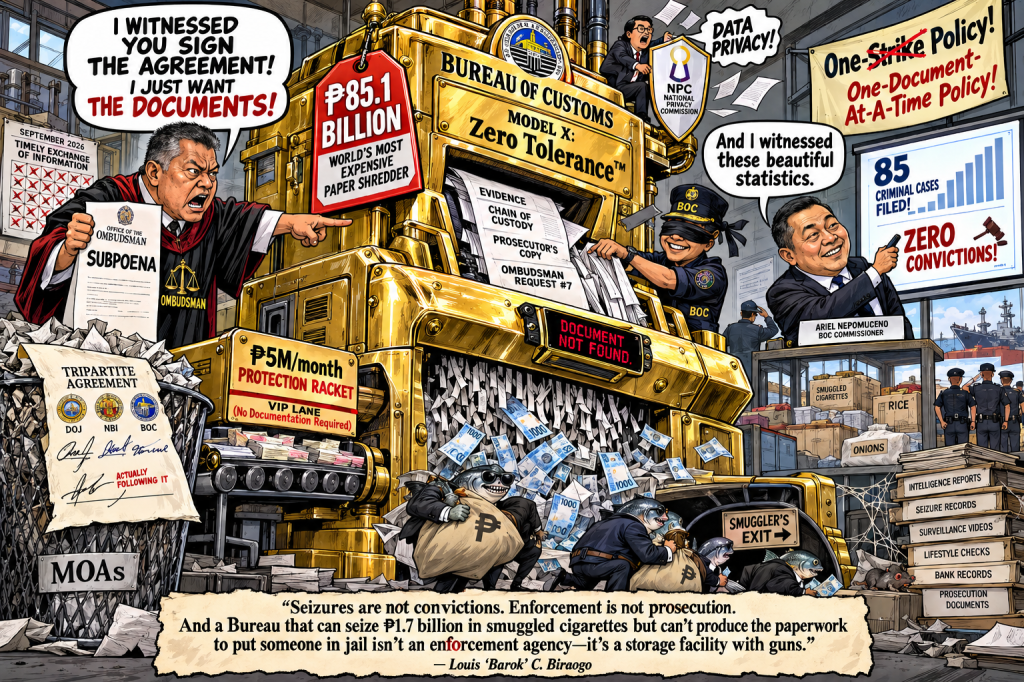
Where Smuggling Cases Go to Die: Inside the BOC’s Documentation Black Hole
By Louis ‘Barok’ C. Biraogo -+ October 6, 2026
FULL disclosure: I actually believe Boying Remulla might be onto something. And that sentence just cost me five years of credibility in certain circles.
Here’s the thing about Philippine governance that nobody tells you: the most dangerous place for a criminal case isn’t the courtroom. It’s the filing cabinet. A case doesn’t die because a judge throws it out—it dies because the documents never make it to the prosecutor’s desk. And according to Remulla, that’s exactly what’s happening at the Bureau of Customs (BOC).
“We had a meeting with Customs and the DOJ to stop this smuggling nonsense,” Remulla said on his radio program.
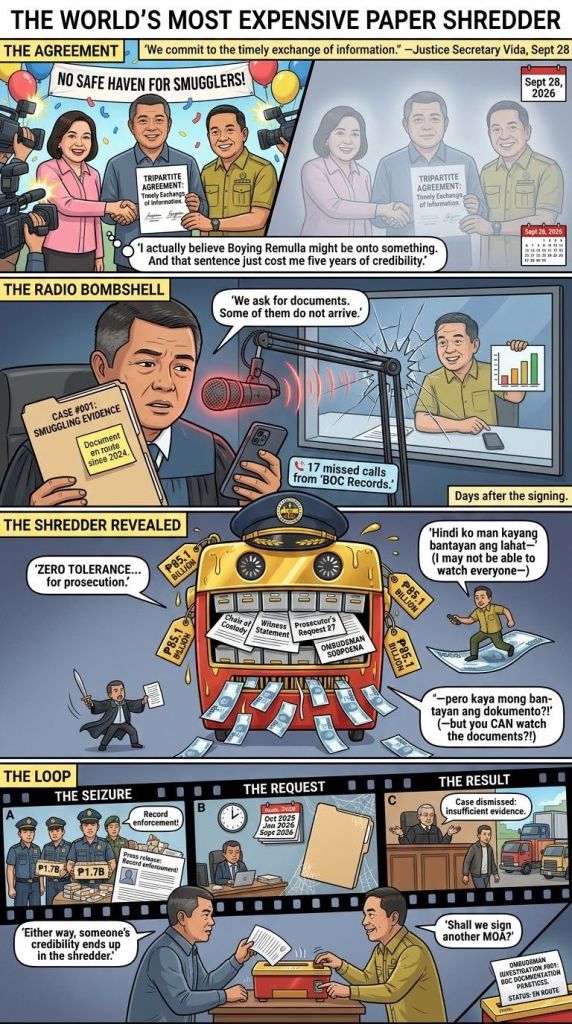
“The problem is always with Customs—they do not want to complete the documentation so that the case will be dismissed. We will file the case or investigate it. But when we ask for the documents, some of them do not arrive.”
Translation: The BOC is the world’s most expensive paper shredder.
Now, I’ve spent enough time in the trenches of Philippine bureaucracy to recognize a pattern when I see one. This isn’t “we’re understaffed” or “our systems are archaic.” This is a feature, not a bug. When an agency controls the evidence and the prosecution depends on that evidence, the agency becomes the de facto arbiter of who gets prosecuted. And if certain documents have a mysterious tendency to vanish when specific names appear, well, that’s just administrative efficiency, right?
But here’s where it gets deliciously complicated: Remulla made these allegations days after he witnessed the signing of a tripartite agreement between the Department of Justice (DOJ), National Bureau of Investigation (NBI), and BOC promising “timely exchange of information.” Let that sink in. He stood there, watched Justice Secretary Fredderick Vida say “we commit to the timely exchange of information,” smiled for the cameras, and then promptly went on radio to announce that the BOC couldn’t share data to save a case’s life.
That’s not just throwing shade. That’s throwing shade, then lighting it on fire, then using the fire to roast marshmallows while staring directly at the person who just signed the agreement.
To be fair to Commissioner Ariel Nepomuceno, he’s been saying all the right things. Zero tolerance. One-strike policy. “Hindi ko man kayang bantayan ang lahat, pero kung may magtatangkang lumabag sa batas, hahabulin at pananagutin natin sila.” The BOC has the receipts: ₱85.1 billion in seizures in 2024, 85 criminal cases filed from January 2025 to September 2026, 15 complaints endorsed to the DOJ under Republic Act No. 12022 (Anti-Agricultural Economic Sabotage Act). The man has data. He has numbers. He has PowerPoint presentations, probably.
But here’s the uncomfortable question: Seizures are not convictions. Enforcement is not prosecution. And a Bureau that can seize ₱1.7 billion in smuggled cigarettes but can’t seem to produce the paperwork that would put someone in jail isn’t an enforcement agency—it’s a storage facility with guns.
The more cynical among us might observe that the BOC’s enforcement statistics are the bureaucratic equivalent of a student who submits a beautiful cover page and an empty essay. “Look at all the work I did!” Yes, but where’s the substance? Where are the convictions? Where are the big fish?
Remulla knows this game. He was DOJ Secretary before he became Ombudsman. He’s seen this movie. He might have even starred in it. And now he’s sitting in the Ombudsman’s chair, armed with subpoena power and the institutional authority to investigate any public officer for “illegal, unjust, improper or inefficient” acts under Republic Act No. 6770 (The Ombudsman Act of 1989). The question is whether the BOC will respond to an Ombudsman subpoena with the same enthusiasm they’ve shown for data-sharing agreements.
Spoiler alert: probably not.
But here’s where Remulla’s position becomes genuinely uncomfortable for the BOC. The Ombudsman isn’t asking for a favor. Under RA 6770, the Ombudsman can compel government agencies to produce documents. A refusal isn’t bureaucratic inertia—it’s potentially obstruction. And obstruction, when it benefits smugglers, starts to look less like incompetence and more like corruption with extra steps.
The BOC’s plausible defense—“data privacy concerns!”—is legally flimsy. The National Privacy Commission (NPC) has explicitly recognized that government agencies can share data for public functions without consent, provided there’s a lawful basis and appropriate safeguards. Investigating smuggling is a public function. The Ombudsman is a lawful authority. The “privacy” argument is the bureaucratic equivalent of “the dog ate my homework,” except the dog is a lawyer and the homework is evidence of a crime.
And then there’s the JV Ejercito allegation—the ₱5 million monthly protection racket for fake cigarette operations. This isn’t a missing document. This is an entire protection economy operating in plain sight, with a government official allegedly collecting a salary larger than most executives earn—tax-free, presumably—for ensuring that certain shipments never see the inside of a courtroom.
Ejercito has referred the matter to the NBI, which is appropriate. But let’s be real: the NBI is investigating the agency that’s supposed to be investigating itself. If the BOC can’t produce documents for the Ombudsman, what makes anyone think they’ll produce documents for the NBI? The only difference is which agency gets stonewalled.
I’m not saying Nepomuceno is personally corrupt. I have no evidence of that, and I’m not interested in defaming a public servant without proof. But I am saying that an agency that consistently fails to complete documentation for prosecution, while simultaneously producing record seizure numbers, has a structural problem that no amount of “zero tolerance” rhetoric can paper over. The seizures look great in press releases. The missing documents look great for the people who don’t want to be prosecuted. Follow the incentives.
The Ombudsman’s most powerful tool here isn’t prosecution—it’s exposure. If Remulla can establish a pattern of documentary obstruction across multiple cases, he creates a record that’s impossible to dismiss as isolated incompetence. And if he can’t, then he’s the one who needs to explain why he made such sweeping allegations without the evidence to back them up.
Either way, someone’s credibility is going to end up in the shredder.
My prediction: The BOC will suddenly discover that it has, in fact, been sharing data all along—just not with the Ombudsman. A few low-level officials will be sacrificed. A new memorandum of understanding will be signed. And the big fish will continue swimming, protected by the most impenetrable barrier in Philippine governance: the missing file.
But here’s the thing about Boying Remulla. He’s not known for letting things go. And he’s not known for playing nice. He’s the guy who, as DOJ Secretary, went after Philippine Offshore Gaming Operators (POGOs) with a zeal that suggested personal grievance. He’s now the Ombudsman, and he’s publicly declared war on the BOC’s documentation practices. That’s not a fight that ends with a press release.
The only question is whether the documents will surface before the scandal does.
Louis ‘Barok’ C Biraogo is a recovering lawyer and recovering optimist. He blogs at Kweba ni Barok, where the cave is dark but the commentary is darker. Follow him for more analysis of Philippine governance, or don’t—he’s not your mother.
Key Citations
A. Legal & Official Sources
- Republic Act No. 6770. An Act Providing for the Functional and Structural Organization of the Office of the Ombudsman, and for Other Purposes (The Ombudsman Act of 1989). Official Gazette of the Republic of the Philippines, 17 Nov. 1989, http://www.officialgazette.gov.ph/1989/11/17/republic-act-no-6770/.
- Republic Act No. 6770. The Ombudsman Act of 1989. Lawphil, 17 Nov. 1989, lawphil.net/statutes/repacts/ra1989/ra_6770_1989.html.
- Republic Act No. 12022. An Act Defining the Crimes of Agricultural Economic Sabotage, Prescribing Penalties Therefor, Vesting Jurisdiction Over Such Offenses with the Court of Tax Appeals, Providing Mechanisms for Its Implementation and Enforcement, Repealing for the Purpose Republic Act No. 10845 or the “Anti-Smuggling Act of 2016” (Anti-Agricultural Economic Sabotage Act). Supreme Court E-Library, 26 Sept. 2024, elibrary.judiciary.gov.ph/thebookshelf/showdocs/2/97875.
- National Privacy Commission. NPC Circular No. 16-02: Data Sharing Agreements Involving Government Agencies. 10 Oct. 2016, privacy.gov.ph/wp-content/uploads/2022/01/Sgd-NPC-Circular-16-02-Data-Sharing-Agreements-Involving-Government-Agencies.pdf.
- Bureau of Customs. “No Safe Haven for Agri Smugglers: DOJ, BOC, NBI Join Forces.” Bureau of Customs, 28 Sept. 2026, customs.gov.ph/no-safe-haven-for-agri-smugglers-doj-boc-nbi-join-forces/.
B. News Reports
- GMA News. “Ombudsman Remulla Flags Lack of Data Sharing with Customs in Anti-Smuggling Campaign.” GMA News Online, GMA Network, 3 Oct. 2026, http://www.gmanetwork.com/news/topstories/nation/1004656/ombudsman-remulla-flags-lack-of-data-sharing-with-customs-in-anti-smuggling-campaign/story/.
- Depasupil, William B. “3 Agencies to Combat Agricultural Smuggling.” The Manila Times, 29 Sept. 2026, http://www.manilatimes.net/2026/09/29/news/national/3-agencies-to-combat-agricultural-smuggling/2434385.
- Chavez, Pot. “3-Way MOA Inked to Fight Agri Sabotage.” Manila Standard, 28 Sept. 2026, manilastandard.net/news/314798905/3-way-moa-inked-to-fight-agri-sabotage.html.
- “Kakulangan ng Data Sharing sa BOC sa Anti-Smuggling Campaign Pinuna ni Remulla.” Remate Online, 4 Oct. 2026, remate.ph/kakulangan-ng-data-sharing-sa-boc-sa-anti-smuggling-campaign-pinuna-ni-remulla/.

- “Ang Hirap Maging Mahirap”: The PAO Scandal That Proves Government Contempt Is Nothing New

- “Far-Off” My Axx: Malacañang’s Claire Castro Drowns in Her Own Legal Gaslighting
- “Forthwith” to Farce: How the Senate is Killing Impeachment—And Why Enrile’s Right (Even If You Can’t Trust Him)
- “HINDI AKO NAG-RESIGN!”

- “I Know Nothing”: Baste Duterte’s Amnesia Defense Meets ₱33M in GenCorp Contracts

- “I’m calling you from my new Globe SIM. Send load!”

- “Mahiya Naman Kayo!” Marcos’ Anti-Corruption Vow Faces a Flood of Doubt

- “Manageable” Debt, Unmanageable Lies: DBM’s ₱21 Trillion Fairy Tale
- “Meow, I’m calling you from my new Globe SIM!”

- “Natrabaho”: One Word, One Ombudsman, and a Judiciary on Trial
- “No Special Jail for Crooks!” Boying Remulla Slams VIP Perks for Flood Scammers

- “Philippine-Controlled” or Yankee Gas Station? The Davao Fuel Depot Farce Exposed





Leave a Reply