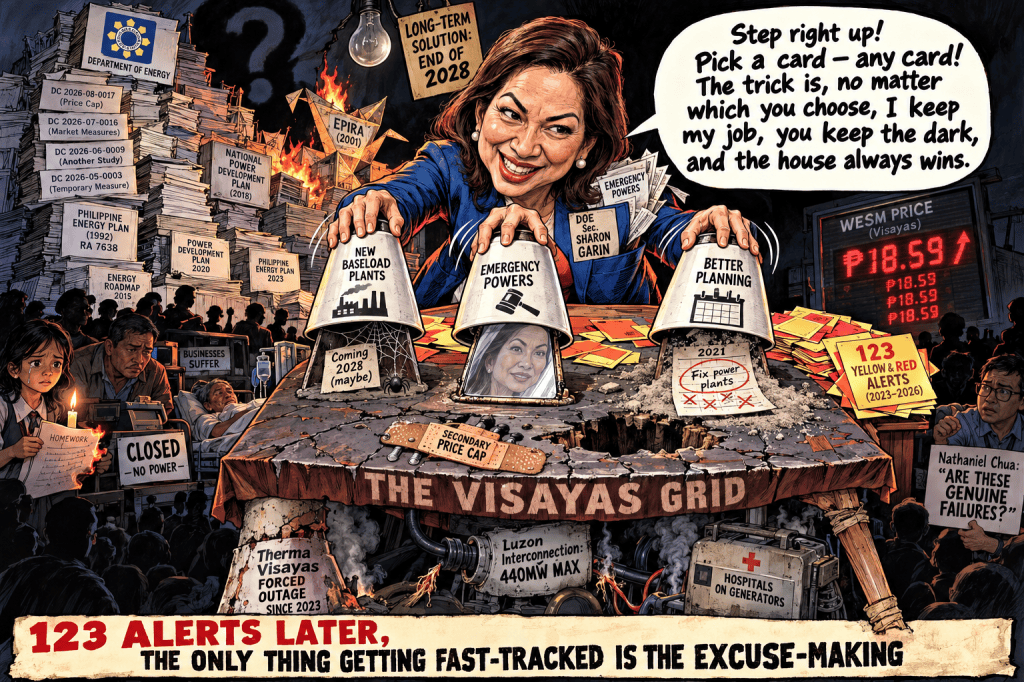
123 Alerts Later, the Only Thing Getting Fast-Tracked Is the Excuse-Making
By Louis ‘Barok’ C. Biraogo –Ocrober 5, 2026
GOOD News, Visayas: the lights may be out, but the press releases are on.
For months, the Visayas grid has been teetering on the edge of collapse. Red alerts, yellow alerts, manual load dropping, businesses shuttering, students losing class hours, hospitals running on generators—all the hallmarks of a functioning 21st-century economy. And when Congress finally dragged the Department of Energy (DOE) to a hearing in Bacolod, what did we get?
Energy Secretary Sharon Garin, with the kind of straight face that would make a used-car salesman blush, admitted that the Visayas “hasn’t had new baseload capacity for a long time” and that the problem was on “the planning side.”
Planning side. As in, the part that the DOE is statutorily mandated to do.
You know, the part where you look at demand projections and say, “Hey, maybe we should build some power plants before the lights go out.”
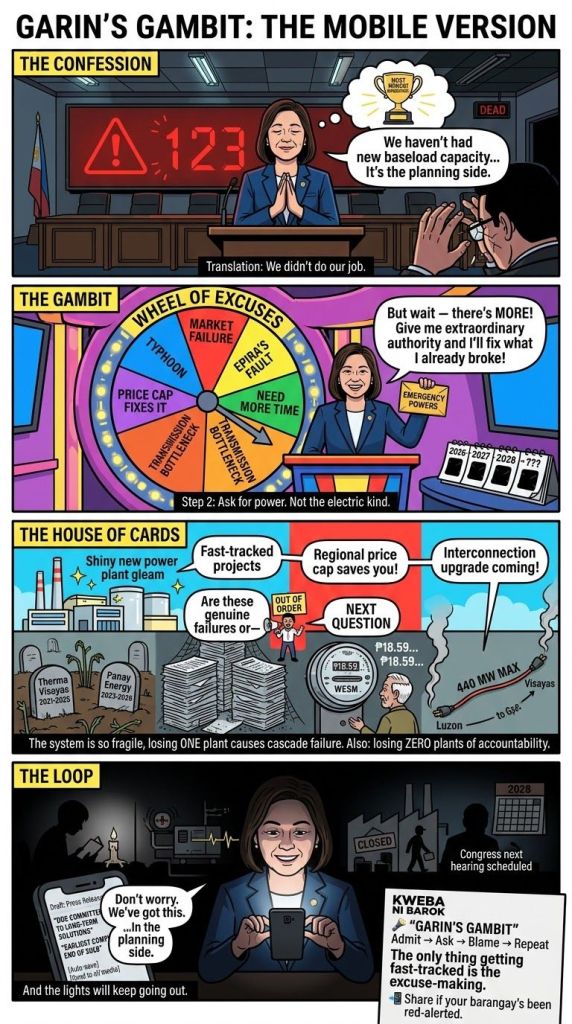
The Admission That Launched a Thousand Excuses
Let’s be clear about what Garin actually said. She didn’t say “we were caught off guard by unprecedented demand.” She didn’t say “a typhoon destroyed critical infrastructure.” She said, in essence, we didn’t plan properly.
That’s not a defense. That’s a confession.
And yet, somehow, the DOE’s response has been to ask for emergency powers to fast-track projects. Because nothing says “we have a handle on this” like requesting extraordinary authority to do the job you were already supposed to be doing.
Garin’s timeline is equally reassuring: the “earliest long-term solution” could arrive by “the end of 2028.” So buckle up, Visayas. You’ve got two more years of this. Maybe three. Maybe four. Who’s counting, really?
The Numbers That Should Haunt Every DOE Official’s Dreams
Let’s talk about what “planning failure” actually looks like in practice.
As of September 2026, the Visayas grid had recorded 123 yellow and red alerts since January. That’s not an anomaly. That’s a pattern. That’s a system telling you, repeatedly, that it is broken.
In August alone, available capacity dropped to around 2,168 MW against peak demand that was routinely hitting 2,500 MW or more. We’re talking about a shortfall of hundreds of megawatts—enough to power entire cities—happening with depressing regularity.
And the culprits? Major coal plants like Therma Visayas Inc. Unit 1 and Panay Energy Development Corporation Unit 3, which have been on forced outage for months. Plants that were supposedly the backbone of the region’s baseload supply.
Garin’s response to this? She told lawmakers that “even with the absence of just a single power plant, we will go on alert.” Translation: the system is so fragile that losing one facility—one—causes cascading failures.
That’s not a grid. That’s a house of cards.
The “Forced Outage” Problem Nobody Wants to Talk About
Here’s where things get interesting. Or suspicious, depending on how cynical you are about human nature.
In August 2026, the National Grid Corporation of the Philippines (NGCP) reported 10 power plants on forced outage in the Visayas, with some units having been offline since 2025, 2024, 2023, and—I’m not making this up—2021. That’s not a maintenance backlog. That’s a graveyard.
Nathaniel Chua of the Cebu Electricity Rights Advocates put it bluntly: “It is completely unacceptable that our major power plants are suddenly ‘conking out’ at the exact same time… Are these genuine technical failures, or is there a lack of proper maintenance and foresight by the generation companies?”
Good question. Let me add another: when Wholesale Electricity Spot Market (WESM) prices are spiking to ₱18.59 per kWh in the Visayas—nearly double the previous month’s rate—what incentive does a profit-driven generator have to keep its plants running reliably, when scarcity creates windfall profits?
I’m not accusing anyone of deliberate withholding. I’m just noting that the incentives are, shall we say, perverse. And the DOE’s response has been to… ask for emergency powers. Because that’s clearly the missing piece.
The Transmission Excuse Is Real—And Also a Damning Indictment
Now, to be fair, some of the blame lies with the physical infrastructure. The Visayas is an archipelago. You can’t just run an extension cord from Luzon when Cebu runs short.
The Luzon-Visayas high-voltage direct current (HVDC) interconnection has a maximum transfer capacity of 440 MW. That’s it. Meanwhile, Luzon sits on thousands of megawatts of reserve capacity that can’t be sent south because the connection is too small.
NGCP has acknowledged this bottleneck and says it’s upgrading the link to double capacity. But here’s the thing: this isn’t a surprise. The Visayas has been growing for decades. Cebu’s demand is, in Garin’s own words, growing “exponentially.” So why is the interconnection capacity still stuck at 440 MW?
Because planning for transmission is apparently as much of an afterthought as planning for generation.
The Price Cap: A Band-Aid on a Gaping Wound
Let’s give credit where it’s due: the Energy Regulatory Commission (ERC)’s decision to apply the secondary price cap (SPC) regionally—rather than diluting Visayas price spikes with Luzon’s cheaper rates—is a genuine consumer protection measure.
The numbers are staggering. Under the regional SPC, average WESM prices in the Visayas for August could have dropped from ₱18.59/kWh to ₱8.47/kWh—a reduction of nearly 54%. That’s not a tweak. That’s the difference between affordable electricity and financial ruin for small businesses.
But here’s the problem: a price cap doesn’t generate electricity. It doesn’t fix the supply shortage. It just stops consumers from being bankrupted by it. Garin herself acknowledged this: “The price cap alone is not enough.”
No kidding. It’s like putting a bandage on a gunshot wound and calling it treatment.
The Emergency Powers Gambit
And so we arrive at the DOE’s proposed solution: emergency powers.
Garin says these powers would “shorten the time needed to address regulatory, permitting and right-of-way requirements for energy projects.” Because apparently, the normal processes are so bogged down that we need to suspend them to get anything built.
Let me ask a different question: why are those processes so bogged down in the first place?
If the regulatory, permitting, and right-of-way bottlenecks are so severe that they require emergency intervention, then the system is broken by design. Emergency powers don’t fix a broken system. They just allow you to bypass it temporarily. And when the emergency powers expire, you’re back to square one—with maybe a few more power plants and a slightly less dysfunctional process.
This is governance by duct tape. It’s not a strategy. It’s a confession of institutional failure.
The Accountability Question
Tinio’s core accusation—that Republic Act No. 9136 (Electric Power Industry Reform Act of 2001, or EPIRA) framework’s market-based architecture has failed to deliver energy security—deserves serious scrutiny. But here’s where I part ways with the simplistic narrative.
EPIRA didn’t cause the Visayas crisis. Bad implementation, inadequate oversight, and a fundamental failure to anticipate foreseeable risks did. The market is a tool. If you use it poorly, you don’t blame the tool. You blame the carpenter.
That said, the DOE’s admission of “planning lapses” is a stunning indictment of the entire governance framework. Under Republic Act No. 7638 (Department of Energy Act of 1992), the DOE is mandated to formulate policies for comprehensive energy planning, update the Philippine Energy Plan annually, and ensure reliability, quality, and security of electricity supply.
Those aren’t suggestions. They’re statutory obligations. And the DOE failed to meet them.
Will anyone be held accountable? Garin is still in office. No one has been fired. No one has been charged. The “fix first, blame later” approach—conveniently adopted by the person who might be blamed—has become the official policy.
The Real Scandal
The deepest scandal here isn’t corruption in the traditional sense. It’s something more insidious: institutionalized incompetence masquerading as crisis management.
The DOE knew demand was growing. It knew plants were aging. It knew transmission was inadequate. And it did… not enough, not soon enough, not well enough.
Now it’s asking for emergency powers to fix problems that shouldn’t have existed in the first place. And when those powers inevitably prove insufficient—because the underlying planning failures remain unaddressed—we’ll get another hearing, another admission, another promise that “the long-term solution” is just a few years away.
The Visayas deserves better. The Philippines deserves better.
But as long as we accept “planning side” failures as an excuse rather than a firing offense, nothing will change.
And the lights will keep going out.
Louis ‘Barok’ C. Biraogo is the author of the Kweba ni Barok blog, where he writes about Philippine governance, law, and the occasional absurdity of both.
Key Citations
A. Legal & Official Sources
- Republic Act No. 7638. An Act Creating the Department of Energy, Rationalizing the Organization and Functions of Government Agencies Related to Energy, and for Other Purposes. Official Gazette of the Republic of the Philippines, 9 Dec. 1992, http://www.officialgazette.gov.ph/1992/12/09/republic-act-no-7638/.
- Republic Act No. 9136. An Act Ordaining Reforms in the Electric Power Industry, Amending for the Purpose Certain Laws and for Other Purposes. Official Gazette of the Republic of the Philippines, 8 June 2001, http://www.officialgazette.gov.ph/2001/06/08/republic-act-no-9136/.
- Department of Energy. Department of Energy Philippines. http://www.doe.gov.ph/.
B. News Reports
- Bayoran, Gilbert. “DOE: Planning Failure Caused Visayas Power Shortfall.” Philstar.com, The Philippine Star, 5 Oct. 2026, http://www.philstar.com/headlines/2026/10/05/2561051/doe-planning-failure-caused-visayas-power-shortfall.
- Bonzo, Lyjah Tiffany. “DOE Admits Planning Failure over Recurring Visayas Grid Outages.” GMA News Online, GMA Network, 4 Oct. 2026, http://www.gmanetwork.com/news/topstories/regions/1004666/doe-admits-planning-failure-over-recurring-visayas-grid-outages/story/.
- Cacho-Laurejas, Katlene O. “Cera Calls for Congressional Probe into Visayas Power Outages.” SunStar Cebu, SunStar Publishing, 9 Sept. 2026, http://www.sunstar.com.ph/cebu/cera-calls-for-congressional-probe-into-visayas-power-outages.
- de la Cruz, Jovee Marie N. “Visayas Power Woes: Failure in Planning?” BusinessMirror, 5 Oct. 2026, businessmirror.com.ph/2026/10/05/visayas-power-woes-failure-in-planning/.
- “DOE Cites Generation Shortfall as Visayas Power Woes Persist.” Malaya Business Insight, 4 Oct. 2026, malaya.com.ph/business/business-news/doe-cites-generation-short-fall-as-visayas-power-woes-persist/.
- “Emergency Powers Pushed for Visayas Power Crisis.” Malaya Business Insight, 4 Oct. 2026, malaya.com.ph/business/business-news/emergency-powers-pushed-for-visayas-power-crisis/.
- Fuentes, Kaiser Jan. “CVisayas Seeks Presidential Emergency Status.” The Manila Times, 5 Oct. 2026, http://www.manilatimes.net/2026/10/05/regions/cvisayas-seeks-presidential-emergency-status/2438574.
- Lelis, Brix. “ERC Orders Price Cap on Visayas and Mindanao Spot Power Rates.” Philstar.com, The Philippine Star, 12 Sept. 2026, http://www.philstar.com/business/2026/09/12/2555618/erc-orders-price-cap-visayas-and-mindanao-spot-power-rates.

- ₱8B BBM Pork: CCTV for Every Captain’s Kumpare?

- ₱8.9 Billion, 331 Ghost Police Stations: The TIKAS Scandal Explained

- ₱8.4 Billion, 42,000 Barangays, 1 Election: The “Bawat Barangay Makikinabang” Vote-Buying Masterclass

- ₱75 Million Heist: Cops Gone Full Bandit

- ₱6.77B Ghost Haunts Duterte: RTC Dismisses Mans Carpio’s Desperate Plea
- ₱6.77 Billion and Zero Cash: The Sara Duterte SALN Math That Doesn’t Add Up

- ₱6.7-Trillion Temptation: The Great Pork Zombie Revival and the “Collegial” Vote-Buying Circus

- ₱58.53B, Zero Receipts: The LGSF Pork Barrel Nobody Wants to Name
- ₱53 Million Man Tells ₱695-a-Day Workers to Stop Being ‘Mayabang’: The Audacity of BSP’s Remolona

- ₱3.06 Billion for Evacuation Centers—But Nobody Knows Where They’ll Stand (Or If They’ll Exist)
- ₱10B Ghost in New Clark City: Matibag’s Haunted Séance for Cayetano

- ₱1.9 Billion for 382 Units and a Rooftop Pool: Poverty Solved, Next Problem Please








Leave a comment