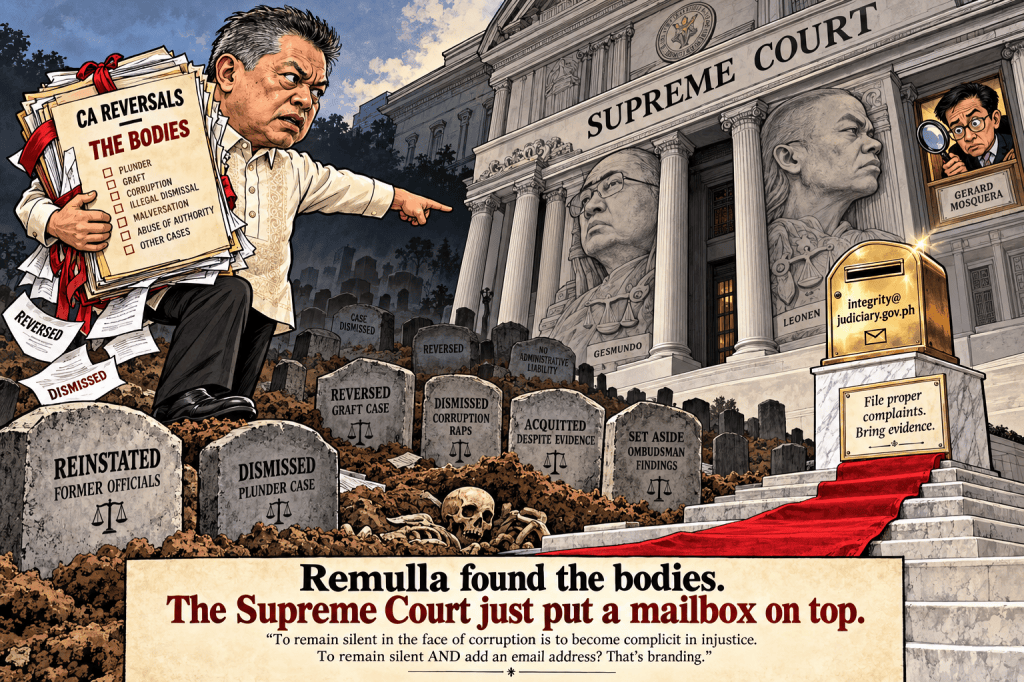
The Ombudsman brought a dossier. The Supreme Court brought an email address. Guess which one changes anything.
By Louis ‘Barok‘ C. Biraogo — October 4, 2026
LET me tell you something about the Philippine judiciary that nobody in Padre Faura wants to admit: the institution doesn’t have a corruption problem. It has a branding problem. And no, I’m not being facetious.
On September 30, 2026, Senior Associate Justice Marvic Leonen signed Memorandum Order No. 94-2026, a document so breathtakingly modest in its ambitions that one might mistake it for a memo reminding court personnel to water the office plants. The order directs courts nationwide to inform litigants about an email address—integrity@judiciary.gov.ph—established two years earlier under Memorandum Order No. 72-2024. The grand innovation? Telling people the inbox exists.
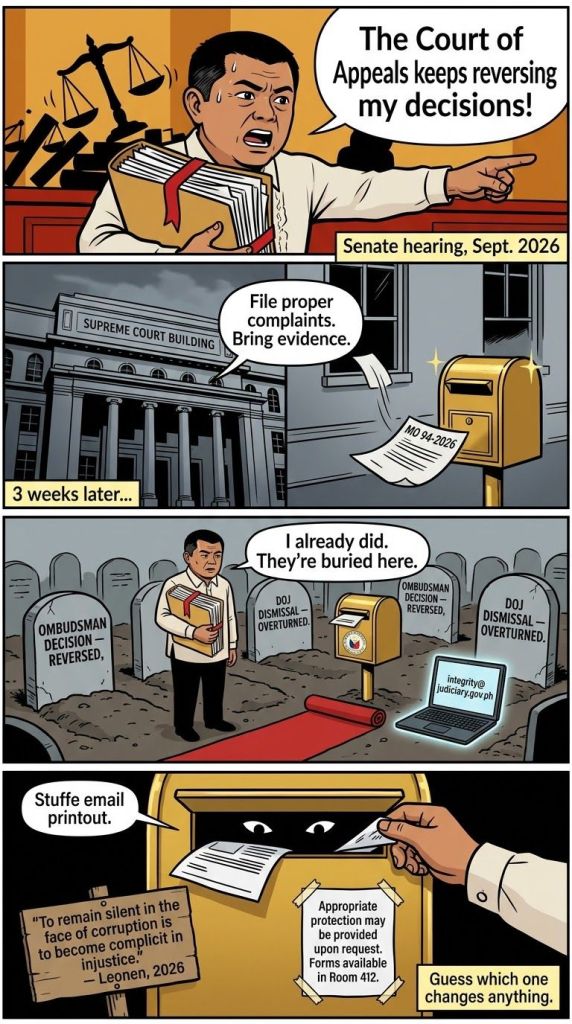
This is the judicial equivalent of discovering fire and deciding to keep it in a locked drawer.
But here’s what makes MO 94-2026 genuinely fascinating, and I mean that in the way a coroner finds a corpse fascinating: its timing. The memorandum landed less than a month after Ombudsman Jesus Crispin Remulla stood before the Senate and called the judiciary “the biggest elephant in the room,” complaining that the Court of Appeals (CA) had developed a habit of reversing Ombudsman decisions. Remulla didn’t just throw shade. He threw a dossier. He demanded the Supreme Court explain why an administrative complaint filed by his predecessor, Samuel Martires, against seven CA justices had apparently vanished into the bureaucratic void.
The Supreme Court’s response was, essentially: “File a proper complaint and bring evidence”. Which is lawyer-speak for “put up or shut up.”
And then, three weeks later, the Court announced its integrity email. Again.
Now, I want to be fair to Leonen here, because I suspect he’s actually the smartest person in this entire tragicomedy. The man has been pushing judicial reform since before some of his colleagues learned to use email. He established the integrity email in 2024, reorganized the Judicial Integrity Board (JIB) into the Judicial Integrity Office (JIO) in 2025, and appointed a former Deputy Ombudsman—Gerard Mosquera—as the first Judicial Integrity Officer in August 2026. That’s not nothing. That’s an actual institutional architecture.
But let’s be clear about what MO 94-2026 actually does. It doesn’t create new investigative powers. It doesn’t establish independent oversight. It doesn’t address the structural problem that the Supreme Court’s Committee on Ethics—chaired by the Chief Justice, vice-chaired by Leonen—is investigating the Supreme Court itself. It tells court managers to post a memo about an email address.
Leonen’s accompanying statement was pitch-perfect: “To remain silent in the face of corruption is to become complicit in injustice.” It’s a beautiful line. I’d put it on a poster. But a poster is not a mechanism.
Here’s the uncomfortable question that MO 94-2026 conveniently sidesteps: What happens when someone emails integrity@judiciary.gov.ph and alleges that a Supreme Court justice accepted a bribe? Under A.M. No. 25-04-04-SC (2025 Code of Judicial Conduct and Accountability) (CJCA), complaints against Supreme Court justices are filed with the Supreme Court and referred to its Committee on Ethics. The same institution. The same building. The same salary structure. The same golf partners.
This isn’t a reporting mechanism. It’s a suggestion box with a seal.
Now, Remulla knows this. That’s why he’s been hammering the CA reversals—not because he expects the Supreme Court to discipline its own appellate justices, but because he wants the pattern on the record. The CA has reversed Ombudsman decisions with remarkable consistency, and the Ombudsman’s office has noticed. Whether those reversals reflect corruption, incompetence, or simply a good-faith disagreement about probable cause is a question the Supreme Court refuses to answer in any public forum.
The Court’s position is technically defensible: it cannot discipline judges for decisions, only for conduct. Article VIII, Section 6 of the 1987 Constitution of the Republic of the Philippines (1987 Constitution) gives it administrative supervision, not appellate oversight. A judge who issues a wrong ruling is not corrupt; a judge who issues a wrong ruling because of a payment is. The distinction matters. The evidence requirements matter.
But here’s where the Court’s logic starts to eat itself. If the only way to prove judicial corruption is through specific, actionable evidence—and the only people who have that evidence are litigants who fear retaliation, lawyers who fear disbarment, and court personnel who fear termination—then the reporting mechanism has to be credible. It has to offer something beyond a promise of “appropriate protection.” It has to have an independent route for complaints against the highest court itself.
Otherwise, you’re asking people to jump into a pit and hoping someone remembered to put a net at the bottom.
The 2025 CJCA is genuinely impressive on paper. The absolute ban on ex parte communications, the extension to digital platforms, the recognition that corruption often flows through intermediaries rather than direct bribes—these are sophisticated, modern provisions. Mosquera’s appointment is a serious hire. The man spent seven years as Deputy Ombudsman for Luzon and has been doing anti-corruption work for nearly three decades. He’s not a fig leaf.
But Mosquera works for the Supreme Court. He investigates judges for judges. His reports go to judges. And when the allegations concern judges at the apex of the institution, the circularity becomes untenable.
The Ombudsman can’t investigate the judiciary. Section 21 of Republic Act No. 6770 (The Ombudsman Act of 1989) specifically exempts the judiciary from its disciplinary jurisdiction. The impeachment route under Article XI is the only constitutional mechanism for removing a Supreme Court justice, and we all know how well that works in practice—ask Chief Justice Corona, or don’t, because he’s dead.
So what’s left? Public scrutiny. Media attention. And an email address that may or may not be monitored by the people you’re complaining about.
I want to believe Leonen knows this. I want to believe the integrity email is a first step, not a final answer. The alternative—that the Supreme Court is engaged in elaborate theatrical performance designed to absorb political pressure while changing nothing—is too cynical even for me.
But the Court has to do better than a memo. It has to publish anonymized statistics: complaints received, investigations opened, cases resolved. It has to create a path for allegations against its own members that doesn’t terminate in the same room where the accused sits. It has to demonstrate that the email isn’t a dead letter.
Remulla, whatever his motives, has done the Court a favor. He’s forced the judiciary to confront questions it would rather avoid. The Court’s response—this measured, technically precise, procedurally correct insistence on evidence—is admirable in its way. It’s also a masterclass in institutional self-preservation.
The real test isn’t whether the Supreme Court can create a reporting mechanism. It’s whether it can handle what happens when the reports arrive.
Remulla’s already shown he knows where the bodies are buried. The Supreme Court just put a suggestion box on top of the graves.
Let’s see if anyone bothers to dig.
Key Citations
A. Legal & Official Sources
- The 1987 Constitution of the Republic of the Philippines. Official Gazette of the Republic of the Philippines, 1987, http://www.officialgazette.gov.ph/constitutions/1987-constitution/.
- The 1987 Constitution of the Republic of the Philippines, art. VIII, sec. 6. Official Gazette of the Republic of the Philippines, http://www.officialgazette.gov.ph/constitutions/the-1987-constitution-of-the-republic-of-the-philippines/the-1987-constitution-of-the-republic-of-the-philippines-article-viii/.
- The 1987 Constitution of the Republic of the Philippines, art. XI. Official Gazette of the Republic of the Philippines, http://www.officialgazette.gov.ph/constitutions/the-1987-constitution-of-the-republic-of-the-philippines/the-1987-constitution-of-the-republic-of-the-philippines-article-xi/.
- Republic Act No. 6770. An Act Providing for the Functional and Structural Organization of the Office of the Ombudsman, and for Other Purposes. Official Gazette of the Republic of the Philippines, 17 Nov. 1989, https://www.officialgazette.gov.ph/1989/11/17/republic-act-no-6770/.
- Supreme Court of the Philippines. A.M. No. 25-04-04-SC, The 2025 Code of Judicial Conduct and Accountability. 11 Nov. 2025, elibrary.judiciary.gov.ph/thebookshelf/showdocs/11/100836.
- Supreme Court of the Philippines. “SC Reorganizes Judicial Integrity Board into Judicial Integrity Office.” 26 Aug. 2025, sc.judiciary.gov.ph/sc-reorganizes-judicial-integrity-board-into-judicial-integrity-office/.
B. News Reports
- Laqui, Ian. “Silence on Corruption Weakens, Marginalizes Poor — Leonen.” Philstar.com, The Philippine Star, 1 Oct. 2026, http://www.philstar.com/headlines/2026/10/01/2560283/silence-corruption-weakens-marginalizes-poor-leonen.
- “Fight Graft.” Journal News Online, 1 Oct. 2026, journalnews.com.ph/fight-graft-2/.
- Mangaluz, Jean. “Ombudsman Urges Examination of Judiciary; SC Says File Proper Complaints.” GMA News Online, GMA Network, 4 Sept. 2026, http://www.gmanetwork.com/news/topstories/nation/1001075/ombudsman-urges-examination-of-judiciary-sc-says-file-proper-complaints/story/.
- Galvez, Daphne. “Ombudsman Urged: Substantiate Allegations vs CA.” Philstar.com, The Philippine Star, 5 Sept. 2026, http://www.philstar.com/headlines/2026/09/05/2554099/ombudsman-urgedsubstantiate-allegations-vs-ca.
- Calalo, Arlie O. “SC Dismisses Administrative Case vs 7 CA Justices.” The Manila Times, 11 Sept. 2026, http://www.manilatimes.net/2026/09/11/news/sc-dismisses-administrative-case-vs-7-ca-justices/2423287.
- Moaje, Marita. “Remulla to Refile Complaint vs. 7 CA Justices after SC Dismissal.” Philippine News Agency, 11 Sept. 2026, http://www.pna.gov.ph/articles/1283893.
- Calalo, Arlie O. “SC’s First Judicial Integrity Officer Takes Oath before Chief Justice Gesmundo.” The Manila Times, 15 Aug. 2026, http://www.manilatimes.net/2026/08/15/news/scs-first-judicial-integrity-officer-takes-oath-before-chief-justice-gesmundo/2406121.
- “Ang Hirap Maging Mahirap”: The PAO Scandal That Proves Government Contempt Is Nothing New

- “Far-Off” My Axx: Malacañang’s Claire Castro Drowns in Her Own Legal Gaslighting

- “Forthwith” to Farce: How the Senate is Killing Impeachment—And Why Enrile’s Right (Even If You Can’t Trust Him)

- “HINDI AKO NAG-RESIGN!”

- “I Know Nothing”: Baste Duterte’s Amnesia Defense Meets ₱33M in GenCorp Contracts

- “I’m calling you from my new Globe SIM. Send load!”

- “Mahiya Naman Kayo!” Marcos’ Anti-Corruption Vow Faces a Flood of Doubt

- “Manageable” Debt, Unmanageable Lies: DBM’s ₱21 Trillion Fairy Tale

- “Meow, I’m calling you from my new Globe SIM!”

- “Natrabaho”: One Word, One Ombudsman, and a Judiciary on Trial

- “No Special Jail for Crooks!” Boying Remulla Slams VIP Perks for Flood Scammers

- “Philippine-Controlled” or Yankee Gas Station? The Davao Fuel Depot Farce Exposed






Leave a comment