Evidence Laundering 101: How a Pentagon-Funded Report Became a National Security Emergency
By Louis ‘Barok‘ C. Biraogo — October 3, 2026
WELCOME back to the Kweba. Today we’re diving into a geopolitical psychodrama so rich in irony it could fund a small university’s political science department for a decade.
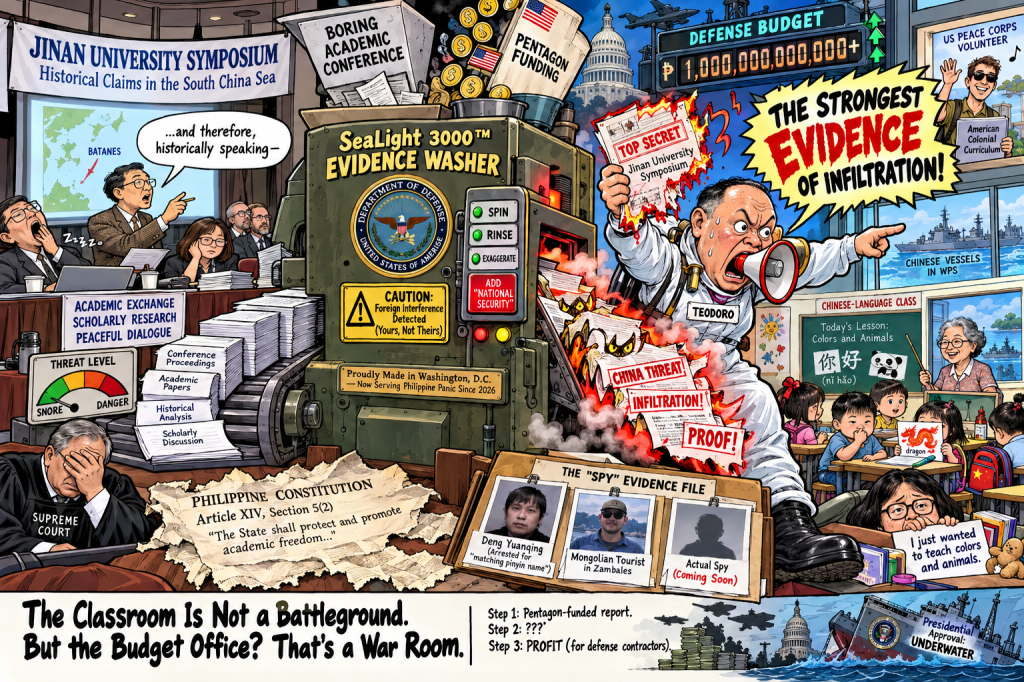
Defense Secretary Gilberto Teodoro Jr., a man who has made “China hawk” his personal brand with the dedication of a startup founder chasing Series A funding, has decided that the real threat to Philippine sovereignty isn’t in the West Philippine Sea. It’s in the classroom. Specifically, in the Chinese-language classroom. And the evidence? A report from a US think tank that is funded by the Pentagon. Let that sink in.
The Plot
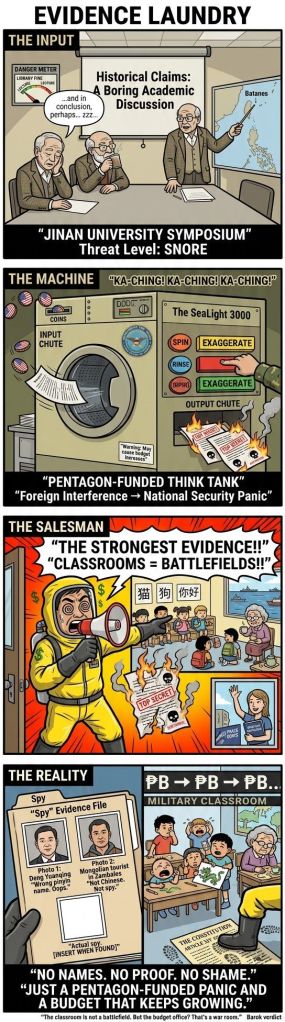
Here’s the chain of events, stripped of the breathless headlines. In late July 2026, the SeaLight Foundation—a group the Global Times describes as having “gained notoriety for its hostile stance against China” and which China Daily notes is “reportedly funded partially by the US Department of Defense”—published a report claiming that Jinan University in Guangzhou is the “single largest training site” for Chinese teachers entering Chinese-Filipino schools in the Philippines. The report alleged ties between Jinan University and China’s “political influence network.”
Secretary Teodoro, apparently reading this report with the same critical rigor one might apply to a Facebook meme, immediately escalated it to a national security crisis. His evidence? The fact that Jinan University had hosted an academic symposium where scholars presented legal and historical arguments that Batanes belongs to China. In Teodoro’s world, the fact that a university hosted an academic conference is apparently “the strongest evidence that this kind of exchange has problems.”
This is what we in the business call “evidence laundering.” You take an academic conference, run it through a Pentagon-funded think tank report, and voilà—you’ve got a national security emergency that justifies blanket scrutiny of an entire educational sector.
The Evidence Problem
Let’s talk about what Teodoro actually has. According to his own admission, the government has “information about such activities and not necessarily established evidence of wrongdoing.” That’s not evidence. That’s a hunch with a security clearance.
The Chinese Embassy in Manila has been pointing this out for months. In March 2026, Chinese Embassy Deputy Spokesperson Wei Guo noted that “over the past two years, Philippine society has repeatedly seen similar ‘Chinese spy’ allegations, but they ultimately often fail to withstand factual scrutiny.” He cited specific cases: a Chinese citizen named Deng Yuanqing who was arrested because his pinyin name matched a People’s Liberation Army (PLA) professor’s name, and a Mongolian national in Zambales who was suspected of China ties but had no connection whatsoever. “They can make headlines, but real credibility must still be built on factual basis,” Wei said.
The timeline here is instructive. The Philippines has been running this playbook for two years: sensational spy allegation, media frenzy, quiet walk-back when the evidence evaporates, repeat. It’s a political perpetual motion machine.
The Constitution Exists, Actually
Here’s the thing that seems to have escaped the Defense Department: the Philippine Constitution has something to say about academic freedom. Article XIV, Section 5(2) is rather explicit: “Academic freedom shall be enjoyed in all institutions of higher learning.”
The Supreme Court has consistently upheld this. In Ateneo de Manila University v. Capulong, the Court defined institutional academic freedom to include who may teach, what may be taught, how it shall be taught, and who may be admitted. In University of the Philippines v. Court of Appeals, the Court recognized academic freedom as protection against outside coercion or interference.
Now, does academic freedom mean universities are above national security law? Of course not. If someone is actually committing espionage, prosecute them. But here’s the critical distinction: the government has not identified a single individual, program, or course that has actually been compromised. What it has done is create a climate of suspicion around an entire linguistic and cultural community.
The Pentagon-Funded Elephant in the Room
Let’s talk about SeaLight. China Daily’s editorial pulls no punches: the organization is “reportedly funded partially by the US Department of Defense,” and its director, Ray Powell, has made it his “top priority to attack and smear China, stoke confrontation and ratchet up tensions by ‘twisting facts, making baseless accusations, and constructing selective narratives.’”
Here’s the delicious irony: Teodoro is warning about foreign interference in Philippine education, and his primary evidence comes from a think tank funded by a different foreign government. The United States has its own extensive history of using educational and cultural programs for soft power and intelligence purposes. As the Chinese Embassy pointed out, the Philippines has no shortage of American educational influence—from the Peace Corps to the English-language curriculum established during the American colonial period. Yet somehow, only the Chinese programs are “infiltration.”
The Batanes Red Herring
The Batanes symposium is the emotional core of Teodoro’s argument. But let’s be precise: academic scholars presented academic arguments. The Chinese government has not issued any official claim on Batanes. As one analysis correctly notes, “the scholars’ discussion does not represent the official position of the Chinese side.”
Are these scholars’ arguments inconvenient for the Philippines? Absolutely. They directly challenge Philippine sovereignty claims. But “inconvenient academic argument” and “intelligence operation” are not the same thing. If every foreign scholar who made an argument adverse to Philippine interests were treated as an intelligence asset, Philippine universities would have to shut down their international programs entirely.
What’s Really Happening Here
The pattern is familiar. You have a defense establishment that needs to justify its budget, its posture, and its relevance. You have a president whose approval ratings are underwater. You have a geopolitical alignment with the United States that requires constant reinforcement of the “China threat” narrative. And you have a Pentagon-funded think tank producing reports that conveniently confirm everything the hawks already believe.
The result is a security apparatus that has begun to see language education as a threat vector. The result is a proposed espionage law so broad that even Philippine legislators are warning it could be used to suppress dissent. The result is Chinese-Filipino schools, which have existed for over a century and serve a legitimate community need, being treated as potential enemy infrastructure.
The Real Vulnerability
Here’s the uncomfortable truth that Teodoro’s framing obscures: the Philippines does have legitimate security concerns about foreign influence. Every country does. But the response to those concerns should be evidence-based, behavior-focused, and institutionally calibrated. It should not be a blanket suspicion of an entire linguistic community based on a report from a Pentagon-funded organization and a single academic conference.
The current approach creates a chilling effect that will damage Philippine education. It will make universities reluctant to pursue any China-related research or partnerships. It will stigmatize Chinese-Filipino students and teachers. And it will do all of this without actually catching a single spy.
The Chinese Embassy’s Wei Guo asked the right question: “Do these cases ultimately provide any evidence proving the relevant persons are ‘Chinese spies,’ or are they just to maintain an existing political narrative?”
Until Teodoro can answer that question with specifics—names, programs, evidence, prosecutions—his warnings are sound and fury, signifying the familiar political theater of a security establishment that has confused suspicion with proof.
And in the meantime, the actual beneficiaries of this panic are the people who get to justify their budgets, their posture, and their alignment with Washington without ever having to demonstrate that the threat they’re selling is real.
That’s the Barok verdict. The classroom is not a battlefield. And a Pentagon-funded think tank is not an impartial arbiter of Philippine national security.
Key Citations
A. Reports & Studies
- Powell, Ray. “The University That Said Batanes Is China’s Is Also Training Manila’s Chinese Teachers.” SeaLight, 27 July 2026, https://www.sealight.live/posts/the-university-that-said-batanes-is-china-s-is-also-training-manila-s-chinese-teachers.
- “Behind SeaLight: China-targeting cognitive warfare platform stokes tensions in South China Sea.” Global Times, 7 Aug. 2026, https://www.globaltimes.cn/page/202608/1367768.shtml.
B. News Articles
- “Manila’s China hawks seek to hijack ties by restricting people-to-people exchanges.” China Daily, 10 Aug. 2026, http://www.chinadaily.com.cn/a/202608/10/WS6a79bc9da310986e2b469f95.html.
- Baroña, Franco Jose C. “Educational exchanges with China flagged.” The Manila Times, 28 Sept. 2026, https://www.manilatimes.net/2026/09/28/news/educational-exchanges-with-china-flagged/2433682.
- “Teodoro urges vigilance over PH-China cultural exchange.” Philippine Daily Inquirer, 29 July 2026, https://globalnation.inquirer.net/332944/teodoro-urges-vigilance-over-ph-china-cultural-exchange.
- “DFA downplays Chinese scholars’ Batanes claim, says government policy—not academic views—matters.” Manila Bulletin, 11 July 2026, https://mb.com.ph/2026/07/11/dfa-downplays-chinese-scholars-batanes-claim-says-government-policynot-academic-viewsmatters.
- Basilio, Kenneth Christiane. “House Passes Anti-Spying Bill Despite Civil Rights Concerns.” INQUIRER.net, 17 Sept. 2026, https://newsinfo.inquirer.net/2307161/house-passes-anti-spying-bill-despite-civil-rights-concerns/. Accessed 2 Oct. 2026.
- Chinese Embassy in the Philippines. “Remarks of the Deputy Spokesperson of the Chinese Embassy Guo Wei on the Repeated Allegations of ‘Chinese Espionage Activities.’” X, 11 Mar. 2026, https://x.com/Chinaembmanila/status/2031719809944351019.
C. Official Websites
- “The 1987 Constitution of the Republic of the Philippines — Article XIV.” Official Gazette, https://www.officialgazette.gov.ph/constitutions/the-1987-constitution-of-the-republic-of-the-philippines/the-1987-constitution-of-the-republic-of-the-philippines-article-xiv/.
- Ateneo de Manila University v. Capulong, G.R. No. 99327, Supreme Court of the Philippines, 27 May 1993. Lawphil, https://lawphil.net/judjuris/juri1993/may1993/gr_99327_1993.html.
- University of the Philippines v. Court of Appeals, G.R. No. 97827, Supreme Court of the Philippines, 9 Feb. 1993. Lawphil, https://lawphil.net/judjuris/juri1993/feb1993/gr_97827_1993.html.
- Peace Corps. United States Government, https://www.peacecorps.gov/.
- Powell, Raymond M. “Founder and Director, SeaLight Maritime Transparency Project.” Pacific Council on International Policy, https://pcgsanfrancisco.org/wp-content/uploads/2024/09/rmp.pdf.

- ₱8B BBM Pork: CCTV for Every Captain’s Kumpare?₱200K per barangay for streetlights and “patrol vehicles” — or just the fastest way to line 42,000 pockets? By Louis ‘Barok’ C Biraogo — April 11, 2026 Middle East Crisis to Barangay Jackpot: ₱8B BBM “Aid” or Pre-Election Pabaon? LADIES and gentlemen of the jury—er, readers—picture this: the Middle East is on fire, the peso… Read more: ₱8B BBM Pork: CCTV for Every Captain’s Kumpare?
- ₱8.9 Billion, 331 Ghost Police Stations: The TIKAS Scandal ExplainedThe PNP Asked. DPWH Built. COA Found Nothing. Everyone Shrugs. By Louis ‘Barok’ C Biraogo — September 12, 2026 Let me get this straight. The Philippine National Police (PNP)—an organization whose job is law enforcement—needs police stations. Makes sense. Cops need roofs. Even in a country where the roof itself might be a “ghost project.”… Read more: ₱8.9 Billion, 331 Ghost Police Stations: The TIKAS Scandal Explained
- ₱8.4 Billion, 42,000 Barangays, 1 Election: The “Bawat Barangay Makikinabang” Vote-Buying MasterclassHow DILG Memo Circular 2026-038 Turned Public Funds Into a Nationwide Pre-Election Patronage Machine By Louis ‘Barok‘ C. Biraogo — July 28, 2026 THE sheer audacity is almost admirable. Almost. With the ink barely dry on the Sandiganbayan dockets from the flood-control scandal—that magnificent cathedral of graft where billions vanished into ghost canals and phantom… Read more: ₱8.4 Billion, 42,000 Barangays, 1 Election: The “Bawat Barangay Makikinabang” Vote-Buying Masterclass
- ₱75 Million Heist: Cops Gone Full BanditBy Louis ‘Barok‘ C. Biraogo — April 6, 2025 IF YOU think the biggest threat to justice comes from criminals, think again. In a raid gone disastrously wrong, 31 police officers from the National Capital Region Police Office (NCRPO) allegedly walked away with ₱75 million in loot—after disabling CCTVs, cracking a vault, and leaving behind… Read more: ₱75 Million Heist: Cops Gone Full Bandit
- ₱6.77B Ghost Haunts Duterte: RTC Dismisses Mans Carpio’s Desperate PleaHouse Hitmen Win Round One as Judge Tosses Hot Potato By Louis ‘Barok‘ C. Biraogo — May 8, 2026 Carpio’s Legal Suicide Note MGA ka-kweba, what a masterpiece of legal strategy, this petition for prohibition and injunction filed by Atty. Manases “Mans” Carpio in the Quezon City Regional Trial Court Branch 81. One can almost… Read more: ₱6.77B Ghost Haunts Duterte: RTC Dismisses Mans Carpio’s Desperate Plea
- ₱6.7-Trillion Temptation: The Great Pork Zombie Revival and the “Collegial” Vote-Buying CircusBARSc and the Art of Theatrical Transparency: 20 Extra Hours of Scrutiny, Zero Hours of Shame By Louis ‘Barok‘ C. Biraogo — December 31, 2025 MGA ka-kweba, gather ’round the fire because the 20th Congress is serving up another steaming pile of budgetary baloney, this time with a side of “allocables” that smell suspiciously like… Read more: ₱6.7-Trillion Temptation: The Great Pork Zombie Revival and the “Collegial” Vote-Buying Circus
- ₱58.53B, Zero Receipts: The LGSF Pork Barrel Nobody Wants to NameCongress calls it ‘financial assistance.’ Rep. Erice calls it ‘presidential pork.’ The public calls it a receipt they never got By Louis ‘Barok‘ C. Biraogo — October 2, 2026 The Return of the Pork Barrel Gather ’round, kweba-kids. Today’s bedtime story is about a fund that died long ago but refused to stay buried. Back… Read more: ₱58.53B, Zero Receipts: The LGSF Pork Barrel Nobody Wants to Name
- ₱53 Million Man Tells ₱695-a-Day Workers to Stop Being ‘Mayabang’: The Audacity of BSP’s RemolonaA Tragedy in Technocratic Tone-Deafness By Louis ‘Barok’ C. Biraogo — September 1, 2026 IN THE gilded annals of Philippine technocracy, there exists a particular breed of public servant who has mastered the art of living like a sultan while lecturing the starving masses on the virtues of asceticism. The latest exhibit in this museum… Read more: ₱53 Million Man Tells ₱695-a-Day Workers to Stop Being ‘Mayabang’: The Audacity of BSP’s Remolona
- ₱3.06 Billion for Evacuation Centers—But Nobody Knows Where They’ll Stand (Or If They’ll Exist)Malacañang Swears the Money Is Real—Just Like Those 14 Flood-Control Projects the DOJ Confirmed Were Never Built By Louis “Barok” C. Biraogo — August 25, 2026 THERE is a species of lie, favored by politicians worldwide, that is technically not a lie at all. It is an architectural falsehood—a structure built from true materials that,… Read more: ₱3.06 Billion for Evacuation Centers—But Nobody Knows Where They’ll Stand (Or If They’ll Exist)
- ₱10B Ghost in New Clark City: Matibag’s Haunted Séance for CayetanoWeaponized Justice or Genuine Probe? The Séance Exposing Everyone’s Dirty Hands By Louis ‘Barok‘ C. Biraogo — July 17, 2026 THE National Bureau of Investigation (NBI) has summoned a ghost. Not the rattling-chains kind that haunts abandoned buildings, but the far more dangerous specter that haunts Philippine governance: a half-decade-old, ₱10 billion infrastructure deal, resurrected… Read more: ₱10B Ghost in New Clark City: Matibag’s Haunted Séance for Cayetano
- ₱1.9 Billion for 382 Units and a Rooftop Pool: Poverty Solved, Next Problem PleaseFeaturing special guest stars Bongbong Marcos and Isko Moreno in the feel-good blockbuster “Unity Tayo, Picture Muna” By Louis ‘Barok‘ C. Biraogo — December 2, 2025 1. The Grand Illusion: A Photo-Op for Strange Bedfellows Yesterday, in the heart of Sta. Cruz, Manila, the nation witnessed a masterclass in political alchemy. There they stood —… Read more: ₱1.9 Billion for 382 Units and a Rooftop Pool: Poverty Solved, Next Problem Please
- ₱1.35 Trillion for Education: Bigger Budget, Same Old Thieves’ BanquetMain Course: Overpriced Classrooms and Confidential-Fund Gravy By Louis ‘Barok‘ C. Biraogo — January 1, 2026 MGA ka-kweba, Senator Bam Aquino calls the ₱1.35 trillion earmarked for education in the 2026 national budget a “historic victory.” The largest education fund in Philippine history, he says—more classrooms, free school meals, bigger support for the Free College… Read more: ₱1.35 Trillion for Education: Bigger Budget, Same Old Thieves’ Banquet




Leave a comment