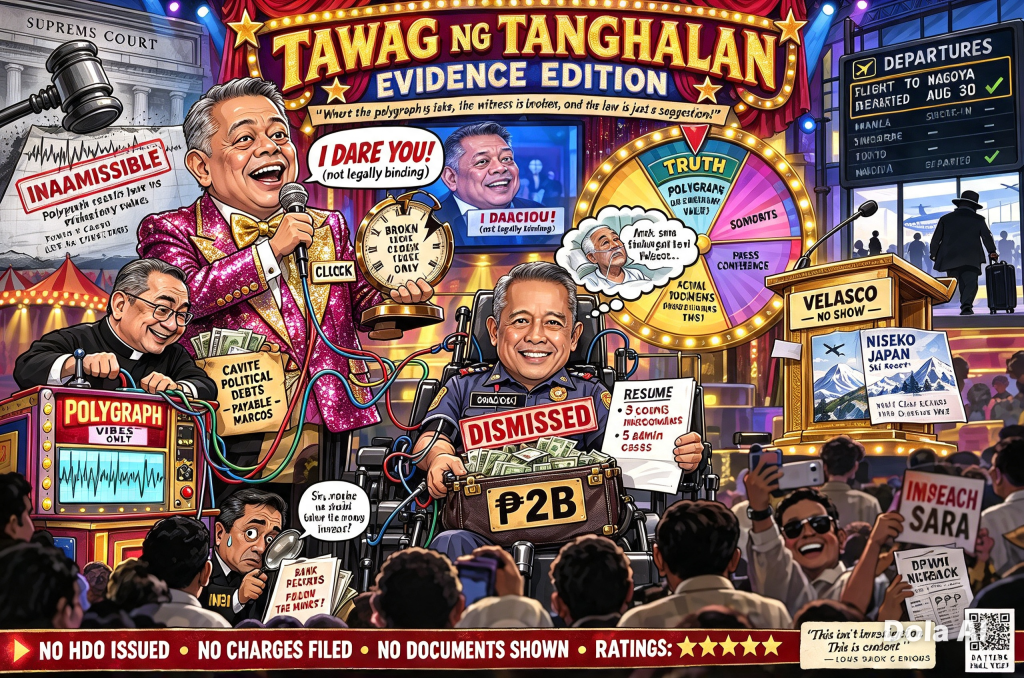
A Lie Detector Nobody Believes, a Witness Nobody Trusts, and a Speaker Nobody Can Find
By Louis ‘Barok‘ C. Biraogo — October 2, 2026
WELCOME back to the Kweba, where we separate the evidence from the theater. Today’s episode: the most Filipino political scandal imaginable—a dismissed cop, a priest, suitcases of cash, a polygraph that everyone admits is inadmissible, and a former Speaker who apparently discovered Niseko, Japan, right around the time the National Bureau of Investigation (NBI) came knocking.
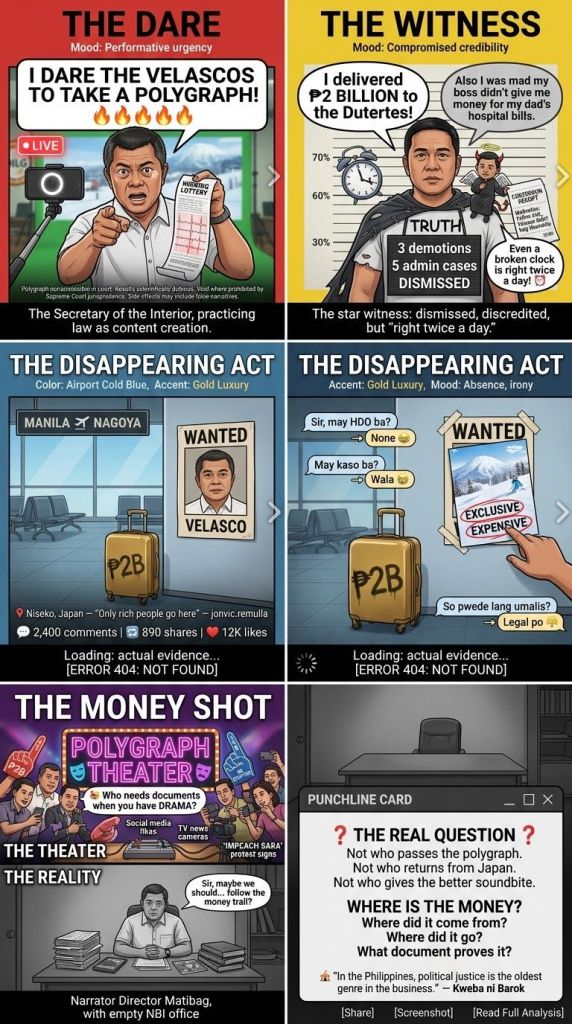
Let’s begin with the central absurdity. Interior Secretary Jonvic Remulla—a man whose primary qualification appears to be being Marcos’s guy in Cavite—publicly dared former Speaker Lord Allan Velasco and his wife to return from Japan and take a polygraph test. His exact words: “But the polygraph is not admissible in court. Still, I dare the Velasco couple to come and take the same polygraph so we can see who is really telling the truth.”
Read that again. The Secretary of the Interior is challenging people to submit to a test he knows is legally meaningless. This isn’t law enforcement. This is Eat Bulaga with constitutional implications. It’s “Tawag ng Tanghalan” but for criminal credibility. If Remulla had any self-awareness, he’d realize he’s essentially saying: “Please take this scientifically dubious test so we can have a narrative winner, even though a court will ignore the result.”
But wait—it gets better. Remulla also offered us this gem: “Even a broken clock is right twice a day.” This is the Secretary of the Interior’s defense of Gracioso’s credibility. A man who was dismissed from the Philippine National Police (PNP) for “three counts of less grave misconduct and conduct unbecoming of a police officer,” with five administrative cases during his 11-year career, is being defended by analogy to a broken clock. The bar for credible witnesses in this administration has officially reached the sub-basement.
#SatirePH #PoliticalTheater #Marcos #Cavite #Philippines
The Polygraph Theater
Let’s talk about the polygraph, because the coverage has been an embarrassment. The NBI first clarified that Gracioso’s initial polygraph covered only his “identity and relationship with the individuals he mentioned,” not the cash delivery allegations themselves. Then, after a second test on September 30, the NBI announced “no deception indicated” regarding the full affidavit.
Here’s the problem: Philippine Supreme Court jurisprudence is unambiguous. In People v. Carpo, the Court held that it “does not put credit and faith on the result of a lie detector test inasmuch as it has not been accepted by the scientific community as an accurate means of ascertaining truth or deception.” This was reinforced in Philippine Savings Bank v. Genove, where the Court reiterated that polygraph results “cannot be offered in evidence to prove the guilt or innocence of an accused in a crime,” though they may have some corroborative value in non-criminal proceedings with a lower quantum of proof.
So what exactly is the evidentiary value of Gracioso “passing” a polygraph? Zero. Nada. Zilch. It’s a vibes test. It’s a narrative prop. Remulla knows this—he said it’s not admissible—yet he’s using it as the centerpiece of his public challenge. This isn’t investigation. This is content.
The NBI’s own Director, Melvin Matibag, has been noticeably more careful, stating that the bureau would “tend not to believe it at once” and that photographs require “authentication and verification.” That’s the professional posture. Remulla’s posture is Tawag ng Tanghalan.
The Priest and the Dismissed Cop
Now, let’s examine the star witness. Rodulfo Gracioso Jr. is a dismissed police officer who, by his own priest’s admission, was motivated in part by resentment. Father Flavie Villanueva—yes, the same priest known for his work with drug war victims—told the Inquirer that Gracioso revealed his first reason for exposing the scheme was that Velasco did not help him financially when his father got sick.
Let’s let that sink in. The whistleblower’s initial motivation, per his own spiritual adviser, was personal grievance because his boss didn’t give him money when his father was dying. That doesn’t make his allegations false, but it certainly complicates the “heroic whistleblower” narrative that Remulla and the administration are selling.
Gracioso served as Velasco’s security aide from November 2020 to March 2022, according to the PNP. His affidavit, however, claims he served Velasco from 2017 to 2024—a discrepancy of years. The PNP’s records say one thing. Gracioso’s affidavit says another. Which is it?
And then there’s the timing. Gracioso was dismissed from the PNP effective September 11, 2026. His affidavit is dated September 14. He went to the NBI in June with Father Villanueva. So the sequence is: he reaches out to a priest in March, goes to the NBI in June, gets dismissed in September, and files his affidavit three days later. The defense will have a field day with this. Is this a man who found his conscience, or a man who found an opportunity after losing his job?
The Disappearing Velascos
Now, the Velascos. Lord Allan and Rowena left the Philippines on August 30 for Nagoya, Japan, with a scheduled return of September 14. They didn’t come back. Rowena traveled to Hong Kong on September 24. As of the latest reports, they’re in Niseko—a luxury ski destination that Remulla helpfully noted is “the most exclusive vacation spot in the entire Japan. It’s expensive there in Niseko, only rich people go there.”
Remulla’s implication is obvious: How can Velasco afford Niseko on a government salary? It’s a fair question. But it’s also a question that requires evidence, not insinuation. The NBI apparently raided properties in Valle Verde, Pasig, on August 24—registered under employees’ and a company’s names. If those are Velasco’s properties, that’s potentially significant for an unexplained wealth investigation. But “potentially significant” is not “proven.”
Here’s the legal reality that Remulla and his allies seem determined to ignore: there is no hold departure order (HDO) against Velasco. The Bureau of Immigration confirmed “no existing” HDO or derogatory alert. Velasco left the country legally and has not been charged with any crime. Being abroad is not a crime. Refusing to return for a press conference polygraph is not obstruction of justice.
The Palace’s statement—”Whether he is afraid or is just taking a vacation, we cannot tell”—is at least more honest than Remulla’s theatrics. But “come home and clear your name” is not a legal obligation. It’s a political demand dressed up as civic duty.
What’s Actually at Stake
Strip away the theater and you have a genuine investigative question: Did Rodulfo Gracioso Jr. deliver billions of pesos in cash to the Duterte family on Lord Allan Velasco’s orders?
The NBI has a duty to investigate this. But the investigation must be evidentiary, not performative. The polygraph is irrelevant. The public challenge is irrelevant. Remulla’s soundbites are irrelevant. What matters is the money trail—bank records, contractor books, travel logs, communications, CCTV, property acquisitions. The things that actually prove or disprove allegations.
If the NBI can reconstruct even one alleged transaction with documentary corroboration—withdrawals, dates, locations, vehicles, recipients—the case transforms. If they can’t, Remulla’s public bravado will look increasingly hollow.
The Legal Framework Nobody’s Talking About
Let’s be clear about the legal exposure here, because the public discourse has been maddeningly vague. If the allegations are proven, we’re not just talking about corruption in the abstract—we’re talking about specific statutory violations with specific penalties.
Perjury: Republic Act No. 11594 (An Act Increasing the Penalties for Perjury) amended Article 183 of Act No. 3815 (Revised Penal Code), increasing penalties for false testimony. A public officer who knowingly makes untruthful statements under oath faces prision mayor in its maximum period (10 years and one day to 12 years), a fine up to ₱1 million, and perpetual absolute disqualification from public office. Gracioso, if his allegations prove false, faces this sword. Ironically, the law was signed by Rodrigo Duterte and bore Velasco’s signature as Speaker.
Plunder: Republic Act No. 7080 (An Act Defining and Penalizing the Crime of Plunder) defines plunder as a public officer amassing ill-gotten wealth through a combination or series of overt or criminal acts totaling at least ₱50 million. The penalty is reclusion perpetua to death, with perpetual absolute disqualification and forfeiture of all ill-gotten wealth. The alleged ₱2 billion dwarfs the threshold. But amount alone isn’t enough—prosecutors must establish the predicate acts, the pattern, and the connection to official action. The Sandiganbayan has exclusive jurisdiction.
Money Laundering: Republic Act No. 9160 (Anti-Money Laundering Act of 2001) defines “unlawful activity” to include violations of Republic Act No. 3019 (Anti-Graft and Corrupt Practices Act) and RA 7080. If the cash allegedly came from Department of Public Works and Highways (DPWH) contractors—as Gracioso claims—and those contractors were paying kickbacks for government projects, we’re potentially looking at a laundering pipeline. The Anti-Money Laundering Council (AMLC) has investigative authority over covered and suspicious transactions. The jurisdictional hook: if committed by public officers or private persons in conspiracy with them, the Sandiganbayan has jurisdiction.
Unexplained Wealth: Republic Act No. 1379 (An Act Declaring Forfeiture in Favor of the State of Unlawfully Acquired Property) allows forfeiture of property manifestly disproportionate to lawful income. This is the route that doesn’t require proving specific transactions—just the disparity. If the Niseko property or the Valle Verde raids yield evidence of assets beyond declared means, this becomes relevant.
The Political Calculus
Let’s be clear about the context. This scandal is unfolding against the backdrop of impeachment proceedings against Vice President Sara Duterte, particularly on unexplained wealth grounds. The Marcos administration has every incentive to see the Duterte family damaged. Remulla, as a Marcos appointee, is not a neutral actor. His “dare” to Velasco is political theater designed to create the impression that the administration is aggressively pursuing corruption—while conveniently targeting both Velasco (a former Duterte ally) and the Dutertes simultaneously.
But here’s the danger: if the NBI’s investigation ultimately finds insufficient corroboration, the administration will have overplayed its hand. Gracioso will face perjury charges. The “broken clock” will be discarded. And the public will be left with yet another example of Philippine political justice as spectator sport.
Meanwhile, Velasco’s camp has already called the allegations “fabricated, logically inconsistent, and contradicted by verifiable facts.” That’s the standard denial. What they haven’t done is provide the verifiable facts that contradict the allegations. If Velasco is innocent, his best defense is not a press release but a transaction-by-transaction rebuttal with documents. “I was in Location X on Date Y; the alleged aircraft was not present; CCTV shows no such vehicle” is dramatically stronger than “the allegations are fabricated.”
The Bottom Line
This scandal has everything: a dismissed cop, a priest, a polygraph that means nothing, a disappearing Speaker, luxury properties in Japan, and a Cabinet secretary performing for the cameras. What it doesn’t yet have is evidence—the kind that survives a courtroom, not just a press conference.
The question is not who passes the polygraph. The question is not who returns from Japan. The question is not who gives the better soundbite.
The question is: Where is the money, where did it come from, where did it go, and what independently verifiable evidence connects each peso to each alleged actor?
Until that question is answered with documents, not drama, this remains what it has been from the start: a political spectacle dressed up as an investigation. And in the Philippines, that’s the oldest genre in the business.
Analysis current as of October 2, 2026.
Key Citations
A. Legal & Official Sources
- Act No. 3815. The Revised Penal Code. Official Gazette of the Republic of the Philippines, 8 Dec. 1930, https://lawphil.net/statutes/acts/act_3815_1930.html.
- Republic Act No. 11594. An Act Increasing the Penalties for Perjury, Amending for the Purpose Articles 183 and 184 of Act No. 3815, as Amended, Otherwise Known as “The Revised Penal Code.” 29 Oct. 2021, https://elibrary.judiciary.gov.ph/thebookshelf/showdocsfriendly/2/93879.
- Republic Act No. 7080. An Act Defining and Penalizing the Crime of Plunder. Official Gazette of the Republic of the Philippines, 12 July 1991, https://www.officialgazette.gov.ph/1991/07/12/republic-act-no-7080/.
- Republic Act No. 9160. Anti-Money Laundering Act of 2001. Official Gazette of the Republic of the Philippines, 29 Sept. 2001, https://www.officialgazette.gov.ph/2001/09/29/republic-act-no-9160/.
- Republic Act No. 3019. Anti-Graft and Corrupt Practices Act. 17 Aug. 1960, https://lawphil.net/statutes/repacts/ra1960/ra_3019_1960.html.
- Republic Act No. 1379. An Act Declaring Forfeiture in Favor of the State Any Property Found to Have Been Unlawfully Acquired by Any Public Officer or Employee and Providing for the Proceedings Therefor. 18 June 1955, https://elibrary.judiciary.gov.ph/thebookshelf/showdocs/2/10888.
- People of the Philippines v. Jaime Carpo, et al. G.R. No. 132676, 4 Apr. 2001, https://lawphil.net/judjuris/juri2001/apr2001/gr_132676_2001.html.
- Philippine Savings Bank v. Hazel Thea F. Genove. G.R. No. 202049, 15 June 2020, https://lawphil.net/judjuris/juri2020/jun2020/gr_202049_2020.html.
B. News Reports
- “DILG Chief to Velasco Couple: Return to PH, Take Lie Detector Test.” Philippine Daily Inquirer, 2 Oct. 2026, https://newsinfo.inquirer.net/2315109/dilg-chief-to-velasco-couple-to-return-to-ph-take-lie-detector-test.
- “Gracioso Sought Priest’s Help over Alleged Duterte Cash Deliveries.” Philippine Daily Inquirer, 28 Sept. 2026, https://newsinfo.inquirer.net/2312916/gracioso-sought-priests-help-over-alleged-duterte-cash-deliveries.
- “Gracioso Lie Detector Test Result: No Deception.” Philippine Daily Inquirer, 1 Oct. 2026, https://newsinfo.inquirer.net/2315189/gracioso-lie-detector-test-result-no-deception.
- Rita, Joviland, and Darlene Cay. “Gracioso Was Demoted, Suspended at Least Thrice before Dismissal, Napolcom Records Show.” GMA News Online, GMA Network, 28 Sept. 2026, https://www.gmanetwork.com/news/topstories/nation/1003933/gracioso-was-demoted-suspended-at-least-thrice-before-dismissal-napolcom-records-show/story/.
- Santos, Rudy, and Mark Ernest Villeza. “BI, NBI Confirm Velasco, Wife Out of Philippines.” The Philippine Star, 30 Sept. 2026, https://www.philstar.com/headlines/2026/09/30/2559926/bi-nbi-confirm-velasco-wife-out-philippines.
- ₱9 Billion in ‘Savings’? DILG’s Fire Truck Deal Smells Like Smoke

- ₱8B BBM Pork: CCTV for Every Captain’s Kumpare?
- ₱8.9 Billion, 331 Ghost Police Stations: The TIKAS Scandal Explained

- ₱8.4 Billion, 42,000 Barangays, 1 Election: The “Bawat Barangay Makikinabang” Vote-Buying Masterclass

- ₱75 Million Heist: Cops Gone Full Bandit

- ₱63 to the Dollar: The Only Thing Falling Faster Than the Peso Is the Government’s Credibility

- ₱6.77B Ghost Haunts Duterte: RTC Dismisses Mans Carpio’s Desperate Plea
- ₱6.77 Billion and Zero Cash: The Sara Duterte SALN Math That Doesn’t Add Up

- ₱6.7-Trillion Temptation: The Great Pork Zombie Revival and the “Collegial” Vote-Buying Circus

- ₱58.53B, Zero Receipts: The LGSF Pork Barrel Nobody Wants to Name
- ₱53 Million Man Tells ₱695-a-Day Workers to Stop Being ‘Mayabang’: The Audacity of BSP’s Remolona
- ₱4.4 Billion and a Witness Who Can’t Explain It: The Duterte Impeachment’s Most Expensive Non-Answer




Leave a Reply