By Louis ‘Barok’ C. Biraogo — October 2, 2026
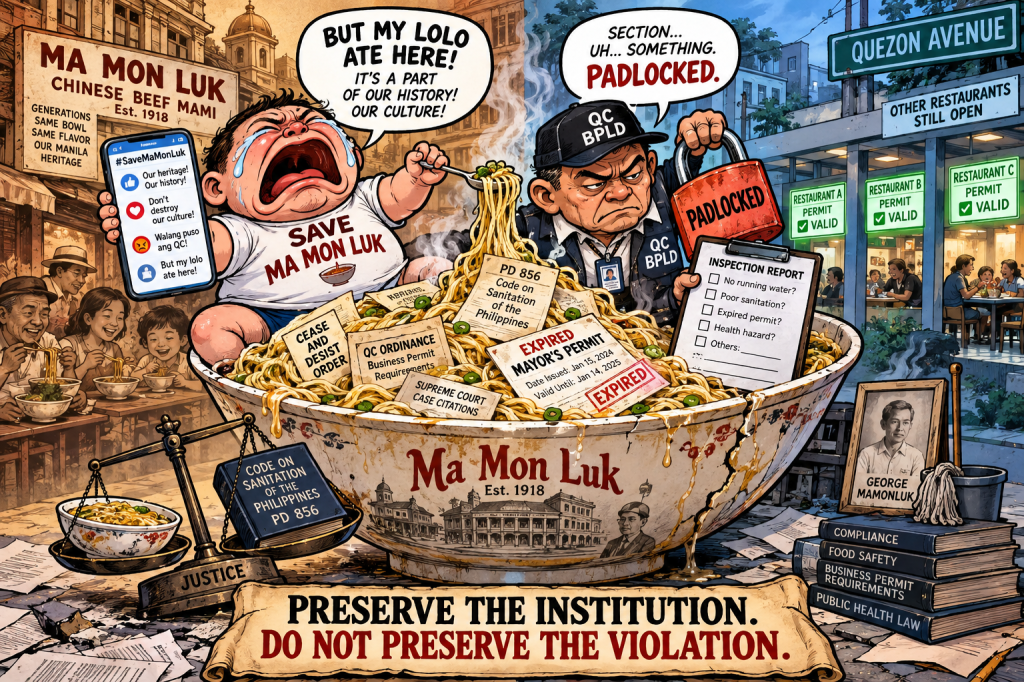
CALL me old-fashioned, but a century of mami does not come with a lifetime exemption from Presidential Decree No. 856 (Code on Sanitation of the Philippines). Quezon City has padlocked Ma Mon Luk on Quezon Avenue — the last standing branch of a house that traces itself to 1918 — and half the internet has already chosen a side. One camp wants the city burned for killing a landmark. The other wants the kitchen burned for daring to serve after a cease-and-desist order. Both camps are eating the story before the inspection report has been served.
What the city has actually said
Here is what the city actually says, and what it has not proved.
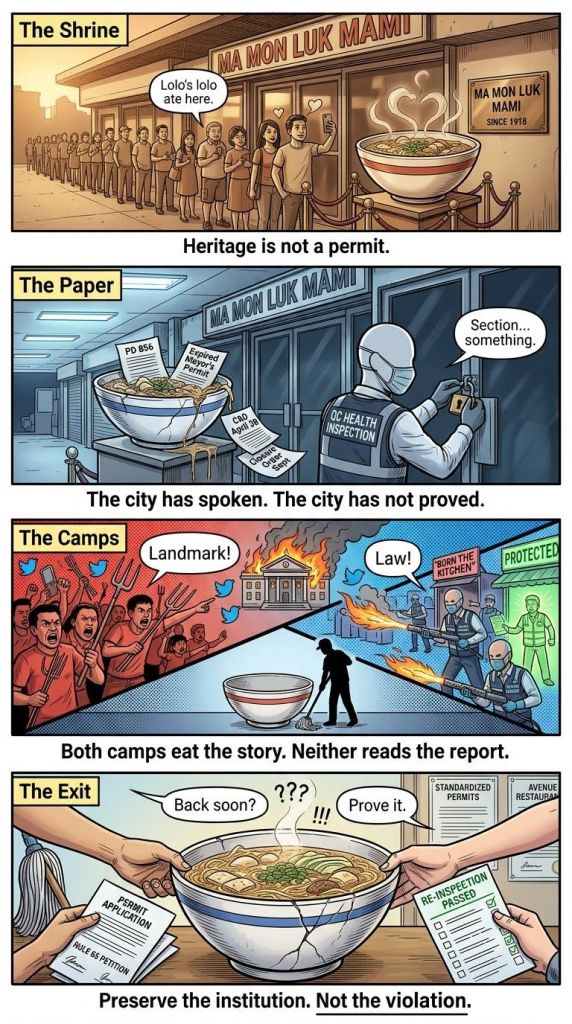
The Quezon City Business Permits and Licensing Department (BPLD) told GMA News that a Quezon City Health Department (QCHD) inspection dated May 29, 2026 still found Ma Mon Luk in violation of the Code on Sanitation. That report recommended revocation of the sanitary permit and continuation of a cease-and-desist order. The same office says the restaurant failed to renew its Mayor’s Permit, and that a verification on August 25, 2026 found it still operating despite a cease-and-desist implemented on April 28. The September closure notice, posted on the facade and first widely noticed on September 18, cited the Code on Sanitation and Quezon City Ordinance No. SP-91, S-93 (Quezon City Revenue Code of 1993), as amended. Staff told radar they had stopped on September 17 and hoped to reopen around September 22. The Facebook page said only this: temporarily closed, back soon, thank you. As of GMA’s October 1 account, the house had not given the press a substantive answer.
That is a regulatory chronology. It is not yet a poisoning case, a tax indictment, or a political hit job. Radar’s early report bundled “alleged sanitation, tax violations.” The city’s later account is narrower: sanitation findings, an unrenewed Mayor’s Permit, and defiance of an April order. No verified record shows a documented outbreak, a named politician ordering the padlock, extortion, or a developer waiting in the alley with a demolition permit. Reddit memories of odor and decline are anecdotes, not findings. Treat the conspiracy theories as hypotheses. They have not earned the status of fact.
Heritage is not a permit
The legal point that nostalgia keeps missing is almost embarrassingly simple. The Code on Sanitation does not care how many generations learned to slurp mami at the same address. Section 14 is blunt: no person or entity shall operate a food establishment for public patronage without a permit from the local health office. Republic Act No. 10611 (Food Safety Act of 2013) puts restaurants squarely under the local government. Section 15 assigns food businesses in the locality to the local government unit (LGU); Section 19 tells that LGU to enforce the Code on Sanitation. Republic Act No. 7160 (Local Government Code of 1991), through its general welfare clause in Section 16, and the city mayor’s power under Section 455 to issue, suspend, and revoke permits, supply the rest of the architecture. A license is a regulated privilege. The Supreme Court has said so often enough that pretending otherwise is theater.
Two Quezon City-adjacent precedents should sober anyone drafting a temporary restraining order (TRO) on letterhead that says “but we have been here forever.” In Mathay, Jr. v. Felt Foods, G.R. No. 137149 (July 28, 1999), the Court dissolved an injunction that would have forced a restaurant back open after its business permit had expired. Longevity did not conjure a right the permit no longer conferred. In Cayabyab v. Dimson, G.R. No. 223862 (July 10, 2017), a business hit with cease-and-desist and closure orders failed to show the clear legal right an injunction demands, because it lacked the permit the law requires. If Ma Mon Luk was unpermitted, already under an April cease-and-desist, and still serving in August, its path to a court-ordered reopening is uphill. Economic injury is not a clear right. Employee hardship is real and still not a sanitary permit.
The due-process hole
That does not make the city untouchable. Administrative due process is not a slogan invented by columnists. Ang Tibay v. Court of Industrial Relations, G.R. No. 46496 (February 27, 1940), still requires a hearing, evidence that is actually weighed, a decision supported by substantial evidence, independent judgment, and reasons the party can answer. The Code on Sanitation itself contemplates inspection, notice of deficiencies, a chance to comply, and a hearing before revocation — with a narrower emergency track when the health officer finds a substantial hazard to public health and orders immediate suspension, hearing to follow. The public has been given the conclusion, “violation of the Code on Sanitation,” and not the particulars. Which section? What condition? What measurement? What photograph? What was corrected between April and May, and what remained on August 25? A four-month gap between a cease-and-desist and a September padlock is awkward for anyone claiming imminent peril. If the hazard was substantial in April, why was the kitchen still a going concern in August? If it was not substantial, why the summary tone? Ynot v. Intermediate Appellate Court, G.R. No. 74457 (March 20, 1987), and City of Manila v. Laguio, Jr., G.R. No. 118127 (April 12, 2005), still whisper the old limits: deprivation needs process, and the remedy should not be broader than the evil.
The BPLD–QCHD split is the one structural point the city has, so far, gotten right. The QCHD finds; the licensing office enforces the business-permit side and the city’s order. A closure that merely parrots a health recommendation is more defensible than a licensing clerk inventing a medical judgment. The Revenue Code citation is a separate axis. An unrenewed Mayor’s Permit can justify closure even if every floor drain is later blessed. Conflating the two is how both press releases and Facebook threads go stupid.
Two lazy frames
So discard the lazy frames. “Save Ma Mon Luk” is not a legal argument. “The government said so” is not one either. Equal enforcement cuts both ways. If ordinary carinderias are padlocked for the same defects while a landmark is indulged, the city is running a patronage kitchen. If only the landmark is padlocked while comparable houses on the same avenue keep boiling, selective enforcement becomes the live constitutional question under the equal-protection clause in Article III, Section 1 of the 1987 Constitution — but it has to be proved, not felt. Republic Act No. 6713 (Code of Conduct and Ethical Standards for Public Officials and Employees) and Article XI of the 1987 Constitution do not require officials to be sentimental. They require them to be impartial. Republic Act No. 11032 (Ease of Doing Business and Efficient Government Service Delivery Act of 2018) requires a Citizen’s Charter and a knowable process. It does not require the city to renew a permit the applicant has not earned.
The rational exit
The family, now on its fourth generation with George Mamonluk on the floor, has the rational move in front of it: get the May 29 report, correct what is real, contest what is not, renew, document, and ask for reinspection. Silence fills itself. The “back soon” post is a compliance signal, not a confession and not a lawsuit. A Rule 65 petition is available if there was grave abuse — no notice, no hearing, no record, a licensing office playing health officer. Dimson warns how that case dies if the clear right to operate is missing. The city, for its part, owes the public the checklist: what was wrong, what is fixed, what reopens the door. Heritage can be recognized after the permit is real. It cannot be pleaded in lieu of the permit.
Preserve the institution. Do not preserve the violation. Make Ma Mon Luk prove compliance. Make Quezon City prove the finding and the process. Anything else is just another bowl of rumor, served hot, and unfit for the table.
Key Citations
A. Legal & Official Sources
- The 1987 Constitution of the Republic of the Philippines. Official Gazette of the Republic of the Philippines, 1987, http://www.officialgazette.gov.ph/constitutions/1987-constitution/.
- Presidential Decree No. 856. Code on Sanitation of the Philippines. 23 Dec. 1975, http://www.officialgazette.gov.ph/1975/12/23/presidential-decree-no-856-s-1975/.
- Republic Act No. 6713. An Act Establishing a Code of Conduct and Ethical Standards for Public Officials and Employees. 20 Feb. 1989, lawphil.net/statutes/repacts/ra1989/ra_6713_1989.html.
- Republic Act No. 7160. The Local Government Code of 1991. 10 Oct. 1991, http://www.officialgazette.gov.ph/1991/10/10/republic-act-no-7160/.
- Republic Act No. 10611. The Food Safety Act of 2013. 23 Aug. 2013, lawphil.net/statutes/repacts/ra2013/ra_10611_2013.html.
- Republic Act No. 11032. Ease of Doing Business and Efficient Government Service Delivery Act of 2018. 28 May 2018, lawphil.net/statutes/repacts/ra2018/ra_11032_2018.html.
- Quezon City Ordinance No. SP-91, S-93. Ordinance Providing for the Quezon City Revenue Code of 1993. 22 June 1993, legaldex.com/issuances/quezon-city-ordinance-no-sp-91-93.
- Ang Tibay v. Court of Industrial Relations. G.R. No. 46496, Supreme Court of the Philippines, 27 Feb. 1940, lawphil.net/judjuris/juri1940/feb1940/gr_46496_1940.html.
- Ynot v. Intermediate Appellate Court. G.R. No. 74457, Supreme Court of the Philippines, 20 Mar. 1987, https://www.lawphil.net/judjuris/juri1987/mar1987/gr_l-74457_1987.html.
- City of Manila v. Laguio, Jr. G.R. No. 118127, Supreme Court of the Philippines, 12 Apr. 2005, lawphil.net/judjuris/juri2005/apr2005/gr_118127_2005.html.
- Mathay, Jr. v. Felt Foods, Inc. G.R. No. 137149, Supreme Court of the Philippines, 28 July 1999, lawphil.net/judjuris/juri1999/jul1999/gr_137149_1999.html.
- Cayabyab v. Dimson. G.R. No. 223862, Supreme Court of the Philippines, 10 July 2017, lawphil.net/judjuris/juri2017/jul2017/gr_223862_2017.html.
B. News Reports
- Ferreras, Vince Angelo. “These Are the Violations Ma Mon Luk Committed, according to QC LGU.” GMA News Online, GMA Network, 1 Oct. 2026, http://www.gmanetwork.com/news/lifestyle/food/1004418/these-are-the-violations-ma-mon-luk-committed-according-to-qc-lgu/story/.
- “EXCLUSIVE: Ma Mon Luk Ordered Closed over Alleged Sanitation, Tax Violations.” radar, 19 Sept. 2026, radar.ph/exclusive-ma-mon-luk-ordered-closed-over-alleged-sanitation-tax-violations/.

- ₱9 Billion in ‘Savings’? DILG’s Fire Truck Deal Smells Like Smoke

- ₱8B BBM Pork: CCTV for Every Captain’s Kumpare?

- ₱8.9 Billion, 331 Ghost Police Stations: The TIKAS Scandal Explained

- ₱8.4 Billion, 42,000 Barangays, 1 Election: The “Bawat Barangay Makikinabang” Vote-Buying Masterclass

- ₱75 Million Heist: Cops Gone Full Bandit

- ₱63 to the Dollar: The Only Thing Falling Faster Than the Peso Is the Government’s Credibility

- ₱6.77B Ghost Haunts Duterte: RTC Dismisses Mans Carpio’s Desperate Plea
- ₱6.77 Billion and Zero Cash: The Sara Duterte SALN Math That Doesn’t Add Up

- ₱6.7-Trillion Temptation: The Great Pork Zombie Revival and the “Collegial” Vote-Buying Circus

- ₱58.53B, Zero Receipts: The LGSF Pork Barrel Nobody Wants to Name
- ₱53 Million Man Tells ₱695-a-Day Workers to Stop Being ‘Mayabang’: The Audacity of BSP’s Remolona

- ₱4.4 Billion and a Witness Who Can’t Explain It: The Duterte Impeachment’s Most Expensive Non-Answer





Leave a Reply