
Weaponized Justice or Genuine Probe? The Séance Exposing Everyone’s Dirty Hands
By Louis ‘Barok‘ C. Biraogo — July 17, 2026
THE National Bureau of Investigation (NBI) has summoned a ghost. Not the rattling-chains kind that haunts abandoned buildings, but the far more dangerous specter that haunts Philippine governance: a half-decade-old, ₱10 billion infrastructure deal, resurrected with theatrical timing that would make a telenovela writer blush. Director Melvin Matibag—erstwhile Duterte loyalist, now Marcos appointee, and prosecution witness-in-chief against Vice President Sara Duterte—has announced his bureau will probe the 2019 SEA Games sports complex in New Clark City. The announcement came in an ambush interview, two days before his scheduled impeachment testimony, and one day after Senator Alan Peter Cayetano publicly humiliated him over a scheduling dispute. The universe, it seems, has a black belt in irony.
But here’s the uncomfortable truth that neither camp wants you to dwell on: this is not a story with a hero. It is a morality play where every actor is compromised, every motive is polluted, and the only thing transparent is the ambition. So let us perform the autopsy that the political class prays never happens—one that applies the same forensic rigor to the accuser as to the accused, and one that dares to ask whether Philippine justice can ever be more than a cudgel in the hands of the powerful.
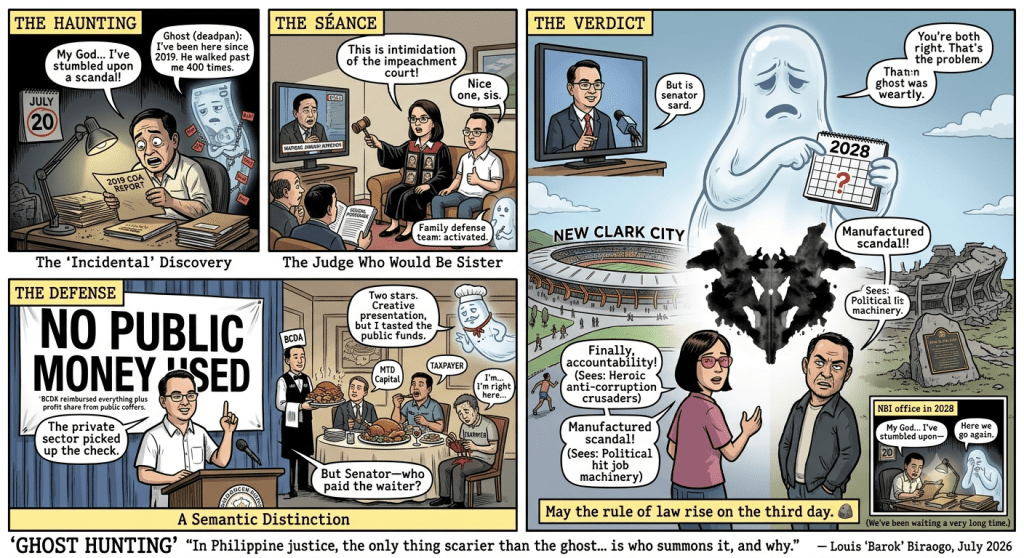
I. THE PLAYERS: A Legal Thriller in Four Acts
Melvin Matibag: The Incidental Inquisitor
The NBI Director would have us believe he stumbled upon this scandal like a man finding a lost peso coin while inspecting the site for his agency’s new academy. “Incidental,” he calls it—the bureaucratic equivalent of “the dog ate my political vendetta.” His defenders point to the formal trappings: a dedicated task force combining the Financial Investigation Unit and Special Action Unit, coordination with the Securities and Exchange Commission (SEC), Commission on Audit (COA), and Bases Conversion and Development Authority (BCDA), and a promise to “go where the evidence leads.” All very proper. All very institutional.
But let us not insult the intelligence of every Filipino who has watched this administration weaponize law enforcement with the subtlety of a sledgehammer. Matibag’s announcement arrived gift-wrapped for maximum political damage: days before his cross-examination by the very senator-judges whose brother he now investigates, fresh off a public feud with Cayetano over testimony scheduling, and delivered through the controlled chaos of an ambush interview rather than a sworn complaint. This is not how legitimate investigations begin. This is how political hits are choreographed.
Matibag’s options now form a trap of his own making. He can formalize the probe with subpoenas and Ombudsman referrals, betting a well-documented case outweighs the stench of its timing. He can recuse himself from any Cayetano-specific inquiry, acknowledging the optics he has so carefully cultivated. Or he can quietly de-prioritize the whole affair, proving the investigation was always a theatrical prop rather than a genuine accountability mechanism. Each path carries a different species of ruin.
Alan Peter Cayetano: The Wounded Lion of Taguig
The Senator’s defense is elegant in its simplicity: “No public money was used.” The private sector, he insists, financed the sports complex. PHISGOC was a private organization. Bases Conversion and Development Authority (BCDA)—not his committee—handled the infrastructure. He had already left the executive branch when the relevant appropriation was enacted. And besides, he dares the NBI to investigate, a posture that screams innocence or, perhaps, the confidence of a man who knows precisely where the documentary bodies are buried.
This defense, however, rests on a semantic distinction that would make a Jesuit blush. The BCDA, a government-owned corporation, reimbursed MTD Capital Berhad’s construction costs from public funds—and paid a handsome profit share on top. To call this “no public money” is like claiming a restaurant meal is free because someone else picked up the check. The public treasury still hemorrhaged; the cashier was just wearing a different name tag.
Moreover, Cayetano’s relationship with Vince Dizon is the unindicted co-conspirator in this narrative. Dizon’s 2016 BCDA appointment is widely attributed to Cayetano’s patronage. The political sponsorship of the Games and the operational implementation of its infrastructure flowed through a single, Cayetano-aligned pipeline. To now claim the left hand knew not what the right hand was doing is a defense more convenient than credible.
Senator Pia Cayetano: The Judge Who Would Be Sister
Pia Cayetano’s moment of righteous indignation—playing Matibag’s ambush interview video on the Senate floor, accusing him of intimidating the impeachment court—was magnificent political theater. It was also a masterclass in conflict of interest. A senator-judge, sworn to impartiality, publicly defending her brother against an investigation that might embarrass him, all while sitting in judgment of a Vice President whose fate may hinge on the credibility of Matibag’s testimony. The circles within circles would make Dante dizzy.
Her motivations are achingly human but institutionally catastrophic. She may genuinely believe the timing is coercive. She may be protecting family. But her position demands she recuse herself from any matter touching her brother’s interests—not double down with floor speeches that transform the impeachment court into a family defense team.
Vince Dizon: The Reformer’s Reckoning
And then there is the administration’s anti-corruption crusader-in-chief, the man purging DPWH of graft-tainted officials and filing cases against former House Speakers, now potentially facing the very allegations he prosecutes: unbid contracts, Swiss Challenge bypasses, and the unholy aroma of congressional insertions. Dizon’s 2020 defenders note the deal was Asian Development Bank (ADB)-advised and Office of the Government Corporate Counsel (OGCC)-cleared—a formidable paper shield. His detractors note the OGCC‘s favorable opinion arrived eight months after the contract was signed, and only after a more skeptical Government Corporate Counsel was replaced.
The irony is so thick you could pave a flood control project with it. Dizon’s leave of absence from DPWH, unexplained as of this writing, invites speculation without confirming anything—the bureaucratic equivalent of pleading the Fifth.
II. THE SEVEN DEADLY SINS OF WEAPONIZED JUSTICE
Let us now construct the pillar of shame upon which this entire episode should be publicly exhibited. The NBI’s action is not merely suspicious—it is a textbook case of law enforcement as political artillery, displaying all seven hallmarks of weaponized justice.
First: Selective Targeting. The NBI suddenly discovers a burning passion for SEA Games accountability precisely when the former chairman’s siblings sit as judges in an impeachment trial critical to the administration. Meanwhile, the flood control scandal—featuring the very same structural sins of insertions and bypassed bidding—has produced no similar theatrical announcement targeting administration allies. The selectivity is the message.
Second: Suspicious Timing. Matibag’s ambush interview landed one day after Cayetano publicly rebuked him, and days before his own testimony. In Philippine jurisprudence, the Supreme Court has held that timing alone does not invalidate prosecution—but in the court of public credibility, this timing is a confession.
Third: Stretched Charges. What exactly is the crime here? A COA flag from 2019? A dormant Ombudsman complaint from 2020? These are not new discoveries—they are archaeological artifacts, dusted off and repackaged for a political moment.
Fourth: Weak Evidence. The NBI’s “documents showing a real need to investigate” remain conveniently unseen. If the evidence is so compelling, file a complaint. Swear affidavits. An ambush interview is not a criminal case; it is a press release with handcuffs.
Fifth: Pre-trial Smear. Announcing an investigation before any formal filing, naming no individuals but ensuring everyone knows whose shadow looms, is the prosecutorial equivalent of a drive-by shooting. The target is damaged, but no one has to take responsibility for pulling the trigger.
Sixth: Harassment Tactics. The investigation pressures not just Alan Peter Cayetano but his sister, Senator Pia, creating a family squeeze play designed to rattle the impeachment court’s equilibrium.
Seventh: No Accountability for Allies. Where is the NBI task force for the flood control billions? Where is the ambush interview on unprogrammed appropriations? The silence is the answer.
III. THE LEGAL INQUISITION: Four Questions That Will Not Die
Beneath the political theater lie genuine legal questions that deserve answers—not from ambush interviews, but from the cold machinery of the Ombudsman, the COA, and the Sandiganbayan.
First: Is the ₱10 Billion Truly Public Funds? Cayetano’s “no public money” defense is a legal contortionist act. Under the Presidential Decree No. 1445 (Government Auditing Code of the Philippines), public funds include “revenue and receipts of, and expenditures or uses of funds and property, owned or held in trust by, or pertaining to, the Government.” If BCDA—a government corporation under Republic Act No. 7227 (Bases Conversion and Development Act of 1992)—reimbursed MTD from its coffers, those are public funds. The “private sector paid” framing is a distinction without a difference, a semantic escape hatch for the politically exposed.
Second: Was There Genuine Competitive Bidding? Republic Act No. 9184 (Government Procurement Reform Act), Section 5, mandates competitive bidding as the default procurement mode. The Swiss Challenge under Republic Act No. 6957 (An Act Authorizing the Financing, Construction, Operation and Maintenance of Infrastructure Projects by the Private Sector, and for Other Purposes) is a recognized alternative—but only if faithfully executed. COA’s finding that the sports complex was “incorporated into” MTD’s unsolicited proposal suggests the competitive challenge may have been a Potemkin process. The Supreme Court’s majority in SM Land, Inc. v. Bases Conversion and Development Authority (G.R. No. 203655, August 13, 2014) gave government broad discretion in modifying competitive challenges—but the dissent’s warning about a “loophole for arbitrary government action” now reads like prophecy.
Third: Who Bears Legal Accountability for Liquidation? If PHISGOC was private, as Cayetano insists, who was the public officer responsible for liquidating the funds? Under Presidential Decree No. 1445, Section 89, failure to liquidate upon demand creates a prima facie presumption of malversation under Article 217 of the Act No. 3815 (The Revised Penal Code). Someone was the accountable officer. The NBI’s task force should be asking who—not holding press conferences.
Fourth: What Drives Matibag’s Inquiry? This is the question that answers all others. The evidence of procurement irregularity is real—COA flagged it, Rappler documented it, a 2020 complaint sits with the Office of the Ombudsman (Ombudsman). The timing and method of Matibag’s resurrection of this evidence are also real—and they scream political weaponization. In the Philippine justice system, both can be true. A genuine crime can be unearthed by a corrupt motive. The tragedy is that the motive taints the truth, making accountability impossible and cynicism inevitable.
IV. THE VERDICT: A System on Trial
The 2019 SEA Games complex controversy is a Rorschach test for Philippine democracy. If you see only the legitimate pursuit of accountability, you are willfully blind to the political machinery driving it. If you see only a politically timed hit job, you are ignoring the genuine procurement rot that the COA, Rappler, and a five-year-old Ombudsman complaint have documented. The truth is both—and that is the indictment of our entire system.
The likely resolution is the most Philippine of outcomes: prolonged stalemate. The NBI task force will issue press releases. The Ombudsman will sit on the 2020 complaint for another election cycle. The impeachment trial will conclude with Matibag’s credibility irreparably damaged, and the ₱10 billion question will float, unanswered, into the 2028 presidential campaign, where it will be resurrected by whichever faction needs a convenient scandal.
The institutions will all lose. The NBI will be further exposed as a political errand boy. The Senate’s impeachment court will be stained by the spectacle of a judge defending her brother against the prosecution’s star witness. The COA’s audit findings will remain unenforced, a paper tiger’s roar. And the Filipino people will add another entry to their mental ledger of “corruption scandals that went nowhere.”
The Call
And yet—we must call for the impossible. Demand that the Ombudsman finally resolve the 2020 complaint, not based on NBI political theater but on the cold, patient accumulation of COA’s audit trails and documentary evidence. Demand that Matibag recuse himself from any Cayetano-related inquiry, file actual cases if evidence exists, and submit to cross-examination on July 20 without using his investigative power as a shield. Demand that Senator Pia Cayetano recuse herself from any impeachment matter touching her family’s interests—the 1987 Constitution of the Republic of the Philippines‘s requirement of senatorial impartiality cannot be a dead letter when it becomes personally inconvenient.
Most of all, demand that the youth—who will inherit the debts this generation of politicians is running up, both fiscal and moral—understand what is being done in their name. The SEA Games complex in New Clark City is real. It stands. It hosted athletes. It is a monument to what the Philippines can build. The question that should haunt every Filipino is whether it also stands as a monument to what the Philippines cannot seem to stop: the alchemy of public funds into private profit, laundered through legal loopholes, defended by political connections, and ultimately buried under the cynicism of a justice system that serves power, not truth.
The ghost of New Clark City will not be exorcised by ambush interviews or Senate floor speeches. It will only be laid to rest by something far rarer in this republic: a credible, independent investigation, blind to political cost, answerable only to evidence and law.
May the rule of law rise on the third day. We have been waiting a very long time. 🪨
Key Citations
A. Legal & Official Sources
- Presidential Decree No. 1445. Government Auditing Code of the Philippines. Official Gazette of the Republic of the Philippines, 11 June 1978, http://www.officialgazette.gov.ph/1978/06/11/presidential-decree-no-1445/.
- Republic Act No. 7227. Bases Conversion and Development Act of 1992. Official Gazette of the Republic of the Philippines, 13 March 1992, http://www.officialgazette.gov.ph/1992/03/13/republic-act-no-7227/.
- Republic Act No. 9184. Government Procurement Reform Act. Official Gazette of the Republic of the Philippines, 10 January 2003, http://www.officialgazette.gov.ph/2003/01/10/republic-act-no-9184/.
- Republic Act No. 6957. An Act Authorizing the Financing, Construction, Operation and Maintenance of Infrastructure Projects by the Private Sector, and for Other Purposes. 9 July 1990, lawphil.net/statutes/repacts/ra1990/ra_6957_1990.html.
- Act No. 3815. The Revised Penal Code. 8 December 1930, lawphil.net/statutes/acts/act_3815_1930.html.
- The 1987 Constitution of the Republic of the Philippines. Official Gazette of the Republic of the Philippines, 1987, http://www.officialgazette.gov.ph/constitutions/1987-constitution/.
- SM Land, Inc. v. Bases Conversion and Development Authority. G.R. No. 203655. Supreme Court of the Philippines, 13 August 2014, jur.ph/jurisprudence/summary/sm-land-inc-v-bcda.
B. News Reports
- Salcedo, Mary Joy. “Matibag: Probing 2019 SEA Games Complex Has Nothing to Do with Cayetano.” Inquirer.net, 15 July 2026, newsinfo.inquirer.net/2264396/matibag-probing-2019-sea-games-complex-has-nothing-to-do-with-cayetano.
- “COA Flags Irregularities in P8.51-B Sports Facilities Project for SEA Games.” Rappler, 14 October 2020, http://www.rappler.com/philippines/coa-2019-report-bcda-sports-facilities-project-sea-games/.





Leave a Reply