Ambiguous Rules, Absent Board, and the Art of the P50-Million Dodge
By Louis “Barok” C. Biraogo –– August 5, 2026
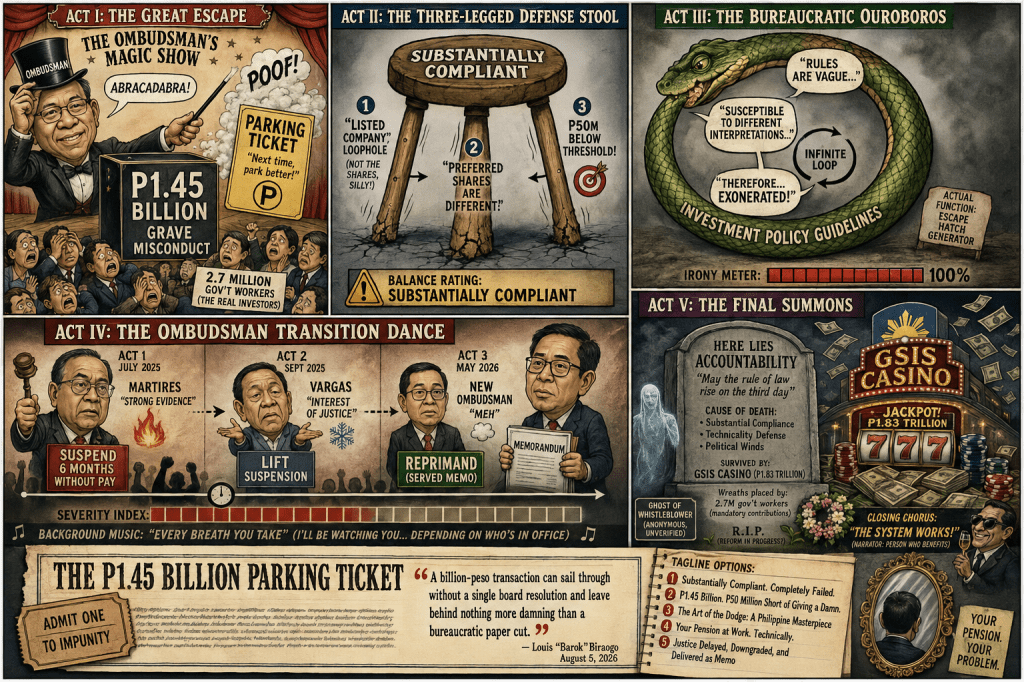
THE Office of the Ombudsman has finally delivered its verdict on the P1.45-billion Alternergy preferred-share gambit, and the Republic’s 2.7 million government workers—whose compulsory contributions funded this adventure—may now rest easy. Their pension fund was not plundered by corrupt masterminds. It was merely subjected to a “light offense.” A reprimand. A sternly worded memo, already served, for violating reasonable office rules. The grave misconduct and gross neglect charges? Dismissed. The criminal case under Republic Act No. 3019 (Anti-Graft and Corrupt Practices Act)? Dead for lack of probable cause. Case closed, dust settled, dividends collected.
Let us all exhale. The system works.
Or rather, let us begin the autopsy, because what the Ombudsman has handed down is not a resolution but a confession—a 27-page admission that the architecture of pension-fund accountability is so riddled with escape hatches, ambiguous language, and jurisdictional trapdoors that a billion-peso transaction can sail through without a single board resolution and leave behind nothing more damning than a bureaucratic paper cut.

When ‘good faith’ and ‘vague rules’ exonerate billion-peso gambles
The Legal Vanishing Act: Substantial Compliance as Get-Out-of-Jail-Free Card
The core of the Ombudsman’s reasoning is a masterwork of legal triangulation. Government Service Insurance System (GSIS) President Jose Arnulfo “Wick” Veloso’s defense rested on three legs, and the Special Panel of Prosecutors politely accepted all three. First: Alternergy Holdings Corporation was already a Philippine Stock Exchange (PSE)-listed company, and Section 36 of Republic Act No. 8291 (The Government Service Insurance System Act of 1997) only requires the corporation to be listed, not the specific preferred shares. Second: the market-capitalization and free-float requirements in GSIS’s own Investment Policy Guidelines were designed for common shares—liquid, traded equities—not fixed-income-like perpetual preferred shares. Third: the P1.45-billion price tag sat a comfortable P50 million below the P1.5-billion threshold requiring board approval, placing the transaction squarely within the President and General Manager’s delegated authority.
Each argument is, in isolation, defensible. The Supreme Court’s Arias v. Sandiganbayan doctrine protects heads of office who rely in good faith on subordinates’ work product, and the panel expressly credited former Vice President Aaron Samuel Chan’s legal memoranda as evidence of Veloso’s good-faith reliance. Imperial v. GSIS—a case dripping with irony, as it involves the same pension fund—holds that misconduct becomes “grave” only where corruption or flagrant disregard is affirmatively proven, not merely inferred. No personal profit was shown. The transaction generated P118 million in dividends. The Ombudsman, applying Imperial and Arias, found the legal equivalent of a parking ticket.
But this is where the satire curdles into tragedy. Read the ruling closely, and you will find that the Ombudsman’s own panel admitted the IPG language was “susceptible to different interpretations.” Let that sink in. The Investment Policy Guidelines—the very rules written to safeguard P1.83 trillion in workers’ retirement funds—were so ambiguously drafted that a P1.45-billion transaction could be routed around the board, the Assets and Liabilities Committee, and the Risk Oversight Committee without triggering grave liability. The ambiguity did not indict the drafters. It exonerated the actors. This is not justice; it is a bureaucratic ouroboros, swallowing its own tail.
And what of the transaction-splitting allegation? The Commission on Audit (COA) flagged that GSIS’s earlier P85-million common-share investment in Alternergy, combined with the P1.45-billion preferred tranche, totals P1.535 billion—technically exceeding the board-approval threshold. The Ombudsman’s resolution appears to have sidestepped this entirely, accepting the defense that these were separate instruments at different times. Perhaps. But in a country where public procurement law has developed entire jurisprudential doctrines around the splitting of contracts to evade bidding thresholds, the silence is deafening.
The Ghost in the Machine: Ombudsman Transitions and the Specter of Politics
No analysis of this case can ignore its political choreography. The investigation was launched under Ombudsman Samuel Martires, who in July 2025 found “strong evidence” of grave misconduct and ordered a six-month preventive suspension without pay—a move reserved for offenses warranting dismissal. Martires retired two weeks later. Acting Ombudsman Dante Vargas lifted the suspension in September 2025 “in the interest of justice and fair play.” By May 2026, the case reached its final form under a new Ombudsman: a reprimand, already served, for what was once called ‘strong evidence’ of grave misconduct. The shift was legal, procedural, and entirely within bounds—but the optics left a bruise.
Let me be precise: nothing in the public record establishes that Remulla personally directed the panel’s findings. Career prosecutors authored both resolutions. But the sequence—harsh opening under a departing Ombudsman, soft landing under an administration-adjacent successor—is the recurring nightmare of Philippine anti-graft enforcement. It invites the inference that institutional posture, not new evidence, drove the downgrade. Whether this is true or merely optically catastrophic, the result is the same: a public left to wonder whether the fix was in.
And then there is the anonymous complainant—the phantom who triggered this entire saga. Their identity remains unknown, their motives opaque. Whistleblower? Political saboteur? Disgruntled insider? The Ombudsman’s rules permit anonymous complaints where verifiable, but the complainant’s invisibility also means their institutional vantage point—and thus the credibility of their allegations—remains forever untested. The system used them to launch a six-month suspension, then discarded them when the political winds shifted. Heroes deserve better. So do villains, for that matter, if only so we know whom to hold accountable.
The Pattern That Dares Not Speak Its Name
Public Services Labor Independent Confederation (PSLINK), the labor group representing government workers, has been screaming into the void that Alternergy is not an isolated interpretive dispute. It is one tile in a mosaic of risk-taking that includes a P2.3-billion placement in three unidentified, unprofitable companies (already carrying a P251-million valuation loss), a P1.46-billion Nickel Asia stake reportedly taken without board approval, and a board-blocked $100-million bid for a Neuberger Berman fund with Lehman Brothers-linked exposure. Separately, each might be explained. Collectively, they sketch a management culture that treats the board-approval threshold not as a governance checkpoint but as a speed limit to be nudged.
The Ombudsman’s reprimand does nothing—zero—to address this pattern. A light offense, already served, carries no deterrent weight. It is a penalty that punishes no one, deters nothing, and reforms zero procedures. The GSIS Board, which wrote the ambiguous IPG and then passively acknowledged the Alternergy transaction after the fact, escapes without a scratch. The COA’s separate disallowance track under Madera v. COA may yet impose personal refund liability for the unrelated P2.3-billion loss, but on Alternergy specifically, the accountability cupboard is bare.
Five Reforms and a Summons to the Living
The Republic deserves better. The 2.7 million teachers, nurses, clerks, and street sweepers whose mandatory contributions fund this casino deserve better. Here is what must happen, and what I demand of Congress, the executive, and the youth who will inherit this mess:
First, legislative clarity. Amend RA 8291 to obliterate the ambiguity between common and preferred shares, lower the board-approval threshold, and mandate that any equity investment in a newly listed company requires full board ratification before disbursement.
Second, internal governance with teeth. The Assets and Liabilities Committee and Risk Oversight Committee must be more than decorative. Their sign-off must be a non-delegable prerequisite, not a consultation checkbox.
Third, broadened COA and Governance Commission for GOCCs (GCG) oversight with clear triggers for real-time intervention, not post-hoc audit flags that arrive years after the money has left the vault.
Fourth, whistleblower protection that shields the next anonymous hero from retaliation and obscurity, encouraging internal disclosure before scandal metastasizes.
Fifth, radical transparency: the mandatory, public, and regular publication of all government-owned and controlled corporation (GOCC) investment portfolios, so that citizens can audit what their government hides.
The Ombudsman’s decision closes a case. It does not close the argument. GSIS remains a P1.83-trillion behemoth, and the same ambiguous rules, the same threshold-nudging culture, and the same political crosswinds remain in place. Reprimand, as a penalty, is a whispered apology in a hurricane of systemic failure.
To the youth reading this: this is your inheritance. A pension system where billion-peso bets on renewable energy are governed by rules so vague that violation earns you a memo. An anti-graft office whose ferocity depends on whose term is ending. A Republic where “substantial compliance” is the alibi for governance by technicality. Do not accept this. Study the law, enter public service, and build the institutions that will make this critique obsolete.
May the rule of law rise on the third day. It has been buried long enough. 🪨
Key Citations
A. Legal & Official Sources
- Republic Act No. 3019. Anti-Graft and Corrupt Practices Act. 1960, lawphil.net/statutes/repacts/ra1960/ra_3019_1960.html.
- Republic Act No. 8291. An Act Amending Presidential Decree No. 1146, as Amended, Expanding and Increasing the Coverage and Benefits of the Government Service Insurance System, Instituting Reforms Therein and for Other Purposes (The Government Service Insurance System Act of 1997). 1997, lawphil.net/statutes/repacts/ra1997/ra_8291_1997.html.
- Arias v. Sandiganbayan. G.R. Nos. 81563 and 82512. Supreme Court of the Philippines, 19 Dec. 1989, lawphil.net/judjuris/juri1989/dec1989/gr_81563_1989.html.
- Imperial, Jr. v. Government Service Insurance System. G.R. No. 191224. Supreme Court of the Philippines, 4 Oct. 2011, lawphil.net/judjuris/juri2011/oct2011/gr_191224_2011.html.
- Madera v. Commission on Audit. G.R. No. 244128. Supreme Court of the Philippines, 8 Sept. 2020, lawphil.net/judjuris/juri2020/sep2020/gr_244128_2020.html.
B. News Reports
- The Manila Times. “Ombudsman Reprimands GSIS Chief, 4 Officials over P1.45B Alternergy Investment.” The Manila Times, 4 Aug. 2026, http://www.manilatimes.net/2026/08/04/news/ombudsman-reprimands-gsis-chief-4-officials-over-p145b-alternergy-investment/2397605.
- De Castro, Isagani, Jr. “Ombudsman Suspends GSIS President over P1.4B Share Deal with Alternergy.” Rappler, 22 July 2025, http://www.rappler.com/business/ombudsman-suspends-jose-arnulfo-wick-veloso-share-deal-alternergy/.
- Maligro, Tatiana. “Ombudsman Lifts Suspension vs. GSIS Chief Veloso.” Rappler, 19 Sept. 2025, http://www.rappler.com/business/ombudsman-lifts-suspension-gsis-chief-wick-veloso/.
- Villanueva, Val A. “[Vantage Point] Alternergy’s Cherry-Picked Financials Used to Defend GSIS Deal.” Rappler, 24 July 2025, http://www.rappler.com/voices/thought-leaders/vantage-point-alternergy-financials-used-defend-gsis-deal/.
- ₱9 Billion in ‘Savings’? DILG’s Fire Truck Deal Smells Like Smoke

- ₱8B BBM Pork: CCTV for Every Captain’s Kumpare?
- ₱8.9 Billion, 331 Ghost Police Stations: The TIKAS Scandal Explained

- ₱8.4 Billion, 42,000 Barangays, 1 Election: The “Bawat Barangay Makikinabang” Vote-Buying Masterclass
- ₱75 Million Heist: Cops Gone Full Bandit

- ₱63 to the Dollar: The Only Thing Falling Faster Than the Peso Is the Government’s Credibility

- ₱6.77B Ghost Haunts Duterte: RTC Dismisses Mans Carpio’s Desperate Plea
- ₱6.77 Billion and Zero Cash: The Sara Duterte SALN Math That Doesn’t Add Up

- ₱6.7-Trillion Temptation: The Great Pork Zombie Revival and the “Collegial” Vote-Buying Circus

- ₱58.53B, Zero Receipts: The LGSF Pork Barrel Nobody Wants to Name
- ₱53 Million Man Tells ₱695-a-Day Workers to Stop Being ‘Mayabang’: The Audacity of BSP’s Remolona
- ₱4.4 Billion and a Witness Who Can’t Explain It: The Duterte Impeachment’s Most Expensive Non-Answer




Leave a Reply