Ghost Ships, Dirty Money, and the Dredging Empire No One Audited
By Louis ‘Barok’ C. Biraogo — October 4, 2026
MGA ka-kweba, grab your shovels and your tinfoil hats. Today we dig into the most brazen regulatory heist since someone convinced the Bureau of Internal Revenue (BIR) that “donations” are tax-deductible. We’re talking about the Zambales dredging controversy—a saga so beautifully convoluted it makes the Napoles pork barrel scam look like a barangay bake sale.
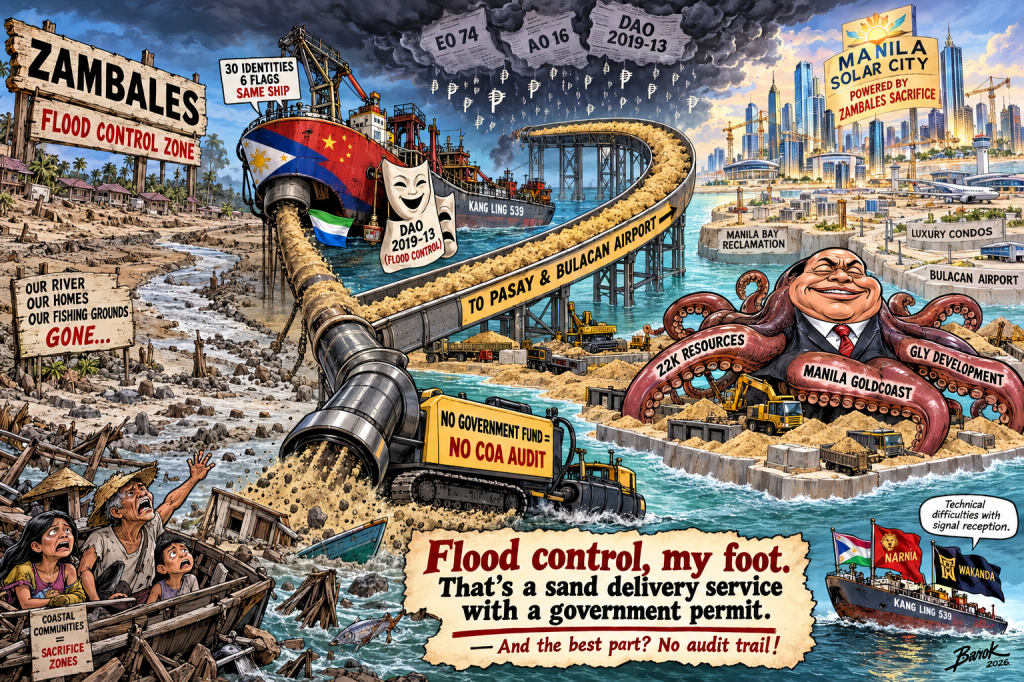
The official narrative? “Flood control.” The actual narrative? A Chinese-operated sand conveyor belt feeding Manila Bay reclamation projects while local fishermen watch their livelihoods sink into the same hole the dredgers carved out.
Let’s unpack this masterpiece of institutional gaslighting.
The Chronology That Should Make You Suspicious
February 2019: Executive Order No. 74, s. 2019 (EO 74) transfers the Philippine Reclamation Authority (PRA) to the Office of the President. Nice timing—centralize control over the reclamation approval pipeline.
February 2019: Administrative Order No. 16, s. 2019 (AO 16) creates the Manila Bay Task Force. “Rehabilitation,” they called it. Nothing to see here.
October 2019: Department of Environment and Natural Resources (DENR) Administrative Order No. 2019-13 (DAO 2019-13) establishes “Exclusive River Dredging Zones” in Zambales’ Bucao, Maloma, and Sto. Tomas rivers.
Now, call me a cynic—I prefer “investigative realist”—but when you line up the institutional architecture for reclamation (EO 74), the environmental justification (AO 16), and the physical sand supply mechanism (DAO 2019-13) within eight months, you’re either looking at miraculous inter-agency synergy or a carefully choreographed supply chain. Occam’s razor says the latter.
The Senate apparently noticed too. Senate Resolution No. 975, introduced by Senator Loren Legarda, explicitly links the San Felipe dredging operations to the Manila Bay Reclamation Development Project and flags the involvement of China Harbour Engineering Company (CHEC), a subsidiary of the US-blacklisted China Communications Construction Company (CCCC).
The resolution even quotes San Felipe Mayor Reinhard Jeresano admitting on the record that sand extracted from Zambales is destined for “the reclamation area in Pasay City and the airport in Bulacan.”
Flood control, my foot. That’s a sand delivery service with a government permit.
The “No Government Fund” Loophole: A Masterclass in Audit Evasion
Here’s where the scheme gets deliciously—or disgustingly, depending on your tolerance for institutional fraud—clever.
DAO 2019-13 reportedly stipulates that “the government will not fund private-sector dredging activities.” The private operator finances the dredging, sells the extracted sand commercially, and pays taxes and fees to the provincial government.
Sounds efficient, right? Wrong.
What this actually creates is an accountability vacuum. No government expenditure means no Commission on Audit scrutiny. The extraction fees, excise taxes, and environmental charges flow to the province, but there’s no centralized ledger tracking how much sand leaves Zambales, where it goes, or whether the volumes align with “flood control necessity.”
ZEN Executive Director Heidi Fernandez put it bluntly: Governor Ebdane earns from excise taxes, environmental fees, and extraction fees that are “not audited and reported because there is no government fund that is used in their business model.”
Translation: We have no idea how much money changed hands, how much sand was extracted, or whether any of it was necessary for flood mitigation. But trust us, it’s all above board.
The Ghost Fleet: When “Dredgers” Become International Men of Mystery
Now, here’s where the story goes from corrupt to genuinely alarming.
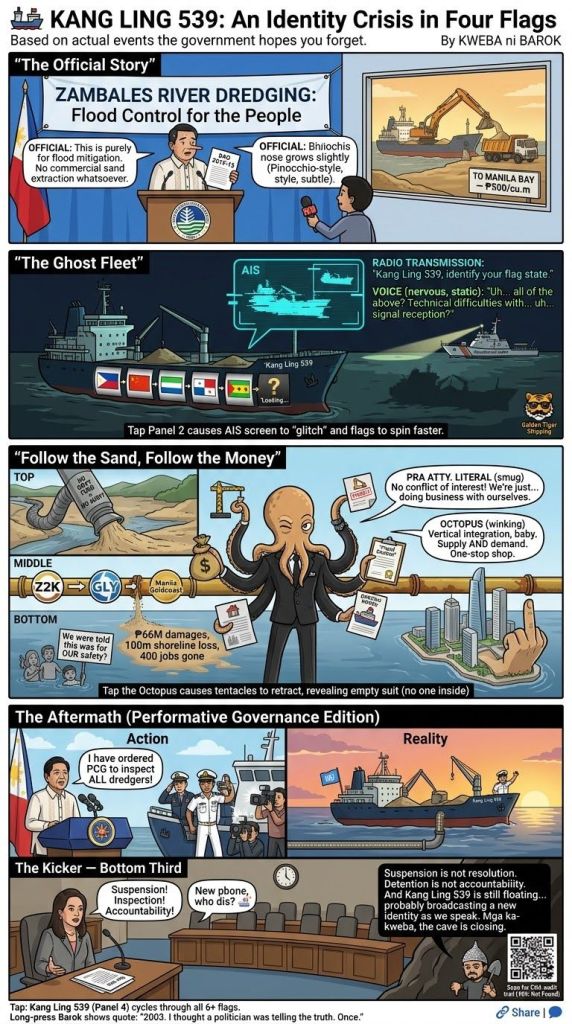
In January 2026, maritime security analyst Ray Powell published a report revealing that a single dredger—the Chinese-origin Kang Ling 539—had broadcast at least 30 different identities while shuttling between Manila Bay and Zambales over a two-year period. The vessel allegedly operated under six different flag states, including the Philippines, Sierra Leone, China, São Tomé and Príncipe, and Panama.
Let me repeat that. One ship. Thirty identities. Six flags. For two years.
This is either the most incompetent vessel registration system in maritime history or a deliberate strategy to evade detection, sanctions, and regulatory oversight. I’ll give you three guesses which one I’m betting on.
Following Powell’s report, President Marcos ordered the Philippine Coast Guard (PCG) to board and inspect all dredgers operating in Manila Bay. The PCG detained four vessels owned by Golden Tiger Shipping Agencies, including Kang Ling 539, citing multiple “detainable deficiencies” including issues with the vessel’s Automatic Identification System (AIS).
Golden Tiger’s defense? “Technical factors such as signal reception, software updates or equipment configuration.” Because nothing says “legitimate maritime operation” like a ship that accidentally changes nationality every few weeks.
But the ghost fleet issue isn’t just about regulatory compliance. It’s about who actually controls the sand supply chain. CHEC’s involvement—a subsidiary of a company blacklisted by the US for militarizing artificial islands in the West Philippine Sea—raises questions that go far beyond environmental protection.
Are we building reclamation projects or strategic logistics infrastructure? And for whom?
The Corporate Web: Follow the Sand, Follow the Money
The BNC report identifies a corporate relationship between Manila Goldcoast Development Corp. (proponent of Manila Solar City reclamation) and Z2K Resources Inc. (involved in Zambales dredging) through the Tieng family’s GLY Development Corp.
If independently confirmed, this is vertical integration on steroids. The same family controls both the demand side (reclamation requiring fill material) and the supply side (dredging producing that material).
PRA Assistant General Manager Joseph Literal’s defense? “There is no conflict of interest there because you are doing something for yourself.”
Atty. Literal, with respect, that’s not a legal argument. That’s a confession with better grammar.
When a single entity controls both supply and demand in a specialized market, competitive pricing mechanisms break down. The government loses the ability to verify whether it’s receiving fair value for extracted resources. And the public loses the ability to distinguish between “flood control” and “commercial extraction with a government-sanctioned alibi.”
The Environmental Justice Dimension: A Tale of Two Zambales
Let’s talk about who bears the costs of this arrangement.
According to the San Felipe Resort Owners Association, shoreline loss has reached 100 meters in some areas, with ₱66 million in structural damages, ₱100 million in lost tourism revenue, and over 400 workers affected. Ten families have been displaced.
Meanwhile, in Caoayan, Ilocos Sur—where similar dredging operations are underway—fisherman Paeng Quillopo told the Philippine Center for Investigative Journalism (PCIJ) that sand formations near the river mouth that once weakened incoming waves have been removed. A natural buffer known locally as Snake Island is now part of the dredging zone. Houses are more exposed to storms. Fish are harder to catch. Fuel costs have tripled for small-scale fishers.
The beneficiaries? Reclamation developers, construction companies, and provincial governments collecting fees. The costs? Borne by coastal communities who never consented to becoming a sacrifice zone.
This is environmental injustice in its purest form: extract resources from one locality, realize economic value elsewhere, and leave the ecological risk with the people who can least afford it.
The Legal Architecture: A Syllabus of Regulatory Failures
Let’s review the legal framework that enabled this mess.
Presidential Decree No. 1586 (Environmental Impact Statement System) requires Environmental Compliance Certificates (ECCs) for projects significantly affecting environmental quality. Did the Zambales dredging operations receive ECCs that evaluated the entire supply chain—river to estuary to coastal zone to reclamation site? Or did they receive streamlined approval under the “flood control” classification?
Republic Act No. 7942 (Philippine Mining Act of 1995) requires proper permits for mineral extraction. If sand was extracted beyond flood-control necessity and sold commercially, did the operators secure Industrial Sand and Gravel Permits? Or did they exploit the semantic distinction between “dredging” and “quarrying” to evade regulatory requirements?
Republic Act No. 7160 (Local Government Code of 1991) gives provincial governors authority to issue quarry permits for areas up to five hectares. Did Governor Ebdane’s administration properly exercise this authority, or did it become a rubber stamp for corporate extraction?
Republic Act No. 3019 (Anti-Graft and Corrupt Practices Act) prohibits causing undue injury to government through manifest partiality or giving unwarranted benefits to private parties. If officials knowingly structured a “flood control” program to supply commercial sand, have they violated Section 3(e)?
The Supreme Court’s Oposa v. Factoran doctrine recognizes intergenerational responsibility for environmental protection. The Concerned Residents of Manila Bay v. MMDA case established continuing mandamus for environmental cleanup. The Resident Marine Mammals v. Reyes case made the Writ of Kalikasan available for environmental threats of sufficient magnitude.
The legal tools exist. The question is whether there’s political will to use them.
The Evidence Gap: What We Still Don’t Know
In the spirit of intellectual honesty—a rare commodity in Philippine discourse—I must acknowledge what remains unproven.
The publicly available evidence supports the conclusion that Zambales sand was used for Manila Bay reclamation. PRA records document a Zambales sand source for the Pasay 360-hectare project beginning September 2021. Mayor Jeresano admitted the destination on the record.
What remains unproven is the stronger claim that DAO 2019-13 was deliberately rushed in 2019 primarily to create a reclamation-sand supply chain.
To establish that, investigators would need:
- Pre-October 2019 internal communications between DENR, Department of Public Works and Highways (DPWH), and PRA
- Sediment-volume studies comparing flood-control necessity to actual extraction
- Shipping records reconstructing every shipment from origin to destination
- Corporate records establishing beneficial ownership and contractual relationships
- The money trail: market value of extracted sand versus government receipts
Until those documents surface, the most defensible conclusion is that there is substantial evidence of a later dual-use system—flood control plus commercial extraction—but insufficient publicly disclosed evidence to conclusively establish premeditated design.
That’s not exoneration. That’s an invitation to investigate.
The Governance Failure: Who Controls the Information?
Here’s the most troubling question in this entire controversy: Who controls the information?
A sophisticated extraction regime should produce a complete public chain:
Permit → dredging zone → vessel → extraction date → cubic meters → mineral classification → tax/fee → loading → transport → destination → purchaser → receiving project.
If that chain cannot be reconstructed, accountability becomes impossible.
The existence of a Freedom of Information (FOI) request seeking dredging revenue, livelihood impacts, and mitigation data—and the DPWH response that it did not possess the requested information—illustrates the fragmented information problem.
This is a governance failure even if every individual transaction turns out to be legal. When the government cannot answer basic questions about resource extraction it authorized, something has gone catastrophically wrong.
What Happens Next?
The Marcos administration has suspended all 22 Manila Bay reclamation projects pending review. The PCG has detained vessels with multiple regulatory violations. Senate resolutions have been filed. Environmental groups continue to document damage.
But suspension is not resolution. Detention is not accountability. Resolutions are not reform.
The question is whether this controversy becomes a genuine reckoning with regulatory capture and environmental injustice—or another episode of performative governance that fades when the cameras leave.
Based on the Philippine track record, I’m not optimistic. But I’ve been wrong before.
Once.
It was 2003. I thought a politician was telling the truth.
The Final Assessment
The Zambales dredging controversy is not merely about sand. It’s about who has the right to decide what happens to natural resources, who benefits from their extraction, and who bears the environmental costs.
The available evidence suggests a system designed to facilitate commercial extraction under the guise of flood control, with regulatory gaps large enough to drive a dredger through.
Whether criminal liability attaches depends on proving intent—manifest partiality, evident bad faith, or gross inexcusable negligence under RA 3019. That requires documents, not speculation.
But here’s what we know for certain:
- Zambales sand was used for Manila Bay reclamation.
- The same corporate family may have controlled both extraction and reclamation.
- Environmental damage occurred.
- Governance gaps enabled opacity.
- Communities bore costs while distant projects captured benefits.
These facts alone—regardless of original intent—demand action grounded in the constitutional right to a balanced and healthful ecology under Article II, Section 16 of the 1987 Constitution, the public trust doctrine over natural resources, and the State’s obligation to protect vulnerable communities from exploitation.
The sand may be gone. The questions remain.
And Kang Ling 539 is still floating somewhere, probably broadcasting a new identity as we speak.
Mga ka-kweba, the cave is closing for now. But the investigation continues.
–Barok out.
Key Citations
A. Legal & Official Sources
- The 1987 Constitution of the Republic of the Philippines. Official Gazette of the Republic of the Philippines, 1987, http://www.officialgazette.gov.ph/constitutions/1987-constitution/.
- Presidential Decree No. 1586. Establishing an Environmental Impact Statement System, Including Other Environmental Management Related Measures and for Other Purposes. Official Gazette of the Republic of the Philippines, 11 June 1978, http://www.officialgazette.gov.ph/1978/06/11/presidential-decree-no-1586-s-1978/.
- Executive Order No. 74, s. 2019. Repealing Executive Order No. 798 (s. 2009) and EO No. 146 (s. 2013), Transferring the Philippine Reclamation Authority to the Office of the President, Delegating to the PRA Governing Board the Power of the President to Approve Reclamation Projects, and for Other Purposes. LawPhil, 1 Feb. 2019, lawphil.net/executive/execord/eo2019/eo_74_2019.html.
- Administrative Order No. 16, s. 2019. Expediting the Rehabilitation and Restoration of the Coastal and Marine Ecosystem of the Manila Bay and Creating the Manila Bay Task Force. Supreme Court E-Library, 19 Feb. 2019, elibrary.judiciary.gov.ph/thebookshelf/showdocsfriendly/6/86407.
- Department of Environment and Natural Resources. Administrative Order No. 2019-13. 2019. Uploaded copy, Scribd, uploaded by Kriezl Nierra Jadulco, http://www.scribd.com/document/466637094/DAO-2019-13.
- Republic Act No. 3019. Anti-Graft and Corrupt Practices Act. LawPhil, 1960, lawphil.net/statutes/repacts/ra1960/ra_3019_1960.html.
- Republic Act No. 7160. Local Government Code of 1991. Official Gazette of the Republic of the Philippines, 10 Oct. 1991, http://www.officialgazette.gov.ph/1991/10/10/republic-act-no-7160/.
- Republic Act No. 7942. Philippine Mining Act of 1995. LawPhil, 1995, lawphil.net/statutes/repacts/ra1995/ra_7942_1995.html.
- Oposa v. Factoran, G.R. No. 101083. Supreme Court of the Philippines, 30 July 1993. LawPhil, lawphil.net/judjuris/juri1993/jul1993/gr_101083_1993.html.
- Metropolitan Manila Development Authority v. Concerned Residents of Manila Bay, G.R. Nos. 171947-48. Supreme Court of the Philippines, 18 Dec. 2008. LawPhil, lawphil.net/judjuris/juri2008/dec2008/gr_171947_2008.html.
- Resident Marine Mammals of the Protected Seascape Tañon Strait v. Reyes, G.R. No. 180771. Supreme Court of the Philippines, 21 Apr. 2015. LawPhil, lawphil.net/judjuris/juri2015/apr2015/gr_180771_2015.html.
- Senate of the Philippines. Resolution No. 975, 19th Congress. Resolution Directing an Inquiry, in Aid of Legislation, on the Operation of Dredging Vessels Operated by Chinese Nationals in San Felipe, Zambales. 2024, legacy.senate.gov.ph/lisdata/4376439764!.pdf.
B. News Reports
- Powell, Ray. “The Hydra of Manila Bay.” SeaLight, 5 Jan. 2026, http://www.sealight.live/posts/the-hydra-of-manila-bay.
- Esguerra, Darryl John. “Marcos Orders PCG to Board, Inspect All Manila Bay Dredgers.” Philippine News Agency, 6 Jan. 2026, http://www.pna.gov.ph/articles/1266328.
- Cupin, Bea. “PCG Probes Manila Bay Reclamation Dredger with Multiple Identities.” Rappler, 7 Jan. 2026, http://www.rappler.com/philippines/coast-guard-inspect-chinese-dredger-change-identity-manila-bay/.
- Philippine Center for Investigative Journalism. “River Dredging Has Replaced Sand Mining but Chinese Firms Are Still Involved and Coastal Communities Are Still Hurting.” PCIJ.org, 16 June 2026, pcij.org/2026/06/16/river-dredging-has-replaced-sand-mining-but-chinese-firms-are-still-involved-and-coastal-communities-are-still-hurting/.
- Bilyonaryo News Channel. “Was Zambales River Dredging Rushed to Supply Manila Bay Reclamation?” BNC, 30 Sept. 2026, bnc.bilyonaryo.com/was-zambales-river-dredging-rushed-to-supply-manila-bay-reclamation/news/.

- “Ang Hirap Maging Mahirap”: The PAO Scandal That Proves Government Contempt Is Nothing New

- “Far-Off” My Axx: Malacañang’s Claire Castro Drowns in Her Own Legal Gaslighting

- “Forthwith” to Farce: How the Senate is Killing Impeachment—And Why Enrile’s Right (Even If You Can’t Trust Him)

- “HINDI AKO NAG-RESIGN!”

- “I Know Nothing”: Baste Duterte’s Amnesia Defense Meets ₱33M in GenCorp Contracts

- “I’m calling you from my new Globe SIM. Send load!”

- “Mahiya Naman Kayo!” Marcos’ Anti-Corruption Vow Faces a Flood of Doubt

- “Manageable” Debt, Unmanageable Lies: DBM’s ₱21 Trillion Fairy Tale

- “Meow, I’m calling you from my new Globe SIM!”

- “Natrabaho”: One Word, One Ombudsman, and a Judiciary on Trial

- “No Special Jail for Crooks!” Boying Remulla Slams VIP Perks for Flood Scammers

- “Philippine-Controlled” or Yankee Gas Station? The Davao Fuel Depot Farce Exposed








Leave a Reply