
Prosecutors Spent Millions to Discover That Two Names for the Same Place Are Still the Same Place
By Louis ‘Barok‘ C. Biraogo — October 3, 2026
DAY 32 of the Sara Duterte impeachment trial delivered what every legal observer secretly craves: a property scandal, a confidentiality meltdown, and a defense motion disguised as a geography lesson. And by the time Presiding Officer Chiz Escudero banged his gavel, the only thing missing was a map of Davao City with “Matina Crossing = Barangay 74-A” circled in red marker.
Let’s walk through this gently, because apparently some people still think “two properties not in the Statement of Assets, Liabilities and Net Worth (SALN)” is the same thing as “two properties deliberately concealed.” It’s not. It’s barely even a coherent thought, and yet here we are.
The Matina Property: A ₱6 Million Question Mark Wearing a ₱8 Million Mortgage
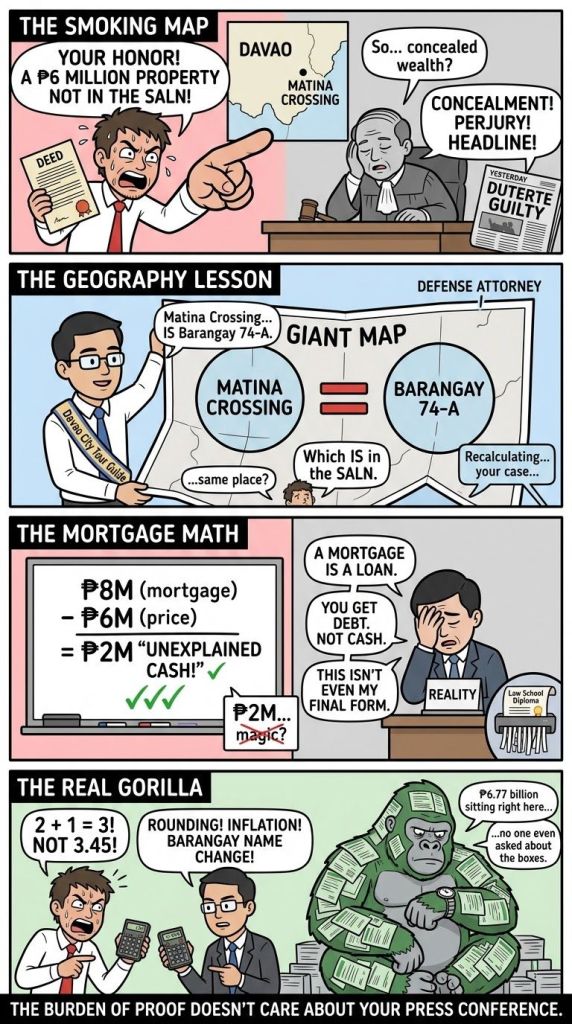
Davao City Register of Deeds Kathy Florence Baldonado testified that Manases Carpio bought a 379-square-meter parcel in Juna Subdivision, Matina Crossing, for ₱6 million in July 2024, then mortgaged it for ₱8 million in August. The prosecution’s theory: this property doesn’t appear in Sara Duterte’s 2025 SALN, therefore something something unexplained wealth.
Except the defense immediately pointed out that Matina Crossing is also known as Barangay 74-A, which does appear in the SALN. And Baldonado—God bless her honest confusion—admitted she had no personal knowledge of Duterte’s SALN contents and didn’t know about the barangay alias.
Escudero, to his credit, acknowledged the obvious: SALN descriptions are “too generic” to definitively match against technical property records. This is the legal equivalent of saying “we don’t actually have a match, but the vibes are suspicious.”
Meanwhile, the ₱6 million purchase price versus the ₱8 million mortgage is being treated like some smoking gun of unexplained cash. Let me explain mortgages to the prosecution, since they seem confused: a mortgage is a loan. You don’t get ₱8 million in cash. You get a liability. The ₱2 million “difference” isn’t money appearing out of thin air—it’s a bank’s appraisal and loan-to-value calculation. This is basic. This is the kind of thing you learn in your first month of law school, assuming you weren’t too busy crafting press releases.
The Samal Property: Where “No Perfect Match” Becomes a Constitutional Crisis
Then there’s the Samal property—751 square meters, acquired in 2018 for ₱3.45 million. Pineda testified that “nothing perfectly matches the Deed of Absolute Sale (DOAS)” in the SALN.
“Perfectly matches.” Those are the operative words.
The 2019 SALN lists two land purchases in Barangay Aundanao, Samal, for ₱2 million and ₱1 million. The deed of sale shows one parcel for ₱3.45 million. So the prosecution’s position is: two entries totaling ₱3 million don’t “perfectly match” one entry for ₱3.45 million, therefore concealment.
Or—and I’m just spitballing here—maybe the SALN description was imprecise. Maybe the barangay name changed. Maybe, just maybe, the Philippine SALN system is a poorly designed Excel template from 1987 that doesn’t require lot numbers, title numbers, or any of the identifiers that would actually make matching possible.
Escudero himself noted that SALNs don’t require exact square meterage. This is the court essentially admitting the prosecution’s evidentiary foundation is built on quicksand.
The Family Code: The Prosecution’s Actually-Good Argument
Here’s where things get interesting, and where I have to give the prosecution some credit they probably don’t deserve given their public rhetoric.
Under Executive Order No. 209 (The Family Code of the Philippines), property acquired during marriage is presumptively community property. Sara and Mans married in 2007. No prenup. These properties were acquired in 2018 and 2024. The prosecution doesn’t even need to prove Sara’s name is on the title—they just need to establish the acquisition date and the marriage.
That’s actually a decent legal argument. The problem is they’re dressing it up as “married to = co-owner,” which the Supreme Court has explicitly rejected. In Heirs of Jugalbot v. Court of Appeals, the Court held that the phrase “married to” on a title is merely descriptive of marital status, not proof of co-ownership. The prosecution should be arguing Article 93 presumption, not title notation. It’s a subtle distinction, but subtlety has never been the House’s strong suit.
The AMLC Confidentiality Circus: Where Everyone Is Wrong Except Maybe the Senate
The trial adjourned early because the defense wanted time to review 23 to 24 boxes of Anti-Money Laundering Council (AMLC) documents against an 11-page summary. The defense invoked Section 8-A of Republic Act No. 9160 (The Anti-Money Laundering Act)—the “shall not reveal” provision—like it’s a magic incantation that makes subpoenas disappear.
Diokno, for the prosecution, countered that Section 8-A prevents leaks, not lawful subpoena compliance. This is almost certainly correct. The Senate already ruled in July that its subpoena power isn’t nullified by AMLA confidentiality. Escudero granted the delay “out of courtesy and equity,” not because the defense had a winning legal argument.
But here’s what’s actually damning about this whole exchange: the AMLC’s cover letter said it was “NOT waiving confidentiality.” Translation: we’re handing over the documents because a court ordered us to, but we want it on record that we’re not happy about it. This is bureaucratic CYA at its finest.
And the defense’s request for more time? Legitimate, actually. Receiving an 11-page summary of 23 boxes of financial records and being expected to cross-examine effectively is the kind of procedural fairness issue that could taint a conviction. Escudero was right to grant the continuance. The trial can survive a weekend delay. It cannot survive a due process violation that gives the Supreme Court an excuse to intervene.
The ₱6.77 Billion Gorilla in the Room
Here’s the number that actually matters, and it’s not ₱6 million or ₱8 million or ₱3.45 million. It’s ₱6.77 billion in AMLC-flagged transactions. The prosecution’s property evidence is essentially a table of contents for a much larger financial tracing exercise.
The properties are the least interesting part of this case. What matters is whether the bank records, Bureau of Internal Revenue (BIR) filings, and AMLC data can establish a pattern of wealth accumulation that cannot be reconciled with Sara Duterte’s lawful income. The properties are just convenient, tangible exhibits that play well in headlines. The financial trail is where this case will either collapse or crystallize.
The Fundamental Problem: Headlines Are Not Evidence
The prosecution has a legitimate evidentiary question: were community properties properly disclosed? That’s a question worth asking.
But they’ve already answered it publicly as “perjury” and “concealment” before establishing the predicate facts. Lorna Kapunan called it “perjurious.” The problem is that perjury requires a knowingly false statement on a material matter. An omission isn’t automatically perjury. A generic SALN description isn’t automatically an omission. And a mismatch between a title and a SALN entry isn’t automatically concealment.
The Supreme Court has repeatedly warned against exactly this kind of prosecutorial enthusiasm. In Navarro v. Office of the Ombudsman, the Court held that a mere misdeclaration in the SALN does not automatically amount to dishonesty, and that where the source of undisclosed wealth can be properly accounted for, it is “explained wealth” which the law does not penalize. These cases exist precisely because the government keeps trying to convert administrative sloppiness into criminal liability.
What Comes Next
The AMLC testimony on Monday will either make this case or break it. If Buenaventura can trace specific transactions to the property acquisitions, the prosecution’s narrative strengthens. If the defense can demonstrate that the AMLC data is volume, not wealth—transactions cycling through accounts rather than accumulating—the bottom falls out.
But here’s my prediction: the properties will turn out to be partially declarable and poorly described, the SALN system will be shown to be structurally inadequate for this kind of forensic matching, and the real fight will be over the billions in transactions that the prosecution hasn’t even begun to explain.
Until then, the Senate impeachment court should keep doing what it’s been doing: reminding everyone that a subpoena isn’t evidence, a mismatch isn’t a crime, and a headline isn’t a conviction.
The burden of proof doesn’t care about your press conference.
Louis ‘Barok’ C. Biraogo observes the legal circus from the cheap seats, writes about it, and wonders why anyone still files SALNs with square meterage as the primary identifier. He can be reached at the comments section, where he will be ignoring your ad hominem attacks.
Key Citations
A. Legal & Official Sources
- Republic Act No. 6713. An Act Establishing a Code of Conduct and Ethical Standards for Public Officials and Employees. Official Gazette of the Republic of the Philippines, 20 Feb. 1989, http://www.officialgazette.gov.ph/1989/02/20/republic-act-no-06713/.
- Executive Order No. 209. The Family Code of the Philippines. 6 July 1987, http://www.lawphil.net/executive/execord/eo1987/eo_209_1987.html.
- Republic Act No. 9160. Anti-Money Laundering Act of 2001. Official Gazette of the Republic of the Philippines, 29 Sept. 2001, http://www.officialgazette.gov.ph/2001/09/29/republic-act-no-9160/.
- Republic Act No. 11521. An Act Further Strengthening the Anti-Money Laundering Law, Amending Republic Act No. 9160 (inserting Section 8-A). 29 Jan. 2021, http://www.lawphil.net/statutes/repacts/ra2021/ra_11521_2021.html.
- Heirs of Jugalbot v. Court of Appeals, G.R. No. 170346. Supreme Court of the Philippines, 12 Mar. 2007, lawphil.net/judjuris/juri2007/mar2007/gr_170346_2007.html.
- Navarro v. Office of the Ombudsman, G.R. No. 210128. Supreme Court of the Philippines, 17 Aug. 2016, lawphil.net/judjuris/juri2016/aug2016/gr_210128_2016.html.
B. News Reports
- Valente, Catherine S. “2 Davao Properties Aren’t in VP’s SALN.” The Manila Times, 2 Oct. 2026, http://www.manilatimes.net/2026/10/02/news/2-davao-properties-arent-in-vps-saln/2437418.
- Cariaso, Bella. “Defense: Properties Mentioned Were in Sara’s SALN.” The Philippine Star, 2 Oct. 2026, http://www.philstar.com/headlines/2026/10/02/2560386/defense-properties-mentioned-were-in-saras-saln.
- Sarao, Zacarian. “Duterte Trial: Defense, Prosecution Clash over AMLA Confidentiality Rule.” Philippine Daily Inquirer, 2 Oct. 2026, newsinfo.inquirer.net/2315204/duterte-trial-defense-prosecution-clash-over-amlc-chief-testimony.
- Mangaluz, Jean. “Defense, Prosecution Debate AMLA’s Confidentiality Provision in Duterte Trial.” GMA News Online, GMA Network, 1 Oct. 2026, http://www.gmanetwork.com/news/topstories/nation/1004468/defense-prosecution-debate-amla-s-confidentiality-provision-in-duterte-trial/story/.

- “Ang Hirap Maging Mahirap”: The PAO Scandal That Proves Government Contempt Is Nothing New

- “Far-Off” My Axx: Malacañang’s Claire Castro Drowns in Her Own Legal Gaslighting

- “Forthwith” to Farce: How the Senate is Killing Impeachment—And Why Enrile’s Right (Even If You Can’t Trust Him)

- “HINDI AKO NAG-RESIGN!”

- “I Know Nothing”: Baste Duterte’s Amnesia Defense Meets ₱33M in GenCorp Contracts

- “I’m calling you from my new Globe SIM. Send load!”

- “Mahiya Naman Kayo!” Marcos’ Anti-Corruption Vow Faces a Flood of Doubt

- “Manageable” Debt, Unmanageable Lies: DBM’s ₱21 Trillion Fairy Tale

- “Meow, I’m calling you from my new Globe SIM!”

- “Natrabaho”: One Word, One Ombudsman, and a Judiciary on Trial

- “No Special Jail for Crooks!” Boying Remulla Slams VIP Perks for Flood Scammers

- “Philippine-Controlled” or Yankee Gas Station? The Davao Fuel Depot Farce Exposed








Leave a comment