
The Supreme Court Killed PDAF—So the DPWH Built a Smarter, Sleeker, Unprosecutable Monster
By Louis ‘Barok‘ C. Biraogo — August 5, 2026
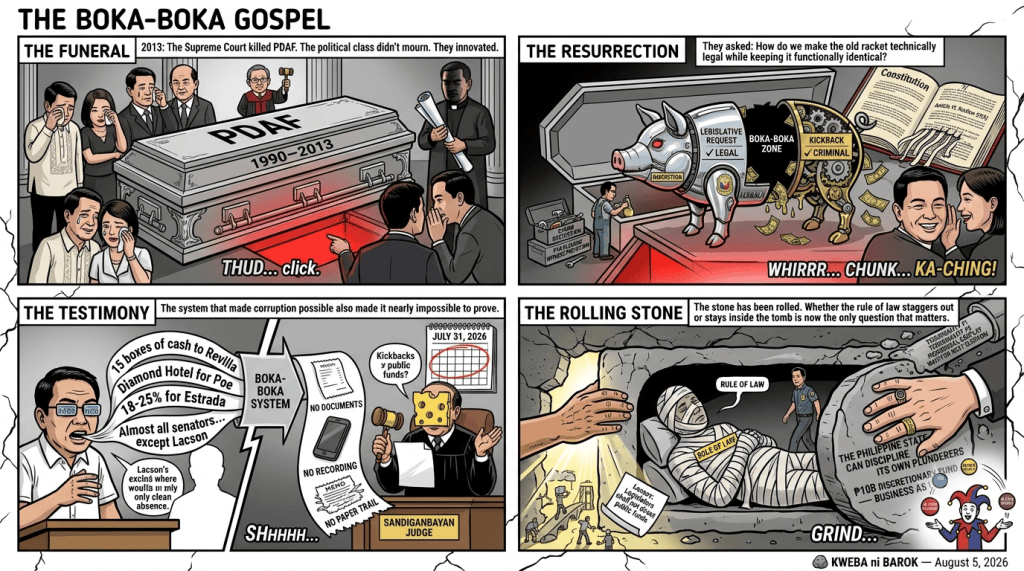
WHEN the Supreme Court killed the Priority Development Assistance Fund (PDAF) in 2013, the political class didn’t mourn. They simply innovated. They retreated to their air-conditioned offices, lit expensive cigars, and asked themselves the only question that matters in Philippine governance: how do we make the old racket technically legal while keeping it functionally identical?
The answer, revealed in all its venal brilliance before the Sandiganbayan Third Division on August 4, 2026, is so elegant it deserves a standing ovation. You don’t abolish pork. You surgically bisect it. The “ask” becomes a lawful legislative function. The “kickback” becomes the criminal act. Between them, a chasm of undocumented, verbal, “boka-boka” discretion swallows all accountability.
This is the post-Belgica v. Ochoa architecture of corruption, and former DPWH Undersecretary Roberto Bernardo is its reluctant tour guide.
The Constitutional Necromancy
The Belgica v. Ochoa ruling didn’t defeat the pork barrel. It merely forced it underground, where it metastasized into something harder to prosecute. When Associate Justice Ronald Moreno asked Bernardo whether a legislator’s request for an allocation was illegal, the witness could honestly answer no. This distinction isn’t a legal nicety—it is the entire strategy.
A P10-billion discretionary fund sits inside the DPWH. Its existence is known. Secretary Manuel Bonoan’s authority over it is acknowledged. Senators and congressmen approach him verbally—a quiet word after a hearing, a discreet phone call, a “boka-boka” conversation with no minutes, no memo, and no paper trail. The secretary exercises his discretion. Projects appear in the National Expenditure Program (NEP). Money flows.
The Supreme Court eviscerated legislative post-enactment interference in budget execution. The current system accomplishes the identical result through pre-enactment insertion at the NEP stage, dressed in executive discretion’s clothing. It is constitutional necromancy—dead principles reanimated through procedural cosplay. Article VI, Section 25(5) of the 1987 Constitution of the Republic of the Philippines (1987 Constitution), which Araullo v. Aquino used to strike down cross-border fund augmentation, sits impotent against a system that never technically crosses borders because it was born inside the executive branch’s preparatory processes.
The genius of the scheme is its deniability. Bernardo’s own admission—that requesting is “not forbidden” and only the kickback constitutes a crime—is both truthful and fundamentally dishonest. It describes a machine engineered to produce kickbacks through legalized channels, like claiming a faucet is innocent because technically it’s not the source of the water.
The Witness as Transaction
And what of Bernardo himself? Rule 133, Section 3 of the Rules of Court demands that the uncorroborated testimony of a state witness be received with utmost caution. The Sandiganbayan should apply that caution generously, because Bernardo is no penitent saint.
He was the operational nexus. Every transaction passed through him. He negotiated percentages, facilitated deliveries, and by his own admission, “earned from other transactions.” Under Rule 119, Section 17(d) of the Rules of Criminal Procedure, a discharged accused must not appear to be the “most guilty.” Bernardo, by his own narrative, is precisely that—the indispensable hub without whom the wheel wouldn’t turn.
His testimony is itself a transaction. P500 million restituted. P1 billion pledged. A cozy spot in the Witness Protection Program under Republic Act No. 6981 (Witness Protection, Security and Benefit Act), Section 12 of which discharges him from criminal liability. The state gets its star witness. Bernardo gets his liberty. Justice gets whatever scraps remain after the bargaining is done.
And consider his most legally convenient admission: “I did not earn from Revilla. I earned from other transactions.” This compartmentalized confession protects him in the very case where he testifies while leaving his exposure in unlitigated matters deliberately vague. It is the witness stand equivalent of pleading the Fifth—specific enough to sound candid, vague enough to be useless for cross-examination.
His incremental disclosures over eleven months—September 2025 to August 2026—follow the classical pattern of cooperative witnesses whose memories miraculously improve as their legal jeopardy deepens. New names. Larger figures. More vivid details. The Sandiganbayan must ask: is this memory recovery, or narrative construction?
The Conspicuous Exception
Senator Panfilo “Ping” Lacson stands alone, excluded from Bernardo’s indictment of “almost all” senators. This is not luck. It is the vindication of a decades-long commitment to a simple, radical proposition: that legislators should not personally direct public funds.
Lacson’s history of exposing post-ratification budget tweaks—anathema under Article VI, Section 26(2) of the 1987 Constitution, which prohibits amendments after a bill’s final reading—positions him as the institutional conscience of a chamber that has none. His exclusion isn’t merely a biographical footnote; it is structural proof that the corruption Bernardo describes is a choice, not an inevitability. Every other senator could have made the same choice. None did.
The Choruses of Denial
The accused senators have responded with the predictability of a bad telenovela. Senator Mark Villar calls the allegations “malaking kasinungalingan.” Former Senator Nancy Binay asserts, “Wala po akong kinalaman.” Their denials are interchangeable, mass-produced for public consumption, and legally meaningless until tested by corroborating evidence.
But Bernardo’s testimony against them is vivid. Fifteen boxes of cash delivered to Bong Revilla on three occasions. A Diamond Hotel rendezvous where Grace Poe’s intermediary allegedly collected commitments. Jinggoy Estrada’s alleged 18-25% kickbacks with deliveries to San Juan City. These are not abstractions. They are operational details that demand answers beyond blanket denials.
Yet here lies the prosecution’s evidentiary chokepoint. The “boka-boka” system that made the corruption possible also makes it nearly impossible to prove. No documents. No letters. No emails. Just Bernardo’s word against a senator’s denial. The Sandiganbayan’s own July 31, 2026 bail resolution for Revilla already signaled the fragility of the malversation theory—finding that contractor-sourced, pre-implementation kickbacks might not constitute misappropriated “public funds.” It is a legal crack wide enough to drive a plunder case through.
The Prosecutorial Imperative
This scandal demands prosecution on multiple fronts, employing every weapon in the legal arsenal.
For plunder under Republic Act No. 7080 (An Act Defining and Penalizing the Crime of Plunder), the evidence of patterned criminality is overwhelming. If Bernardo’s figures hold—P5 billion annually in projects, 15% average kickback commitment—the P50 million plunder threshold becomes almost laughably easy to satisfy for the principal actors. Plunder, unlike malversation, does not require the accused to be an accountable officer over the specific funds. It requires a pattern and a public officer. Both are present.
For graft under Republic Act No. 3019 (Anti-Graft and Corrupt Practices Act), Section 3(b) fits like a tailored glove: public officers who “request or receive” a “percentage” in connection with any contract or transaction where they can intervene. The kickback structure Bernardo describes is precisely what Congress criminalized.
For ethical violations under Republic Act No. 6713 (Code of Conduct and Ethical Standards for Public Officials and Employees), Section 7(d), the mere solicitation of any “gift” in connection with official duties—independent of any criminal charge—provides grounds for administrative sanctions. And the constitutional command of Article XI, Section 1—that “public office is a public trust”—renders the “asking is not illegal” defense morally bankrupt even where legally sufficient.
Reforms and Resurrection
Absent structural reform, this scandal will recycle itself with new actors and new boxes of cash. The “boka-boka” system must die. Congress must legislate that every legislative request for project allocation be made in writing, stamped with an official tracking number, and published in real time on a public, searchable database. The DPWH’s discretionary pool must be eliminated or subjected to line-item specificity with no secretary-level reallocation authority.
The Ombudsman must pursue not just the bagmen and intermediaries but the principal architects—Bonoan, the senators, and any executive officials who enabled the discretionary architecture. The Sandiganbayan divisions must harmonize their divergent rulings on the “public funds” question to prevent the prosecution from dying the death of a thousand technicalities.
This is a battle for more than one conviction. It is a battle for the principle that the Philippine state can discipline its own plunderers, that the youth deserve a government where public funds build bridges rather than bankroll senatorial reelection campaigns, and that the constitutional promise of accountability is not a dead letter.
Roberto Bernardo’s testimony has cracked open a door. It remains to be seen whether the Sandiganbayan will kick it wide or allow the system to quietly close it again. The stone has been rolled. Whether the rule of law staggers out or remains inside the tomb is now the only question that matters. 🪨
Key Citations
A. Legal & Official Sources
- The 1987 Constitution of the Republic of the Philippines. Lawphil Project, lawphil.net/consti/cons1987.html.
- Belgica v. Ochoa, G.R. No. 208566, 19 Nov. 2013, lawphil.net/judjuris/juri2013/nov2013/gr_208566_2013.html.
- Araullo v. Aquino, G.R. No. 209287, 1 July 2014, lawphil.net/judjuris/juri2014/jul2014/gr_209287_2014.html.
- Rules of Court (Rule 133, Section 3). Lawphil Project, lawphil.net/courts/rules/rc_128-134_evidence.html.
- Rules of Criminal Procedure (Rule 119, Section 17). Lawphil Project, lawphil.net/courts/rules/rc_110-127_crim.html.
- Republic Act No. 6981. An Act Providing for a Witness Protection, Security and Benefit Program and for Other Purposes. 1991, lawphil.net/statutes/repacts/ra1991/ra_6981_1991.html.
- Republic Act No. 7080. An Act Defining and Penalizing the Crime of Plunder. 1991, lawphil.net/statutes/repacts/ra1991/ra_7080_1991.html.
- Republic Act No. 3019. Anti-Graft and Corrupt Practices Act. 1960, lawphil.net/statutes/repacts/ra1960/ra_3019_1960.html.
- Republic Act No. 6713. An Act Establishing a Code of Conduct and Ethical Standards for Public Officials and Employees. 1989, lawphil.net/statutes/repacts/ra1989/ra_6713_1989.html.
B. News Reports
- Torres-Tupas, Tetch. “SC declares PDAF unconstitutional.” INQUIRER.net, 19 Nov. 2013, newsinfo.inquirer.net/530223/sc-declares-pdaf-unconstitutional.
- Mendoza, John Eric. “‘Almost all’ senators, ‘except Lacson,’ ask for DPWH allocations – witness.” INQUIRER.net, 4 Aug. 2026, newsinfo.inquirer.net/2277337/almost-all-senators-except-lacson-ask-for-dpwh-allocations-witness.
- ₱9 Billion in ‘Savings’? DILG’s Fire Truck Deal Smells Like Smoke

- ₱8B BBM Pork: CCTV for Every Captain’s Kumpare?
- ₱8.9 Billion, 331 Ghost Police Stations: The TIKAS Scandal Explained

- ₱8.4 Billion, 42,000 Barangays, 1 Election: The “Bawat Barangay Makikinabang” Vote-Buying Masterclass

- ₱75 Million Heist: Cops Gone Full Bandit

- ₱63 to the Dollar: The Only Thing Falling Faster Than the Peso Is the Government’s Credibility

- ₱6.77B Ghost Haunts Duterte: RTC Dismisses Mans Carpio’s Desperate Plea

- ₱6.77 Billion and Zero Cash: The Sara Duterte SALN Math That Doesn’t Add Up

- ₱6.7-Trillion Temptation: The Great Pork Zombie Revival and the “Collegial” Vote-Buying Circus

- ₱58.53B, Zero Receipts: The LGSF Pork Barrel Nobody Wants to Name
- ₱53 Million Man Tells ₱695-a-Day Workers to Stop Being ‘Mayabang’: The Audacity of BSP’s Remolona
- ₱4.4 Billion and a Witness Who Can’t Explain It: The Duterte Impeachment’s Most Expensive Non-Answer



Leave a Reply