Frozen Accounts, Shifting Witnesses, and a Defense Nobody Wants to Acknowledge
By Louis ‘Barok‘ C. Biraogo — August 4, 2026
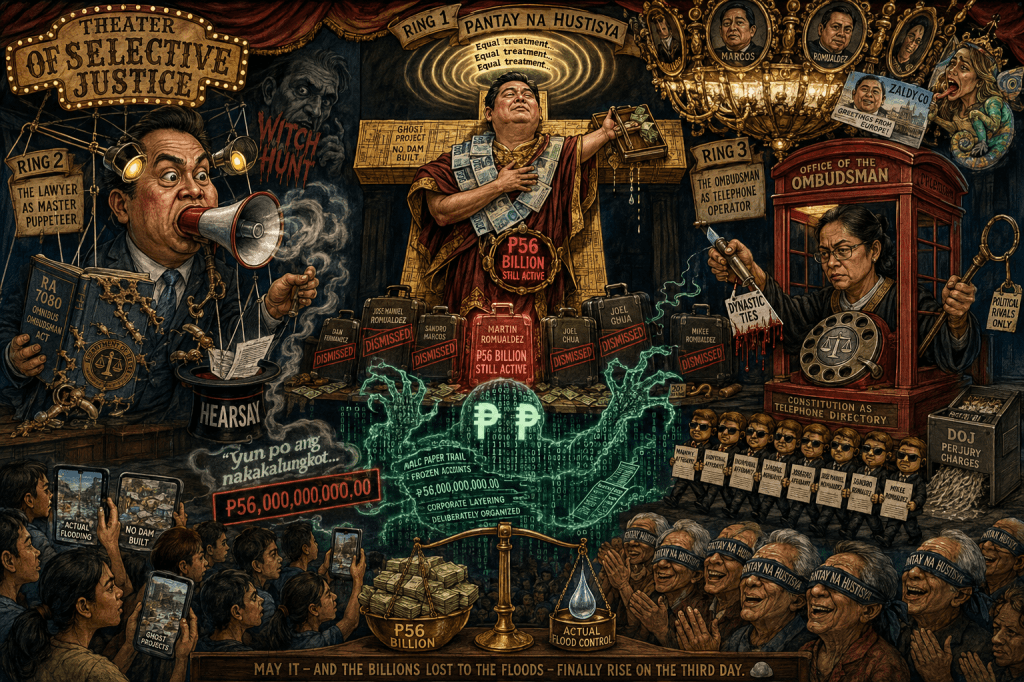
IF you want to know how a cornered political titan wages war, you don’t look to the courts of law. You look to the theater of public opinion. It’s a stage where a procedural defeat for the prosecution can be dressed as a fatal wound, and where a client facing a mountain of financial evidence can be recast as a lone martyr on a cross of “selective justice.”
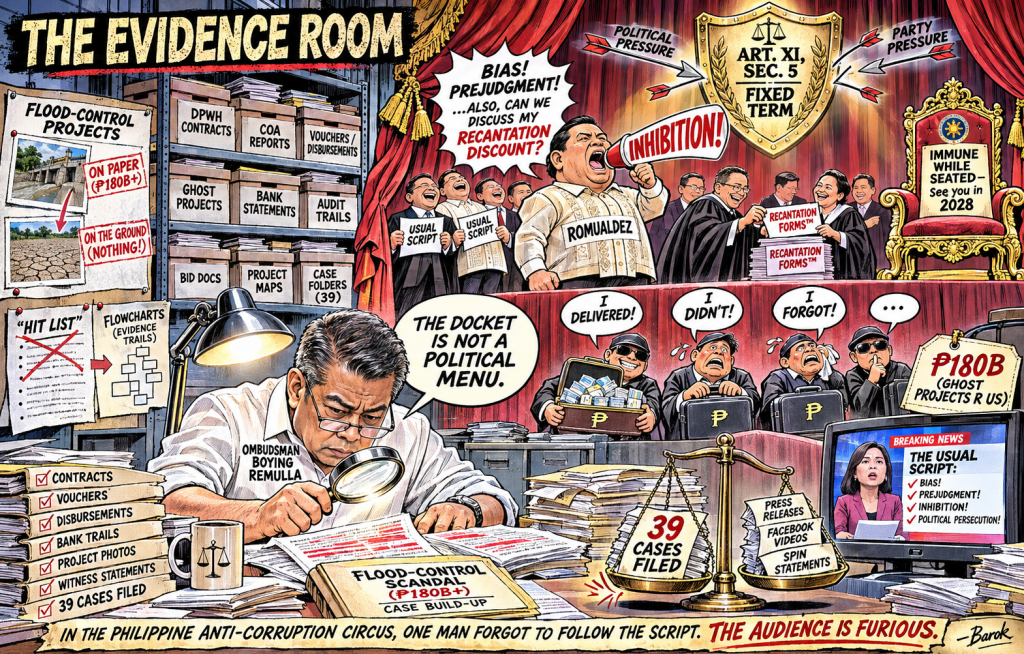
Enter Atty. Abdiel Dan Elijah “Ade” Fajardo on DZMM radio. The script? A masterclass in deflection. With the chummy cadence of a man simply asking for fairness, he cracked open the door to an accusation he was too legally savvy to make outright: that the Office of the Ombudsman (OMB) is singling out his client, former House Speaker Martin Romualdez. He “stopped short,” but the message was a bullhorn in a library. This isn’t legal advocacy; it’s a strategic psy-op, a pre-trial motion argued on airwaves to empanel the ultimate jury—a scandal-weary public—long before a Sandiganbayan justice taps their gavel.
At the heart of this entire blockbuster scandal lies a single, seductive, and spectacularly misleading phrase: “equal treatment.” Fajardo’s entire defensive architecture rests on it, and it’s time we dismantle it, brick by rhetorical brick. This case is no longer just about missing P56 billion in flood control funds. It is the trial of the Marcos-Romualdez dynasty’s soul, a referendum on the independence of our constitutional bodies, and a test of whether the President’s anti-corruption crusade is a scalpel for justice or merely a garrote for his political rivals.

Why Him and Not the Other Twenty? Let’s Count the Billions.
Fajardo paints a picture of a devastated landscape: twenty-plus lawmakers were named in the original, now-junked “mother affidavit” of the “maleta boys,” but the legal wrecking ball of time and procedure has left only Romualdez standing in the rubble. “Yun po ang nakakalungkot at nakakabahala,” he sighs, virtuously. “Para bang nakalock o lahat abswelto, at siya lang ang naiwan.”
The strategic logic is beautiful in its simplicity: find the prosecution’s most vulnerable point—here, the chaotic, shifting, and partially perjured testimony of a group of former bodyguards—and hammer it until the public sees not a valid probe narrowing in on a central figure, but a witch hunt. Fajardo weaponizes the Department of Justice (DOJ) perjury charges against the “maleta boys” with the finesse of a literary critic: if the DOJ says they lie, how can the OMB say they tell the truth?
This is where the gaslighting flickers. The defense asks us to believe that the dismissal of the scattershot joint affidavit is proof that everything in it is a lie, a grand absolution for all twenty names. But in the theatre of law, a withdrawn or defective pleading is not an acquittal. The OMB itself deemed the joint affidavit a messy, inadmissible hearsay sandwich and ordered individual, re-sworn accounts. What happened next is the inconvenient truth Fajardo skates past: eight of the eighteen returned with individual, “firsthand” accounts specifically and consistently placing Romualdez at the center of the suitcase economy.
The others faded not because they were exonerated, but because their specific allegations collapsed under scrutiny. To paraphrase a certain legal maxim, the life of one line of inquiry does not prove the death of all the others. This is not unequal justice; it’s what a narrowing investigation looks like. The “why him?” question is answered not by OMB malice, but by another question: did any of the other 20 have 25 bank accounts and 10 insurance policies frozen by the Anti-Money Laundering Council (AMLC) based on objective financial intelligence? This brings us to the second fatal flaw in the defense’s narrative.
The Ghost in the Machine: The Evidence the Maleta Boys Don’t Carry
Fajardo’s entire cross-examination of the public’s mind rests on discrediting the human, fallible, and admittedly tainted “maleta boys.” But he is asking us to ignore the ghost in the machine—the cold, hard, digital trail of money. The AMLC’s provisional freeze order, secured from the Court of Appeals, isn’t based on the hazy recollection of a bodyguard who may or may not have carried a suitcase. It’s based on the objective, corroborated analysis of suspicious transaction reports and complex corporate layering that the AMLC alleges were “deliberately organized” as conduits for dirty money.
This is the legal and factual chasm in the “equal treatment” argument. Under Republic Act No. 7080 (Plunder Law), the offense is a single composite crime—a pattern of accumulating ill-gotten wealth of at least P50 million. The P56-billion scale here isn’t just a detail; it’s a distinguishing factor of colossal, unprecedented magnitude that inherently justifies a distinct prosecutorial focus. The Supreme Court in Estrada v. Sandiganbayan gave the OMB wide latitude precisely to piece together this “combination or series” of acts. The financial paper trail, independent of any witness’s flawed memory, is the objective difference that shatters the defense’s cry of arbitrary persecution.
A Constitution, Not a Telephone Directory
This leads to the most profound institutional gaslight of all: the implication that the OMB should be bound by the prosecutorial conclusions of the DOJ. Fajardo’s theatrical bewilderment—why would the OMB give weight to narratives the DOJ has called lies?—is a brilliant act of constitutional vandalism. The OMB is not a subordinate of the DOJ. It is a constitutionally independent body, a creation of Article XI (Accountability of Public Officers) of the 1987 Constitution, vested with the “power to investigate and prosecute… on its own or on complaint by any person, any act or omission of any public official.”
The DOJ charged the maleta boys with perjury for specific, publicly declared falsehoods that damaged private reputations. The OMB, exercising its independent prosecutorial discretion as affirmed in Dimayuga v. Office of the Ombudsman, can look at the same chaotic narrative and surgically extract a verifiable core that matches other evidence—like AMLC records. One office dealt with a lie; the other with a pattern. To demand they march in lockstep is to treat the Constitution like a mere telephone directory, and it’s an argument that should be laughed out of the room before it even reaches a certiorari petition.
The President’s Scalpel and the Dynastic Equation
And so the spotlight swivels violently back to Malacañang. The President has promised the OMB probe will proceed. A conviction would validate his State of the Nation Address (SONA) anti-corruption pledge at a direct and devastating personal cost to his own political family. Yet a dismissal or a perpetually stalled case—arguably the most politically useful outcome for all powerful sides—would gift the Duterte camp a durable narrative that “selective justice” is not Romualdez’s defense, but the administration’s entire strategy. The spectacular August 3 Sandiganbayan slapdown of the OMB’s procedurally botched motion to discharge former Department of Public Works and Highways (DPWH) chief Manuel Bonoan is a stark reminder that the anti-graft court will not be a mere rubber stamp. The chessboard is set, and every piece—from the fugitive Zaldy Co taunting from Europe to the politically protean Imee Marcos—is calculating its next move.
A Call to the Republic’s Conscience
This is a defining moment for the rule of law, fought in the Sandiganbayan but won or lost in the hearts of the Filipino people. The tactical brilliance of the “equal treatment” defense lies in its power to shift our gaze—away from the staggering scale and the independent financial evidence, toward the procedural narrative of a man who may be legitimately seeking fairness. Whether this is a cry for justice or a masterful deflection is precisely what the proper legal process must determine. The risk is that “pantay na hustisya” becomes not a shield for the innocent, but a blinding light that obscures the path to the truth.
To the youth who will inherit this flood-prone republic, watch closely. You are being taught that accountability can be muddled by clever framing, that the language of fairness can be weaponized to stall and obscure. The institutions in your civics textbooks—the Ombudsman, the Sandiganbayan, the AMLC—are not abstractions. They are fallible bodies whose strength is being tested right now, and their success or failure will echo through your future.
We must demand the supremacy of the rule of law, not as a slogan, but as the uncompromising standard applied to the mighty and the meek alike. We must insist on strengthening democratic institutions against the political headwinds that threaten to extinguish their independence. We must call for genuine public service where flood control funds build actual dams, not dynastic war chests.
And to the youth, a challenge: this is your country. The P56 billion allegedly stolen is your future, siphoned away before you could even claim it. Let this scandal forge in you an unshakeable commitment to the truth that no lawyer’s spin can obscure. May it—and the billions lost to the floods—finally rise on the third day. 🪨
Key Citations
A. Legal & Official Sources
- 1987 Constitution of the Republic of the Philippines. Official Gazette of the Republic of the Philippines, 1987, http://www.officialgazette.gov.ph/constitutions/1987-constitution/.
- Republic Act No. 7080. An Act Defining and Penalizing the Crime of Plunder. 1991, lawphil.net/statutes/repacts/ra1991/ra_7080_1991.html.
- Estrada v. Sandiganbayan. G.R. No. 148560. Supreme Court of the Philippines, 19 Nov. 2001, lawphil.net/judjuris/juri2001/nov2001/gr_148560_2001.html.
- Dimayuga v. Office of the Ombudsman. G.R. No. 129099. Supreme Court of the Philippines, 20 July 2006, lawphil.net/jurisprudence/2006/jul2006/gr_129099_2006.htm.
B. News Reports
- Quismorio, Ellson. “Romualdez Lawyer Stops Short of Saying Client Is Being Singled Out in Flood Control Mess.” Manila Bulletin, 2 Aug. 2026, mb.com.ph/2026/08/02/romualdez-lawyer-stops-short-of-saying-client-is-being-singled-out-in-flood-control-mess.
- “Sandigan junks bid to drop Bonoan from graft case to be state witness.” Philippine Daily Inquirer, Inquirer.net, 4 Aug. 2026, newsinfo.inquirer.net/2276116/sandigan-junks-bid-to-drop-bonoan-from-graft-case-to-be-state-witness.

- “Ang Hirap Maging Mahirap”: The PAO Scandal That Proves Government Contempt Is Nothing New

- “Far-Off” My Axx: Malacañang’s Claire Castro Drowns in Her Own Legal Gaslighting
- “Forthwith” to Farce: How the Senate is Killing Impeachment—And Why Enrile’s Right (Even If You Can’t Trust Him)
- “HINDI AKO NAG-RESIGN!”

- “I Know Nothing”: Baste Duterte’s Amnesia Defense Meets ₱33M in GenCorp Contracts

- “I’m calling you from my new Globe SIM. Send load!”

- “Mahiya Naman Kayo!” Marcos’ Anti-Corruption Vow Faces a Flood of Doubt

- “Manageable” Debt, Unmanageable Lies: DBM’s ₱21 Trillion Fairy Tale
- “Meow, I’m calling you from my new Globe SIM!”

- “Natrabaho”: One Word, One Ombudsman, and a Judiciary on Trial
- “No Special Jail for Crooks!” Boying Remulla Slams VIP Perks for Flood Scammers

- “Philippine-Controlled” or Yankee Gas Station? The Davao Fuel Depot Farce Exposed




Leave a Reply