A Story of Flood Control Projects That Drowned Only in Corruption
By Louis ‘Barok‘ C. Biraogo — August 4, 2026
Spot-the-Anomaly 101: The 97% Cavite Jackpot
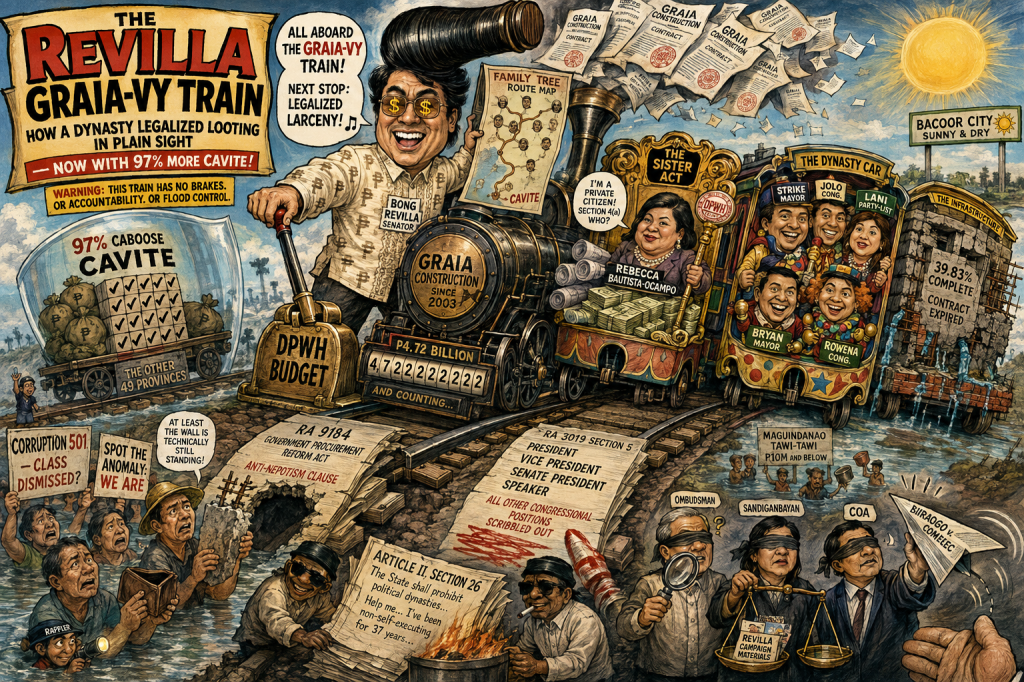
Let’s play a game of spot-the-anomaly. In the nine years from 2016 to 2025, a company called Graia Construction Corporation won 67 government contracts worth P4.72 billion. A whopping 65 of those projects—97%—landed in a single province: Cavite. Not just anywhere in Cavite, mind you, but overwhelmingly in Bacoor City, a place that just happens to be the multi-generational political fiefdom of the Revilla dynasty. The value of these contracts magically ballooned from a modest P145 million in 2016 to a staggering P911 million in 2023, a growth curve that fits not the province’s flood-risk profile, but the Senate tenure of one Ramon “Bong” Revilla Jr. as chairman of the Public Works Committee.
That’s not an anomaly. That’s a syllabus for Corruption 501, and the Revillas are the tenured professors.

Family Business, Legislative Edition
The company’s president is Rebecca Bautista-Ocampo, Bong’s younger sister. The Rappler exposé that unearthed this pattern was a masterwork of shoe-leather journalism, but let’s be honest: in the Philippines, this barely registers as a scandal. It’s practically a family tradition. Graia was founded in 2003—the year before Bong first became a senator and public works chair, and the last full year his father, the late Ramon Revilla Sr., held the same gavel. The paterfamilias passes the committee chairmanship to his son, and a construction company appears in the family portfolio the very same year. What a remarkable coincidence.
The “No Smoking Gun” Silencer Doctrine
Let’s now engage in the ritualistic defense attorney pantomime. The Revillas’ arguments are legally formidable, and that’s precisely the tragedy. First, the “no direct evidence” shield: where is the smoking gun proving Bong himself personally intervened to secure a contract for his sister? The answer is that the gun isn’t smoking because the entire system is designed to be a silencer. Under the Supreme Court’s Teves v. Sandiganbayan doctrine, mere correlation is not criminal intervention. Chairing a committee does not, by itself, equal steering a contract. You need proof of a personal, pecuniary interest or a specific act of intervention. A sister’s corporate ownership is not automatically the brother-legislator’s financial interest. This is the legal equivalent of a mob boss never touching the trigger and calling his insulation a constitutional right.
The Clean-Bid Lullaby and the Unlocked Back Door
The second defense is the “clean bid” lullaby: every one of those 67 contracts went through the Department of Public Works and Highways (DPWH)’s Bids and Awards Committee, fully compliant with Republic Act No. 9184 (Government Procurement Reform Act). And you know what? They probably did. That’s the sick genius of it. RA 9184, in its anti-nepotism wisdom, brilliantly disqualifies a bidder who is related to the head of the procuring entity. Rebecca Revilla is not related to the DPWH Secretary. She is related to the legislators who write the DPWH’s budget, carve out the line items, and informally designate which bailiwick gets a flood-control Christmas bonus. RA 9184 polices the procurement window while leaving the legislative back door unlocked, floodlit, and decorated with a welcome mat.
Section 4(a) Saw This Coming—Section 5 Looked Away
A third whispered defense is that Rebecca is a private citizen with a constitutional right to engage in business. True enough, a principle that remains completely intact until you read Section 4(a) of Republic Act No. 3019 (Anti-Graft and Corrupt Practices Act). That section explicitly makes it unlawful for any person having a family relation with a public official to “capitalize or exploit” that connection to obtain government contracts in which the official has to intervene. As Bong’s sister, she is within the second civil degree of consanguinity. The law, at least in theory, already saw this coming.
But here the architecture of impunity reveals its masterstroke: Section 5 of the very same RA 3019. It flatly prohibits relatives of the President, Vice President, Senate President, and Speaker of the House from intervening in government contracts. Bong Revilla was never Senate President; he was merely the committee chairman who held the DPWH budget by the throat. The law, in its majestic equality, forbids the kin of four specific people from looting the treasury but politely steps aside for the relatives of everyone else. This isn’t a loophole; it’s an engraved invitation.
Crumbling Walls, Crumbling Morals
And what did the billions buy? Rappler’s team visited a revetment wall in Barangay Habay that was a mere 39.83% complete, its contract already expired. Another wall from 2020 along Daang Bukid River was already deteriorating, steel bones exposed to the elements. The physical infrastructure mirrors the moral one: visibly crumbling, structurally unsound, but technically still standing as long as no one leans too hard.
The Dynasty the Constitution Tried (and Failed) to Ban
The Revillas—from Bong, to brother Strike, son Jolo, wife Lani, and nephew Bryan—are not an aberration. With eight family members holding elective office, they are the constitutional crisis that Article II, Section 26 of the 1987 Constitution was meant to prevent. You remember that provision: “The State shall… prohibit political dynasties as may be defined by law.” In 2012, I petitioned the Supreme Court to compel Congress to pass the enabling law—a futile exercise in legal quixotry that, looking at the Revilla dynasty’s P4.72 billion family business, only proves my point with a vengeance. The Court, in Biraogo v. COMELEC, shrugged. The provision, it said, is non-self-executing. Congress must act. And Congress, a glorified family reunion of competing dynasties, has spent 37 years lighting its cigars with that constitutional mandate.
Demand the Impossible (Because the Possible Already Failed)
So what is to be done? We must demand the impossible, because the possible has failed us. First, pass an Anti-Dynasty Law. Not a watered-down bill with a reversion clause that grandfathers in every incumbent, but a genuine, career-ending piece of legislation. Second, amend RA 3019 Section 5. The prohibition on relatives’ contracts must apply to every member of Congress, or no one is safe. Third, mandate beneficial ownership transparency so companies can’t hide behind scrims of family members. Fourth, the Supreme Court must eventually clarify that a pattern this obscene, a correlation this precise, constitutes the “indirect interest” that RA 3019’s Section 3(h) criminalizes.
In the meantime, the youth get to watch this masterclass in legalized larceny. The institutions—the Ombudsman, the Sandiganbayan, the Commission on Audit (COA)—must pursue every available charge, from RA 3019 to the mundane but powerful administrative lash of Republic Act No. 6713 (Code of Conduct and Ethical Standards for Public Officials and Employees), which forbids using public office to secure a financial benefit for one’s family. That’s a lower bar to clear.
The Graia story isn’t a scandal. It’s a normal Tuesday in a system built by dynasts, for dynasts. The Revillas didn’t break the machine; they just showed the rest of the class how smoothly it runs. The hope—and we must cling to it with satirical, desperate fingers—is that showing the gears so nakedly is the first step toward jamming them for good.
Key Citations
A. Legal & Official Sources
- The 1987 Constitution of the Republic of the Philippines. Official Gazette of the Republic of the Philippines, 1987, http://www.officialgazette.gov.ph/constitutions/1987-constitution/.
- Republic Act No. 9184. An Act Providing for the Modernization, Standardization and Regulation of the Procurement Activities of the Government and for Other Purposes. 2003, lawphil.net/statutes/repacts/ra2003/ra_9184_2003.html.
- Republic Act No. 3019. Anti-Graft and Corrupt Practices Act. 1960, lawphil.net/statutes/repacts/ra1960/ra_3019_1960.html.
- Republic Act No. 6713. An Act Establishing a Code of Conduct and Ethical Standards for Public Officials and Employees. 1989, lawphil.net/statutes/repacts/ra1989/ra_6713_1989.html.
- Teves v. Sandiganbayan. G.R. No. 154182. Supreme Court of the Philippines, 17 Dec. 2004, lawphil.net/judjuris/juri2004/dec2004/gr_154182_2004.html.
- Biraogo v. Commission on Elections. G.R. No. 203603. Supreme Court of the Philippines, 13 Nov. 2012, http://www.digest.ph/decisions/biraogo-v-commission-on-elections.
B. News Reports
- Cainglet, Axel, and Miriam Grace A. Go. “Bong Revilla’s sister bags almost P5-billion DPWH contracts in family’s Cavite bailiwick.” Rappler, 3 Aug. 2026, http://www.rappler.com/philippines/luzon/bong-revilla-sister-graia-construction-dpwh-contracts-cavite/.


 KWEBA ni BAROK
Leave a comment