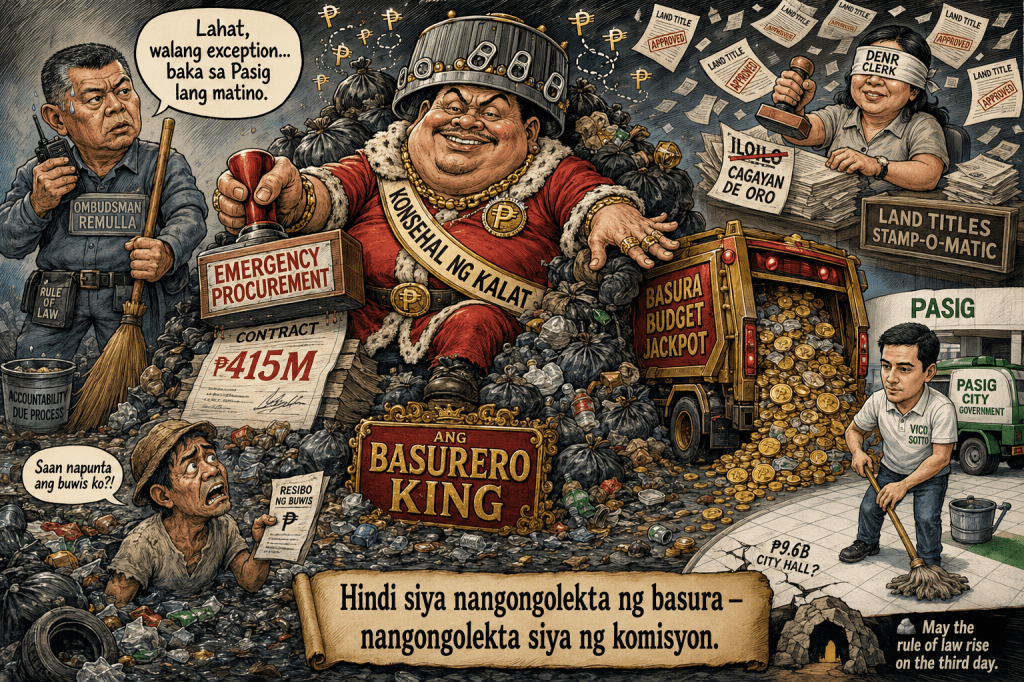
Your Mayor Collects Kickbacks Faster Than He Collects Your Trash
By Louis “Barok” C.. Biraogo — August 3, 2026
I. The Ombudsman’s Sweeping Wake-Up Call: Trash Talk or Truth?
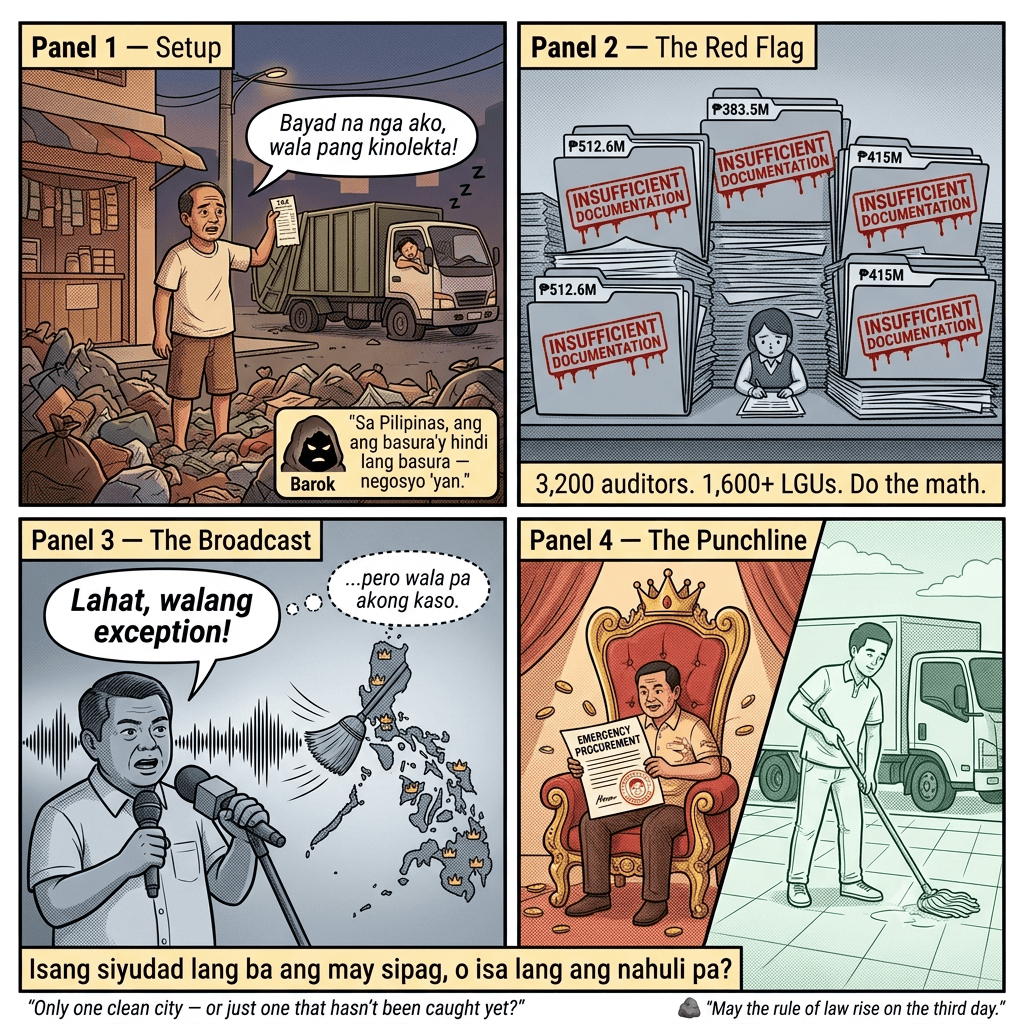
On August 1, 2026, Ombudsman Jesus Crispin “Boying” Remulla made a provocative statement on his radio program: “Pinakamalaking negosyo ng lahat ng mayor ng Pilipinas. Lahat, walang exception. Baka sa Pasig lang matino.” Waste management, he claimed, is the biggest business of all mayors—all of them, no exception, except maybe Pasig.
The statement was bold, sweeping, and notably lacking in specific evidence. Yet beneath the rhetorical excess lies an uncomfortable truth: waste management contracts have become a persistent vector for corruption in local governance, and the structural mechanisms enabling this abuse demand urgent attention.
II. Why Waste Contracts Are Corruption Magnets
The Structural Vulnerability
Under Republic Act No. 7160 (Local Government Code), Section 17, solid waste management is a devolved basic service. Mayors control procurement and contract awards. This creates a “garbage hostage” dynamic: garbage collection is perpetual, essential, and non-deferrable. You cannot stop collecting trash while rebidding a contract. The incumbent contractor knows this. The mayor knows this. And so contracts get “extended” rather than rebid.
The negotiated procurement exception under Republic Act No. 9184 (Government Procurement Reform Act), Section 53—intended for genuine emergencies—becomes a permanent loophole. Because garbage collection cannot lawfully lapse, local government units (LGUs) have a recurring justification to invoke “emergency” procurement, bypassing competitive bidding.
Documented Pattern of Abuse
The Commission on Audit (COA)’s trail is damning:
- Manila (2013-2014): COA questioned ₱512.6 million in garbage payouts for inadequate documentation and lack of performance criteria.
- Cebu City (2021): COA flagged ₱383.5 million in procurement irregularities indicating possible bid-rigging.
- Parañaque (2023): Graft charges filed against the mayor and 13 others over a ₱415-million contract awarded to a bidder lacking required documents.
- Central Luzon (recurring): The Environmental Management Bureau (EMB) filed Republic Act No. 9003 (Ecological Solid Waste Management Act) violation complaints against officials in at least ten towns for open dumping tied to failed hauling arrangements.
The Legal Architecture
Republic Act No. 9003 (Ecological Solid Waste Management Act) places primary responsibility on LGUs but has never been properly funded. The National Solid Waste Management Fund under Section 26 of RA 9003 remains largely unoperationalized after 26 years.
Republic Act No. 3019 (Anti-Graft and Corrupt Practices Act): Section 3(e) prohibits causing undue injury through manifest partiality; Section 3(g) prohibits contracts manifestly disadvantageous to government. Notably, Section 3(g) does not require proof of personal gain—a grossly overpriced contract is sufficient for prosecution.
Republic Act No. 9184 (Government Procurement Reform Act): The default rule is public bidding, but the emergency exception has swallowed the rule.
III. The DENR’s Shared Responsibility: Titling Frauds and Reclamation Blind Spots
Remulla also criticized the Department of Environment and Natural Resources (DENR) for failures in land titling and reclamation oversight. Here too, the criticism has foundation.
Land Titling Fraud
In February 2026, an Iloilo investigation uncovered homestead patents whose numbers, per DENR’s own confirmation, belonged to entirely different provinces—Cagayan de Oro, Davao del Norte, Negros Occidental. “Beneficiaries” based in Makati obtained Iloilo titles through a paper trail that never originated from the proper CENRO/PENRO process.
This echoes the Boracay case, where DENR’s internal audit invalidated 31 homestead patents issued to well-connected owners, several holding more than the one-patent-per-person limit. Nueva Vizcaya’s Registry of Deeds intercepted 18 forged titles in the first half of 2026 alone.
Reclamation Concerns
The DENR’s own 2025 Manila Bay Cumulative Impact Assessment concluded that 13 approved reclamation projects covering roughly 6,000 hectares would disrupt water circulation, destroy mangroves, degrade fisheries, and worsen flooding. Yet DENR issued ECCs for these projects years before the assessment—a clear case of approving first and assessing later.
The Supreme Court’s ruling in MMDA v. Concerned Residents of Manila Bay (G.R. Nos. 171947-48, December 18, 2008) imposed a continuing mandamus on agencies to clean up Manila Bay. Reclamation projects that worsen the bay’s condition directly frustrate this writ.
IV. The Pasig Exception: A Real Distinction or Convenient Carve-Out?
Remulla’s carve-out for Pasig is not arbitrary. Under Mayor Vico Sotto, Pasig has piloted “Garbage Collection by Administration”—direct government operation using city-owned trucks and personnel instead of private haulers. This removes the single procurement decision point that is the recurring locus of anomalies elsewhere. This is verifiable through United States Agency for International Development (USAID), Japanese Embassy, and United Nations Development Programme (UNDP) program records.
However, Pasig faces its own allegations. Engr. Selwyn Lao has publicly claimed that Pasig’s ₱9.6-billion City Hall project should have cost roughly ₱3.2 billion—an allegation unrelated to waste management but relevant to the “exception” narrative.
V. The Ombudsman’s Position: Strengths and Due-Process Caveats
Nailed the Stench, Missed the Names
The documentary record genuinely supports a nationwide pattern. COA findings, EMB complaints, and the structural logic of negotiated procurement all point to systemic issues. Remulla’s constitutional mandate under Article XI, Section 13(7) of the 1987 Constitution is explicitly preventive—directing the Ombudsman to “determine the causes of inefficiency, red tape, mismanagement, fraud, and corruption.” Public advocacy and the Resident Ombudsman Program are legitimate exercises of this authority.
Hagad v. Gozo-Dadole (G.R. No. 108072, December 12, 1995) confirms that the Ombudsman’s disciplinary authority under Republic Act No. 6770 (The Ombudsman Act of 1989) is concurrent with—and in practice primary to—Local Government Code disciplinary mechanisms.
Cracks in the Crusade
The absence of specific evidence in his broadcast raises legitimate questions. Publicly accusing thousands of officials without filed cases tests the boundaries of due process guaranteed by Article III, Section 14 of the 1987 Constitution. The statement’s timing—same broadcast addressing the Sandiganbayan’s bail grant to Bong Revilla in a flood-control case—invites questions about distraction.
The “lahat, walang exception” framing creates a due process challenge. An Ombudsman should avoid prejudging cases his office may later investigate. The challenge now is to convert rhetoric into concrete enforcement action.
VI. The Systemic Failure: Institutions Too Thin, Costs Too Human
Institutional Weaknesses
COA cannot effectively audit 1,600+ LGUs with only 3,200 auditors. The EMB lacks enforcement capacity. The courts are slow. Without political will, no amount of legal reform will matter.
The Human Cost
Open dumping continues in hundreds of LGUs, leaching toxins into groundwater and spreading disease. Every peso stolen is a peso that should have gone to services. The people pay twice—through their taxes and through the disease, environmental degradation, and neglect that corruption leaves in its wake.
VII. Call for Reform: From Rhetoric to Results
To the Ombudsman
Follow the statement with specific case filings. Name names. File charges. Let the courts decide. The Resident Ombudsman Program, already announced, must be properly implemented with real authority.
To Congress
Operationalize the National Solid Waste Management Fund under Republic Act No. 9003 (Ecological Solid Waste Management Act), Section 26. Amend Republic Act No. 9184 (Government Procurement Reform Act) to restrict the emergency exception for waste contracts. Strengthen Republic Act No. 9003 (Ecological Solid Waste Management Act) penal enforcement and EMB budget.
To the Executive
Suspend Manila Bay reclamation projects pending full cumulative impact assessment. Revoke ECCs issued without proper review. Digitize land titling to eliminate forgery.
To the Judiciary
Expedite environmental cases. Apply the precautionary principle. Consider specialized environmental courts.
To the People
Demand accountability. File citizen suits under Republic Act No. 9003 (Ecological Solid Waste Management Act), Section 52. The November 2026 Barangay and Sangguniang Kabataan Elections (BSKE) offers an opportunity to reward reformists and reject the corrupt.
VIII. Your Mayor’s Worst Nightmare (If Anyone Bothered to File)
The laws exist. The prosecutors? Not so much.
RA 3019, Section 3(e): Punishes officials who cause undue injury through manifest partiality. Proof of intent required—but COA’s trail of incomplete bidders winning millions makes the case for you.
RA 3019, Section 3(g): The easier path. No proof of personal gain needed. A grossly disadvantageous contract is enough. COA’s Manila and Cebu findings already built the foundation. Where are the cases?
RA 9003, Sections 48-50: Open dumping is a crime. Fines up to ₱1 million. Administrative removal from office. The EMB filed complaints in ten towns. Where are the suspensions?
RA 6770, Section 24: Preventive suspension—the nuclear option—if evidence is strong. Remulla claims corruption is everywhere. So why aren’t suspensions flying?
RA 9003, Section 52: Citizen suits. Any Filipino can file—no fees, attorney’s fees awardable. The people don’t need to wait for the Ombudsman.
The Bottom Line:
Every tool exists. Every tool has worked before. The gap isn’t legal—it’s political. It’s a will gap that radio programs won’t close.
The law is ready. Now who’s going to use it?
IX. Hope for the Future
The youth of the Philippines are angrier, more aware, and better connected than previous generations. They are not willing to accept corruption as normal. They can demand transparency, organize through social media, run for office, and sustain generational resistance.
A better Philippines is possible: where garbage is collected efficiently and transparently, where land titles are secure, where reclamation is guided by science, where local officials are accountable, and where the Ombudsman prosecutes with integrity.
This is not utopia. This is compliance with laws already on the books. This is the Philippines the Constitution promised.
X. Conclusion
Remulla’s claim identifies a real and under-scrutinized corruption vector. The Pasig exception tracks a genuine structural choice that removes the specific contracting vulnerability. But the framing—a blanket accusation without individual cases—tests the credibility of an institution that must balance advocacy with due process.
The ultimate test will be whether the Office of the Ombudsman converts broad accusations into specific, evidence-based prosecutions. If successful, this could mark a turning point. If unsuccessful, it risks eroding public trust in anti-corruption institutions.
The people, especially the youth, are watching. And they are demanding accountability.
May the rule of law rise on the third day.
“The trouble with our corrupt officials is not that they are corrupt, but that they are corrupt and hypocritical. They pretend to be saints while acting like thieves. They invoke the Constitution while violating it. They claim to serve the people while robbing them blind. And they sleep soundly at night because they know the system is rigged in their favor—and that it will take a revolution, not a radio program, to change that.”
— Kweba ni Barok
Key Citations
A. Legal & Official Sources
- The 1987 Constitution of the Republic of the Philippines. Official Gazette of the Republic of the Philippines, 1987, http://www.officialgazette.gov.ph/constitutions/1987-constitution/.
- Republic Act No. 7160. An Act Providing for a Local Government Code of 1991. 1991, lawphil.net/statutes/repacts/ra1991/ra_7160_1991.html.
- Republic Act No. 9184. An Act Providing for the Modernization, Standardization and Regulation of the Procurement Activities of the Government and for Other Purposes. 2003, lawphil.net/statutes/repacts/ra2003/ra_9184_2003.html.
- Republic Act No. 9003. An Act Providing for an Ecological Solid Waste Management Program, Creating the Necessary Institutional Mechanisms and Incentives, Declaring Certain Acts Prohibited and Providing Penalties, Appropriating Funds Therefor, and for Other Purposes. 2001, lawphil.net/statutes/repacts/ra2001/ra_9003_2001.html.
- Republic Act No. 3019. Anti-Graft and Corrupt Practices Act. 1960, lawphil.net/statutes/repacts/ra1960/ra_3019_1960.html.
- Republic Act No. 6770. An Act Providing for the Functional and Structural Organization of the Office of the Ombudsman, and for Other Purposes. 1989, lawphil.net/statutes/repacts/ra1989/ra_6770_1989a.html.
- MMDA v. Concerned Residents of Manila Bay. G.R. Nos. 171947-48, 18 Dec. 2008, lawphil.net/judjuris/juri2008/dec2008/gr_171947_2008.html.
- Hagad v. Gozo-Dadole. G.R. No. 108072, 12 Dec. 1995, lawphil.net/judjuris/juri1995/dec1995/gr_108072_1995.html.
B. News Reports
- “Except Pasig?”: Ombudsman Claims Waste Deals Are Local Executives’ Dirtiest Business. Politiko, 1 Aug. 2026, politiko.com.ph/2026/08/01/except-pasig-ombudsman-claims-waste-deals-are-local-executives-dirtiest-business/politiko-lokal/.
- Ramos, Marlon. “COA Questions Manila’s P512M Trash Payments.” Inquirer.net, Philippine Daily Inquirer, 2 Dec. 2014, newsinfo.inquirer.net/654009/coa-questions-manilas-p512m-trash-payments.
- Vestil, Justin K. “COA: Cebu City’s P383M Garbage Collection Deal ‘Irregular’.” SunStar, 23 July 2022, http://www.sunstar.com.ph/cebu/local-news/coa-cebu-citys-p383m-garbage-collection-deal-irregular.
- Cabalza, Dexter. “Parañaque Mayor, 13 Others Face Graft Raps.” Inquirer.net, Philippine Daily Inquirer, 19 Feb. 2023, newsinfo.inquirer.net/1731855/paranaque-mayor-13-others-face-graft-raps.
- “EMB Files Charges vs 10 CL Towns for Waste Management Violations.” SunStar, 11 Feb. 2016, http://www.sunstar.com.ph/more-articles/emb-files-charges-vs-10-cl-towns-for-waste-management-violations.
- Garcia, Patrick. “Pasig City Rolls Out Environment, Business-Centered Initiatives.” Manila Bulletin, 19 Feb. 2024, mb.com.ph/2024/2/19/pasig-city-on-a-roll-on-environment-business-centered-initiatives.

- “Ang Hirap Maging Mahirap”: The PAO Scandal That Proves Government Contempt Is Nothing New

- “Far-Off” My Axx: Malacañang’s Claire Castro Drowns in Her Own Legal Gaslighting
- “Forthwith” to Farce: How the Senate is Killing Impeachment—And Why Enrile’s Right (Even If You Can’t Trust Him)
- “HINDI AKO NAG-RESIGN!”

- “I Know Nothing”: Baste Duterte’s Amnesia Defense Meets ₱33M in GenCorp Contracts
- “I’m calling you from my new Globe SIM. Send load!”

- “Mahiya Naman Kayo!” Marcos’ Anti-Corruption Vow Faces a Flood of Doubt

- “Manageable” Debt, Unmanageable Lies: DBM’s ₱21 Trillion Fairy Tale
- “Meow, I’m calling you from my new Globe SIM!”

- “Natrabaho”: One Word, One Ombudsman, and a Judiciary on Trial
- “No Special Jail for Crooks!” Boying Remulla Slams VIP Perks for Flood Scammers

- “Philippine-Controlled” or Yankee Gas Station? The Davao Fuel Depot Farce Exposed




Leave a Reply