How a Re-Election Bid, a Reform Law, and Creative Accounting Created the Perfect Political Storm
By Louis ‘Barok’ C. Biraogo — October 5, 2026
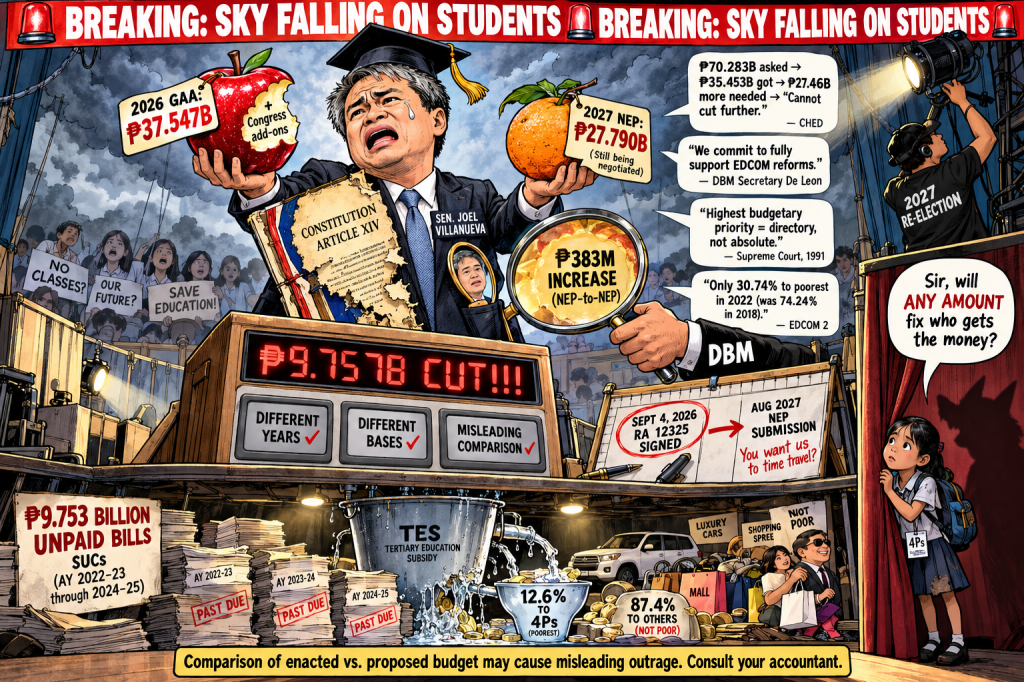
SENATOR Joel Villanueva wants you to believe the sky is falling on Filipino students. The man who has spent more time running for office than running anything else has discovered a new outrage: a ₱9.757 billion “cut” to the free tuition fund.
Cue the dramatic music. Roll the B-roll of tearful students. Cue Villanueva’s concerned face, the one he practices in the mirror before every budget hearing.
There’s just one problem: the “cut” is a complete fiction. And the man selling it knows it.
The Apples-to-Oranges Trick
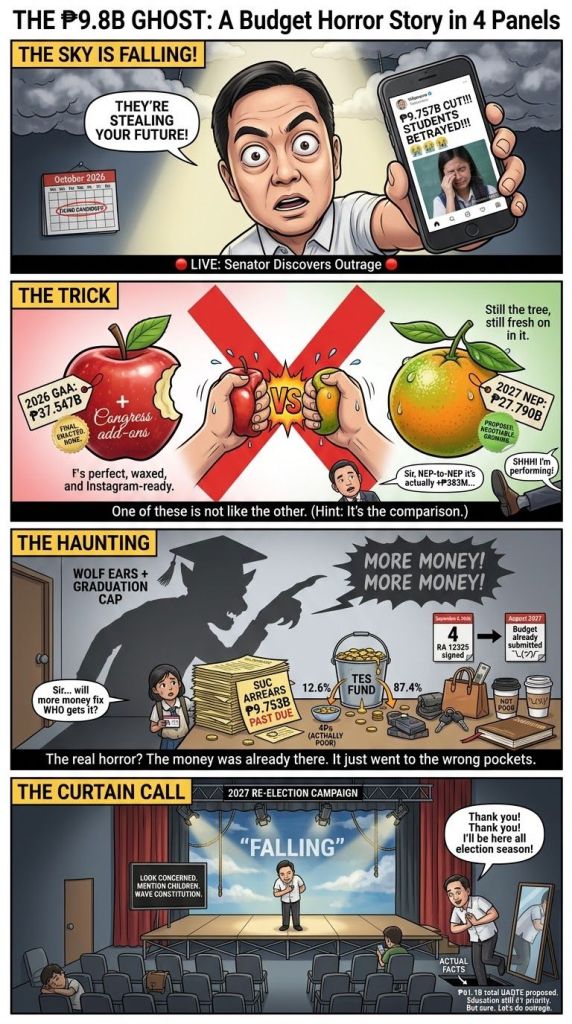
Here’s what Villanueva wants you to believe: The 2026 General Appropriations Act (GAA) allocated ₱37.547 billion for the Universal Access to Quality Tertiary Education (UAQTE) program. The 2027 National Expenditure Program (NEP) proposes ₱27.790 billion. That’s a ₱9.757 billion reduction. The horror! The humanity! The talking points!
But here’s what he conveniently omits: comparing a final, enacted budget to a proposed budget is like comparing your actual grocery bill to the shopping list you wrote while hungry. It’s amateur hour.
The Department of Budget and Management (DBM) has already pointed out the rather embarrassing fact that on a NEP-to-NEP basis—comparing what the Executive proposed last year to what it’s proposing this year—the Commission on Higher Education’s (CHED) UAQTE allocation actually increases by ₱383 million, or 1.4%.
Yes, you read that correctly. The Executive branch is proposing more for UAQTE than it proposed last year. The “cut” only exists because Congress, in its infinite wisdom, added money to the 2026 GAA after the fact.
This is not a cut. This is Villanueva performing outrage over a budget comparison that any first-year accounting student would flag as misleading. But outrage is the currency of Philippine politics, and Villanueva is spending it freely.
The Senator Who Cried Wolf
Let’s be clear about something: Joel Villanueva is not a neutral observer. He is the principal author of Republic Act No. 10931 (Universal Access to Quality Tertiary Education Act), the original free tuition law. He is the co-author of Republic Act No. 12325 (Enhancing the Universal Access to Quality Tertiary Education Act), the amendment designed to “fix” the targeting failures of his original creation. He is the Second Congressional Commission on Education (EDCOM 2) Co-Chairperson who has spent years telling anyone who will listen that the program he built isn’t working as intended.
And now, with his reform law about to be implemented, he’s discovered that funding it might be… inconvenient.
Villanueva’s core argument is that RA 12325 expands the government’s obligations—more targeted subsidies, new benefit categories, private school assistance, internship coverage—and therefore requires more money. That’s a legitimate policy point. The new law does create new obligations.
But here’s the question Villanueva won’t answer directly: If he believed so strongly in the reform, why did the budget proposal submitted by the administration he ostensibly supports fail to account for it?
The timeline is damning. The 2027 NEP was prepared between January and July 2026. RA 12325 was signed on September 4, 2026. The budget was submitted to Congress in August, before the law was enacted. The Executive couldn’t have fully accounted for obligations that didn’t legally exist yet.
This is not a conspiracy. This is basic legislative sequencing. But Villanueva is using it to spin a narrative of intentional sabotage.
The Real Numbers You’re Not Hearing
While Villanueva waves the ₱9.8 billion figure around like a bloody shirt, here’s what’s actually happening in the budget:
CHED’s original proposal for 2027 was ₱70.283 billion. The NEP gave them ₱35.453 billion. That’s a ₱34.83 billion reduction from their request.
Sounds bad, right? But government agencies always ask for more than they get. CHED knew it wasn’t getting ₱70 billion. The question is whether ₱35.45 billion is sufficient to implement RA 12325.
And here’s where it gets interesting: CHED itself later submitted a revised appeal, paring down its request to ₱27.46 billion in additional requirements. Of that, ₱17.05 billion is for “critical and non-deferrable programs”—which is bureaucrat-speak for “we need this or things break.”
CHED Chairperson Shirley Agrupis told the Senate that the agency “cannot cut it further,” and that 940,000 existing and incoming students could be affected if the funding isn’t restored.
That’s a serious number. But it’s also a number that CHED’s own recalibration suggests is negotiable. The agency didn’t say it needed ₱70 billion. It said it needed ₱27.46 billion more than the NEP allocation. That’s a very different request.
The 12.6% Figure: Real Problem, Wrong Solution
Villanueva’s most compelling data point is this: Only 12.6% of Tertiary Education Subsidy (TES) grantees in the first semester of Academic Year (AY) 2025-2026 came from Pantawid Pamilyang Pilipino Program (4Ps) households.
That’s a staggering failure of targeting. And it’s the exact problem RA 12325 was designed to fix.
But here’s what Villanueva doesn’t explain: If only 12.6% of current TES beneficiaries are from 4Ps, that means 87.4% are from other categories. Some may be poor but not in 4Ps. Some may be near-poor. Some may be… not poor at all.
The EDCOM 2 research revealed that the share of TES going to the poorest households fell from 74.24% in 2018 to just 30.74% in 2022. That’s a catastrophic leakage problem. The program was supposed to help the poorest, but it increasingly became a subsidy for the relatively well-off.
Villanueva wants you to believe that a bigger budget would fix this. But the evidence suggests the opposite: The problem isn’t how much money is going into TES. It’s who is getting it. Throwing more money at a broken targeting system just means more money leaking to the wrong people.
RA 12325 attempts to fix this by prioritizing 4Ps households and using per-capita income for remaining slots. That’s the right approach. But if the implementation capacity isn’t there—if the data systems don’t work, if the validation mechanisms don’t exist—then no amount of money will solve the problem.
The DBM’s Own Admission of Failure
Here’s a fact that should be front and center but is getting buried: In August 2026, the DBM released ₱9.75 billion to settle validated Free Higher Education deficiencies involving 108 state universities and colleges (SUCs), covering arrears from AY 2022-23 through AY 2024-25.
Nearly ₱10 billion in accumulated obligations. The government wasn’t paying its bills for three years. And this happened before the 2027 budget proposal was even submitted.
This is the real scandal. Not a proposed reduction in a budget line item, but the systemic failure to adequately fund existing obligations. SUCs were forced to absorb costs they couldn’t afford because the national government wasn’t reimbursing them on time.
If Villanueva wants to be outraged about something, he should be outraged about that. Instead, he’s using it as evidence that more money is needed—when it’s actually evidence that the existing money wasn’t being managed properly.
The Constitutional Canard
Villanueva has also been waving the Constitution around, citing Article XIV, Section 5(5) of the 1987 Constitution: “The State shall assign the highest budgetary priority to education.”
He’s not the first politician to do this. And the Supreme Court has repeatedly shot it down.
In Guingona Jr. v. Carague (1991), the Court held that the constitutional education priority does not deprive Congress of the ability to respond to other national interests and fiscal requirements. The provision has been characterized as essentially directory—a guiding principle, not an absolute command.
The education sector as a whole still receives the largest allocation in the 2027 budget: ₱1.326 trillion, according to DBM. The UAQTE program alone is proposed at ₱61.1 billion, across CHED, SUCs, and the Technical Education and Skills Development Authority (TESDA).
Villanueva can argue that the composition of the education budget is wrong—that higher education is getting squeezed while infrastructure gets a boost. That’s a legitimate policy debate. But he cannot credibly argue that the Constitution requires any particular line item to be immune from reduction.
The Real Villanueva
Let’s be honest about what’s happening here.
Joel Villanueva is up for re-election in 2027. He needs a signature issue. Education is popular. Students are a sympathetic constituency. And nothing gets attention like a good “the government is cutting your future” narrative.
Villanueva has spent his entire career in government—as TESDA Director General, as a congressman, as a senator. He knows how the budget process works. He knows the difference between a GAA and a NEP. He knows that agencies always ask for more than they get. He knows that the timing of RA 12325’s enactment made full integration into the 2027 NEP impossible.
And yet he’s out there, microphone in hand, telling students their tuition is being slashed.
This isn’t advocacy. This is performance. And it’s a performance designed to distract from the real questions: Why did his original free tuition law fail to target the poor? Why has his reform law been enacted without a clear funding strategy? Why does he keep proposing solutions without ensuring they can actually be implemented?
The Questions That Matter
If Villanueva truly cared about tertiary education funding, he would be asking different questions:
- How many 4Ps students will actually be eligible for TES in 2027? No one knows.
- What is the normative cost per beneficiary under RA 12325’s expanded benefits? No one knows.
- How many continuing beneficiaries will need to be protected? No one knows.
- What is the projected cost of the new Private Education Assistance program? No one knows.
- How much will the expanded internship and Related Learning Experience (RLE) coverage actually cost? No one knows.
These are the numbers that matter. Not the difference between a GAA and a NEP.
Villanueva wants a headline. He wants students angry at the government. He wants voters to remember his face when they cast their ballots.
What he doesn’t want is a serious conversation about whether his legislative legacy is actually working, or whether the reforms he’s championing are structurally sound.
The Bottom Line
The ₱9.8 billion “cut” is a budget optical illusion. On a like-for-like basis, the Executive is proposing more for UAQTE than it proposed last year. Villanueva knows this. He’s betting you don’t.
The real issues—targeting failures, implementation capacity, unfunded obligations—are being buried under a pile of political theater.
Villanueva is not wrong that tertiary education needs adequate funding. He’s not wrong that RA 12325 creates new obligations. He’s not wrong that the government has a constitutional duty to prioritize education.
But he’s wrong to present a misleading budget comparison as proof of intentional sabotage. He’s wrong to ignore the fact that his own reform law was enacted without a clear funding strategy. And he’s wrong to pretend that more money alone will fix a program that has been failing the poor for years.
The question isn’t whether ₱27.79 billion is enough. The question is whether any amount of money can make a broken system work—especially when the people running it are more interested in scoring political points than in actually solving problems.
Joel Villanueva has been in government for over a decade. He’s had plenty of time to fix these problems. If free tuition still isn’t reaching the poorest students after all these years, maybe the problem isn’t the budget.
Maybe the problem is the people who keep claiming they have the answers.
Key Citations
A. Legal & Official Sources
- The 1987 Constitution of the Republic of the Philippines. Official Gazette of the Republic of the Philippines, 1987, http://www.officialgazette.gov.ph/constitutions/the-1987-constitution-of-the-republic-of-the-philippines/the-1987-constitution-of-the-republic-of-the-philippines-article-xiv/.
- Guingona Jr. v. Carague. G.R. No. 94571, Supreme Court of the Philippines, 22 Apr. 1991, lawphil.net/judjuris/juri1991/apr1991/gr_94571_1991.html.
- Republic Act No. 10931. An Act Promoting Universal Access to Quality Tertiary Education by Providing for Free Tuition and Other School Fees in State Universities and Colleges, Local Universities and Colleges and State-Run Technical-Vocational Institutions, Establishing the Tertiary Education Subsidy and Student Loan Program, Strengthening the Unified Student Financial Assistance System for Tertiary Education, and Appropriating Funds Therefor. Official Gazette of the Republic of the Philippines, 3 Aug. 2017, http://www.officialgazette.gov.ph/2017/08/03/republic-act-no-10931/.
- Republic Act No. 12325. An Act Enhancing the Universal Access to Quality Tertiary Education Act, Amending for the Purpose Republic Act No. 10931 and Appropriating Funds Therefor. Official Gazette of the Republic of the Philippines, 4 Sept. 2026, http://www.officialgazette.gov.ph/2026/09/04/republic-act-no-12325/.
- Department of Budget and Management. “DBM: Education Remains Top Priority in Proposed P7.2-T 2027 Budget.” DBM.gov.ph, 27 Aug. 2026, http://www.dbm.gov.ph/index.php/management-2/4189-dbm-education-remains-top-priority-in-proposed-p7-2-t-2027-budget.
- Department of Budget and Management. “Marcos Admin Increases Budget in 2027 for Universal Access to Quality Tertiary Education, Accommodating More Students Pursuing College.” DBM.gov.ph, 28 Aug. 2026, http://www.dbm.gov.ph/index.php/management-2/4191-marcos-admin-increases-budget-in-2027-for-universal-access-to-quality-tertiary-education-accommodating-more-students-pursuing-college.
- Presidential Communications Office. “DBM Allocates P9.753 Billion to CHED to Address SUC Funding Shortfall.” PCO.gov.ph, 17 Aug. 2026, pco.gov.ph/news_releases/dbm-allocates-p9-753-billion-to-ched-to-address-suc-funding-shortfall/.
B. News Reports
- Bacelonia, Wilnard. “Senate Eyes CHED 2027 Budget Augmentation after P27.5-B Appeal.” Philippine News Agency, 25 Sept. 2026, http://www.pna.gov.ph/articles/1284875.
- “CHEd Seeks Additional P17B for Free Tuition Program.” Inquirer.net, 27 Sept. 2026, newsinfo.inquirer.net/2311731/ched-seeks-additional-p17b-to-fund-940000-students-under-free-tuition-program.
- Chi, Cristina. “Marcos Signs Law Putting Poorest Students First in College Subsidies.” Philstar.com, 4 Sept. 2026, http://www.philstar.com/headlines/2026/09/04/2554015/marcos-signs-law-putting-poorest-students-first-college-subsidies.
- Valente, Catherine S. “Villanueva Flags P9.8B Cut to Free Tuition Fund.” The Manila Times, 27 Sept. 2026, http://www.manilatimes.net/2026/09/27/news/villanueva-flags-p98b-cut-to-free-tuition-fund/2433559.
- “Ang Hirap Maging Mahirap”: The PAO Scandal That Proves Government Contempt Is Nothing New
- “Far-Off” My Axx: Malacañang’s Claire Castro Drowns in Her Own Legal Gaslighting
- “Forthwith” to Farce: How the Senate is Killing Impeachment—And Why Enrile’s Right (Even If You Can’t Trust Him)

- “HINDI AKO NAG-RESIGN!”

- “I Know Nothing”: Baste Duterte’s Amnesia Defense Meets ₱33M in GenCorp Contracts

- “I’m calling you from my new Globe SIM. Send load!”

- “Mahiya Naman Kayo!” Marcos’ Anti-Corruption Vow Faces a Flood of Doubt

- “Manageable” Debt, Unmanageable Lies: DBM’s ₱21 Trillion Fairy Tale
- “Meow, I’m calling you from my new Globe SIM!”

- “Natrabaho”: One Word, One Ombudsman, and a Judiciary on Trial

- “No Special Jail for Crooks!” Boying Remulla Slams VIP Perks for Flood Scammers

- “Philippine-Controlled” or Yankee Gas Station? The Davao Fuel Depot Farce Exposed





Leave a Reply