
The Valuation They Don’t Want You to See: Why P436K Per Square Meter Is an Insult to Every Filipino Taxpayer
By Louis ‘Barok‘ C. Biraogo — October 6, 2026
READ the fine print they hoped you’d skip: Administrative Order No. 50 (AO 50) is not a sale. It is not a privatization. It is not even, despite the breathless headlines, a “return” of anything meaningful to the Filipino people.
What AO 50 actually does is move a 2.29-hectare piece of prime Makati real estate from one government filing cabinet to another. That’s it. That’s the ballgame.
The President signed a piece of paper on September 30, 2026, and the only thing that changed is which bureaucracy gets to dust the furniture while the rest of us wait for the actual transaction that will determine whether this is a fiscal windfall or another entry in the long, sordid history of government assets being sold for peanuts to friends of the palace.
And the best part? Nobody seems to know what happens next.
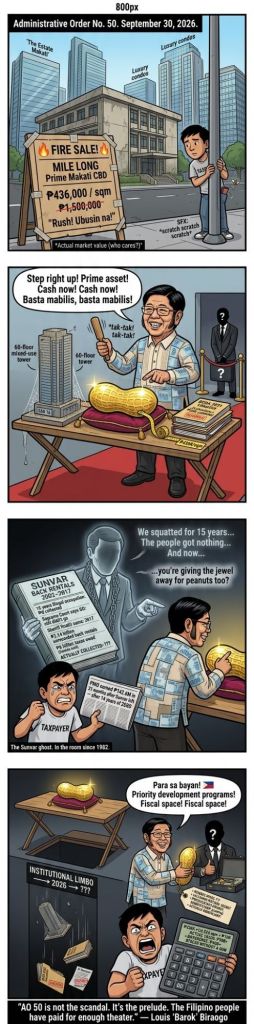
The Circular Firing Squad of Institutional Custody
Here’s your timeline of bureaucratic hot potato:
- Pre-2020: The Privatization and Management Office (PMO) manages Mile Long. Government earns P142.6 million in net rental income over 21 months. That’s P6.7 million per month from an asset that had previously generated exactly nothing for 14 years while Sunvar Realty squatted on it.
- January 2020: Duterte issues Administrative Order No. 21 (AO 21), transferring management to the Bases Conversion and Development Authority (BCDA) for “redevelopment prior to eventual disposition.” The rationale? BCDA knows how to develop things. Ignore the fact that Mile Long isn’t a former military base, which is BCDA’s actual statutory mandate.
- September 2026: Marcos Jr. issues AO 50, returning management to PMO for “expeditious disposition.”
Six years. Millions spent on valuation studies, master plans, and technical working groups. And the property is back exactly where it started.
The BCDA’s 2021 Terms of Reference for valuation is a thing of beauty, if you appreciate bureaucratic comedy. They wanted appraisals for market value, market rent, accommodation value, development and usufructuary rights, the value of those rights in a joint venture (JV) structure, and valuation under different litigation-risk scenarios. The Palafox master plan from 2018 contemplated mixed-use commercial development with a floor-area ratio (FAR) of 16.
What did all of this produce?
A property that, as of 2026, is still sitting in the same state it was in when BCDA took over. The redevelopment never happened. The disposition never happened. What happened was a six-year detour through institutional limbo, and now we’re supposed to believe that returning to PMO will somehow accelerate the process.
The Valuation Question They Don’t Want You to Ask
Here’s the number that matters: P10 billion.
That’s what the Department of Finance (DOF) was reportedly targeting for the sale of Mile Long by the end of Q3 2026. Let’s put that in perspective.
The property is 22,924 square meters. At P10 billion, that’s roughly P436,000 per square meter.
For those unfamiliar with Makati commercial real estate: that number is almost laughably low. Prime Makati central business district (CBD) lots routinely trade at P800,000 to P1.5 million per square meter, depending on location, zoning, and development potential.
The BCDA’s own valuation work contemplated a FAR of 16 and mixed-use commercial development. At a 22,924-square-meter lot with FAR 16, you’re talking about 366,784 square meters of gross floor area. Even at a conservative P150,000 per square meter of sellable residential or office space, that’s a gross development value north of P50 billion. And that’s before you consider the land value itself.
The 2021 BCDA valuation explicitly wanted to price the Development and Usufructuary Rights — not just the bare land. This is critical. A JV structure where government contributes land rights while a private partner contributes capital could allow the state to capture significantly more value than a one-time land sale.
So why is the DOF talking about P10 billion?
Because “cash now” is not the same as “maximum public value.” And if the government sells a prime Makati asset for a fraction of its development potential, the Filipino people will have been robbed — not through a smoking-gun kickback, but through the more insidious mechanism of institutional incompetence masquerading as fiscal prudence.
The Sunvar Ghost and the Missing Billions
Let’s talk about the elephant that’s been in this room since 1982.
The Mile Long property was subleased to Sunvar Realty Development Corporation, owned by the Rufino-Prieto families, in 1982. The lease expired in 2002. Sunvar stayed anyway. For 15 years.
The government filed an unlawful detainer case. Sunvar fought it. The case went all the way to the Supreme Court, which in 2012 affirmed that the government owned the property and Sunvar had to go. Sunvar didn’t actually vacate until August 2017, after a Sheriff’s Notice to Vacate.
During those 15 years of illegal occupation, the government collected nothing. Zero. The PMO later reported that after taking over in 2017, it generated P142.6 million in net income over 21 months. Extrapolate that backward: the government lost well over P1 billion in foregone rental income because it couldn’t evict a squatting corporation owned by one of the country’s most prominent families.
The Duterte administration made hay of this. Solicitor General Calida called Sunvar the “Philippine Daily Squatter.” Duterte himself claimed the Prietos owed P8 billion in taxes. The PMO’s records showed P2.14 billion in unrecorded back rentals.
Where did that money go? Did the government ever collect? Was there a settlement? Was there a quiet write-off?
The official record is silent. And AO 50 doesn’t mention any of this. It just says PMO should prepare a disposition plan and get Privatization Council approval.
Convenient.
The Privatization Council: The Only Adult in the Room
Here’s the one genuinely reassuring thing in this entire mess: AO 50 explicitly requires PMO to obtain Privatization Council approval before any disposition.
This matters because the Privatization Council, established under Executive Order No. 323 (EO 323), is the statutory body responsible for overseeing government privatization efforts. Without Council approval, any sale would be legally suspect. The Council’s involvement is the difference between a structured, transparent transaction and a backroom deal.
But here’s the problem: the Privatization Council can only be as rigorous as the information it receives. If PMO presents a valuation that’s based on “as-is” land value rather than development potential, and if the Council doesn’t independently verify, then the Council becomes a rubber stamp.
The BCDA’s 2021 valuation work should be the starting point, not an afterthought. That study explicitly contemplated JV structures, development rights, usufructuary rights, and multiple litigation-risk scenarios. Why would we ignore that work and start from scratch?
The “Fiscal Space” Canard
The government’s stated rationale for AO 50 is to “optimize the utilization of public assets, enhance fiscal space, and support priority development programs.”
Let’s translate that from bureaucratese: We need cash, and we need it fast.
The Department of Budget and Management (DBM) was directed to study how proceeds should be used “subject to the budgetary process and applicable laws.” Note the qualifier. AO 50 cannot appropriate funds; only Congress can do that under Article VI, Section 29(1) of the Constitution. So the “priority development programs” language is aspirational, not operational.
But here’s the deeper question: Is selling Mile Long actually the best use of this asset for fiscal purposes?
Mile Long is generating rental income. It’s in the heart of Makati. It has development potential that, if realized through a well-structured JV, could generate recurring revenue streams for decades. A one-time sale of P10 billion (or even P20 billion) might look good on a spreadsheet today, but it forfeits all future upside.
The government’s own 2021 BCDA documents show that officials previously understood this. They wanted to value development rights, not just land. They contemplated JV structures. They wanted scenario analysis for litigation risk.
What changed between 2021 and 2026 that makes a quick sale preferable to development?
That’s the question no one in the Marcos administration has answered.
The “Who Benefits?” Test
Whenever a government asset moves — especially one this valuable, in this location, with this history — the first question should be: Who benefits?
The official beneficiaries are the Filipino people, through “priority development programs.” But “priority development programs” is a phrase so vague it could mean anything from infrastructure to political patronage.
The potential beneficiaries of a fire sale are more concrete:
- The buyer, who acquires prime Makati real estate at below-market value.
- Intermediaries, who collect commissions and fees.
- Political allies, who get to claim credit for “revenue generation” without disclosing the opportunity cost.
There is, as of this writing, no credible public evidence of a predetermined buyer or a secret sweetheart deal. That’s important. Speculation is not proof.
But the absence of transparency around the valuation methodology, the reserve price, and the planned disposition structure creates a fertile environment for exactly the kind of mischief that has plagued Philippine privatization efforts for decades.
Remember the Chavez v. Public Estates Authority ruling? The Supreme Court held that before any disposition of valuable government property, the government must publicly disclose the size, location, technical description, terms and conditions, qualified bidders, and minimum price. The Court grounded this in the constitutional principle that public office is a public trust.
If the government is serious about selling Mile Long, it should start by publishing:
- The full valuation report (not just the number, but the methodology).
- The proposed disposition structure (sale, lease, JV, or hybrid).
- The reserve price and how it was determined.
- The Privatization Council’s approval resolution.
- The bidding rules and evaluation criteria.
Anything less is an invitation to litigation — and suspicion.
The Path Forward (If Anyone Cares)
Here’s what a credible Mile Long disposition would look like:
- Independent, development-based valuation using multiple methodologies. Not just “as-is” land value, but income approach, development rights approach, and JV structure analysis.
- Comparative net present value (NPV) analysis of sale vs. long-term lease vs. competitive JV. Show the math. Let the public see why one structure beats the others.
- Public bidding with adequate marketing period. No negotiated sales unless there’s a compelling legal or practical justification.
- Reserve price based on the valuation, with the option to walk away if bids are below threshold.
- Congressional appropriation for proceeds. The Constitution requires it. The executive cannot spend the money on its own authority.
- Commission on Audit (COA) participation from the start. Not just after-the-fact audit, but real-time oversight.
- Conflict-of-interest disclosures for every official involved in valuation, bidding, and award.
This is not rocket science. It’s basic fiduciary responsibility. The fact that it needs to be spelled out tells you everything about the state of government asset management in this country.
The Bottom Line
Administrative Order No. 50 is not the scandal. It’s the prelude to a scandal waiting to happen if the disposition process that follows is rushed, opaque, and driven by the need to generate cash before the next election cycle.
The Mile Long property has been a government asset for decades. It survived the Sunvar occupation. It survived the Duterte-BCDA detour. It will survive the return to PMO.
What it may not survive is a fire sale that converts a generational asset into a one-time budget line item — and a quiet transfer of wealth from the Filipino people to whoever ends up holding the title.
The government has the legal authority to sell Mile Long. What it lacks, so far, is the procedural credibility to convince anyone that the sale will be conducted in the public interest.
That credibility can only be earned through transparency, independent valuation, and genuine competitive bidding. Everything else is just theater.
And the Filipino people have paid for enough theater already.
Louis ‘Barok’ C. Biraogo is the author of the Kweba ni Barok blog. He has never owned a hectare of Makati real estate, but he has watched governments sell them for less than they’re worth more times than he cares to count.
Key Citations
A. Legal & Official Sources
- Official Gazette of the Republic of the Philippines. “Administrative Order No. 50, s. 2026.” Official Gazette, 30 Sept. 2026.
- Supreme Court E-Library. “Administrative Order No. 21, January 29, 2020.” Supreme Court E-Library, 29 Jan. 2020.
- Lawphil Project. “Executive Order No. 323, December 06, 2000.” Lawphil, 6 Dec. 2000.
- Official Gazette of the Republic of the Philippines. “The 1987 Constitution of the Republic of the Philippines — Article VI.” Official Gazette.
- Bases Conversion and Development Authority. “Terms of Reference: Procurement of Consulting Services for the Valuation of the Various Properties and Assets.” BCDA, Mar. 2021.
- Presidential Communications Office. “PBBM Orders Return of Mile-Long Property Management to Privatization and Management Office.” Presidential Communications Office, 1 Oct. 2026.
- Philippine Information Agency. “PBBM, Iniutos ang Pagbabalik ng Pamamahala ng Mile-Long Property sa Privatization and Management Office.” Philippine Information Agency, 1 Oct. 2026.
- Supreme Court of the Philippines. “Republic of the Philippines and National Power Corporation v. Sunvar Realty Development Corporation, G.R. No. 194880, June 20, 2012.” Supreme Court E-Library, 20 June 2012.
- Supreme Court of the Philippines. “Chavez v. Public Estates Authority, G.R. No. 133250.” Supreme Court E-Library, 11 Nov. 2003.
B. News Reports and Agency Statements
- Department of Finance. “Gov’t Earns P142.6-M in 21 Months from Mile Long Property.” Department of Finance, 17 July 2019.
- Commission on Audit. Commission on Audit. COA, http://www.coa.gov.ph.
- BusinessWorld. “Gov’t Targets Sale of 3 Major Assets.” BusinessWorld, 17 July 2026.
- Caliwan, Christopher Lloyd. “Makati RTC Orders SunVar to Vacate Mile Long Property.” Philippine News Agency, 15 Aug. 2017.
- Cordero, Ted. “Sunvar Lawyer: ‘We Are Not Squatter.’” GMA News Online, 28 July 2017.
- Sinaking, Erika Mae P. “Immediate Disposal of Mile Long Site Ordered.” BusinessWorld, 1 Oct. 2026.

- “Ang Hirap Maging Mahirap”: The PAO Scandal That Proves Government Contempt Is Nothing New

- “Far-Off” My Axx: Malacañang’s Claire Castro Drowns in Her Own Legal Gaslighting
- “Forthwith” to Farce: How the Senate is Killing Impeachment—And Why Enrile’s Right (Even If You Can’t Trust Him)

- “HINDI AKO NAG-RESIGN!”

- “I Know Nothing”: Baste Duterte’s Amnesia Defense Meets ₱33M in GenCorp Contracts

- “I’m calling you from my new Globe SIM. Send load!”

- “Mahiya Naman Kayo!” Marcos’ Anti-Corruption Vow Faces a Flood of Doubt

- “Manageable” Debt, Unmanageable Lies: DBM’s ₱21 Trillion Fairy Tale

- “Meow, I’m calling you from my new Globe SIM!”

- “Natrabaho”: One Word, One Ombudsman, and a Judiciary on Trial

- “No Special Jail for Crooks!” Boying Remulla Slams VIP Perks for Flood Scammers

- “Philippine-Controlled” or Yankee Gas Station? The Davao Fuel Depot Farce Exposed









Leave a comment