
While Real Plunderers Walk Free, San Fernando Shames a Man on the Operating Table
By Louis ‘Barok‘ C. Biraogo — July 16, 2026
THERE is a particular cruelty in kicking a man while he’s on the operating table. Yet that, with surgical precision, is exactly what Kamanggagawa party-list Rep. Elijah San Fernando did on July 13, 2026. As former Health Secretary Teodoro Herbosa was beginning the long, painful rehabilitation from bilateral knee replacement surgery, San Fernando wielded his smartphone like a shiv, gleefully declaring that his adversary had been “natablan na ng hiya”—finally shamed into resignation.
The performance was viral-ready, colloquial, and utterly savage. It was also, almost certainly, the public-facing execution of a long-planned political hit.
Let us be clear about what actually happened here. A dedicated public servant, navigating one of the most notoriously treacherous bureaucracies in the Philippine government, resigned for the most human of reasons: his body had failed him. A knee replacement is not a weekend spa retreat; it requires three to four months of intensive rehabilitation. Herbosa himself told Department of Health (DOH) staff it would be “unfair” to cling to a post he could not give his full attention. This is not the language of a man fleeing accountability. This is the conscience of a public servant.
So why the bloodlust? Because Herbosa’s departure is not the end of a story—it is the climax of a conspiracy. What we have witnessed is the systematic, coordinated dismantling of a reformer by a “DOH Mafia” he dared to disrupt. And San Fernando, whether a willing co-conspirator or a useful idiot, has served as their public mouthpiece, converting their anonymous whispers into viral video clips.
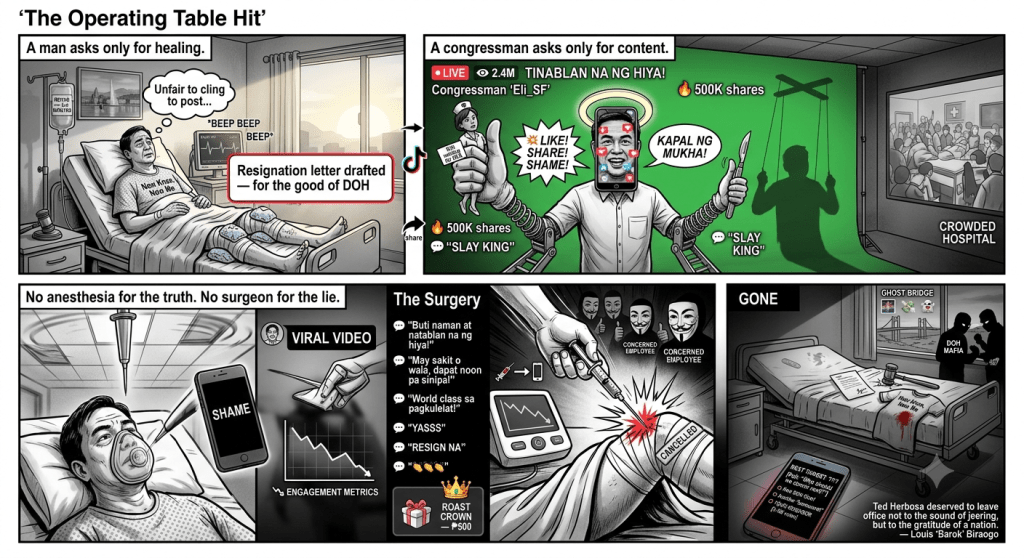
The Conspiracy Hiding in Plain Sight
Consider the architecture of the attack. Roughly a dozen Ombudsman complaints were filed against Herbosa since mid-2025—an astonishing volume for a Cabinet secretary barely two years into his tenure. These complaints, Herbosa has noted, were overwhelmingly filed by anonymous “concerned employees.” In a functioning democracy, we might call this whistleblowing. In the parallel universe of Philippine bureaucratic warfare, it has a more honest name: demolition job.
Herbosa himself has identified the source. He sidelined entrenched interests upon assuming office, uncovering what he described as internal corruption. These displaced operators—a “DOH Mafia,” if you will—did not pack up quietly. They began feeding a compliant media ecosystem a steady diet of scandalous allegations: ₱1.5 billion in expired medicines, a ₱1.8 billion bid-rigging scheme over mobile clinics, a business-class flight upgrade for an undersecretary to Geneva. Each allegation was calibrated for maximum public outrage, designed to paint a portrait of an out-of-touch bureaucrat feasting while frontliners starved.
Yet examine the substance and it crumbles. The expired medicines complaint, for instance, is a classic bureaucratic hand grenade—hurl the largest possible number into the public square and let the explosion do the work. But inventory management of multi-billion-peso pharmaceutical stockpiles is a structural nightmare that long predates Herbosa and will long outlast him. It reflects the systemic rot of procurement and supply chains, not one man’s malfeasance.
The “business-class upgrade” is the most transparently cynical hit of them all. A single personnel order upgrading one official’s flight becomes a national scandal? The pettiness is the point. When the “DOH Mafia” cannot find genuine corruption, they manufacture symbolic outrages—little “let them eat cake” narratives designed to contrast the comfort of Geneva with the hardship of Philippine hospital wards. The strategy is psychological warfare, not legal accountability.
And those foreign trips that San Fernando brands “walang kapararakang pagbiyahe”? They are, on closer inspection, the work of a diplomat. Herbosa served as President of the 78th World Health Assembly in 2025—an international distinction the Philippines has rarely achieved. Those trips secured grants, forged alliances, and elevated the country’s standing in global health governance. To dismiss them as pointless junkets is either willful ignorance or deliberate defamation.
The HEA Delays: A Systemic Hostage Crisis
The most emotionally potent weapon in San Fernando’s arsenal is the delayed Health Emergency Allowance (HEA) for COVID-19 frontliners. And it is a genuine tragedy—billions of pesos that healthcare workers, who risked their lives during the pandemic, are still owed. But to pin this on Herbosa is a breathtaking act of misdirection.
The HEA logjam is a multi-agency catastrophe involving the Department of Budget and Management, local government units, and private hospitals. The “final” computation has been reopened repeatedly by late claims, appeals, and record-keeping gaps. Herbosa did not create this morass; he inherited it. Under his watch, tens of billions of pesos were disbursed. The residual ₱6.7 billion is a fiscal and bureaucratic Hydra that no single secretary could slay in two years. Yet San Fernando, with the precision of a propagandist, collapses this systemic failure onto one man, weaponizing the very real suffering of frontliners to settle a political score.
The Grandstanding Congressman
And what of San Fernando himself? Here, the investigative trail grows particularly interesting. This is a man who built his political career not on legislative achievement but on viral TikTok videos. A former “content creator” whose rhetorical toolbox consists almost entirely of hyperbolic ad hominem attacks—before Herbosa, he deployed the same style against the Manila City Health Department, earning himself a cyber libel complaint. Consistency of method is not the same as integrity of purpose.
His “selective outrage” is the more damning indictment. Where was San Fernando’s blistering, shaming rhetoric during the flood-control plunder scandal, where billions vanished into infrastructure ghost projects touching the administration directly? He has called for identifying implicated congressmen—a safe, diffuse target—but has conspicuously avoided targeting the Palace with the same ferocity he reserves for an outgoing health secretary. This is not fiscalization. This is the choreographed savaging of a politically weakened target, dressed in the borrowed clothes of worker advocacy.
A Call to Real Accountability
The Filipino people deserve better than trial by viral video. If San Fernando genuinely believes Herbosa is corrupt, the House of Representatives has constitutional tools at its disposal—a formal committee inquiry, a resolution, a privilege speech carrying actual parliamentary immunity. Instead, he chose a press release peppered with “kapal ng mukha,” words more suited to a barangay brawl than legislative oversight. This is the performance of accountability without its substance.
The real accountability should fall on the anonymous complainants and their shadowy backers. Let the Ombudsman not allow these complaints to molder in quiet administrative limbo. Let the Commission on Audit expedite its special audit of HEA disbursements. True transparency would not bury Herbosa; it would vindicate him. It would reveal a man navigating a broken system, facing down a corrupt internal network, and ultimately being felled not by his own failures but by a conspiracy of whispers amplified by an opportunist with a smartphone and a grudge.
Ted Herbosa deserved to leave office not to the sound of jeering, but to the gratitude of a nation he served while his own body demanded rest. The tragedy is not that he resigned. The tragedy is that the “DOH Mafia” and its public mouthpiece have made a martyr out of a man who only ever asked for a new knee and a little peace.
Key Citations
A. News Articles
- “Herbosa Resigns as Health Chief.” BusinessWorld Online, 13 July 2026, https://bworldonline.com/the-nation/2026/07/13/763102/herbosa-resigns-as-health-chief/.
- “DOH Chief, Naka-Sick Leave Matapos Sumailalim sa Knee Replacement Surgery.” Bombo Radyo News, 11 July 2026, https://www.bomboradyo.com/doh-chief-naka-sick-leave-matapos-sumailalim-sa-knee-replacement-surgery.
- Manatlao, Eirene. “Herbosa Faces Graft Complaint as P1.5B Worth of Medicines, Vaccines ‘Wasted’.” Rappler, 1 Apr. 2026, https://www.rappler.com/philippines/department-health-expired-undelivered-medicines-vaccines-graft-complaint-march-2026/.
- Cruz, James Patrick. “DOH Chief Herbosa, 3 Others Face Graft Complaint over P1.8-B Mobile Clinics.” Rappler, 10 Mar. 2026, https://www.rappler.com/philippines/health-department-secretary-herbosa-baggao-mobile-clinics-graft-complaint/.
- “Marcos Appoints Philippine Orthopedic Center Chief Pujalte as New Health Secretary.” Manila Bulletin, 13 July 2026, https://mb.com.ph/2026/07/13/marcos-appoints-philippine-orthopedic-center-chief-pujalte-as-new-health-secretary.
- “Herbosa Sinupalpal ni Cong San Fernando, Tinablan Na ng Hiya.” Abante News, 13 July 2026, https://tnt.abante.com.ph/2026/07/13/herbosa-sinupalpal-ni-cong-san-fernando-tinablan-na-ng-hiya/news/.
- “With GAA Signed, Solon Seeks Release of Stalled HEA.” Manila Standard, 5 Jan. 2026, https://manilastandard.net/?p=314687956.
B. Official & Institutional Sources
- Rocamora, Joyce Ann L. “DOH Chief Assumes Presidency of 78th World Health Assembly.” Philippine News Agency, 20 May 2025, https://www.pna.gov.ph/articles/1250489.
- “Eli San Fernando.” Wikipedia, https://en.wikipedia.org/wiki/Eli_San_Fernando.
- ₱9 Billion in ‘Savings’? DILG’s Fire Truck Deal Smells Like Smoke
- ₱8B BBM Pork: CCTV for Every Captain’s Kumpare?
- ₱8.9 Billion, 331 Ghost Police Stations: The TIKAS Scandal Explained

- ₱8.4 Billion, 42,000 Barangays, 1 Election: The “Bawat Barangay Makikinabang” Vote-Buying Masterclass
- ₱75 Million Heist: Cops Gone Full Bandit

- ₱63 to the Dollar: The Only Thing Falling Faster Than the Peso Is the Government’s Credibility
- ₱6.77B Ghost Haunts Duterte: RTC Dismisses Mans Carpio’s Desperate Plea
- ₱6.77 Billion and Zero Cash: The Sara Duterte SALN Math That Doesn’t Add Up

- ₱6.7-Trillion Temptation: The Great Pork Zombie Revival and the “Collegial” Vote-Buying Circus

- ₱58.53B, Zero Receipts: The LGSF Pork Barrel Nobody Wants to Name
- ₱53 Million Man Tells ₱695-a-Day Workers to Stop Being ‘Mayabang’: The Audacity of BSP’s Remolona
- ₱4.4 Billion and a Witness Who Can’t Explain It: The Duterte Impeachment’s Most Expensive Non-Answer



Leave a Reply