
Same Pork, Different Packaging.
By Louis ‘Barok‘ C. Biraogo — July 16, 2026
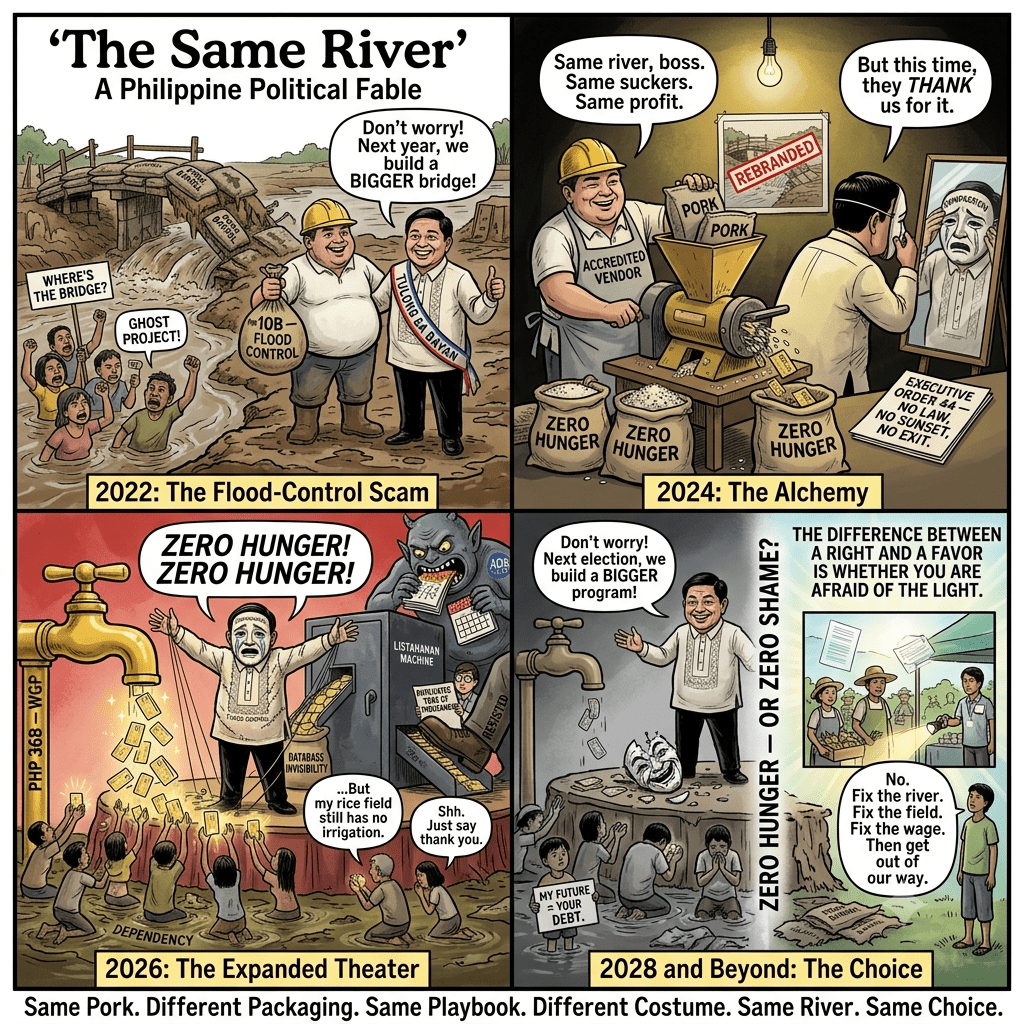
THIS is not a social program. Let’s be clear about that from the first sentence, because clarity is the first casualty in the Marcos administration’s latest grand anti-poverty theater. What we are witnessing with the breathless rollout of the Expanded Walang Gutom Program (WGP) is the construction of the Philippines’ most sophisticated pre-election machine, a PHP36-billion monument to the political genius of turning empty stomachs into grateful votes. The architects of this program have looked at the rotting edifice of flood-control corruption and, with a wink to the ghosts of pork barrels past, simply swapped cement for calories. The structural beams are identical; only the commodity has changed.
The press release from National Anti-Poverty Commission Lead Convenor Lope Santos III, dutifully transcribed by the Philippine News Agency, is a masterclass in political alchemy. He waves his hands over a PHP36-billion annual dole and conjures visions of a “stable market for farmers and fisherfolk” and a nation reaching “Zero Hunger” in two to three years. It is a beautiful tapestry, woven from the desperation of 760,000 food-poor families and the threadbare promises of a government that has failed to manage the price of rice. But pull one thread, just one, and the whole thing unravels.
The Manufactured Dilemma
The central lie here is a manufactured choice. The administration would have us believe there is a tragic dilemma: urgent humanitarian relief or the long, hard slog of fixing agriculture, wages, and food supply chains. This is a magician’s trick of misdirection.
The truth is far more sinister. The tragedy is not choosing one noble goal over another; it is using the raw, screaming need of hunger as political leverage to secure power, while the root causes of that hunger are left to fester. The WGP is not a bridge to food security — it is a permanent pier built into the swamp of dependency, a jetty designed for the easy loading of votes onto the ship of state in 2028.
A Program Built on a Legal Vacuum
To see the program’s true nature, look at the law — or more precisely, the vacuum where a law should be. This is a creature of Executive Order No. 44, a gossamer decree floating on a discretionary budget. It has no statutory floor, no sunset clause, no objective exit criteria, and no clear pathway for a family to graduate out of dependency. This is not an oversight; it’s the core design.
Contrast this with the 4Ps (Pantawid Pamilyang Pilipino Program), institutionalized by a real law: Republic Act No. 11310. That’s a rigid, predictable bureaucracy with its own statutory beneficiary-selection rules and penalties for abuse. The WGP, by contrast, is a pot of discretionary cash, fattened further by a pending institutionalization bill still working its way through Congress. It is fat enough to buy a million families’ loyalty before an election, and if the political winds change, it can be starved, reprogrammed, or abolished with a stroke of a presidential pen. It’s not a social contract; it’s a politician’s option.
Same Playbook, Different Costume
This executive agility is the key that opens the door to the same old ghosts of corruption. The expanded WGP is not a new idea; it is the flood-control scam in a humanitarian costume. Let’s trace the hallowed playbook.
In the infrastructure scandals, you had massive outlays of money funneled through a closed loop of vetted intermediaries and contractors who captured the state. Here, we have a closed system of accredited merchants and an EBT payment operator — with the DSWD itself confirming over a thousand accredited retail partners nationwide. With billions in guaranteed food credits flowing through a single digital pipeline, we aren’t just inviting a cartel; we are handing it a golden key and a legal monopoly. The same corruption that delivers a ghost bridge will simply deliver ghost chickens and phantom kilos of rice.
The Secret List
Then there is the lifeblood of a patronage machine: the secret list. The DSWD boasts that it bypasses local mayors, using a centralized Listahanan database to pick the “deserving.” They frame this as an anti-patronage, post-Belgica firewall — a reference to the landmark Supreme Court ruling that struck down the pork barrel system for letting legislators intrude on executive budget functions. But don’t believe the pious press release for a second. This isn’t the elimination of political discretion; it’s the relocation of that discretion from the LGU to Malacañang.
A list of millions, compiled and controlled centrally in total opacity, is not a tool of fairness. It is a weapon for selective inclusion and political exclusion. The Commission on Audit has already documented this pathology in similar centrally run DSWD cash-aid programs. Auditors flagged hundreds of millions of pesos in duplicate and ineligible payouts under AKAP (Ayuda sa Kapos ang Kita Program), along with documented instances of politicians co-opting payout events for self-promotion — what COA itself called a form of electioneering. A similar pattern surfaced years earlier in the pandemic-era Social Amelioration Program, where tens of thousands of duplicate beneficiaries were uncovered. A secret algorithm for mercy is just a machine for manufacturing political indebtedness away from the prying eyes of the republic.
A Calendar, Not a Coincidence
The timing strips away the last shred of pretense. This isn’t a coincidence; it’s a calendar. We are less than two years from a national election, and the administration is scaling up a direct, monthly financial pipeline to a million of the country’s most vulnerable families. This is “ayuda for loyalty,” the long-horizon clientelism the Philippines knows all too well.
The choreography is already being refined: the mandatory branding on EBT cards, the photo-ops of officials with glossy flyers, the distribution events that look suspiciously like campaign rallies. Eligibility rules will change ad-hoc, and a disproportionate amount of this “humanitarian” aid will, by some statistical miracle, find its way into vote-rich swing provinces while opposition strongholds develop a curious case of database invisibility.
Debt to Buy Groceries
And for a program that claims to be a pathway to a better life, its fiscal architecture is a ticking time bomb. A chunk of this is being financed through concessional loans from the ADB and AFD — meaning the government is putting the country into debt to buy groceries, all while leaving land reform and agricultural modernization to gather dust.
This isn’t sustainability; it’s a diversion. The government announces a shiny new PHP36-billion dole, and the public’s attention is diverted from the lack of investment in irrigation, the absence of a livable wage, and the gutting of support for the very farmers and fisherfolk Lope Santos claims to be helping. We are paying interest on a Band-Aid while the patient hemorrhages from a systemic wound.
What Dignity Would Actually Look Like
My message, then, is this: treat the poor not as grateful, frightened clients, but as rights-holders. The first act of a government that respected the dignity of its people would be to publish everything:
- The granular, verifiable, anonymized beneficiary lists
- The vendor accreditation criteria and the full concentration of redemptions, to ensure we aren’t funding a new supermarket oligarchy
- The COA and Anti-Red Tape Authority (ARTA) reviews this administration has so far resisted
- An independent, continuous audit, accepted rather than fought
The difference between a right and a favor is whether you are afraid of the light.
Solve the root causes. Use the budget to guarantee a fair price for farmers, not just to fund a captive market for a few politically connected merchants. Invest in a national food security apparatus that builds resilience rather than a digital dependency that builds a voter file. Serve the people’s dignity, not just their hunger. Deliver honestly, without a single peso’s kickback.
This is a fight for the soul of the Republic. The choice is between a feudal state where our hunger is a line item in a political campaign and a democracy where the government’s highest calling is to empower its citizens to feed themselves. We must demand — not ask, but demand — the strengthening of our democratic institutions so they can withstand a PHP36-billion bribe. We must call for a future where the youth inherit not a feculent system of transactional governance disguised as compassion, but a nation where public service and pro-people governance are the twin pillars of a truly just society. Anything less is to accept that our democracy, like the bellies of the poor, will remain perpetually empty. 🪨
Key Citations
A. Reports & Studies
- Commission on Audit. 2024 Annual Audit Report on the Department of Social Welfare and Development. Cited in “COA Flags Lapses in 2024 Rollout of DSWD’s AKAP.” GMA News Online, 22 Dec. 2025, gmanetwork.com.
- “COA Asks DSWD to Explain How Some Cash Aid Went to Wrong People.” Rappler, rappler.com.
- “Ending Hunger in the Philippines, One Household at a Time.” Asian Development Bank, 11 June 2026, adb.org.
B. News Articles
- “Expanded Walang Gutom Program Seen to Advance PH Zero Hunger Goal.” Philippine News Agency, pna.gov.ph.
- “Electioneering, Duplicate Payments Plague AICS and AKAP — COA.” Philstar.com, 23 Dec. 2025, philstar.com.
- “DSWD Welcomes House Bill Institutionalizing Walang Gutom Program.” DSWD, dswd.gov.ph.
C. Official Websites & Legal Texts
- Walang Gutom Program. Department of Social Welfare and Development, dswd.gov.ph.
- Executive Order No. 44, s. 2023. Office of the President of the Philippines, lawphil.net.
- Republic Act No. 11310 (Pantawid Pamilyang Pilipino Program Act). Official Gazette of the Republic of the Philippines, officialgazette.gov.ph.
- Belgica v. Executive Secretary Ochoa, G.R. No. 208566 (S.C., Nov. 19, 2013). LawPhil Project, lawphil.net.

- “Ang Hirap Maging Mahirap”: The PAO Scandal That Proves Government Contempt Is Nothing New

- “Far-Off” My Axx: Malacañang’s Claire Castro Drowns in Her Own Legal Gaslighting
- “Forthwith” to Farce: How the Senate is Killing Impeachment—And Why Enrile’s Right (Even If You Can’t Trust Him)
- “HINDI AKO NAG-RESIGN!”

- “I Know Nothing”: Baste Duterte’s Amnesia Defense Meets ₱33M in GenCorp Contracts

- “I’m calling you from my new Globe SIM. Send load!”

- “Mahiya Naman Kayo!” Marcos’ Anti-Corruption Vow Faces a Flood of Doubt

- “Manageable” Debt, Unmanageable Lies: DBM’s ₱21 Trillion Fairy Tale
- “Meow, I’m calling you from my new Globe SIM!”

- “Natrabaho”: One Word, One Ombudsman, and a Judiciary on Trial
- “No Special Jail for Crooks!” Boying Remulla Slams VIP Perks for Flood Scammers

- “Philippine-Controlled” or Yankee Gas Station? The Davao Fuel Depot Farce Exposed





Leave a Reply