Inside the Palace’s Favorite Trick: Swap the Officials, Bury the Scandal, Wait for the Next Typhoon
By Louis ‘Barok‘ C. Biraogo | October 27, 2026
A Swap Made In The Palace Basement
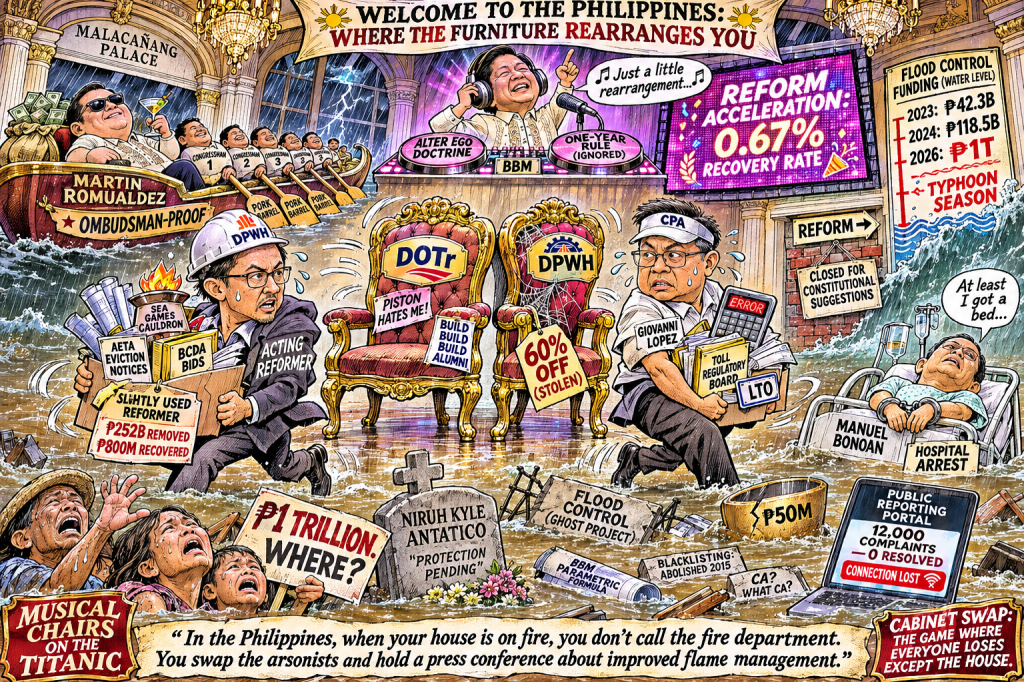
On October 26, 2026, President Ferdinand Marcos Jr. ordered Transportation Secretary Vince Dizon and Public Works Secretary Giovanni Lopez to trade offices. Dizon returns to the Department of Transportation (DOTr); Lopez takes over the Department of Public Works and Highways (DPWH), where Senator Panfilo Lacson estimates 60% of flood control budgets have been pocketed through ghost projects, substandard infrastructure, and kickback schemes.
The Palace’s official explanation? “To accelerate reform.”
That’s like rearranging the deck chairs on the Titanic and calling it “improved deck management.”
The flood control scandal—an estimated ₱42.3 to ₱118.5 billion annually lost since 2023, potentially ₱1 trillion per Greenpeace—has now claimed its first “casualty”: Dizon’s transfer to a less toxic department. Notice I said “transfer,” not “resignation.” In the Philippines, when you’re at the center of a corruption scandal, you don’t get fired. You get promoted sideways.
The Bonoan Hospital Arrest And The Burden Of History
Former DPWH Secretary Manuel Bonoan resigned in August 2025 under a cloud of flood control irregularities. His reward? A hospital arrest as suspicious as the “hospitals” allegedly built with ghost funds.
In comes Vince Dizon—the same Dizon accused of plunder in the ₱50 million “Olympic cauldron” scandal during the 2019 Southeast Asian Games (SEA Games), the same Dizon who faced allegations of violently displacing Aeta indigenous communities in New Clark City, the same Dizon who cut his teeth as a key architect of Duterte’s “Build Build Build” program where bid-rigging allegations were as common as typhoons.
And what does Dizon do at DPWH? He sends an “unqualified courtesy resignation” order to over 250 officials—all undersecretaries, assistant secretaries, regional directors, and 197 district engineers. Because nothing says “meaningful reform” quite like mass firing without individual due process, followed by a public reporting portal that receives 12,000 complaints in less than a month—most unresolved to this day.
The Numbers Don’t Lie, But The Government Does
Dizon proudly announced removing ₱252 billion worth of locally-funded flood control projects from the 2026 budget. The government claims it has “recovered” ₱800 million.
Let’s do the math:
- Estimated annual losses since 2023: ₱42.3–118.5 billion
- Recovered funds: ₱800 million
- Recovery rate: Approximately 0.67% to 1.9%
If the government were a bank, it would have been seized for money laundering. If it were a hospital, it would have been closed for malpractice. But because it’s the Philippine government, it gets to call this “reform.”
The Acting Secretary And The One-year Rule
Giovanni Lopez had been serving as acting DOTR secretary beyond the one-year mark before this swap. The Executive Order No. 292 (The Administrative Code of 1987) is clear: temporary designations cannot exceed one year, “in no case.” But in the Philippines, “in no case” apparently means “in most cases.”
If this were the United States, Lopez would face quo warranto challenges from every law student with Westlaw access. In the Philippines, he’s now being promoted to head one of the most corrupt departments in government. Because meritocracy is for countries that don’t have political dynasties.
The “Reformer” Who Can’t Pass The Sniff Test
Let’s review Dizon’s record, because the mainstream media has developed collective amnesia.
The SEA Games Cauldron: P50 million for a decorative flame holder. For that amount, the Philippines could have built actual housing for displaced indigenous communities. Instead, we got a fiery symbol of excess that lasted 48 hours.
New Clark City Displacement: Aeta communities of Capas, Tarlac were reportedly displaced for sports facilities that are now underutilized and overpriced.
BCDA Conflicts: As former Bases Conversion and Development Authority (BCDA) CEO, Dizon was instrumental in bidding processes critics say favored specific contractors. His return to DOTr—where large-scale infrastructure projects are the bread and butter—should raise eyebrows higher than the traffic barriers that never seem to get installed.
This is the man the Palace wants us to believe is a “reformer.” His reward for failing to reform DPWH is a return to the department he left before being sent to clean up the flood control mess. It’s like sending the fox back to the henhouse it left before it was sent to guard the chicken coop. The chickens are still missing, but the fox has a corner office.
The “Fresh Face” At DPWH
Giovanni Lopez—a lawyer and Certified Public Accountant (CPA) with no DPWH experience whatsoever—replaces Dizon. His qualifications:
- Director for Legal Service at DOTr (2017),
- Assistant Secretary for Procurement (2017),
- Undersecretary for Finance (2021),
- Officer-in-Charge (OIC) of the Toll Regulatory Board (2021),
- Executive Director of the Land Transportation Office (LTO) (2022),
- Senior Undersecretary for Administration (2025),
- Acting Secretary (September 2025–present).
The man has spent his entire career at DOTr and its attached agencies. He has never managed a flood control project. He has never overseen roads and bridges at DPWH scale. But sure, let’s put him in charge of the agency where ghost projects have been delivered for decades. Because a CPA will definitely stop corruption that has survived generations of accountants. This is the equivalent of hiring a vegetarian to manage a steakhouse because “they’ll be objective about the meat.”
The Romualdez Elephant In The Room
While the Palace plays musical chairs, let’s not forget the actual central figure in the flood control scandal: former House Speaker Martin Romualdez, who happens to be Marcos Jr.’s cousin.
The Ombudsman identified Romualdez as “the central figure in a scheme built on the diversion of public funds.” Sixty-seven members of Congress were reportedly public works contractors for their own projects in 2022. Cash was allegedly delivered in suitcases to lawmakers’ aides in hotel parking lots.
And the President’s response? A Cabinet reshuffle. Because when your cousin is implicated in the largest corruption scandal in recent Philippine history, the solution is to move two Cabinet secretaries, hold press conferences about “reform,” and hope the public gets distracted by traffic jams. The swap conveniently occurs just as the Ombudsman prepares cases against Romualdez and others. You don’t need to be a conspiracy theorist to see the timing. You just need functioning eyes.
The Legal Theater Of The Alter Ego Doctrine
The President’s defenders will invoke the alter ego doctrine—that constitutional principle where Cabinet secretaries are merely extensions of the President’s will. They’ll cite Manubay v. Garilao and Villena v. Secretary of Interior. And they’re not wrong—technically. Under Article VII, Section 17, the President has control over all executive departments.
But here’s the thing about technical correctness: it’s often used to justify terrible policy. The President can legally reassign secretaries. The President can legally ignore the one-year limit if challenged. The President can legally keep his cousin in power despite the Ombudsman’s findings.
The question isn’t whether Marcos Jr. has the legal authority. The question is why he thinks a Cabinet swap constitutes an adequate response to a scandal of this magnitude. If your house is on fire and you rearrange the furniture, you haven’t solved the fire. You’ve just made it harder to find the exit.
The Commission On Appointments And The Avoidance Thereof
If Dizon and Lopez are treated as “reassignments” rather than “new appointments,” they may avoid fresh Commission on Appointments (CA) confirmation. The Constitution requires CA consent for department heads. But the Palace can argue the swap is a mere reassignment, not a new appointment.
This sets a troubling precedent: future presidents can shuffle Cabinet members between departments without legislative oversight, effectively circumventing the CA’s constitutional role. In a democratic system with genuine institutional checks, the CA would demand confirmation hearings. Instead, it will likely rubber-stamp the appointments or conveniently find they don’t require confirmation. Because in the Philippines, constitutional provisions are more like suggestions than requirements.
The Actual Reforms That Won’t Happen
Let’s talk about what genuine reform would look like, because the Palace has no intention of pursuing it.
Reform 1: Abolish Congressional Pork. The “BBM Parametric Formula” for allocable funds allows legislators to insert projects into the DPWH budget—the structural driver of corruption. A Cabinet swap doesn’t address it.
Reform 2: Strengthen Whistleblower Protection. Niruh Kyle Antatico was killed after exposing corruption at the National Irrigation Authority. The government hasn’t enacted meaningful protection despite years of promises.
Reform 3: Procurement Transparency. Republic Act No. 9184 (Government Procurement Reform Act) has been weakened by exceptions and lax enforcement. The abolition of blacklisting reforms since 2015 has allowed corrupt contractors to continue winning bids.
Reform 4: Institutional Independence. The Ombudsman, Commission on Audit (COA), and Sandiganbayan need genuine independence to investigate and prosecute corruption regardless of political affiliation.
Reform 5: Convictions, Not Announcements. The Philippines’ conviction rate for corruption cases hovers near statistical insignificance. Powerful officials escape prosecution while small-time employees face jail time.
None of these reforms are being pursued. Instead, we get a Cabinet swap and a press conference.
The Piston Problem
Transport group Pinagkaisang Samahan ng Tsuper at Operators Nationwide (PISTON) strongly opposed Dizon’s original DOTR appointment, calling him “a puppet of corporations and foreign capital.” His return should alarm commuters and transport workers. Under Dizon’s previous tenure, PISTON members faced harassment for organizing strikes. Transport modernization programs were implemented without adequate consultation. The riding public’s interests were subordinated to transport corporations. Now Dizon returns—not because he did a good job, but because he needs to escape the DPWH scandal.
The Political Calculations
Every Cabinet reshuffle in the Philippines is a political calculation. Five theories explain this one:
Theory 1: The Sacrificial Lamb. Dizon was sent to DPWH to absorb the scandal’s damage. Now, before the Ombudsman files cases, he’s extracted to a less toxic department.
Theory 2: Protecting Romualdez. The swap distracts from the Ombudsman’s imminent charges against Marcos Jr.’s cousin.
Theory 3: The 2028 Elections. Dizon is positioned for future political ambitions. DOTR is more visible than DPWH.
Theory 4: Corporate Interests. Dizon’s return serves private infrastructure interests aligned with BCDA.
Theory 5: Testing Lopez. Marcos Jr. may be grooming Lopez for a larger role.
The truth may involve elements of all five. But none involve genuine reform.
The International Implications
Climate finance donors are watching closely. The flood control scandal has raised questions about whether international climate funds can be trusted in a country where 60% of infrastructure budgets allegedly end up in officials’ and contractors’ pockets. Greenpeace estimates up to ₱1 trillion in climate-related projects may have been compromised. This isn’t just a Philippine problem—it’s a global one.
Every misappropriated dollar is a dollar that doesn’t protect vulnerable communities from climate disasters. The Cabinet swap won’t restore international confidence. Only genuine accountability will.
The “Reform” Narrative Falls Apart
The Palace wants you to believe the swap is “reform acceleration.” Let’s test that claim.
Dizon’s DPWH Tenure (August 2025–October 2026): Claim Reality Ordered 250+ officials to resign Mass resignations without due process; many reappointed Created public reporting portal 12,000 complaints, few resolved Cut construction material prices Marginal impact on corrupt procurement Partnered with Philippine Competition Commission (PCC) and Anti-Money Laundering Council (AMLC) Investigations ongoing, no convictions Removed ₱252 billion in projects Budget theater; no institutional reforms Filed complaints vs Bulacan engineers Token prosecutions; big fish still swimming
After 14 months, Dizon achieved no systemic reforms. He was the face of DPWH cleanup without actually cleaning anything up. The real message: If you’re a Cabinet secretary and corruption happens under your watch, you won’t face consequences. You’ll be transferred.
The Flood Waters Are Still Rising
While the political elite play musical chairs, Filipino communities continue to suffer from floods that should have been prevented by the very projects meant to protect them. Substandard flood control infrastructure has been linked to deaths and displacement. Families who should be safe are underwater because officials and contractors pocketed the money meant to protect them.
In November 2024, Typhoon Kristine devastated communities across Luzon. Investigators found flood control projects in affected areas were incomplete, substandard, or nonexistent. The storm killed over 100 people and caused billions in damage. When the next typhoon hits—and it will—the same corrupt procurement systems will still be in place. The Cabinet swap won’t change that.
What Actually Needs To Happen
If Marcos Jr. were serious about reform—which he isn’t—he would:
- Issue an executive order mandating all government agencies to fully cooperate with the Ombudsman’s investigations—producing documents, witnesses, and resources without delay—and to preserve all records related to the flood control scandal.
- Support legislation abolishing congressional pork in infrastructure projects.
- Fund and protect whistleblower programs with genuine security guarantees.
- Mandate open contracting for all public procurement.
- Allow independent audits of the flood control scandal by international organizations.
- Publish Dizon’s complete transition audit and preserve all investigative materials.
- Publicly address the Aeta displacement from New Clark City.
- Meet with flood victims and explain how he plans to prevent future deaths.
None of these things are happening. Instead, we get a Cabinet swap and a press conference.
The Verdict: Cinema Verité Meets Theatre Of The Absurd
The Dizon-Lopez Cabinet swap is constitutionally valid but politically insufficient. It’s a management maneuver masquerading as reform. It’s a shell game where the ball is always under the cup the President controls, and the public never gets to see what’s inside.
Dizon returns to DOTr with his baggage intact—the SEA Games scandal, the Aeta displacement, the BCDA conflicts. Lopez takes over DPWH with no relevant experience and an impossible mandate. Romualdez remains untouched. The flood control scandal continues without resolution.
The Palace’s claim that the swap will “accelerate reform” is laughable on its face. What reform? What acceleration? The only thing accelerating is the amount of public funds disappearing into private pockets. After 14 months of “reform” at DPWH, no high-level officials have been convicted. No major funds recovered. No systemic changes implemented. And now the “reformer” is being moved.
If this is reform, then the word has lost all meaning.
The Final Question
If you were President of the Philippines and discovered 60% of your public works budget was being stolen, would you:
- A) Order prosecution of all responsible officials, including family members.
- B) Implement systemic reforms to prevent future corruption.
- C) Transfer two Cabinet secretaries and hold a press conference.
The answer, apparently, is C. Because in the Philippines, the appearance of action is more important than actual results.
The flood waters will continue to rise. Public funds will continue to disappear. And the political elite will continue to shuffle Cabinet secretaries around like chess pieces on a rigged board. Marcos Jr. had an opportunity to demonstrate genuine accountability. Instead, he chose the same old game of musical chairs that has defined Philippine politics for generations.
The Cabinet secretaries have swapped seats. The corruption has not. The flood victims have not been helped. The public trust has not been restored. But the Palace’s communications team has a new “reform” narrative to promote. So I suppose that’s what matters. Or at least, that’s what they’d like you to believe.
Islamic Insurgency? Typhoon Devastation? Fragile Economy? Don’t Worry—another Cabinet Swap Will Fix It.
Welcome to the Philippines, where the government’s solution to every crisis is to rearrange the furniture and pretend the house isn’t on fire.
Louis ‘Barok’ C. Biraogo is the author of Kweba ni Barok, a blog dedicated to critical analysis of Philippine politics, corruption, and governance. He has been described as “a pest” by at least two Cabinet secretaries and “the only person who reads procurement documents” by a retired COA auditor.
Key Citations
A. Legal & Official Sources
- Executive Order No. 292. Administrative Code of 1987. 25 July 1987. Official Gazette of the Republic of the Philippines, http://www.officialgazette.gov.ph/1987/07/25/executive-order-no-292-s-1987/.
- Manubay v. Garilao. G.R. No. 140717, 16 Apr. 2009. ChanRobles Virtual Law Library, chanrobles.com/cralaw/2009aprildecisions.php?id=346.
- Philippines. The 1987 Constitution of the Republic of the Philippines. Art. VII, secs. 16–17; Art. XI, sec. 5. Official Gazette of the Republic of the Philippines, http://www.officialgazette.gov.ph/constitutions/1987-constitution/.
- Republic Act No. 7080. An Act Defining and Penalizing the Crime of Plunder. 12 July 1991. Official Gazette of the Republic of the Philippines, http://www.officialgazette.gov.ph/1991/07/12/republic-act-no-7080/.
- Republic Act No. 9184. Government Procurement Reform Act. 2003. Official Gazette of the Republic of the Philippines, http://www.officialgazette.gov.ph/2003/01/10/republic-act-no-9184/.
- Villena v. Secretary of the Interior. 67 Phil. 451 (1939). LawPhil, lawphil.net/judjuris/juri1939/apr1939/gr_l-46570_1939.html.
B. News Reports
- Domingo, Katrina. “Vince Dizon returns to DOTR, Lopez heads DPWH to ‘accelerate reforms’ — Palace.” ABS-CBN News, 26 Oct. 2026, https://www.abs-cbn.com/news/nation/2026/10/26/dpwh-s-dizon-dotr-s-lopez-swap-posts-on-marcos-order-to-accelerate-reforms-1044.
- ₱9 Billion in ‘Savings’? DILG’s Fire Truck Deal Smells Like Smoke

- ₱8B BBM Pork: CCTV for Every Captain’s Kumpare?

- ₱8.9 Billion, 331 Ghost Police Stations: The TIKAS Scandal Explained

- ₱8.4 Billion, 42,000 Barangays, 1 Election: The “Bawat Barangay Makikinabang” Vote-Buying Masterclass

- ₱75 Million Heist: Cops Gone Full Bandit

- ₱63 to the Dollar: The Only Thing Falling Faster Than the Peso Is the Government’s Credibility

- ₱6.77B Ghost Haunts Duterte: RTC Dismisses Mans Carpio’s Desperate Plea
- ₱6.77 Billion and Zero Cash: The Sara Duterte SALN Math That Doesn’t Add Up

- ₱6.7-Trillion Temptation: The Great Pork Zombie Revival and the “Collegial” Vote-Buying Circus

- ₱58.53B, Zero Receipts: The LGSF Pork Barrel Nobody Wants to Name

- ₱53 Million Man Tells ₱695-a-Day Workers to Stop Being ‘Mayabang’: The Audacity of BSP’s Remolona

- ₱4.4 Billion and a Witness Who Can’t Explain It: The Duterte Impeachment’s Most Expensive Non-Answer




Leave a Reply