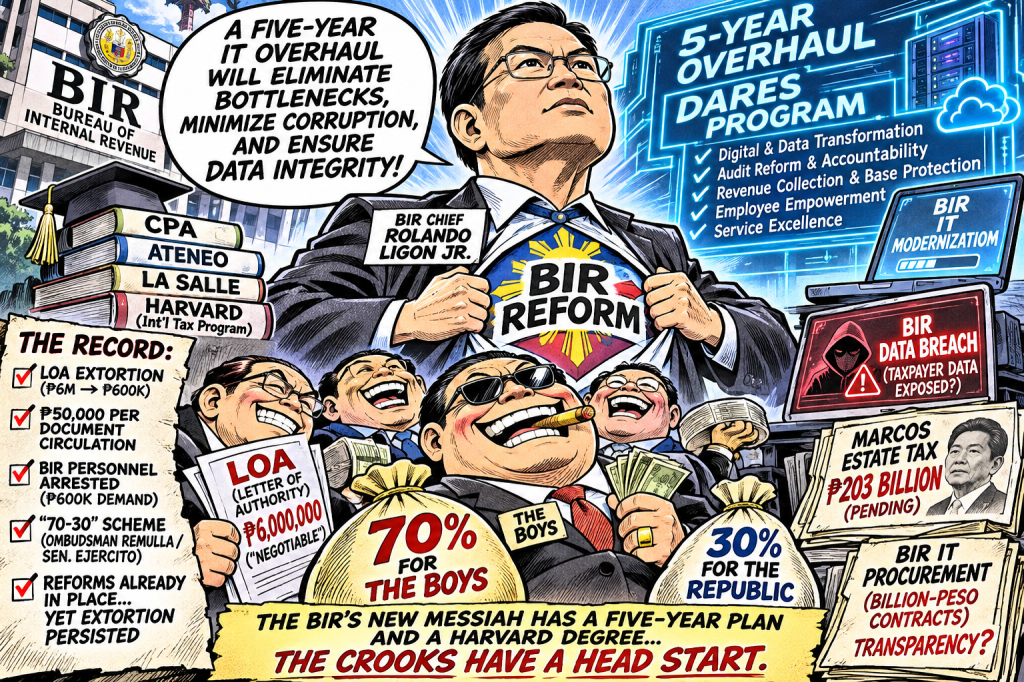
70 for the Boys, 30 for the Republic: The Math Ligon’s Technology Cannot Fix
By Louis ‘Barok‘ C. Biraogo — November 16, 2026
ROLANDO Ligon Jr. is the kind of appointment that makes you want to believe. Tax lawyer. Certified Public Accountant (CPA). Ateneo. La Salle. Harvard Law’s International Tax Program. A career that began as a Bureau of Internal Revenue (BIR) Revenue Officer I and climbed to Undersecretary at the Department of Finance (DOF).
On paper, he is the technocrat’s technocrat—the insider who knows where the bodies are buried because he used to hand out the shovels.
And that, dear taxpayers, is precisely the problem.
Ligon’s inaugural promise is a five-year overhaul of the BIR’s core Information Technology (IT) systems, a vow to “eliminate administrative bottlenecks, minimize room for corruption, ensure data integrity.”
He will sustain the DARES framework—Digital and Data Transformation, Audit Reform and Accountability, Revenue Collection and Base Protection, Employee Empowerment and Welfare Promotion, Service Excellence. It sounds like a McKinsey deck come to life.
It is also, almost word for word, the same promise the BIR has been making since at least 2024, when it published a Digital Transformation Roadmap covering 2025–2028 with twenty-two projects and a data governance framework.
So what exactly is Ligon adding? A new commissioner’s face on an old brochure? Or is the five-year timeline an admission that the existing four-year roadmap is already dead on arrival?
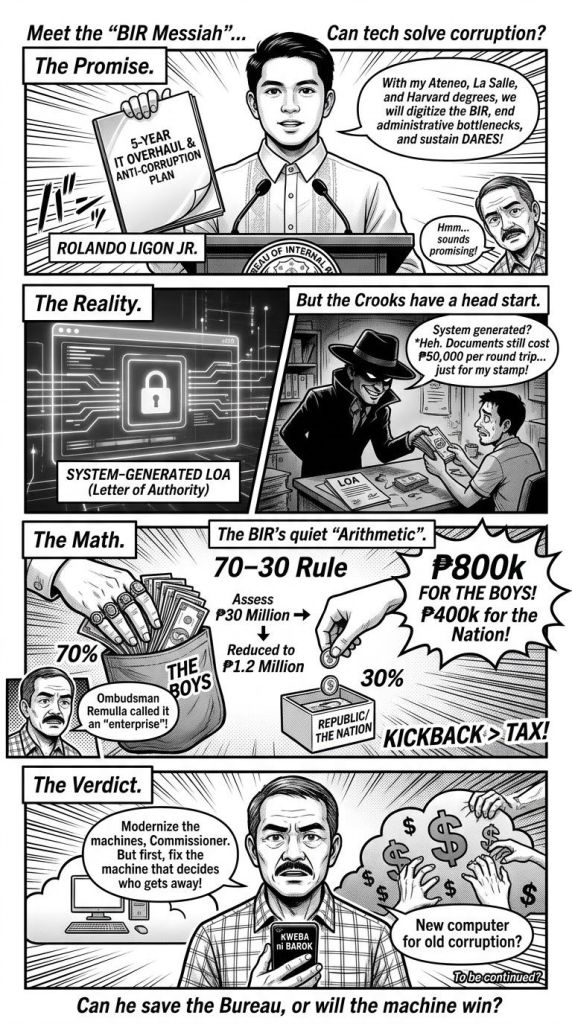
The Reform That Wasn’t
In November 2025, the BIR suspended all field audits and Letter of Authority (LOA) issuances amid allegations that LOAs had become weapons of extortion. Commissioner Charlito Mendoza responded with system-generated LOAs, risk-based audit selection, a “Single-Instance Audit Framework,” the Revalida system, and the dissolution of VAT audit units.
By February 2026, Mendoza was telling the Senate Blue Ribbon Committee that thirty employees were under investigation and twenty-five faced formal charges.
By September 2026, Yolanda dela Cruz of the Philippine Chamber of Commerce and Industry (PCCI) was telling a different Senate committee that nothing had changed. She described a ₱6 million LOA demand negotiated down to ₱600,000, with subsequent examiners demanding their own cuts.
Her 2022 LOA remained unresolved because the BIR wanted ₱3 million but would receipt only ₱500,000. Documents bounced between offices five times, each round trip costing ₱50,000.
That is ₱2.5 million allegedly destined for “the boys,” against ₱500,000 for the Republic.
And in March 2026, the Presidential Anti-Corruption Commission and the National Bureau of Investigation (NBI) arrested three BIR Regional Investigation Division personnel for allegedly demanding ₱600,000 from a restaurant owner over a claimed ₱1.2 million tax liability.
The reforms were already in place. The extortion allegedly continued anyway.
The Ombudsman Says the Quiet Part Out Loud
On November 6, 2026—one week before Ligon’s appointment—Ombudsman Jesus Crispin Remulla went on radio and described the BIR as an “enterprise” where “the republic always owes them something.”
He then invoked the figure that has haunted the Bureau since Senator JV Ejercito first raised it in 2025: “70-30: 70 sa BIR, 30 sa bayan.” Seventy for the Bureau. Thirty for the nation.
Remulla did not elaborate. He did not need to. Senator Ejercito’s version: a ₱30 million assessment reduced to ₱1.2 million, with ₱800,000 “for the boys” and ₱400,000 receipted. The arithmetic is not subtle. The kickback exceeds the official tax.
Ligon inherits this. His response, thus far, is that technology will fix it.
But corruption did not disappear when the BIR launched its online filing portal. It did not disappear when LOAs became system-generated. It did not disappear when Mendoza suspended audits entirely for two months. The machine adapted. The fixers adapted. The examiners who demanded ₱50,000 per document circulation adapted.
What makes Ligon think a five-year IT overhaul will succeed where a two-month audit suspension and a Senate investigation did not?
The Cybersecurity Elephant
On November 6 and 7, 2026—days before his appointment—cyber attackers targeted the BIR along with nine other government agencies. The BIR admitted it may have exposed taxpayer data. The new commissioner’s solution to corruption is to centralize more taxpayer information into a system that was, quite literally, just breached.
The logic is impeccable if you do not think about it:
- Reduce face-to-face contact to reduce bribery.
- Digitize records to create audit trails.
- Centralize data to enable analytics.
But every centralized database is a target. Every audit trail can be deleted by someone with privileged access. Every algorithm can be gamed by the person who knows how it scores. Ligon’s five-year plan does not address who will guard the guards.
The Marcos Estate and the Credibility Trap
There is a test case for Ligon’s independence, and it is already in the news. The 1Sambayan coalition has called on him to collect the Marcos family’s unpaid estate tax before the prescription period expires on December 2, 2026.
The liability was assessed at ₱23 billion in 1991, affirmed by the Supreme Court, and had grown to approximately ₱203 billion by 2021. Ligon serves under a President who is himself an heir and co-administrator of that estate.
1Sambayan’s framing is careful: the Commissioner should not be presumed conflicted, but “public confidence requires that the law be seen to operate equally.” That is the entire ballgame.
If Ligon’s BIR pursues small businesses with extortionate LOAs while the largest tax liability in Philippine history gathers dust, the five-year digital overhaul is theater.
If he pursues the Marcos estate with the same vigor he promises against “those who deliberately dodge payment of taxes,” he will have done something no recent BIR commissioner has managed: demonstrate that the Bureau’s enforcement machinery is not for sale. His stated anti-corruption agenda makes that the obvious yardstick.
The Procurement Question Nobody Is Asking
Ligon’s five-year overhaul will require contracts. Large ones. Servers, cloud infrastructure, cybersecurity, enterprise software, systems integration, data migration, maintenance.
The New Government Procurement Act, Republic Act (RA) 12009, governs these contracts. It emphasizes transparency, competitiveness, and value for money. It also creates opportunities for tailor-made specifications, bid rigging, and vendor lock-in—the same pathologies that have plagued every major government IT project in recent memory.
The BIR’s existing Digital Transformation Roadmap already committed public resources to modernization. How much has been spent? How many of its twenty-two projects are complete? Which contractors were paid, and for what deliverables?
Ligon’s first act should be an independent audit of his predecessor’s digitalization spending, not a press release about a new five-year plan. Otherwise, the new program becomes a convenient way to bury the old one’s failures.
The Verdict Barok Cannot Avoid
I want to be wrong about Ligon. His credentials are real. His career trajectory—from Revenue Officer I to DOF Undersecretary—suggests he understands the institution from the inside out.
His retention of the DARES framework is sensible continuity, not reinvention. His acknowledgment that taxpayers who want to comply deserve assistance is a welcome departure from the pure enforcement posture that has defined the BIR’s public face.
But I have watched this movie. The reformer arrives. The Senate holds hearings. The agency announces a new acronym. The cameras roll. And six months later, a PCCI official is testifying that examiners are still demanding ₱50,000 per document circulation.
Ligon’s five-year plan will take five years. The crooks he inherited have already had one year since the LOA suspension to figure out how to monetize whatever comes next. They know the systems better than he does. They know the people who will build the new systems. Some of them may be the people who will approve the procurement.
The question is not whether Rolando Ligon can modernize the BIR. The question is whether he can modernize it without giving old corruption a new computer.
On the evidence so far—a breach before his first week, a PCCI testimony eight months after the reforms, an Ombudsman’s 70-30 allegation that nobody has refuted with data—the answer is not encouraging.
Modernize the machines, Commissioner. But the machine that needs fixing first is the one that decides who gets audited and who gets away.
Key Citations
A. Legal & Official Sources
- Republic Act No. 12009. Supreme Court E-Library, elibrary.judiciary.gov.ph/thebookshelf//showdocs/2/97750.
B. News Articles
- Bacelonia, Wilnard. “BIR Lays Out Audit Reforms in Senate Probe on LOA Misuse.” Philippine News Agency, 10 Feb. 2026, www.pna.gov.ph/articles/1268715.
- BusinessMirror. “Digitalization, Tax Reforms to Rake in ₱4.593T for Government.” BusinessMirror, 13 Aug. 2025, businessmirror.com.ph/2025/08/13/digitalization-tax-reforms-to-rake-in-%e2%82%b14-593t-for-government/.
- GMA News. “Ombudsman Remulla Flags BIR over Taxation, Abuse Concerns.” GMA Network, 6 Nov. 2026, www.gmanetwork.com/news/topstories/nation/1008653/ombudsman-remulla-flags-bir-over-taxation-abuse-concerns/story/.
- Inosante, Aubrey Rose. “Corruption Crackdown, Digitalization among New BIR Chief’s Top Agenda.” Philstar.com, 14 Nov. 2026, www.philstar.com/headlines/2026/11/14/2569993/corruption-crackdown-digitalization-among-new-bir-chiefs-top-agenda.
- Inquirer.net. “BIR’s Ligon Eyes 5-Year Overhaul of IT Systems.” Inquirer.net, 12 Nov. 2026, business.inquirer.net/620862/birs-ligon-eyes-5-year-overhaul-of-it-systems/amp.
- Lalu, Gabriel Pabico. “BIR Examiners Still into ‘Extortion,’ Senate Told.” Inquirer.net, 11 Sept. 2026, newsinfo.inquirer.net/2303972/bir-examiners-still-into-extortion-senate-told/amp.
- Manila Standard. “New BIR Chief Vows to Sustain Drive vs. Corruption, Speed Up Digital Shift.” Manila Standard, 12 Nov. 2026, manilastandard.net/business/314818170/new-bir-chief-vows-to-sustain-drive-vs-corruption-speed-up-digital-shift.html.
- Philippine News Agency. “Blue Ribbon to Look into BIR’s Resumption of LOA Issuance.” Philippine News Agency, 2 Feb. 2026, www.pna.gov.ph/articles/1268162.
- Tribune.net.ph. “New BIR Chief Ligon Vows Five-Year Digital Overhaul, Anti-Corruption Drive.” Daily Tribune, 13 Nov. 2026, tribune.net.ph/2026/11/13/new-bir-chief-ligon-vows-five-year-digital-overhaul-anti-corruption-drive.
C. Official Websites
- Presidential Anti-Corruption Commission. “3 BIR Personnel Arrested by NBI and PACC.” PACC, 19 Mar. 2026, pacc.gov.ph/3-bir-personnel-arrested-by-nbi-and-pacc/.
- Bureau of Internal Revenue. Bureau of Internal Revenue, www.bir.gov.ph.
- Department of Finance. Department of Finance, www.dof.gov.ph.
- Harvard Law School. Harvard Law School, hls.harvard.edu.

- ₱9 Billion in ‘Savings’? DILG’s Fire Truck Deal Smells Like Smoke

- ₱8B BBM Pork: CCTV for Every Captain’s Kumpare?

- ₱8.9 Billion, 331 Ghost Police Stations: The TIKAS Scandal Explained

- ₱8.4 Billion, 42,000 Barangays, 1 Election: The “Bawat Barangay Makikinabang” Vote-Buying Masterclass

- ₱75 Million Heist: Cops Gone Full Bandit

- ₱63 to the Dollar: The Only Thing Falling Faster Than the Peso Is the Government’s Credibility

- ₱6.77B Ghost Haunts Duterte: RTC Dismisses Mans Carpio’s Desperate Plea
- ₱6.77 Billion and Zero Cash: The Sara Duterte SALN Math That Doesn’t Add Up

- ₱6.7-Trillion Temptation: The Great Pork Zombie Revival and the “Collegial” Vote-Buying Circus

- ₱58.53B, Zero Receipts: The LGSF Pork Barrel Nobody Wants to Name
- ₱53 Million Man Tells ₱695-a-Day Workers to Stop Being ‘Mayabang’: The Audacity of BSP’s Remolona
- ₱491-M Right-of-Way Scam: DPWH Paid for Ghost Land, Ombudsman Finally Notices






Leave a Reply