
A regulator who bent for ABS-CBN, blocked Bulatlat, and suspended vessel tracking while his family owned a fishing company is now the last word on constitutional rights.
By Louis ‘Barok’ C. Biraogo — November 15, 2026
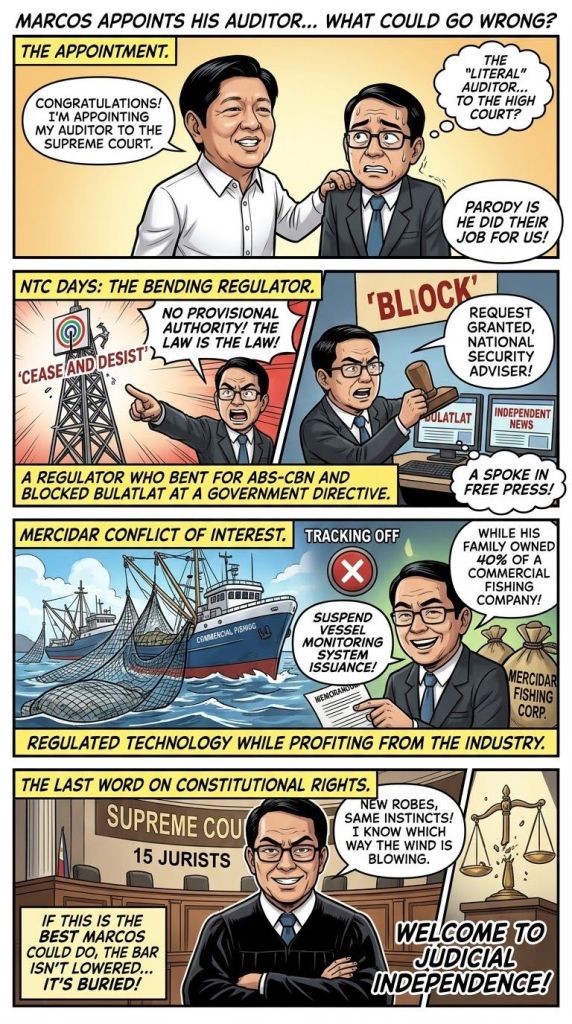
PARODY is a dying art when the Palace keeps doing its job for us, so consider this one done: Ferdinand Marcos Jr. has just appointed his auditor to the Supreme Court. Not metaphorically. Literally.
Gamaliel Cordoba, the man whose job was to scrutinize government books, is now one of fifteen jurists who will decide whether the government’s actions pass constitutional muster. If you are waiting for the punchline, congratulations—you are living in it.
The Palace Spin and the Resume
The Palace’s spin is as predictable as it is polished. Cordoba, we are told, is a “lawyer, economist, and public administrator” who “helped open the telecommunications industry to a third major player” and “led a comprehensive fraud audit of flood control projects”. All true, in the same way that a menu describing a dish as “locally sourced” technically tells you where the ingredients came from while conveniently omitting that the chef spat in it.
The question is not whether Cordoba has a resume. The question is what that resume actually reveals about the man Marcos just handed a lifetime appointment.
The National Telecommunications Commission Years
Start with the National Telecommunications Commission (NTC) years, because they are the gift that keeps on giving. Cordoba served as Commissioner from 2009 to 2022—thirteen years, four presidents, an impressive feat of bureaucratic survival that Politiko attributed, at least in part, to his being a “brother” of then-First Gentleman Mike Arroyo in the Fraternal Order of Utopia and to backing from the Iglesia ni Cristo.
That fraternity connection is not a scandal in itself; Ateneo Law’s Utopia has produced chief justices before. But it is a data point in a pattern that the Judicial and Bar Council (JBC) and the Palace would prefer you not connect to anything else.
The ABS-CBN Reversal
What you should connect it to is ABS-CBN. In 2020, Cordoba told Congress, under oath, that the NTC would issue a provisional authority allowing the network to continue operating while its franchise renewal was pending. Then, after then-Solicitor General Jose Calida threatened graft charges, the NTC issued a cease-and-desist order instead.
Thousands lost their jobs. A broadcast giant went dark. And Cordoba’s explanation? The franchise had expired, the law was the law, nothing personal.
It is a defense that would be more convincing if the NTC had not previously allowed other broadcasters with expired franchises to keep operating pending renewal—a fact ABS-CBN’s CEO pointed out at the time to no avail. The law, it turns out, has a remarkable ability to bend precisely when the political winds demand it.
The Bulatlat Blocking
Then there is Bulatlat. In June 2022, Cordoba’s NTC ordered internet service providers to block 26 websites, including the independent news outfit, at the request of National Security Adviser Hermogenes Esperon Jr.
Esperon’s letter was a masterpiece of guilt-by-association, listing Bulatlat alongside CPP-NPA-NDF websites because the news organization had allegedly “supported” affiliated organizations. A Quezon City court later enjoined the blocking, finding that it implicated freedom of speech and of the press.
Cordoba’s defenders will say he was merely implementing a government directive. But a regulator with any constitutional spine might have asked, before ordering the silencing of a news outlet, whether the directive itself was lawful. Cordoba did not. He complied.
The Mercidar Conflict of Interest
And then there is Mercidar.
This is where the appointment stops being merely politically distasteful and starts being ethically radioactive. Rappler’s 2024 investigation revealed that Cordoba’s wife, Monica Elena Cordoba, and two other family members own 40% of Mercidar Fishing Corporation—a commercial fishing company that was itself involved in litigation contesting small fishers’ preferential rights over municipal waters. Douglas Michael Mallillin, who served as NTC deputy commissioner under Cordoba, owns another 30%.
In January 2021, Cordoba issued a memorandum suspending the issuance of Maritime Mobile Service Identity numbers, which are essential for the vessel monitoring system designed to track commercial fishing vessels and deter illegal fishing. The suspension came in response to a lower court injunction obtained by commercial fishers—including, presumably, the very industry in which his family had a substantial stake.
Let that sink in. The man responsible for regulating telecommunications—including the tracking technology used to monitor fishing vessels—suspended the issuance of tracking identifiers while his family owned a significant chunk of a commercial fishing company.
When Rappler asked the NTC about this, the agency’s legal department claimed it “never received” a June 2021 legal opinion from the Office of the Solicitor General. Convenient.
Leaving the Commission on Audit Behind
Now, Cordoba is headed to the Supreme Court, where he may eventually be asked to adjudicate fisheries cases, media freedom cases, and—most deliciously—cases involving the Commission on Audit (COA) he just left. Malacañang insists he is leaving COA with a sterling record of fraud audits and geotagging initiatives.
What the Palace does not mention is that his departure creates a vacancy at the very institution that would ordinarily be auditing the administration he is joining. The COA’s flood-control investigations—the ones the Palace is so eager to cite as evidence of Cordoba’s integrity—will now be overseen by someone else. Who? The Palace hasn’t said. Take your time, gentlemen. No rush.
The JBC Fig Leaf
The JBC, for its part, included Cordoba in its shortlist of eleven candidates for the associate justice position. This is the constitutional fig leaf that the Palace and its apologists will wave at anyone who questions the appointment: he was vetted, he was qualified, the President chose from the list.
But the JBC’s screening process is not a seal of ethical sainthood. It is a gatekeeping mechanism that has historically been susceptible to precisely the kind of political and fraternal networking that Cordoba embodies.
The fact that he made the shortlist tells us that he met the formal requirements. It does not tell us that the JBC seriously grappled with the Mercidar conflict, the ABS-CBN reversal, or the Bulatlat blocking. If it did, the public has seen no evidence of it.
The Fifteen-Year Practice Requirement
And what of the fifteen-year practice-of-law requirement? Cordoba passed the Bar in 1997. He worked briefly at Siguion Reyna and SGV before entering government in 2001. His subsequent career has been administrative and regulatory, not what most lawyers would recognize as the practice of law.
The Constitution’s requirement is not merely a counting exercise; it demands substantive legal engagement. The JBC presumably satisfied itself that his government work counted. Fine. But the public deserves to know how that determination was made, and on what evidence.
The Supreme Court is not a regulatory agency. The skills required to run the NTC or the COA are not the same skills required to adjudicate constitutional disputes with independence and rigor.
Cordoba’s defenders will point to his administrative experience as an asset. It may well be. But it is not a substitute for the judicial temperament that the Constitution demands and that the appointment process is supposed to guarantee.
What Cordoba Represents
The deeper problem, of course, is not Cordoba. It is what Cordoba represents. Marcos has now appointed three Supreme Court justices: Chief Justice Rodil Zalameda, Associate Justice Raul Villanueva, and now Cordoba. Each appointment is lawful. Each is drawn from a JBC shortlist.
And each, cumulatively, tilts the composition of the Court toward a president who has every incentive to ensure that the judiciary does not scrutinize his administration too closely.
The empirical literature on Philippine Supreme Court voting patterns has found evidence of “loyalty effects”—justices are more likely to vote in favor of the administration that appointed them, particularly early in their tenure. This is not a conspiracy theory. It is a documented pattern. And it is precisely why appointments like Cordoba’s matter.
The Palace will tell you that Cordoba’s record speaks for itself: the third telco, Starlink, the fraud audits, the geotagging. And it does speak. It says that Gamaliel Cordoba is a man who has spent his career in government, serving whoever happened to be in power, adapting to whatever the political environment demanded.
That is not necessarily a disqualification for judicial office. But it is not the profile of an independent jurist. It is the profile of a survivor. And survivors, in the Supreme Court as in the NTC, tend to know which way the wind is blowing.
Charitable and Uncharitable Readings
The most charitable interpretation of this appointment is that Marcos genuinely believes Cordoba’s administrative experience will enrich the Court. The least charitable interpretation is that Marcos has placed a loyalist with a documented conflict of interest and a troubling record on press freedom onto the highest court in the land, at precisely the moment when that court may be called upon to rule on matters affecting the administration’s interests.
The truth probably lies somewhere in between, in the murky space where political calculation and genuine belief in a nominee’s qualifications overlap.
What We Know for Certain
But here is what we know for certain:
- The man who suspended the issuance of vessel tracking numbers while his family owned a fishing company is now a Supreme Court justice.
- The man who reversed course on ABS-CBN after a threat from the Solicitor General is now a Supreme Court justice.
- The man who ordered the blocking of a news website at the behest of a national security adviser is now a Supreme Court justice.
And the President who appointed him will never have to answer a single question about any of it, because the Constitution does not require confirmation, and the JBC has already done its part.
The Court Is Not a Reward
The Supreme Court is not a reward for loyal service. It is not a retirement home for outgoing constitutional commissioners. It is the last line of defense against executive overreach, the final arbiter of constitutional rights, the institution upon which the entire edifice of Philippine democracy ultimately rests.
If Gamaliel Cordoba is the best Marcos could do, then the bar has not just been lowered. It has been buried.
But perhaps we should be grateful. At least now we know exactly what this administration thinks judicial independence looks like: a man who spent thirteen years at the NTC learning when to bend, followed by four years at the COA learning when to look away, now elevated to a lifetime position where he will never have to answer to anyone again.
Welcome to the Supreme Court, Justice Cordoba. The robes are new. The instincts are not.
Key Citations
A. News Articles
- ABS-CBN News. “JBC Submits Shortlist for Next Chief Justice to Marcos.” ABS-CBN News, 29 Oct. 2026, www.abs-cbn.com/news/nation/2026/10/29/jbc-submits-shortlist-for-next-chief-justice-to-marcos-1440.
- Carlos, Ruth Abbey. “PBBM Names COA Chair Gamaliel Cordoba as New SC Associate Justice.” Philippine News Agency, 13 Nov. 2026, www.pna.gov.ph/article/pbbm-names-coa-chair-gamaliel-cordoba-as-new-sc-associate-justice.
- Cervantes, Filane Mikee. “ABS-CBN’s TV Plus Ops Violate Cease and Desist Order: NTC.” Philippine News Agency, 29 June 2020, www.pna.gov.ph/articles/1107377.
- Cervantes, Filane Mikee. “House Leader Calls for NTC Abolition.” Philippine News Agency, 6 May 2020, www.pna.gov.ph/index.php/articles/1102086.
- Dela Cruz, Raymond Carl. “NTC Orders ISPs to Block Terror Group-Related Sites.” Philippine News Agency, 22 June 2022, www.pna.gov.ph/index.php/articles/1177276.
- Inquirer.net. “COA Chief Cordoba Named New Supreme Court Associate Justice.” Inquirer.net, 13 Nov. 2026, newsinfo.inquirer.net/2340723/coa-chief-named-new-supreme-court-associate-justice/amp.
- Politiko. “From COA to Supreme Court? Gamaliel Cordoba Reportedly Eyed as Associate Justice.” Politiko, 26 Oct. 2026, politiko.com.ph/from-coa-to-supreme-court-gamaliel-cordoba-reportedly-eyed-as-associate-justice/.
- Politiko. “It’s like They Never Left: GMA Appointees Get Juicy Posts under Duterte.” Politiko, 23 Nov. 2017, politiko.com.ph/like-never-left-gma-appointees-get-juicy-posts-under-duterte/.
- Rappler. “Top Officials with Private Interests Spoil Effort to Track Big Fishers.” Rappler, 5 Apr. 2024, www.rappler.com/newsbreak/investigative/officials-private-interests-spoil-effort-track-big-fishers/.
B. Official Websites
- Esperon, Hermogenes C., Jr. “The Restriction of Communist Terrorist Group Affiliated Websites Is a Win for the Nation against LEF.” National Task Force to End Local Communist Armed Conflict, 22 June 2022, www.ntfelcac.gov.ph/post/the-restriction-of-communist-terrorist-group-affiliated-websites-is-a-win-for-the-nation-against-lef-1.
- Presidential Communications Office. “President Marcos Selects COA Chair Gamaliel Asis Cordoba as Next Supreme Court Associate Justice.” Presidential Communications Office, 13 Nov. 2026, pco.gov.ph/news_releases/president-marcos-selects-coa-chair-gamaliel-asis-cordoba-as-next-supreme-court-associate-justice/.
- Presidential Communications Office. “Press Briefing of Palace Press Officer and PCO Undersecretary Claire Castro.” Presidential Communications Office, 13 Nov. 2026, pco.gov.ph/press-briefing/20261113-press-briefing-of-palace-press-officer-and-pco-undersecretary-claire-castro/.
- Presidential Communications Office. “President Marcos Appoints Zalameda as Next Supreme Court Chief Justice.” Presidential Communications Office, 4 Nov. 2026, mirror.pco.gov.ph/news_releases/president-marcos-appoints-zalameda-as-next-supreme-court-chief-justice/.
C. Reference Works
- Wikipedia. “Gamaliel Cordoba.” Wikipedia, en.m.wikipedia.org/wiki/Gamaliel_Cordoba.

- “Ang Hirap Maging Mahirap”: The PAO Scandal That Proves Government Contempt Is Nothing New

- “Far-Off” My Axx: Malacañang’s Claire Castro Drowns in Her Own Legal Gaslighting
- “Forthwith” to Farce: How the Senate is Killing Impeachment—And Why Enrile’s Right (Even If You Can’t Trust Him)
- “HINDI AKO NAG-RESIGN!”

- “I Know Nothing”: Baste Duterte’s Amnesia Defense Meets ₱33M in GenCorp Contracts

- “I’m calling you from my new Globe SIM. Send load!”

- “Mahiya Naman Kayo!” Marcos’ Anti-Corruption Vow Faces a Flood of Doubt

- “Manageable” Debt, Unmanageable Corruption: The ₱19.66-Trillion Lie

- “Manageable” Debt, Unmanageable Lies: DBM’s ₱21 Trillion Fairy Tale

- “Meow, I’m calling you from my new Globe SIM!”

- “Natrabaho”: One Word, One Ombudsman, and a Judiciary on Trial

- “No Special Jail for Crooks!” Boying Remulla Slams VIP Perks for Flood Scammers







Leave a Reply