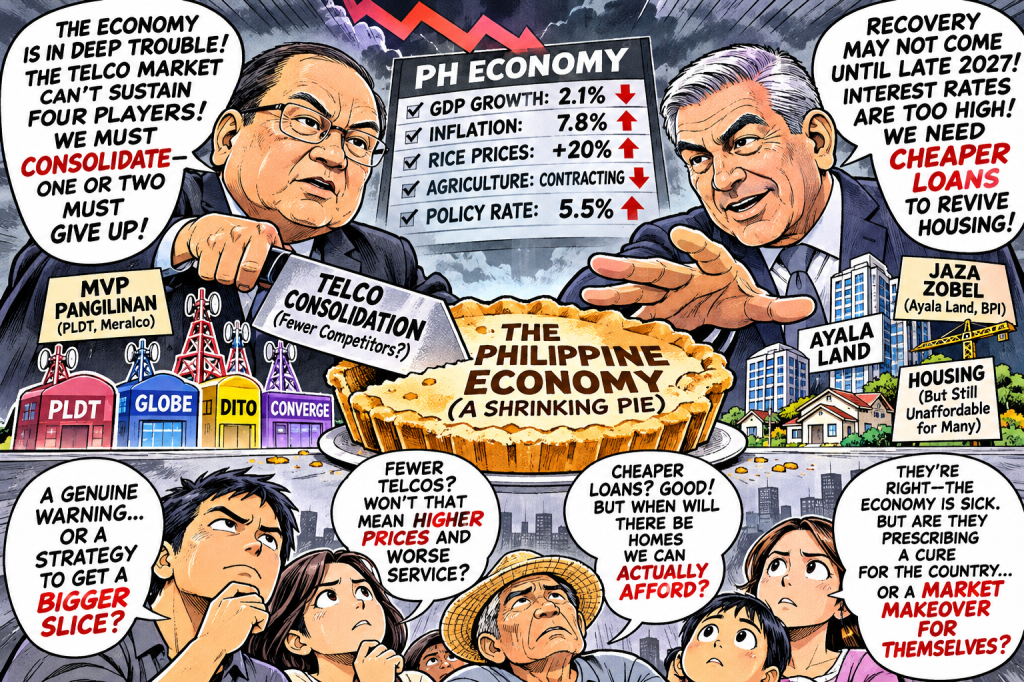
Pangilinan wants fewer telcos. Zobel wants cheaper loans. The rest of us want the truth.
By Louis ‘Barok’ C. Biraogo — November 15, 2026
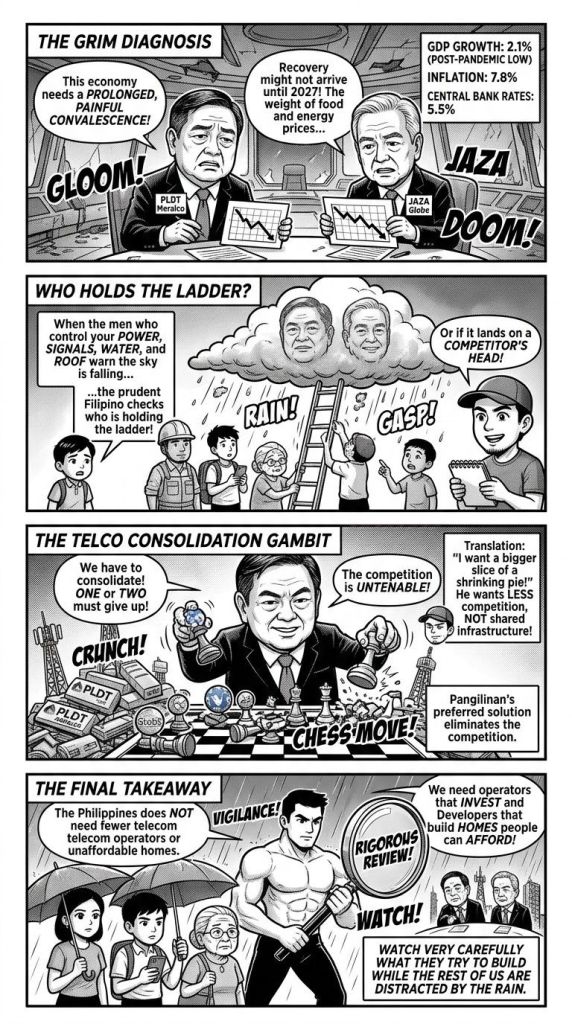
WHEN the two men who arguably control the flow of electricity into your home, the signal on your phone, the water from your tap, and the roof over your head sit down to warn the nation that the sky is falling, the prudent Filipino does not merely listen. The prudent Filipino checks who is holding the ladder, who owns the sky, and whether the falling object might conveniently land on a competitor’s head.
A Grim Diagnosis From the Boardrooms
Last week, Manuel V. Pangilinan and Jaime Augusto Zobel de Ayala—MVP and JAZA, the twin pillars of Philippine oligarchy—emerged from their boardrooms to deliver a sobering diagnosis: the Philippine economy is in for a prolonged, painful convalescence. Pangilinan, with the weariness of a man who has spent 45 years navigating crises, declared the current business climate “worse than COVID”. Zobel, more measured but equally grim, suggested that recovery might not arrive until late 2027, citing the crushing weight of food and energy prices and the rising cost of borrowing.
On the surface, this is the responsible lamentation of captains of industry. The data, after all, is genuinely bleak.
The Numbers Behind the Gloom
- Gross Domestic Product (GDP) growth has stumbled to a post-pandemic low of 2.1 percent, according to the Philippine Statistics Authority’s third-quarter national accounts.
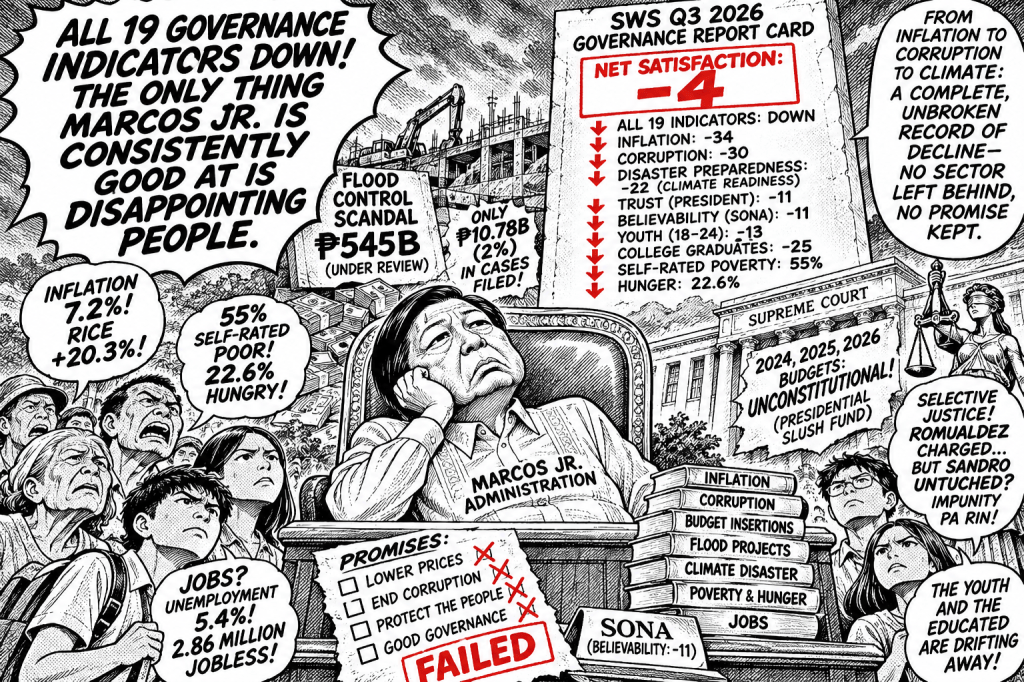
- Inflation is galloping at 7.8 percent, with rice—the political weather vane of the Philippines—surging by over 20 percent.
- The agriculture sector is contracting.
- The central bank has been forced to hike rates to 5.5 percent, strangling the very credit markets that Zobel’s property buyers depend on.
Whose Interests Are Being Served?
Yet, we must resist the instinct to treat these men as disinterested economic Cassandra’s. Their warnings are not public services. They are strategic interventions by actors whose sprawling conglomerates—PLDT, Meralco, Ayala Land, Bank of the Philippine Islands (BPI), Globe, and a constellation of others—are deeply embedded in the very structures they critique.
The question that should haunt every policymaker and every Filipino consumer is not whether Pangilinan and Zobel are telling the truth about the economy’s malaise. They largely are. The question is what they intend to do with that truth.
Pangilinan’s Telecom Consolidation Gambit
Consider Pangilinan’s most explosive proposition. Amidst the gloom, he casually dropped a policy grenade: the Philippine telecommunications market, he said, cannot sustain four players. “We have to consolidate, [and] one or two of us must give up at some point,” he declared, describing the current competition as “untenable”.
This is not an observation. This is a merger proposal dressed in the somber robes of economic necessity.
Pangilinan is the chairman of Philippine Long Distance Telephone Company (PLDT), the incumbent dominant player. When he says the industry must consolidate, he is not speaking as a neutral analyst of market structure; he is speaking as the man who would likely benefit most from a reduced field of competitors. The Philippine Competition Act exists precisely to scrutinize such statements, which is why the Philippine Competition Commission must treat his remarks not as a friendly tip but as a potential signal of intent that demands rigorous, independent review.
The Case For and Against Consolidation
The argument for consolidation is that building and maintaining 5G networks and fiber infrastructure is brutally expensive, and four competitors slicing a relatively small market cannot generate the returns necessary to invest. There is an economic logic to this. But there is also a profound public interest in maintaining competition, especially in an essential service where the Philippines already suffers from notoriously slow and expensive internet.
The counter-argument, embodied in the newly enacted Konektadong Pinoy Act, is that the solution to infrastructure duplication is not fewer competitors, but shared infrastructure—open access that allows multiple service providers to compete over the same physical networks. Pangilinan’s preferred solution eliminates the competition. The legislative alternative preserves it while addressing the cost problem. One wonders why the tycoon did not lead with the latter.
Zobel and the Housing Contradiction
Zobel’s warnings, while less overtly self-serving, carry their own contradictions. He speaks of homebuyers hesitating due to high interest rates, a phenomenon that is undeniably real. Ayala Land’s residential reservation sales plummeted from ₱32.7 billion to ₱20.5 billion year-on-year.
But what Zobel does not dwell on is the structural issue that predates the current rate cycle: the fundamental mismatch between Philippine housing prices and Filipino incomes. For millions of families, Ayala Land’s developments were already unaffordable long before the Bangko Sentral ng Pilipinas (BSP) raised rates. The property sector’s pain is real, but it is not solely the fault of macroeconomic headwinds; it is also the result of a business model that has long prioritized luxury and high-margin projects over mass housing.
A developer lamenting that buyers cannot afford his product is a curious thing; the more pertinent question is whether the product was ever priced for them in the first place.
When Economic Analysis Becomes Political Advocacy
There is a deeper, more insidious current running beneath these statements. Both Pangilinan and Zobel are warning of political instability as an economic risk. Pangilinan specifically cited the impeachment proceedings against Vice President Sara Duterte as a factor weighing on business confidence.
This is where the tycoon’s lament crosses from economic analysis into political advocacy. By framing a constitutional accountability process as an economic threat, they subtly align the interests of the business class with those who would prefer that the impeachment simply go away.
The implicit message is clear: political controversy is bad for business, therefore, perhaps, the controversy should be resolved in a manner that restores “certainty.” It is a short step from that logic to the view that democratic processes are a luxury the economy cannot afford.
Two Readings of the Tycoons’ Motives
The most charitable interpretation of Pangilinan and Zobel is that they are genuinely frightened. They see a confluence of global shocks—Middle East tensions, United States (US) political turmoil, technological disruption—that are beyond their control, and they are pleading for competent governance and stability. This interpretation deserves some weight.
These are not cartoon villains; they are men who have built institutions and who have a stake in the country’s long-term health.
But the less charitable interpretation is also the more historically grounded one. The Philippine oligarchy has a long and documented history of using crises to restructure markets in its favor. The Asian Financial Crisis, the 2008 Global Financial Crisis, and the COVID-19 pandemic all saw consolidation and the strengthening of incumbents.
Pangilinan’s call for telecom consolidation is a textbook example of a crisis being leveraged for market restructuring. He is not merely predicting a shakeout; he is actively advocating for one, and doing so in a way that positions PLDT as the natural survivor.
What Regulators and the Public Must Do
The public should not be fooled by the somber suits and the concerned furrows of brows. The tycoons’ warning is a Rorschach test for Philippine economic governance.
If regulators and policymakers treat it as a call to double down on competition enforcement, to accelerate infrastructure sharing, to scrutinize mergers with a gimlet eye, and to address the structural affordability crisis in housing and food, then the warning will have served a public purpose. If, instead, they treat it as a signal to step aside and let “market forces”—which in the Philippines so often mean the largest players—determine the outcome, then the tycoons will have succeeded in using a national crisis to fortify their own positions.
The Philippines does not need fewer telecom operators. It needs operators that invest in quality service and compete on price. It does not need developers to sell fewer homes; it needs them to build homes that people can actually afford.
And it does not need business leaders to tut-tut about the inconvenience of impeachment; it needs institutions that hold the powerful accountable, regardless of the temporary discomfort this causes for the stock market.
Pangilinan and Zobel have every right to warn us about the storm. But we should watch very carefully what they try to build while the rest of us are distracted by the rain.
Key Citations
A. Reports & Studies
- Philippine Statistics Authority. “Summary Inflation Report Consumer Price Index (2018=100): October 2026.” Philippine Statistics Authority, 5 Nov. 2026.
- Philippine Statistics Authority. “The Seasonally Adjusted National Accounts of the Philippines Third Quarter 2026 (At Constant 2018 Prices).” Philippine Statistics Authority, 9 Nov. 2026.
B. News Articles
- Daily Tribune. “MVP Says Phl Telco Market Cannot Sustain 4 Players.” Daily Tribune, 13 Nov. 2026.
- Manila Bulletin. “Pangilinan, Zobel Brace for Prolonged Economic Headwinds.” Manila Bulletin, 14 Nov. 2026.
- Philstar.com. “MVP Proposes Telcos Mergers, Says 4 Players in Philippines ‘Too Many.’” Philstar.com, 13 Nov. 2026.
- Xinhua. “Philippine Q3 Growth Slows to 2.1 Pct.” Xinhua, 10 Nov. 2026.
C. Official Websites
- Philippine Competition Commission. Philippine Competition Commission. Government of the Philippines.
- PLDT Inc. PLDT.
- Ayala Land, Inc. Ayala Land.
- Encyclopaedia Britannica. “Asian Financial Crisis.” Britannica.

- “Ang Hirap Maging Mahirap”: The PAO Scandal That Proves Government Contempt Is Nothing New
- “Far-Off” My Axx: Malacañang’s Claire Castro Drowns in Her Own Legal Gaslighting
- “Forthwith” to Farce: How the Senate is Killing Impeachment—And Why Enrile’s Right (Even If You Can’t Trust Him)
- “HINDI AKO NAG-RESIGN!”

- “I Know Nothing”: Baste Duterte’s Amnesia Defense Meets ₱33M in GenCorp Contracts

- “I’m calling you from my new Globe SIM. Send load!”

- “Mahiya Naman Kayo!” Marcos’ Anti-Corruption Vow Faces a Flood of Doubt

- “Manageable” Debt, Unmanageable Corruption: The ₱19.66-Trillion Lie
- “Manageable” Debt, Unmanageable Lies: DBM’s ₱21 Trillion Fairy Tale
- “Meow, I’m calling you from my new Globe SIM!”

- “Natrabaho”: One Word, One Ombudsman, and a Judiciary on Trial
- “No Special Jail for Crooks!” Boying Remulla Slams VIP Perks for Flood Scammers



Leave a Reply