From Frabelle Director to Agriculture Secretary: The Paper Trail, the Promises, and the Pork That Never Shrank
By Louis “Barok” C. Biraogo | October 26, 2026
Here’s how it works: the fox guards the henhouse, appoints his cousins to the board, restructures the egg allocation system to favor poultry processors—and then files a libel suit against the chicken who squawked.
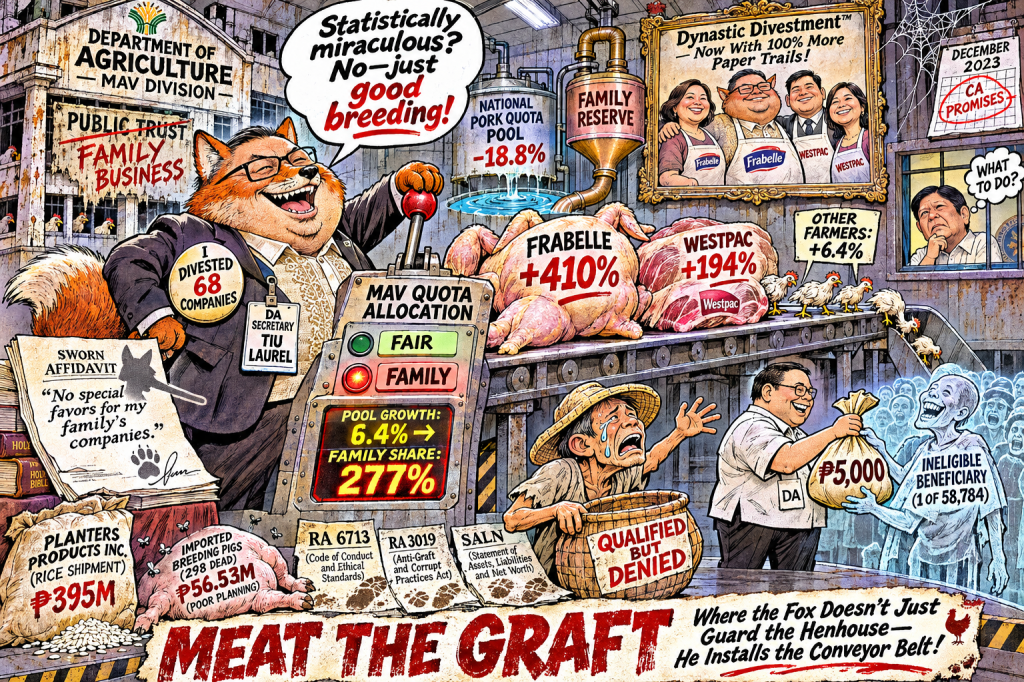
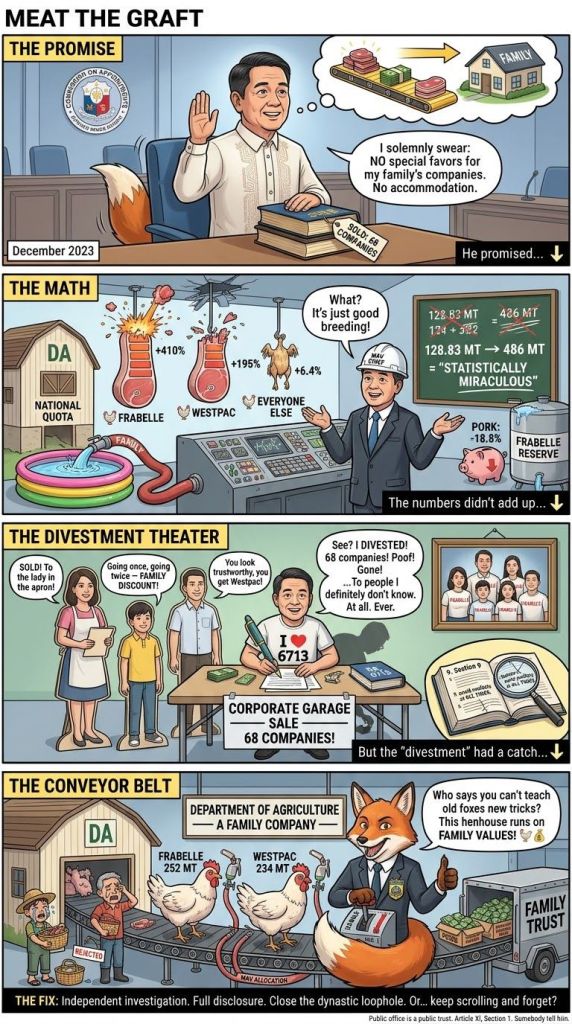
Welcome to the Tiu Laurel Meat Quota Scandal, where the numbers are so obscenely disproportionate that even the most jaded Manila journalist had to blink twice. We’re talking about a man who stood before the Commission on Appointments (CA) in December 2023 and solemnly promised: “There should be no special favors for my family’s companies, no accommodation.”
Fast forward to 2026. Frabelle Corporation’s poultry quota increased by 410.3%. Westpac Meat Processing Corporation’s jumped 194.5%. Combined, the family enterprises went from 128.83 metric tons (MT) to 486 metric tons—a 277.2% increase—while the overall poultry quota pool grew by a measly 6.4%.
I’m no mathematician, but I believe the technical term for that is “skullduggery.”
THE DIVESTMENT THEATER
Let’s begin with the most tired defense in the Philippine government playbook: “I divested my interests.”
Tiu Laurel claims he divested from 68 companies upon joining the Cabinet. Sixty-eight. That’s not a divestment; that’s a corporate garage sale. One imagines the Secretary frantically signing transfer documents while his lawyers sprint between offices, desperately trying to create enough paper trail to satisfy Republic Act No. 6713 (Code of Conduct and Ethical Standards for Public Officials and Employees).
But here’s the thing about RA 6713 that our dear Secretary seems to have overlooked: Section 9 requires avoiding conflicts of interest “at all times.” It’s not a one-time checkbox. It’s not a “divest and forget” situation. And here’s the kicker—the law specifically prohibits transferring interests to your spouse or relatives.
So while Tiu Laurel may have technically disposed of his personal shareholdings, the companies “remain associated with his family.” Frabelle and Westpac didn’t vanish into some magical corporate ether where the Secretary has no relationship to them. They’re still family businesses. The family still benefits. The family still profits.
This is what I call ‘dynastic divestment’—a legal fiction so transparent that even the Supreme Court in Samson v. Restrivera (G.R. No. 178454, 2011) cited the language of Section 4(b) of RA 6713—’discourage wrong perceptions of their roles as dispensers or peddlers of undue patronage’—though the Court ultimately held that this ‘aspirational norm’ alone cannot serve as a basis for punishment; Samson was convicted of ‘conduct unbecoming’ instead.
If the Secretary genuinely believed that quadrupling his family’s poultry quota while the overall pool barely budged would somehow not create a wrong perception, he’s either spectacularly naive or insulting our intelligence. I’m betting on the latter.
THE NUMBERS THAT DON’T LIE (BUT THE SECRETARY HOPES YOU WON’T DO THE MATH)
Let’s break down the arithmetic, because this is where the scandal truly reveals its grotesque proportions.
Poultry Quotas:
- Frabelle 2024: 49.38 MT → 2026: 252 MT (+410.3%)
- Westpac 2024: 79.45 MT → 2026: 234 MT (+194.5%)
- Combined: 128.83 MT → 486 MT (+277.2%)
Pork Quotas:
- Combined family allocation: 1,472 MT → 1,680 MT (+14.1%)
Overall Context:
- Poultry quota pool growth: 6.4%
- Pork quota pool change: -18.8% (it shrank!)
The Tiu Laurel family’s share of the poultry pool went from 0.55% to 1.94%—more than tripled—while the pool itself grew by less than 7%. Their pork share increased from 2.72% to 3.82% despite the overall pork pool shrinking by nearly 19%.
This isn’t just anomalous. This is statistically miraculous. It’s as if the Secretary’s family companies possess some metaphysical quality that makes them uniquely deserving of government largesse, even when the government has less to give.
The defense will say: “The Minimum Access Volume (MAV) overhaul benefits all processors equally.” But here’s the problem—Frabelle is a processor. The Secretary restructured the system to reserve 50% of pork quotas for meat processors. Frabelle conveniently qualified for this allocation. This is like a referee changing the rules mid-game to favor one team, then claiming the victory was “objective.”
THE ARCHITECTURE OF SELF-DEALING
What makes this scandal particularly nauseating is the structural nature of the conflict. This isn’t a case of a rogue official accepting an envelope in a dark alley. This is systemic. This is architectural.
Tiu Laurel, as Agriculture Secretary, oversees the MAV system. He has authority over the Department of Agriculture (DA)’s allocation mechanisms. His department determines who gets import quotas and how much. And his family’s companies happen to be major beneficiaries of these quotas.
Under Section 3(h) of Republic Act No. 3019 (the Anti-Graft and Corrupt Practices Act), it is illegal to “directly or indirectly [have] financial or pecuniary interest in any business, contract or transaction in connection with which he intervenes or takes part in his official capacity.”
The Supreme Court in Domingo v. Sandiganbayan (G.R. Nos. 149175 & 149406) affirmed that this provision covers situations where a public officer has a financial interest in a transaction involving his office—even without direct evidence of receiving a bribe.
Does Tiu Laurel have a “financial or pecuniary interest” in Frabelle and Westpac? He claims to have divested, but the family connection remains. The companies remain “associated with his family.” If he still holds even indirect benefits—through family trusts, shared assets, or future inheritance rights—the violation is clear.
And even if the technical elements of Section 3(h) haven’t been met, Section 3(e) of RA 3019 prohibits “giving any private party any unwarranted benefits, advantage or preference” through “manifest partiality, evident bad faith or gross inexcusable negligence.”
A 410.3% increase in a company’s quota while the overall pool grows by only 6.4%—combined with the fact that the Secretary’s own department designed the system that produced this outcome—meets the threshold for “manifest partiality.” The numbers scream it. The pattern confirms it.
THE PLANTILLA OF PLUNDER
If the meat quota scandal were an isolated incident, perhaps we could chalk it up to poor judgment. But this is part of a pattern—a deeply disturbing pattern that suggests the Secretary views the Department of Agriculture as a personal benefit-distribution mechanism.
The Planters Products Rice Scandal: Tiu Laurel, as chairman of Planters Foundation Inc., nominated all nine directors of Planters Products Inc. (PPI)—the company behind a controversial ₱395 million Vietnamese rice shipment. The foundation holds 80.11% of PPI shares. Tiu Laurel ordered cancellation of the shipment’s import clearance after it arrived, but questions remain about when he first learned of the transaction and whether he recused himself from decisions affecting a company he effectively controls.
The COA Audit Flags: The Commission on Audit (COA) found that ₱294 million was paid to 58,784 ineligible beneficiaries under the Rice Farmers Financial Assistance program. Another ₱56.53 million was wasted when all 298 imported breeding pigs died due to “poor planning, quarantine lapses.” Meanwhile, qualified farmers missed ₱7,000 in aid while ineligible recipients received payments.
The Cyberlibel Campaign: Tiu Laurel filed cyberlibel complaints against lawyer Levito Baligod (counsel for ex-Marines alleging “maleta” money kickbacks) and former Rep. Zaldy Co (who alleged onion smuggling and rice import anomalies). He also backed libel cases against former Agriculture Secretary William Dar.
This is what I call the “sue the critics, ignore the auditors” strategy. When you can’t defend your record, attack the people pointing out the problems. It’s a classic authoritarian move dressed up in legal paperwork—a potential SLAPP (Strategic Lawsuit Against Public Participation) tactic designed to silence scrutiny.
THE PRESIDENT’S DILEMMA
So where does this leave President Ferdinand Marcos Jr.? The man who appointed Tiu Laurel—a longtime friend and major campaign contributor—now faces a credibility test.
The administration has positioned itself as a reformist government committed to transparency and accountability. But Tiu Laurel’s continued tenure sends a different message: loyalty trumps ethics. Campaign contributions matter more than public trust.
Marcos has options. He could accept a resignation (as he did with other Cabinet officials in the May 2025 revamp). He could order an independent investigation. He could ask the Ombudsman to probe. Or he could continue to protect his ally and hope the scandal fades.
The problem with the last option is that scandals like this don’t fade—they metastasize. Every day Tiu Laurel remains in office, the administration’s anti-corruption rhetoric rings hollower. Every time the Secretary appears at a press conference, journalists will ask about the meat quotas. Every Senate hearing on agriculture will become a forum for opposition lawmakers to score political points.
The President needs to ask himself: Is defending Tiu Laurel worth the institutional damage to the Department of Agriculture? Is one man’s loyalty more important than the credibility of an entire government?
THE LEGAL LANDMINES
For those who believe the Secretary has nothing to worry about, let me outline the legal exposure:
- RA 6713, Section 9 (Divestment): The law requires actual disposal of interests, not merely formal transfers. If any beneficial ownership, control, or economic interest remains—even through family—the divestment is incomplete.
- RA 6713, Section 7(a) (Prohibited Acts): “Public officials and employees shall not, directly or indirectly, have any financial or material interest in any transaction requiring the approval of their office.” The MAV allocations require the approval of the DA, which Tiu Laurel heads.
- RA 3019, Section 3(e) (Undue Injury/Unwarranted Benefit): The disproportionate quota increases, combined with the Secretary’s restructuring of the MAV system, strongly suggest “manifest partiality” and “evident bad faith.”
- RA 3019, Section 3(h) (Financial Interest): If Tiu Laurel retains any financial interest in Frabelle or Westpac—through family holdings, trusts, or other arrangements—his participation in MAV decisions violates this provision.
- The 1987 Constitution, Article XI, Section 1: “Public office is a public trust. Public officers and employees must, at all times, be accountable to the people, serve them with utmost responsibility, integrity, loyalty, and efficiency.”
The DA’s own Administrative Order No. 07, Rule VI, further prohibits officials from participating in decisions where their “immediate family… would derive pecuniary or material benefit.” The Secretary’s family benefited. The Secretary oversees the system that benefited them. The math is simple.
THE FIX (IF ANYONE CARES TO IMPLEMENT IT)
If the government were serious about addressing this, here’s what would happen:
- Independent Investigation: An independent body—not the DA investigating itself—must examine the allocation records, applications, scoring, and approval documents. The Ombudsman should be given full access.
- Full Disclosure: The DA should publish the MAV allocation rules, the applications submitted by Frabelle and Westpac, the scoring criteria, and the reasons for the specific allocations awarded.
- Divestment Verification: The Secretary’s claimed divestment from 68 companies should be independently verified. Transfer documents, beneficiary records, and Statements of Assets, Liabilities and Net Worth (SALN) filings should be scrutinized.
- Recusal and Safeguards: Going forward, Tiu Laurel should recuse himself from all MAV-related decisions affecting family-linked companies. An independent committee should handle these allocations.
- Legislative Reform: Congress should strengthen RA 6713 to close the “dynastic divestment” loophole—the ability to transfer assets to family members while maintaining de facto control.
- Actual Utilization Analysis: The government should determine how much of the allocated quotas were actually used. Import entitlements have no value if unused; if used, they represent concrete economic benefits that must be accounted for.
THE VERDICT (SO FAR)
I am not a judge. I cannot convict. But I can read numbers, and the numbers in the Tiu Laurel meat quota scandal are damning.
A 410.3% increase. A 277.2% combined increase. A 6.4% pool growth. A 410.3% increase. The Secretary’s own restructuring of the system created the category that his family’s company qualified for. The Secretary’s own promises of impartiality are belied by the outcomes.
At minimum, this is a catastrophic conflict of interest. At worst, it’s graft and corruption of the most brazen kind—the kind that happens in plain sight, with paper trails, while everyone involved claims to be doing nothing wrong.
The Tiu Laurel scandal is a test case for Philippine governance. Will the Ombudsman act? Will Congress investigate? Will the President prioritize accountability over personal loyalty? Or will this become just another scandal that fades into the background noise of Philippine politics, another example of the powerful protecting their own?
The Constitution says public office is a public trust. The Secretary’s conduct suggests he views it as a family inheritance. The President’s response will tell us which interpretation prevails.
Until then, I’ll be watching. And I suspect—I hope—many others will be too.
Louis “Barok” C. Biraogo is the author of Kweba ni Barok and a persistent observer of Philippine governance dysfunction. He has been described as “unnecessarily critical” by people who are wrong.
Key Citations
A. Legal & Official Sources
- Domingo v. Sandiganbayan. G.R. Nos. 149175 & 149406, Supreme Court of the Philippines, Oct. 2005. LawPhil, lawphil.net/judjuris/juri2005/oct2005/gr_149175_2005.html.
- Department of Agriculture. Code of Conduct for the Officials and Employees of the Department of Agriculture. Administrative Order No. 07, s. 2009, 29 May 2009. Supreme Court E-Library, elibrary.judiciary.gov.ph/thebookshelf/showdocsfriendly/11/45908.
- The 1987 Constitution of the Republic of the Philippines. Official Gazette of the Republic of the Philippines, 1987, http://www.officialgazette.gov.ph/constitutions/1987-constitution/.
- Republic of the Philippines. Republic Act No. 3019: Anti-Graft and Corrupt Practices Act. Official Gazette, 17 Aug. 1960, http://www.officialgazette.gov.ph/1960/08/17/republic-act-no-3019/.
- —. Republic Act No. 6713: Code of Conduct and Ethical Standards for Public Officials and Employees. Official Gazette, 20 Feb. 1989, http://www.officialgazette.gov.ph/1989/02/20/republic-act-no-06713/.
- Philippines, Supreme Court. Filipina Samson v. Julia A. Restrivera. G.R. No. 178454, 28 Mar. 2011, lawphil.net/judjuris/juri2011/mar2011/gr_178454_2011.html.
B. News Reports
- Mencias, Eileen. “No Special Favors for Family Business Daw! Frabelle, Westpac Poultry Quotas Nearly Quadruple Under Tiu Laurel’s DA; Total Meat Allocations Jump 35%.” Bilyonaryo Business News, 23 Oct. 2026, bilyonaryo.com/no-special-favors-for-family-business-daw-frabelle-westpac-poultry-quotas-nearly-quadruple-under-tiu-laurels-da-total-meat-allocations-jump-35/.
- Mencias, Eileen. “Hugas-kamay pa, boy! Frabelle Heir Tiu Laurel Picked Entire Board of Zeny Angping-Led Planters Products, Importer behind P395M Vietnam Rice Scandal.” Bilyonaryo Business News, 15 Oct. 2026, bilyonaryo.com/hugas-kamay-pa-boy-frabelle-heir-tiu-laurel-picked-entire-board-of-zeny-angping-led-planters-products-importer-behind-p395m-vietnam-rice-scandal/ .
- GMA Integrated News. “COA Flags DA over 58,000 ‘Unqualified’ Farmer Beneficiaries.” GMA Network, 3 Dec. 2025, http://www.gmanetwork.com/news_duplicate/topstories/nation/968401/coa-flags-da-over-58-000-unqualified-farmer-beneficiaries/story/ .
- “Ang Hirap Maging Mahirap”: The PAO Scandal That Proves Government Contempt Is Nothing New
 A viral video, an eye-rolling staffer, and the ₱180,000 question: Why is Acosta’s PAO lecturing anyone about dignity? By Louis ‘Barok‘ C. Biraogo — September 19, 2026 LET me tell you about the most predictable sentence in Philippine governance. “We have ordered an investigation.” Something embarrassing goes viral. An agency spokesperson emerges. The magic words… Read more: “Ang Hirap Maging Mahirap”: The PAO Scandal That Proves Government Contempt Is Nothing New
- “Far-Off” My Axx: Malacañang’s Claire Castro Drowns in Her Own Legal Gaslighting
 By Louis ‘Barok‘ C. Biraogo — September 4, 2026. WELCOME back to the Kweba, my fellow troglodytes of truth, where we crack open the coconuts of state propaganda to suck out the sweet, sweet nectar of legal reality—or, in this case, the bitter bile of bureaucratic deflection. Our subject today is the Honorable Undersecretary Claire… Read more: “Far-Off” My Axx: Malacañang’s Claire Castro Drowns in Her Own Legal Gaslighting
- “Forthwith” to Farce: How the Senate is Killing Impeachment—And Why Enrile’s Right (Even If You Can’t Trust Him)
 By Louis ‘Barok‘ C. Biraogo — June 20, 2025 A CONSTITUTIONAL TRAINWRECK IN SLOW MOTION The Philippine Senate had one job: try Sara Duterte. Instead, on June 10, 2025, 18 senator-jurors staged a constitutional coup by remanding the impeachment articles back to the House—a move so legally dubious, it reeks of political arson[1]. The Constitution’s… Read more: “Forthwith” to Farce: How the Senate is Killing Impeachment—And Why Enrile’s Right (Even If You Can’t Trust Him)
- “HINDI AKO NAG-RESIGN!”
 The Executive Secretary Screams from the Grave of His Own Political Funeral By Louis “Barok” C. Biraogo — November 22, 2025 1. The Resignation That Wasn’t: A Love Story in Two Contrasting Scripts Malacañang: “He stepped down out of delicadeza. So noble. So graceful. So very voluntary.”Lucas Bersamin, live on national television: “Hindi ako nag-resign.”… Read more: “HINDI AKO NAG-RESIGN!”
- “I Know Nothing”: Baste Duterte’s Amnesia Defense Meets ₱33M in GenCorp Contracts
 The Mayor Who Forgot His Sister’s Business, The VP Who Swore She Had One, and The SEC That Can’t Find Either By Louis ‘Barok’ C. Biraogo — September 24, 2026 FORGIVE me while I untangle this pretzel of Duterte logic. The Vice President of the Republic of the Philippines declares in two consecutive sworn Statements… Read more: “I Know Nothing”: Baste Duterte’s Amnesia Defense Meets ₱33M in GenCorp Contracts
- “I’m calling you from my new Globe SIM. Send load!”
 A Cat-astrophic Error: Globe Telecom’s SIM Registration Tailspin
- “Mahiya Naman Kayo!” Marcos’ Anti-Corruption Vow Faces a Flood of Doubt
 By Louis ‘Barok‘ C. Biraogo — August 2, 2025 Executive Summary: Can Marcos Break the Cycle of Corruption? President Ferdinand Marcos Jr.’s fiery 2025 SONA pledge to expose and prosecute corruption in failed flood control projects taps into public fury over persistent flooding and squandered funds. His call to shame negligent officials and publish project… Read more: “Mahiya Naman Kayo!” Marcos’ Anti-Corruption Vow Faces a Flood of Doubt
- “Manageable” Debt, Unmanageable Lies: DBM’s ₱21 Trillion Fairy Tale
 The Marcos Administration’s Greatest Fiction Since Martial Law: Debt Is Fine By Louis ‘Barok‘ C. Biraogo — August 19, 2026 ON August 17, 2026, Acting Budget Secretary Kim Robert C. De Leon—a 35-year-old former assistant professor who now holds the unenviable distinction of being the third person to occupy that chair in under a year—stood… Read more: “Manageable” Debt, Unmanageable Lies: DBM’s ₱21 Trillion Fairy Tale
- “Meow, I’m calling you from my new Globe SIM!”
 A Cat-astrophic Error: Globe Telecom’s SIM Registration Tailspin
- “Natrabaho”: One Word, One Ombudsman, and a Judiciary on Trial
 When the Head Prosecutor Whispers What the Whole Republic Is Screaming By Louis ‘Barok‘ C. Biraogo — August 7, 2026 THE structure does not exist. The Sandiganbayan justices went to Barangay Bunsuran, Pandi, Bulacan, and saw for themselves: no concrete, no rebar, no flood control barrier. Just, as the inspection report noted, “bushes and lushes.”… Read more: “Natrabaho”: One Word, One Ombudsman, and a Judiciary on Trial
- “No Special Jail for Crooks!” Boying Remulla Slams VIP Perks for Flood Scammers
 Country Club Custody Cancelled: Flood Thieves Now Share the Same Stink By Louis ‘Barok‘ C. Biraogo — February 24, 2026 MGA ka-kweba, close your eyes and picture it. Your lola in Tondo, knee-deep in floodwater that smells like death and broken promises, because the ₱545 billion “flood control” budget from 2022-2025 somehow produced zero functional… Read more: “No Special Jail for Crooks!” Boying Remulla Slams VIP Perks for Flood Scammers
- “Philippine-Controlled” or Yankee Gas Station? The Davao Fuel Depot Farce Exposed
 From “Philippine-controlled facility” to high-value target: How one depot in Mindanao could turn the Philippines into America’s unsinkable refueling stop. By Louis ‘Barok‘ C. Biraogo — April 13, 2026 My fellow Filipinos, Picture this: It’s 2026, the South China Sea is simmering like a pot about to boil over, and the Armed Forces of the… Read more: “Philippine-Controlled” or Yankee Gas Station? The Davao Fuel Depot Farce Exposed





Leave a Reply