The Operative Fact Doctrine Was Supposed to Protect Innocent Beneficiaries—Not Give Congress a Get-Out-of-Jail-Free Card
By Louis ‘Barok‘ C. Biraogo — October 26, 2026
CORRECT me if I’m wrong—and Congress will—but I was under the impression that ‘unconstitutional’ wasn’t a suggestion.
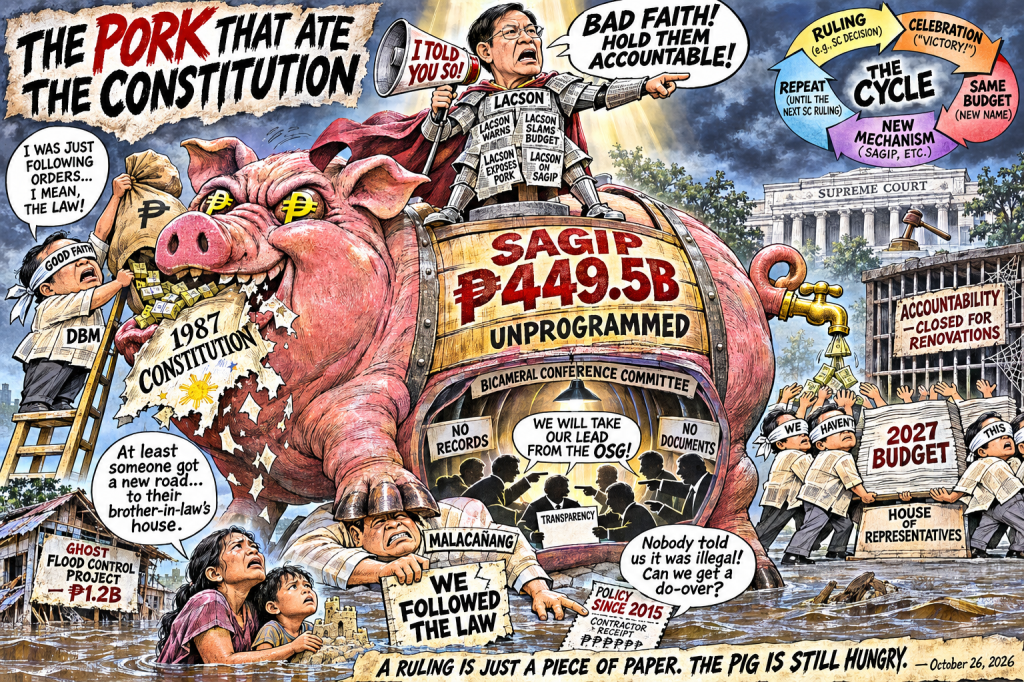
The Supreme Court, in a decision that took longer to summarize than most people’s attention spans, has finally told Congress what every budget watchdog has been screaming for years: you cannot take a standby fund, stuff it with ₱449.5 billion of projects that were never in the President’s proposal, call it “unprogrammed,” and pretend you didn’t just resurrect the pork barrel your predecessors swore off after the Priority Development Assistance Fund (PDAF) and the Disbursement Acceleration Program (DAP).
And Malacañang’s response? Essentially: “We were just following the law. The law was unconstitutional? Well, nobody told us. Can we get a do-over?”
Senator Ping Lacson, meanwhile, is doing what Ping Lacson does best: standing on the rubble of a constitutional crisis and yelling “I told you so” with the righteous fury of a man who has been waiting his entire political career for this moment.
But here’s the thing about Lacson’s crusade, and I say this with the grudging respect of someone who has watched him play this role for decades: he’s right on the principle, slippery on the details, and conveniently positioned outside the blast radius. He wasn’t in the Senate when these budgets passed. That’s not a criticism. It’s just… convenient.
Let’s dissect this masterpiece of legislative theater.
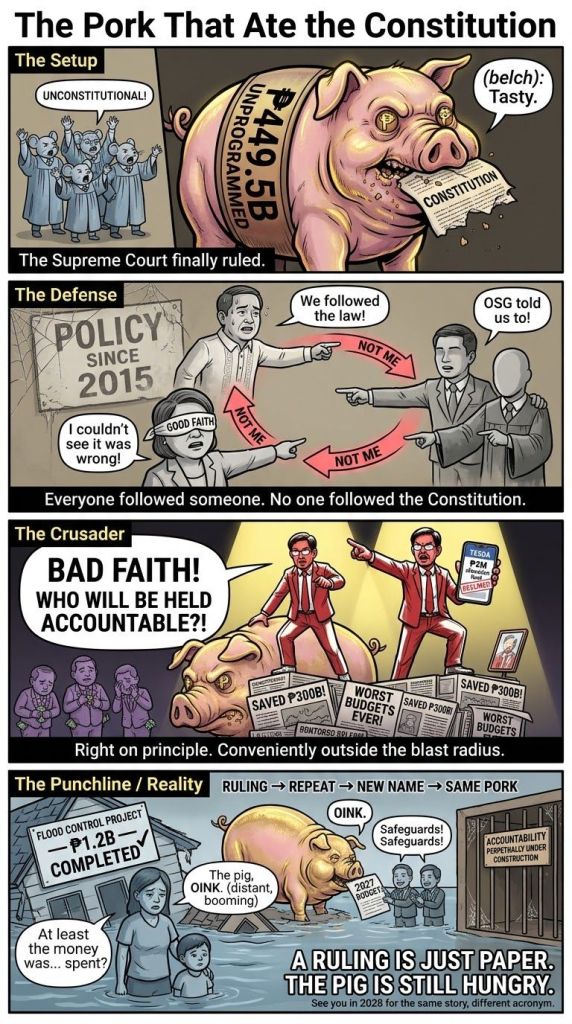
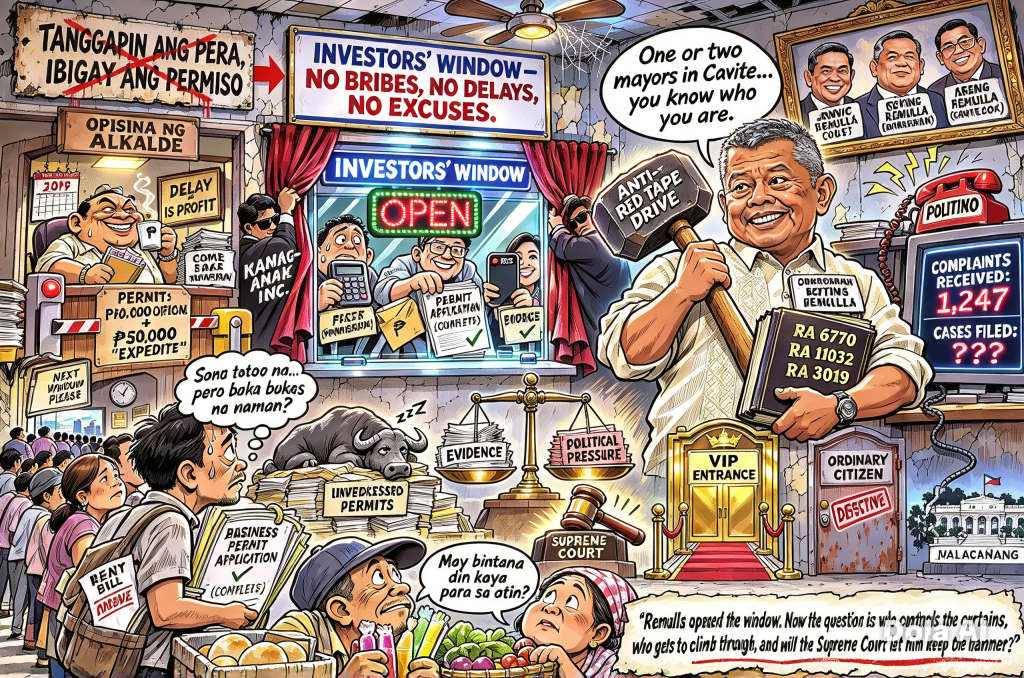
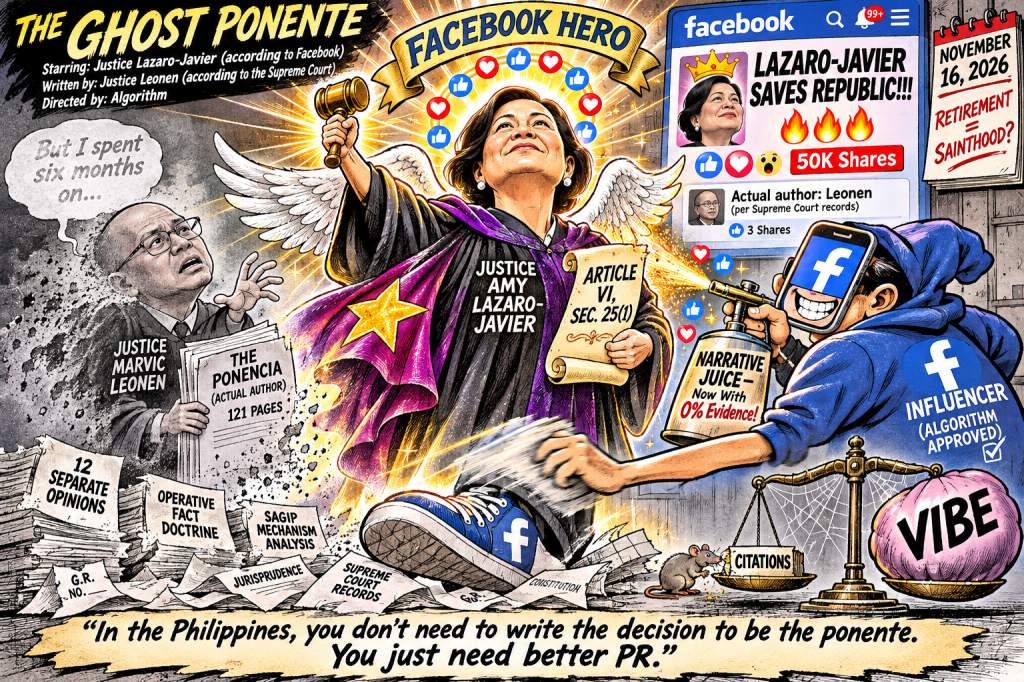
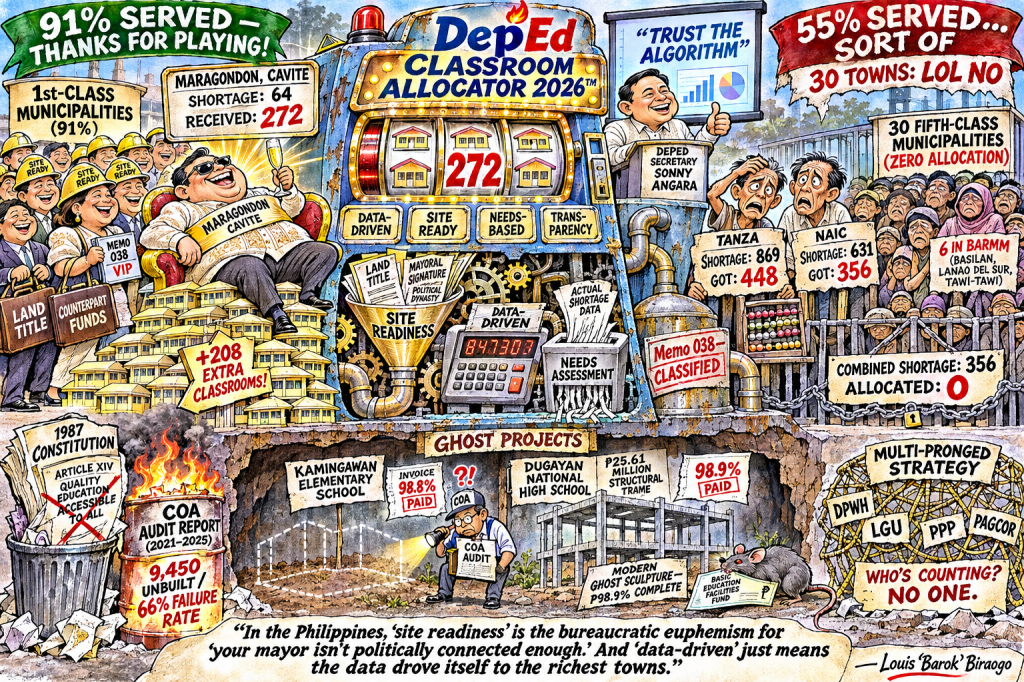
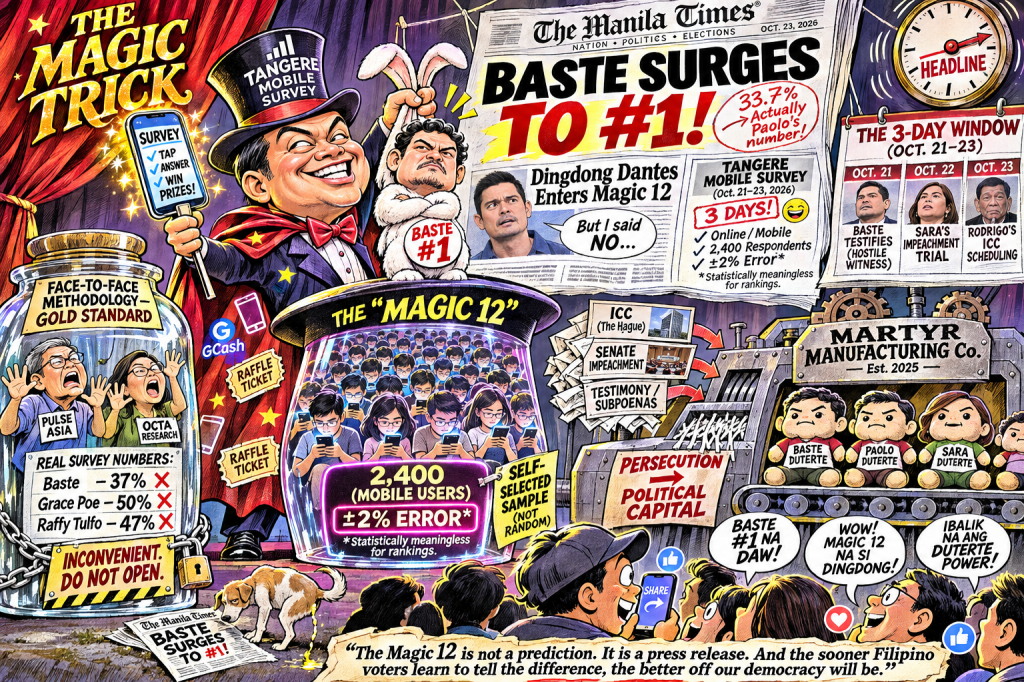
Philippines budget scandal explained in 4 panels. SAGIP, pork barrel, and why nobody goes to jail.
The “Operative Fact” Shell Game
Lacson’s core argument is legally seductive: the doctrine of operative fact protects innocent beneficiaries who relied on an unconstitutional law in good faith, but it does not shield the authors, proponents, and implementors who acted in bad faith. The Supreme Court, to its credit, said exactly this in its ruling.
But here’s where the script gets fuzzy. When asked how to distinguish good faith from bad faith, Lacson offered this gem: “Bad faith refers to how the funds were spent.”
That’s it? That’s the standard?
So if a ghost flood control project was “spent” on nonexistent construction, that’s bad faith. But if a real flood control project was built at triple the cost through a contractor who happens to be the congressman’s brother-in-law, and the funds were “spent” on actual concrete? Is that good faith because the money moved?
The Supreme Court’s own summary is more precise: the doctrine covers “irreversible programs whose beneficiaries acted in good faith” but does not shield authors, proponents, or implementors “unless the proper tribunals explicitly find that they acted in good faith.” That’s a bifurcated regime. Beneficiaries get the benefit of the doubt. Officials have to prove it.
Lacson’s simplification—that how the money was spent determines good faith—isn’t wrong so much as it’s dangerously incomplete. It ignores the intent behind the appropriation itself. If you designed a mechanism specifically to evade constitutional limits, the fact that some of the money eventually funded a real road doesn’t retroactively cleanse the scheme.
The Palace’s “We Didn’t Know It Was Illegal” Defense
Let’s turn to Malacañang, which has decided that the best defense against a Supreme Court ruling is to ask the Supreme Court to reconsider.
The Palace’s argument, delivered with a straight face, is that the administration merely followed a policy established by Congress since 2015: release unprogrammed funds when collections exceed targets from at least one specified non-tax revenue source.
The Supreme Court said this is precisely the problem. Pegging releases to any new or excess revenue, regardless of whether total revenue targets were met, “departs from the unprogrammed appropriations’ original feature as a deficit neutral mechanism” and “repudiates the Court’s ruling in Araullo v. Aquino III (G.R. No. 209287).”
Translation: you’ve been doing it wrong since 2015, and nobody bothered to stop you until now.
But wait—there’s a delicious irony here. The Palace says it followed Congress’s policy. Congress, meanwhile, is hiding behind the Office of the Solicitor General (OSG), with House Senior Deputy Speaker Ferdinand Hernandez saying, “We will take our lead from OSG and let constitutional process take its course.”
So the Executive blames the Legislature. The Legislature blames the Executive’s lawyers. And the Supreme Court sits there, holding a ruling that says both of you messed up, wondering if anyone in this government is actually willing to take responsibility for anything.
The SAGIP Slush Fund: A Masterclass in Creative Accounting
Here’s the part that should make every Filipino taxpayer’s blood pressure spike.
The Supreme Court found that SAGIP—the “Strengthening Assistance for Government Infrastructure and Social Programs” (SAGIP)—was a “prohibited lump sum appropriation” because it gave the Executive “post-enactment identification/allocative powers, which are constitutionally vested in Congress.”
Read that again. Slowly.
Congress created a fund. It put ₱449.5 billion into it. It attached a name that sounds like a social safety net. And then it handed the actual power to decide which projects got funded to the Executive branch—the same Executive branch that was supposedly the victim of congressional budget insertions.
The Court’s summary is blunt: SAGIP became “the covert repository of lump sum allocations for [Department of Public Works and Highways (DPWH)] infrastructure like flood control projects.”
So the flood control scandal—the ghost projects, the substandard construction, the contractors who somehow kept winning billion-peso awards—wasn’t an accident. It was the design. Congress created a pot of money, pretended it was for “social programs,” and then let the Executive decide where it went. And somehow, a disproportionate amount of it went to flood control projects that either didn’t exist or were built with the structural integrity of a sandcastle.
And Lacson wants to know who acted in bad faith?
The Supreme Court already answered: the Bicameral Conference Committee, which had “no records” of its discussions and submitted “no documents supporting the changes in the budget.” That’s not a finding of individual criminal liability, but it’s a finding of institutional bad faith so glaring that the Court had to invent new transparency requirements just to prevent it from happening again.
The 2027 Budget: Same Play, Different Year?
Here’s the kicker. While everyone was congratulating themselves over the Supreme Court ruling, the House of Representatives had already passed a ₱7.2-trillion 2027 budget bill that Makabayan lawmakers say contains provisions identical to those the Court just struck down.
Alliance of Concerned Teachers (ACT) Teachers Rep. Antonio Tinio called for the House to recall its version of the budget bill. House leadership’s response? “We haven’t discussed any of this.”
You can’t make this up. The Supreme Court says the budget process is broken. Congress says “noted” and keeps passing budgets with the same broken provisions. The only thing missing is a laugh track.
Lacson’s Real Target (And Why It Matters)
Let’s be clear about what Lacson is actually doing here. He’s not just calling for accountability. He’s building a case for his own legacy.
Lacson has been the Senate’s resident budget scold for decades. He’s the guy who saved ₱300 billion by scrutinizing the budget line by line. He’s the guy who called these “the worst budgets ever, even counting the 2013 DAP.” He’s the guy who, when offered a ₱5-million “allocation fund” from the Technical Education and Skills Development Authority (TESDA) just days after the Supreme Court ruling, publicly exposed the offer and said he declined it in three minutes.
That last detail is important. Lacson isn’t just talking about accountability. He’s demonstrating it. While other senators quietly accept their allocations, Lacson is posting screenshots and naming names. Whether you think he’s a genuine reformer or a master of political branding, you have to admit: the man knows how to create a contrast.
But here’s the uncomfortable question: if Lacson is right—and he is, on the principle—what happens next?
The Supreme Court’s ruling is prospective. It applies the operative fact doctrine to protect completed transactions where beneficiaries acted in good faith. It does not automatically invalidate every peso spent under the unconstitutional provisions. It does leave the door open for criminal, civil, and administrative liability against authors, proponents, and implementors.
But who are they?
The Bicameral Conference Committee members? Legislative immunity under Article VI, Section 11 of the 1987 Constitution protects them for acts done in the performance of legislative duties. Good luck piercing that.
The Department of Budget and Management (DBM) officials who certified releases? They were following the law as written. The presumption of good faith is strong until proven otherwise.
The President who signed the budget? Malacañang’s position is that he “merely complied with the law.” And unless you can prove he knew the law was unconstitutional at the time he signed it, you’re stuck with a very high bar.
This is the trap Lacson is walking into. He’s right that accountability should happen. He’s probably wrong that it will happen at the scale the scandal demands. The legal architecture of the Philippines is very good at protecting powerful people from the consequences of their own decisions, provided those decisions were made through proper procedures with the right paperwork.
The Verdict
The Supreme Court did its job. It drew a line and said: no more. The unprogrammed appropriations cannot be a constitutional loophole. The SAGIP fund cannot be a slush fund with a social welfare veneer. The Bicameral Conference Committee cannot operate in darkness.
But a ruling is not accountability. A ruling is a piece of paper. What happens next depends on whether anyone with power actually cares enough to enforce it.
Lacson cares. Or at least he’s performing caring with enough conviction that it’s hard to tell the difference. The Palace doesn’t care—it’s asking for a reconsideration. The House doesn’t care—it’s passing the same budget again. The only people who really care are the ones whose homes get flooded every year because the flood control budget went to ghost projects and “allocation funds.”
So here’s my prediction: the Supreme Court ruling will be celebrated. The Palace will file its motion for reconsideration. The House will pass a 2027 budget with “safeguards” that are either cosmetic or performative. Lacson will hold hearings. Some mid-level officials will be sacrificed. And in 2028, someone will invent a new budget mechanism that does exactly what unprogrammed appropriations did, and we’ll all pretend we didn’t see it coming.
Because that’s the cycle. And until someone goes to jail—actually goes to jail, not just gets investigated—the cycle will keep spinning.
Lacson knows this. The Supreme Court knows this. Even Malacañang knows this, which is why they’re asking for a do-over instead of a confession.
The only question is whether the Filipino public is paying enough attention to make them regret it.
Louis ‘Barok’ C. Biraogo is the author of the Kweba ni Barok blog. He has been described as “suspiciously well-informed” and “probably too angry for his own good.” He considers both descriptions accurate.
Key Citations
A. Legal & Official Sources
- Araullo v. Aquino III. G.R. No. 209287, Supreme Court of the Philippines, 1 July 2014. Supreme Court E-Library, elibrary.judiciary.gov.ph/assets/pdf/philrep/2014/G.R.%20No.%20209287.pdf.
- Belgica v. Ochoa, Jr. G.R. No. 208566, Supreme Court of the Philippines, 19 Nov. 2013. Supreme Court E-Library, elibrary.judiciary.gov.ph/assets/pdf/philrep/2013/G.R.%20No.%20208566.pdf.
- The 1987 Constitution of the Republic of the Philippines. Supreme Court E-Library, elibrary.judiciary.gov.ph/thebookshelf/showdocs/3/353. Accessed 25 Oct. 2026.
- Supreme Court of the Philippines. Official Summary of the 7 October 2026 Decision on Unprogrammed Appropriations. Supreme Court of the Philippines, 20 Oct. 2026, sc.judiciary.gov.ph/sc-holds-unprogrammed-appropriations-subject-to-guidelines-voids-congressional-increases-in-2024-and-2025-budgets/.
B. News Reports
- “Ping: Hold Accountable Officials in Budget Misuse.” The Philippine Star, 24 Oct. 2026. (URL not supplied or verified.)
- “Ang Hirap Maging Mahirap”: The PAO Scandal That Proves Government Contempt Is Nothing New
- “Far-Off” My Axx: Malacañang’s Claire Castro Drowns in Her Own Legal Gaslighting
- “Forthwith” to Farce: How the Senate is Killing Impeachment—And Why Enrile’s Right (Even If You Can’t Trust Him)
- “HINDI AKO NAG-RESIGN!”

- “I Know Nothing”: Baste Duterte’s Amnesia Defense Meets ₱33M in GenCorp Contracts

- “I’m calling you from my new Globe SIM. Send load!”

- “Mahiya Naman Kayo!” Marcos’ Anti-Corruption Vow Faces a Flood of Doubt

- “Manageable” Debt, Unmanageable Lies: DBM’s ₱21 Trillion Fairy Tale
- “Meow, I’m calling you from my new Globe SIM!”

- “Natrabaho”: One Word, One Ombudsman, and a Judiciary on Trial

- “No Special Jail for Crooks!” Boying Remulla Slams VIP Perks for Flood Scammers

- “Philippine-Controlled” or Yankee Gas Station? The Davao Fuel Depot Farce Exposed




Leave a Reply