Crooked Mayors on Notice: Remulla Opens the Window, and the Fixers Start Sweating
By Louis “Barok” C. Biraogo | October 26, 2026
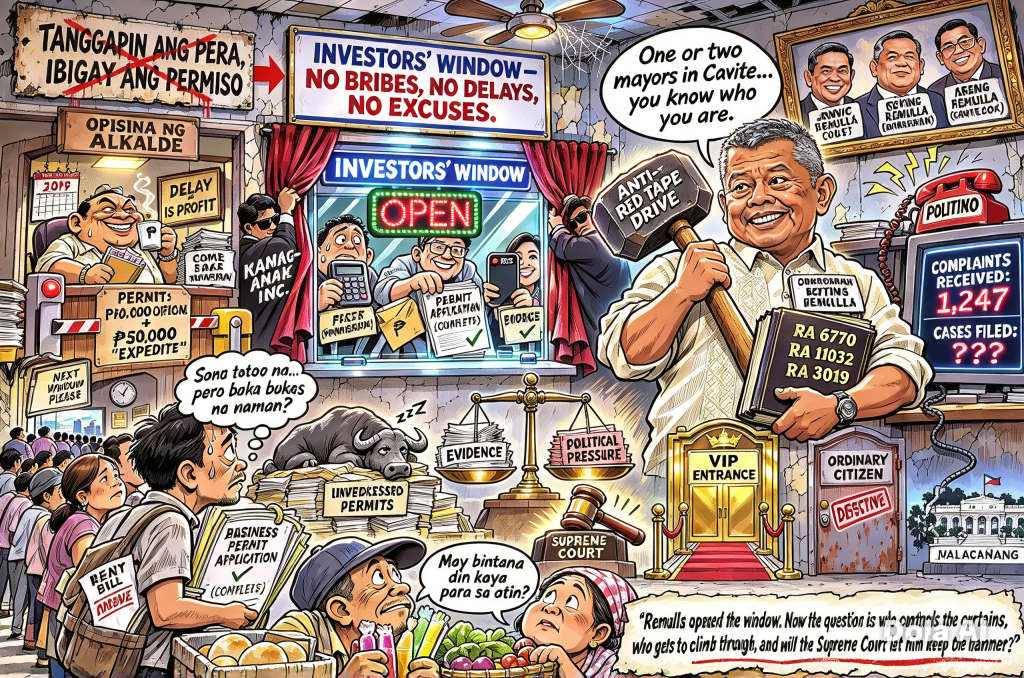
THERE is something deliciously inconvenient about an Ombudsman who tells government officials that their desks are not private tollbooths, their signatures are not merchandise, and their offices are not miniature kingdoms where businessmen must pay tribute before the sovereign will deign to notice their applications.
Enter Jesus Crispin “Boying” Remulla, who has apparently decided that the Philippine bureaucracy needs less ceremonial handshaking and more nervous perspiration.
On October 22, during a meeting with Cebu’s lechon industry, Remulla announced an Investors’ Window through which businesses could report extortion, abuse of authority, and unreasonable permit delays. He also delivered a warning that should have caused several municipal hall coffee machines to stop working: officials who ignore notices from the Anti-Red Tape Authority, or ARTA, could face immediate preventive suspension. And in Cavite, he declared, one or two mayors would be removed.
Good heavens. An Ombudsman threatening consequences for public officials who abuse public office. What an outrage. Somewhere, a fixer is probably clutching his calculator and wondering whether his retirement plan still works.
But let us not confuse a promising initiative with a completed prosecution. Remulla has opened a window. Whether he can keep it open, prevent political fingers from controlling the curtains, and persuade the courts that his enforcement machinery operates within the law remains to be seen.
For now, however, the man deserves credit for identifying a problem that successive administrations have discussed with the solemnity of a national emergency and the practical urgency of a sleeping carabao.
The Republic Of Please-Come-Back-Tomorrow
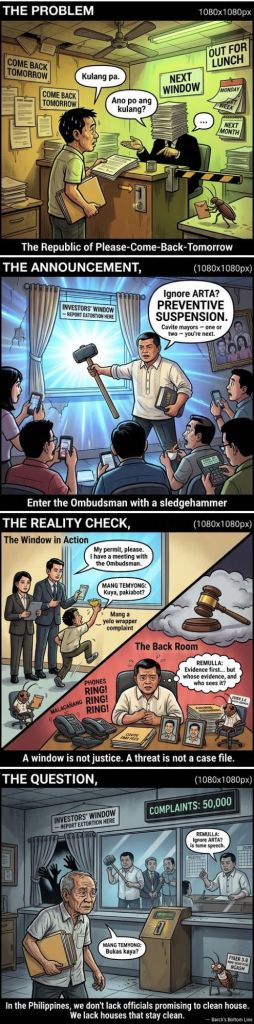
Every Filipino entrepreneur understands the peculiar economics of government delay.
The application is complete. The fees have supposedly been paid. The requirements have been satisfied. Yet the permit remains imprisoned somewhere between an overworked clerk’s desk and an official’s unexplained reluctance to sign.
Come back tomorrow.
Tomorrow becomes next week. Next week becomes next month. Meanwhile, rent accumulates, workers wait, equipment sits idle, and the businessman begins wondering whether the missing ingredient is another document or a more persuasive envelope.
Not every delay is corruption, of course. Some applications are defective. Some inspections uncover genuine safety violations. Some offices are understaffed, badly managed, or drowning in paperwork designed by people who apparently believe simplicity is a threat to national security.
But deliberate delay is different. When an official withholds a lawful service to extract money, reward an ally, punish an adversary, or manufacture dependence, bureaucracy becomes a business model.
The state collects its taxes while certain gatekeepers collect their unofficial commissions.
That is where Remulla’s initiative deserves serious attention. Republic Act No. 11032, the Ease of Doing Business and Efficient Government Service Delivery Act, was designed to attack red tape, unreasonable processing delays, and other prohibited practices. Republic Act No. 3019, the Anti-Graft and Corrupt Practices Act, provides additional weapons against specified abuses of public office.
The laws already exist. The question is whether the people entrusted with enforcing them will finally stop treating violations as administrative weather.
Remulla’s proposal offers a potentially useful answer: bring the complaint beyond the local office allegedly responsible for the abuse and into the hands of an institution empowered to investigate it.
For a businessman accustomed to pleading with the same official who is causing his problem, that could be a meaningful change.
For an official accustomed to operating without scrutiny, it could be considerably less pleasant.
The Beautiful Thing About Section 24
Remulla’s promise of immediate preventive suspension is where the legal machinery becomes particularly interesting.
Section 24 of Republic Act No. 6770, the Ombudsman Act of 1989, authorizes the Ombudsman or a Deputy Ombudsman to order preventive suspension when the evidence of guilt is strong and at least one statutory circumstance exists. These include charges involving dishonesty, oppression, grave misconduct, or neglect of duty; charges that would warrant removal from the service; or circumstances in which the respondent’s continued stay in office may prejudice the investigation.
This is not a trivial power. It allows the Ombudsman to act before a final administrative judgment when the law’s conditions are satisfied.
Nor must the public wait for a potentially corrupt official to finish rearranging the evidence, contacting witnesses, or reminding subordinates who signs their performance evaluations.
Preventive suspension is not a punishment. It is a precautionary measure. The distinction matters because the state can protect an investigation without pretending that an accusation is already a conviction.
And there is the catch.
An ARTA notice followed by continued inaction may provide important evidence. It does not automatically establish every element necessary for preventive suspension in every conceivable case.
Imagine a licensing officer who receives a complete application, ignores repeated notices, and privately demands ten percent of the applicant’s projected earnings. If the documentary evidence supports the allegation, Remulla would have compelling reasons to investigate aggressively and consider appropriate interim measures.
Now imagine another official who refuses to approve a restaurant because the premises failed a legitimate fire-safety inspection.
Suspending the first official may protect the public interest. Punishing the second for refusing to endanger customers would turn anti-red-tape enforcement into a recipe for regulatory stupidity.
The Ombudsman must distinguish the two.
That is not an argument for softness. It is an argument for precision. The strongest enforcement action is the one that survives judicial scrutiny.
Remulla should move quickly, certainly. But speed must describe the investigation, not replace the evidence.
The Cavite Challenge: Show Us The Case File
Then comes the declaration that makes the political atmosphere particularly combustible: Remulla says he intends to remove one or two mayors in Cavite.
This is no small detail. Ombudsman Jesus Crispin “Boying” Remulla is no stranger to Cavite politics: he served as the province’s governor from 2016 to 2019 and previously represented Cavite in Congress. His brother, Jonvic Remulla, is now the Secretary of the Interior and Local Government, while his son, Francisco Gabriel “Abeng” Remulla, serves as Cavite’s governor.
That family history does not prove wrongdoing or political favoritism. But it makes impartiality, transparency, and the selection of enforcement targets especially important. Remulla’s familiarity with Cavite’s political landscape could help him identify entrenched problems—or invite scrutiny over whether investigations are being pursued evenhandedly. The decisive question is not who knows whom, but whether every case is supported by evidence and handled according to law.
Those questions deserve examination, not automatic conclusions.
There are at least three possible interpretations of Remulla’s announcement.
- First, he may know of serious misconduct that warrants investigation. If so, the public should welcome evidence-based accountability, regardless of the officials’ political affiliations.
- Second, the declaration may be intended as a deterrent. Mayors who believe that their permitting practices are about to receive national scrutiny might suddenly discover the virtues of answering correspondence.
- Third, announcing intended removals before identifying the factual basis risks creating the impression that the outcome has been decided in advance.
The third possibility is precisely why Remulla must be careful.
Under Section 60 of the Local Government Code, Republic Act No. 7160, grounds for disciplining elective local officials include misconduct, oppression, gross negligence, and abuse of authority. The Ombudsman possesses significant investigative and administrative powers under Republic Act No. 6770.
But an elected mayor is not a department employee whom the Ombudsman can dismiss by issuing a particularly stern memorandum.
In Pablico v. Villapando, G.R. No. 147870, the Supreme Court addressed the legal authority governing the removal of elective local officials. The applicable statutory process cannot simply be replaced by an official’s personal declaration.
Remulla can investigate. He can pursue appropriate administrative proceedings. He can order preventive suspension when legally justified and seek the sanctions or judicial remedies authorized by law.
What he cannot do is turn a press statement into a substitute for the required legal process.
So, Mr. Ombudsman, by all means open the Cavite files. Follow the money. Examine the permit records. Identify the responsible officials when disclosure is legally appropriate. Pursue the evidence wherever it leads.
But let the evidence identify the villains. Do not ask the public to accept the cast list before the investigation begins.
The Politics Of Being Anti-corruption
Remulla’s political background also complicates his undertaking.
As former Justice Secretary, he was associated with the government’s handling of Rodrigo Duterte’s arrest and transfer to the International Criminal Court. His subsequent appointment as Ombudsman drew criticism from Senator Imee Marcos, who characterized the appointment as a possible political strategy against Vice President Sara Duterte.
The accusation was politically explosive. It was not, by itself, proof that Remulla’s appointment or subsequent investigations were unlawful.
Nevertheless, it supplies political opponents with an obvious narrative: the Ombudsman is not an independent watchdog but an instrument in the administration’s struggle against the Duterte camp.
The appropriate response is not to demand that Remulla abandon enforcement to appease his critics. It is to insist that his office produce a record that makes accusations of selective justice increasingly difficult to sustain.
- Does it investigate allies with the same enthusiasm as adversaries?
- Does it pursue credible complaints against officials connected to powerful political families?
- Does it explain why one complaint results in preventive suspension while another receives further investigation?
- Does it publish meaningful statistics about referrals, dispositions, and final outcomes?
These are questions of institutional credibility, not invitations to political sabotage.
Remulla’s assertion that his office resists pressure from influential people is encouraging. But declarations of independence are cheap. Demonstrable independence is expensive, because it occasionally requires investigating people whose friendship would be politically convenient.
If the Ombudsman wants to silence the “Plan C” accusation, he should do so with a record of impartial enforcement, not merely with another press conference.
Investors Are Not The Only People Who Need A Window
There is another potential weakness in the initiative.
Business chambers and established investors are often better positioned to secure meetings with senior officials than ordinary citizens. They have lawyers, professional associations, and the resources to document complicated transactions.
The sari-sari store owner, market vendor, small restaurant operator, farmer, or first-time entrepreneur may have none of these advantages.
If the Investors’ Window becomes a VIP entrance for companies with political connections, it will reproduce the very inequality it claims to correct.
The program should therefore be accessible to businesses of every size. Complaints should receive reference numbers, documented timelines, clear referral procedures, and appropriate protection against retaliation.
ARTA and the Ombudsman should also publish anonymized statistics showing how quickly complaints are acknowledged, how many are verified, how many result in corrective action, and how many lead to administrative or criminal proceedings.
A complaint received is not a violation established. A case filed is not a conviction obtained. A suspension ordered is not proof of guilt.
The public deserves to know the difference.
Most importantly, the government should digitalize permit applications, publish requirements, record processing times, and require written explanations for denials. Every unnecessary discretionary step is another opportunity for a fixer to offer a shortcut around a problem the bureaucracy itself created.
Punishing corrupt officials is necessary. Designing systems in which corruption becomes harder to commit is better.
The Real Test Is Not The Window. It Is What Happens Next.
Remulla’s initiative has the potential to improve the business climate, reduce opportunities for extortion, and strengthen the credibility of the Ombudsman’s office.
But the economic argument must also be kept in perspective. Faster permits cannot compensate for weak household purchasing power, expensive credit, poor infrastructure, or inadequate public services. And no serious investment policy should sacrifice fire safety, public health, environmental protection, or other legitimate regulatory objectives for the sake of impressive processing statistics.
The goal is not to make government say yes to everything.
The goal is to make government say yes when the law requires approval, say no when legitimate requirements are not satisfied, explain its decisions, and never sell the answer.
Remulla has correctly identified an enemy that thrives in the shadows between public authority and private desperation. His Investors’ Window could give businesses a way to expose that enemy.
Now comes the difficult part: converting the announcement into a functioning institution.
If the Cavite mayors are implicated in substantiated misconduct, investigate them. If officials elsewhere are demanding illicit payments, investigate them too. If the evidence points toward powerful allies, follow it. If the evidence clears a respondent, acknowledge that result as readily as an indictment.
That is how an Ombudsman builds authority: not by making the loudest threats, but by producing the most defensible decisions.
For once, the bureaucracy has been warned that a delayed permit may attract more than another letter requesting an explanation. It may attract investigators.
That is good news for honest entrepreneurs, bad news for professional extortionists, and an uncomfortable development for anyone who has mistaken public office for a private franchise.
But Remulla should remember that an Ombudsman’s greatest weapon is not the threat to suspend. It is the credibility to prove that the suspension was justified.
Open the window, Mr. Ombudsman. Let the complaints come in. Follow the evidence, resist the political telephone calls, and make the law work with the same urgency that businesses are expected to display when paying their taxes.
And if there really are crooked mayors in Cavite, the public does not need a preview of their political funerals.
It needs the case files.
Because in the Philippines, we have never suffered from a shortage of officials promising to clean house. We have suffered from the astonishing durability of the dirt.
Barok’s Bottom Line
Remulla deserves credit for taking aim at bureaucratic extortion. But the Investors’ Window will be judged not by how many officials he threatens to remove, but by whether he can establish misconduct, enforce the law impartially, and deliver results that survive the courts. A watchdog must bite when the evidence warrants it—and know precisely why it is biting.
Louis ‘Barok’ C. Biraogo is the author of Kweba ni Barok, where he writes about Philippine politics, governance, and the occasional lechon-related scandal.
Key Citations
A. Statutes & Court Decisions
- Republic Act No. 11032: An Act Promoting Ease of Doing Business and Efficient Delivery of Government Services, Amending for the Purpose Republic Act No. 9485, Otherwise Known as the Anti-Red Tape Act of 2007, and for Other Purposes. Supreme Court E-Library, 28 May 2018, elibrary.judiciary.gov.ph/thebookshelf/showdocs/2/83125/.
- Official Gazette of the Republic of the Philippines. “Republic Act No. 3019: Anti-Graft and Corrupt Practices Act.” Official Gazette, 17 Aug. 1960. Accessed 8 Mar. 2025.
- Official Gazette of the Republic of the Philippines. “Republic Act No. 6770: Ombudsman Act of 1989.” Official Gazette, 17 Nov. 1989. Accessed 8 Mar. 2025.
- Official Gazette of the Republic of the Philippines. “Republic Act No. 7160: Local Government Code of 1991.” Official Gazette, 10 Oct. 1991. Accessed 8 Mar. 2025.
- Supreme Court of the Philippines. Pablico v. Villapando. G.R. No. 147870, 29 June 2001. Supreme Court E-Library. Accessed 8 Mar. 2025.
B. News Reports & Studies
- Cabañog, April Blanche. “New Reporting Channel Aims to Protect Business Owners.” SunStar, 24 Oct. 2026, sunstar.com.ph/cebu/new-reporting-channel-aims-to-protect-business-owners.
- United Nations Office on Drugs and Crime. “United Nations Convention against Corruption.” UNODC. Accessed 8 Mar. 2025.
C. Official Websites
- Office of the Ombudsman of the Philippines. Office of the Ombudsman. Accessed 25 Oct. 2026.
- Anti-Red Tape Authority. Anti-Red Tape Authority. Accessed 25 Oct. 2026.
- International Criminal Court. International Criminal Court. Accessed 25 Oct. 2026.
- Senate of the Philippines. Senate of the Philippines. Accessed 25 Oct. 2026.

- “Ang Hirap Maging Mahirap”: The PAO Scandal That Proves Government Contempt Is Nothing New

- “Far-Off” My Axx: Malacañang’s Claire Castro Drowns in Her Own Legal Gaslighting

- “Forthwith” to Farce: How the Senate is Killing Impeachment—And Why Enrile’s Right (Even If You Can’t Trust Him)
- “HINDI AKO NAG-RESIGN!”

- “I Know Nothing”: Baste Duterte’s Amnesia Defense Meets ₱33M in GenCorp Contracts

- “I’m calling you from my new Globe SIM. Send load!”

- “Mahiya Naman Kayo!” Marcos’ Anti-Corruption Vow Faces a Flood of Doubt

- “Manageable” Debt, Unmanageable Lies: DBM’s ₱21 Trillion Fairy Tale
- “Meow, I’m calling you from my new Globe SIM!”

- “Natrabaho”: One Word, One Ombudsman, and a Judiciary on Trial

- “No Special Jail for Crooks!” Boying Remulla Slams VIP Perks for Flood Scammers

- “Philippine-Controlled” or Yankee Gas Station? The Davao Fuel Depot Farce Exposed





Leave a Reply