Leonen Wrote It, Lazaro-Javier Got the Fan Mail: Anatomy of a Judicial Ghost Story
By Louis ‘Barok‘ C. Biraogo — October 26, 2026
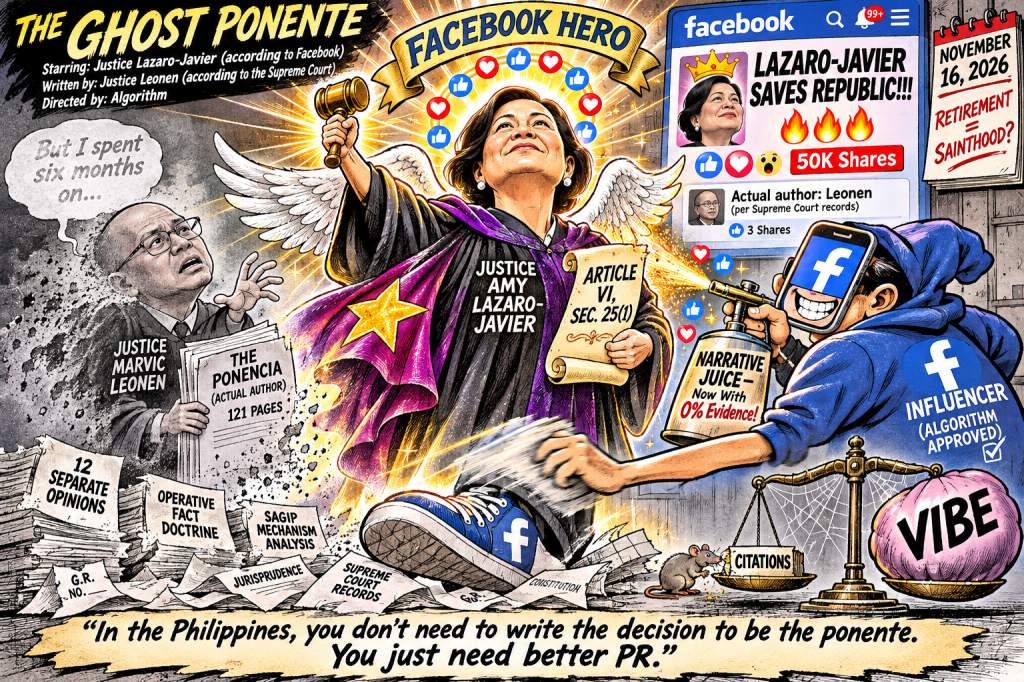
ALLOW me to describe a miracle of modern alchemy. A Facebook post managed to do something the entire Philippine Supreme Court could not: it turned Associate Justice Amy Lazaro-Javier into the author of a 121-page ponencia she didn’t write, gave her a starring role in a constitutional drama she may have only watched from the wings, and packaged her as the fiscal guardian angel of the Republic—all while the actual author, Senior Associate Justice Marvic Leonen, presumably sat somewhere wondering if he’d been airbrushed out of his own magnum opus.
This is not journalism. This is fan fiction with a citation problem.
What the Post Claimed vs. What the Record Shows
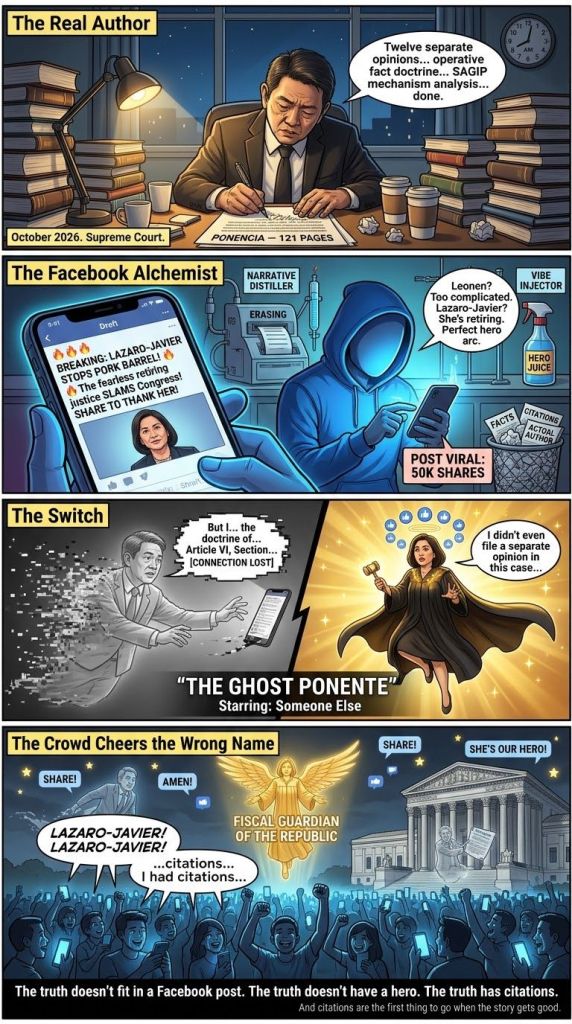
The post, which circulated with the breathless urgency of a scoop, claimed Lazaro-Javier “stressed that Congress cannot raise government spending beyond constitutional limits.” It framed her as the intellectual engine of the Court’s October 2026 budget ruling, the woman who stared down Congress’s pork-barrel machine and reminded everyone that Article VI, Section 25(1) exists.
There’s just one problem: the official Supreme Court announcement, the one with the actual byline, identifies Leonen as the ponente. Lazaro-Javier’s separate opinion—if she filed one in this specific case—does not appear in the Court’s own summary of separate opinions, which names Chief Justice Gesmundo, Justice Caguioa, and Justice Hernando, but not her.
So either the Facebook post has access to Supreme Court records that the Supreme Court itself does not, or someone decided that a retiring female justice made for a better narrative than the actual author. I’ll let you guess which.
Now, before the defenders of Lazaro-Javier’s honor start sharpening their keyboards, let me be clear: this is not an attack on her. Her actual jurisprudence may well be sterling. Her concurring and dissenting opinions may be models of judicial craftsmanship.
But the post doesn’t cite her actual words. It cites a vibe. It cites the idea of her. It cites what someone wants her to have said, because saying it herself would require evidence, and evidence is so much less exciting than a hero arc.
What the Supreme Court Actually Did
Here’s what the Court actually did, stripped of the Facebook-friendly embellishment: it voided the 2024 and 2025 General Appropriations Acts (GAAs) because Congress inflated unprogrammed appropriations by ₱449.5 billion and ₱17.99 billion respectively, circumventing the constitutional ceiling on presidential budget recommendations. It struck down two special provisions in the 2026 GAA governing unprogrammed fund releases.
It called the SAGIP mechanism a “covert repository” for lump-sum flood control allocations. And it applied the doctrine of operative fact to irreversible programs undertaken in good faith—while explicitly preserving criminal, civil, and administrative liability for authors, proponents, and implementors who acted otherwise.
That’s a big deal. It’s a legitimate constitutional earthquake. It builds on Araullo v. Aquino III and Belgica v. Ochoa, the twin pillars of Philippine anti-pork jurisprudence, and extends their logic to the murky world of unprogrammed appropriations.
The Court even called out the Bicameral Conference Committee for operating without records, without explanations, and without the transparency the rules require. If you care about fiscal accountability, this ruling is your friend.
Why Build a Hero?
But the Facebook post doesn’t trust you to care about that. It doesn’t trust the dry, procedural, institutionally complex reality of a Supreme Court decision to hold your attention. So it gives you a character.
It gives you Lazaro-Javier, the retiring justice on the cusp of her 70th birthday, delivering constitutional thunderbolts before riding into the sunset of compulsory retirement on November 16, 2026. It’s a great story. It’s also, as far as the official record shows, not the story of this case.
And here’s the part that should make you suspicious rather than merely annoyed: why Lazaro-Javier? Why not Leonen, the actual ponente? Why not Gesmundo, the Chief Justice who concurred? Why not Caguioa, who called for the express abandonment of the Tolentino doctrine that let bicameral committees run wild?
The answer, I suspect, is that Lazaro-Javier occupies a specific narrative niche. She’s a woman on the verge of retirement. She has a reputation—deserved or not—as a meticulous jurist.
She’s safe to praise because she’s leaving, which means she can’t be accused of angling for anything. And she’s not Leonen, whose public profile carries its own political baggage. Elevating Lazaro-Javier allows the post’s author to signal virtue without triggering the usual partisan reflexes.
It’s identity politics as judicial criticism, and it’s insulting to everyone involved—including Lazaro-Javier herself, who presumably would prefer to be known for what she actually wrote rather than what a Facebook post decided she should have written.
The Romualdez Plunder Case: Conflating Legal Categories
Meanwhile, the post’s treatment of the Romualdez plunder case is a masterclass in conflating legal categories. Yes, Romualdez was arrested and charged with ₱7.44 billion in plunder in September 2026. Yes, the allegations involve kickbacks from flood control and infrastructure projects funded under the 2022-2025 GAAs.
Yes, the Supreme Court’s ruling provides evidentiary context that could strengthen the prosecution’s narrative about systemic budget manipulation. But the ruling does not establish Romualdez’s guilt. It does not establish that the ₱449.5 billion in 2024 unprogrammed increases were the same money as the alleged ₱7.44 billion in kickbacks.
It does not convert a constitutional finding into a criminal conviction. The post’s implication that the Supreme Court somehow validated the plunder charge is a leap that would make a gymnast wince.
The Operative Fact Doctrine, Glossed Over
And then there’s the operative fact doctrine, which the post glosses over with the subtlety of a sledgehammer. The Court said the doctrine covers “irreversible programs whose beneficiaries acted in good faith” but “does not shield authors, proponents, or implementors from criminal, civil, or administrative liability unless the proper tribunals explicitly find that they acted in good faith.”
This is a carefully calibrated statement. It preserves the possibility of accountability while acknowledging that you can’t un-build a bridge. It’s the kind of nuance that legal analysts spend careers parsing.
The Facebook post, by contrast, treats it as a footnote. Because nuance doesn’t get shares.
The Palace Pushes Back
The Palace, for its part, has already signaled it will seek reconsideration, with the Office of the Solicitor General (OSG) arguing that the Court’s guardrails on unprogrammed appropriations may exceed what the Constitution actually requires and intrude on Congress’s power to prescribe budget form and content. That’s a legitimate legal debate. The Solicitor General isn’t wrong that the line between constitutional safeguard and legislative policy is contested.
But the Palace’s position also reveals the stakes: if the Court’s ruling stands, the executive branch loses a great deal of flexibility in how it releases standby funds. If it doesn’t, the pork barrel survives in a new costume.
Why a Fabricated Hero Is Corrosive
Which brings me back to the Facebook post and why it matters beyond its factual errors. In a political culture where disinformation travels faster than Supreme Court decisions, the post does something insidious: it substitutes a fabricated judicial hero for the actual work of judicial review.
It tells readers that a single justice, armed with constitutional conviction, can fix the budget. It ignores the twelve separate opinions, the institutional complexity, the years of litigation, the dry procedural record that made the ruling possible. It turns a collective act of constitutional interpretation into a solo performance, because solo performances are easier to market.
And it does all this while the actual author of the decision, Leonen, presumably continues to do his job without the benefit of a Facebook fan page. The irony would be delicious if it weren’t so corrosive.
What to Read Instead
So here’s what I suggest. If you want to know what Lazaro-Javier actually thinks about the budget cases, read her separate opinion—if she filed one—in the Supreme Court’s official records. If you want to know what the Court decided, read the decision itself, or at least the Court’s own summary.
If you want to know whether Romualdez is guilty, wait for the Sandiganbayan to finish its work, because that’s how criminal justice operates in a system that still, nominally, presumes innocence. And if you want to know why a Facebook post decided to make Lazaro-Javier the star of a show she didn’t headline, ask yourself who benefits from that narrative, and what they’re hoping you won’t notice while you’re busy applauding.
I’ll give you a hint: it’s not the truth. The truth is boring. The truth is a 121-page ponencia by Leonen, twelve separate opinions, a doctrine of operative fact, and a Solicitor General preparing a motion for reconsideration.
The truth doesn’t fit in a Facebook post. The truth doesn’t have a hero. The truth has citations.
And citations, as we’ve just seen, are the first thing to go when the story gets good.
Key Citations
A. Legal & Official Sources
- Philippines, Supreme Court. Maria Carolina P. Araullo v. Benigno Simeon C. Aquino III. G.R. No. 209287, 1 July 2014, lawphil.net/judjuris/juri2014/jul2014/gr_209287_2014.html.
- Philippines, Supreme Court. Greco Antonious Beda B. Belgica v. Hon. Executive Secretary Paquito N. Ochoa Jr. G.R. No. 208566, 19 Nov. 2013, lawphil.net/judjuris/juri2013/nov2013/gr_208566_2013.html.
- Republic Act No. 7080. LawPhil, lawphil.net/statutes/repacts/ra1991/ra_7080_1991.html.
- The 1987 Constitution of the Republic of the Philippines. LawPhil, lawphil.net/consti/cons1987.html.
B. News Articles
- “SC Rules 2024, 2025 Budgets ‘Unconstitutional,’ Voids P467-B Hike in Lump-Sum Funds.” Bilyonaryo, 20 Oct. 2026, bnc.bilyonaryo.com/sc-rules-2024-2025-budgets-unconstitutional-voids-p467-b-hike-in-lump-sum-funds/news/.
- “SC: Congress Can’t Bloat President’s Budget.” Inquirer.net, 20 Oct. 2026, newsinfo.inquirer.net/2327363/sc-congress-cant-bloat-presidents-budget/amp.
- “SC Slams ‘Unchecked Vault.’” Daily Tribune, 24 Oct. 2026, tribune.net.ph/2026/10/24/sc-slams-unchecked-vault.
- “Ailing Romualdez Served Warrant at Hospital.” Philippine News Agency, 7 Sept. 2026, www.pna.gov.ph/articles/1283516.
C. Official Websites
- “SC Holds Unprogrammed Appropriations Subject to Guidelines, Voids Congressional Increases in 2024 and 2025 Budgets.” Supreme Court of the Philippines, Oct. 2026, sc.judiciary.gov.ph/sc-holds-unprogrammed-appropriations-subject-to-guidelines-voids-congressional-increases-in-2024-and-2025-budgets/.
- Office of the Solicitor General. Republic of the Philippines, www.osg.gov.ph.
D. Social Media
- Facebook post on the Supreme Court’s 2024–2025 budget ruling and Associate Justice Amy Lazaro-Javier. Facebook, www.facebook.com/share/p/1J2m2aLboA/.



Leave a Reply