
91% of rich towns got classrooms. 55% of poor towns got scraps. 30 got nothing. That’s not data. That’s a filter.
By Louis ‘Barok‘ C. Biraogo — October 26, 2026
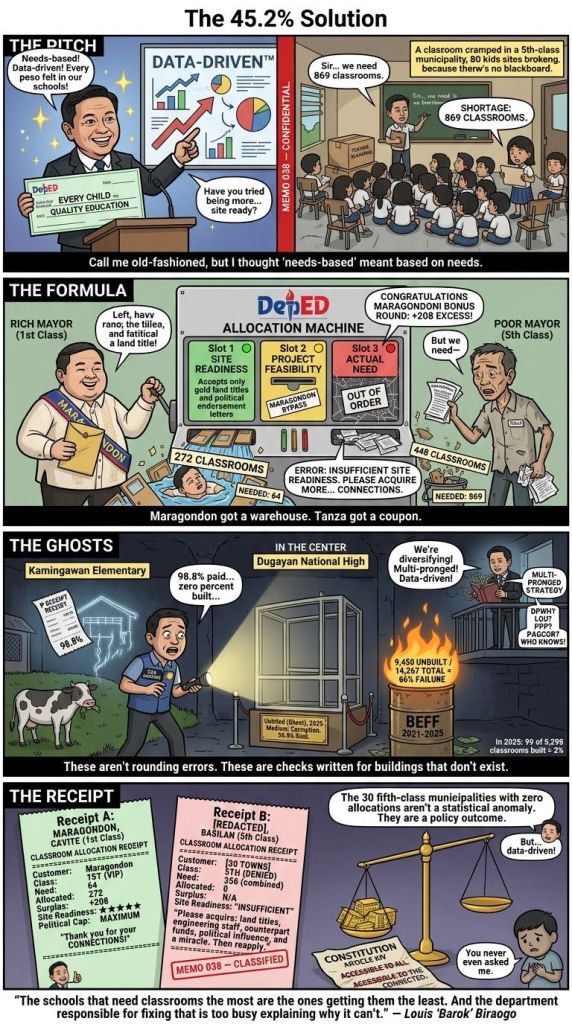
CALL me old-fashioned, but I thought ‘needs-based’ meant based on needs.
The Department of Education (DepEd) looked at the municipalities with the worst classroom shortages in the country and decided that 54.8% of them didn’t make the cut for the 2026 construction program. Not because they lacked need—the data literally says they have the most need—but because they lacked “site readiness,” “project feasibility,” and “implementation timelines.”
In the Philippines, “site readiness” is the bureaucratic euphemism for “your mayor isn’t politically connected enough to get a land title processed.” “Project feasibility” means “we already gave your classrooms to Maragondon.”
And Maragondon, Cavite? A municipality with an estimated shortage of 64 classrooms received 272. That’s not allocation. That’s a warehouse. That’s a procurement officer looking at a spreadsheet and saying, “Eh, we have extra, just put them here.”
Meanwhile, Tanza (shortage: 869, allocation: 448) and Naic (shortage: 631, allocation: 356) are sitting there doing the math. Combined, they’re short 1,564 classrooms and got 1,076. Maragondon alone got more than four times what it needed.
If this were a charity drive, someone would be asking why the rich kid got four Christmas presents while the poor kids got a coupon. But this is DepEd, so instead we get a statement about “data-driven criteria” and a memo nobody can read.
The Memo You Can’t Read
Secretary Sonny Angara, in his now-standard defense, cited DepEd Memorandum No. 038, s. 2026 (Memo 038) as the basis for these allocations. The memo supposedly contains the “classroom needs assessment and validated school-site priorities” that justify everything.
Great. Publish it.
Not a press release. Not a statement saying “we use data.” The actual memo. The actual scoring rubric. The actual weights assigned to “shortage severity” versus “site readiness.” Because right now, “site readiness” is doing a lot of heavy lifting in a system where 91% of first-class municipalities got allocations but only 55% of fifth-class municipalities did.
Thirty of the sixty-six fifth-class municipalities got zero. Not fewer. Zero. Despite a combined shortage of 356 classrooms. Six of those zero-allocation municipalities are in the Bangsamoro Autonomous Region in Muslim Mindanao (BARMM), including areas of Basilan, Lanao del Sur, and Tawi-Tawi.
So let’s do the math that DepEd won’t do for us.
A first-class municipality has engineering staff, land titles, counterpart funds, and the bureaucratic muscle to prepare project documents. A fifth-class municipality might have a mayor, a clerk, and a dream. When DepEd says “site readiness,” what it actually means is “we only fund the places that already have their act together.” Which is a great way to run a business. It’s a terrible way to run a constitutional mandate.
The poorest municipalities need national government assistance precisely because they can’t do it themselves. If DepEd’s model rewards local capacity, then the poorest local government units (LGUs) are being punished twice: once by poverty, and once by the agency that’s supposed to help them.
The Ghosts Are Still There
Here’s the part that should terrify anyone who thinks Angara’s “data-driven” defense is anything other than a PR band-aid.
The Commission on Audit (COA) found that from 2021 to 2025, DepEd failed to build 9,450 out of 14,267 classrooms funded under the Basic Education Facilities Fund—that’s 66% unbuilt.
In Davao del Norte alone, COA flagged ₱83.26 million in projects that were either ghost, abandoned, or materially incomplete. At Kamingawan Elementary School, a two-classroom building was paid up to 98.8% but no structure existed. At Dugayan National High School, a ₱25.61 million building was 98.9% paid but only the structural frame had been constructed.
These aren’t rounding errors. These are checks written for buildings that don’t exist.
And now DepEd wants us to believe that the same agency that oversaw this pipeline of ghosts has suddenly developed a rigorous, data-driven allocation system that just happens to favor first-class municipalities and just happens to over-allocate to certain Cavite towns?
The “site readiness” defense would be more credible if DepEd hadn’t spent the last five years demonstrating that it can’t monitor construction even when the sites are ready, the contracts are signed, and the money is gone.
The Multi-Pronged Distraction
Angara’s other defense is that DepEd is diversifying: Department of Public Works and Highways (DPWH)-led construction, LGU partnerships, public-private partnerships (PPPs), Learning Continuity Spaces, Philippine Amusement and Gaming Corporation (PAGCOR) tripartite agreements. The LGU-led initiative alone covers 8,777 classrooms across 1,955 schools in 439 LGUs.
Sounds impressive. Until you ask the obvious question: Who is counting?
If DPWH is building some, LGUs are building others, PAGCOR is funding a third tranche, and PPPs are somewhere in the mix, then who has the unified project registry? Who can tell you, right now, how many of those 8,777 LGU-led classrooms are actually under construction versus just announced? How many are completed and accepted versus completed and defective?
COA already found that DepEd’s monitoring of DPWH-led projects was so weak that the agency couldn’t enforce construction timelines. What makes anyone think LGU-led projects—scattered across 439 local governments with wildly different capacity levels—will be better monitored?
The answer is nothing. Nothing makes anyone think that. But “multi-pronged strategy” sounds better than “we have no idea where the classrooms are.”
What Angara Should Say
Here’s the statement that would actually be credible:
“We don’t have a good explanation for why Maragondon got 272 classrooms against a shortage of 64 while Tanza got 448 against a shortage of 869. We suspect our ‘site readiness’ criteria are systematically disadvantaging poor municipalities. We are publishing the full scoring methodology today, and we invite COA and the Second Congressional Commission on Education (EDCOM 2) to audit every allocation decision. We are also suspending the 2026 allocation round until we can demonstrate that the formula actually prioritizes need over convenience.”
That statement will never be made. Because it would require admitting that the “data-driven” emperor has no clothes—or, more precisely, that his clothes are made of PowerPoint slides and press releases.
Instead, we get Angara saying “we share the same mission with EDCOM” and “every peso should be felt in our schools.” Fine words. But the peso allocated to Maragondon’s 208 excess classrooms is a peso that wasn’t allocated to a fifth-class municipality in Basilan. The mission isn’t shared. The mission is being managed.
The Constitutional Question Nobody Wants to Ask
Article XIV of the 1987 Constitution requires the State to “protect and promote the right of all citizens to quality education” and to “take appropriate steps to make such education accessible to all.” It also mandates that education receive the “highest budgetary priority.”
DepEd’s defenders will say the Constitution doesn’t prescribe a formula. True. But the Constitution does prohibit the kind of structural inequity that a 91%-versus-55% allocation gap represents. If the national government’s classroom construction program systematically favors municipalities that already have resources over municipalities that don’t, then the State is not making education “accessible to all.” It is making it accessible to those who can navigate the paperwork.
The 30 fifth-class municipalities with zero allocations aren’t a statistical anomaly. They are a policy outcome. And the policy that produced them—whether intentional or merely convenient—is a failure of constitutional fidelity.
What Happens Next
EDCOM 2 has done its job. It found the gap, published the numbers, and put them on the record during a Senate budget hearing. The Commission deserves credit for that. But a finding without a consequence is just a press release with footnotes.
The Ombudsman should investigate the Davao del Norte ghost projects. COA should audit every 2026 classroom allocation against the actual shortage data. Congress should demand the publication of Memo 038 before it approves another peso for classroom construction.
And Angara should stop saying “data-driven” until he’s willing to show us the data.
Because right now, the data says this: the schools that need classrooms the most are the ones getting them the least. And the department responsible for fixing that is too busy explaining why it can’t.
Louis ‘Barok’ C. Biraogo is the author of Kweba ni Barok, where he has been documenting the DepEd-DPWH classroom catastrophe since before it was fashionable. He is still waiting for someone to explain how a classroom gets 98.8% paid for and 0% built.
Key Citations
A. Legal & Official Sources
- The 1987 Constitution of the Republic of the Philippines. Official Gazette of the Republic of the Philippines, http://www.officialgazette.gov.ph/constitutions/1987-constitution/.
- Department of Education. DepEd Memorandum No. 038, s. 2026. 2026. (No public full text located.)
- Department of Education. “Angara, Iginiit Ang Data-Driven Na Alokasyon Ng Silid-Aralan Para Sa Mga Paaralang May Pinakamatinding Pangangailangan.” DepEd.gov.ph, 22 Oct. 2026, http://www.deped.gov.ph/2026/10/22/angara-iginiit-ang-data-driven-na-alokasyon-ng-silid-aralan-para-sa-mga-paaralang-may-pinakamatinding-pangangailangan/.
- Aquino, Bam, and Karol Mark R. Yee. “Put Classrooms Where They’re Needed Most, EDCOM 2 Tells DepEd.” EDCOM 2, 19 Oct. 2026, edcom2.gov.ph/put-classrooms-where-theyre-needed-most-edcom-2-tells-deped/.
- Philippine Amusement and Gaming Corporation. “PAGCOR, DepEd Partner with 66 LGUs to Build More Classrooms Nationwide.” PAGCOR, 24 Sept. 2026, http://www.pagcor.ph/headlines/pagcor-deped-partner-with-66-lgus-to-build-more-classrooms-nationwide.html.
B. News Reports
- Macairan, Evelyn. “EDCOM 2 Cites Gaps in Classroom Allocations.” Philstar.com, 21 Oct. 2026, http://www.philstar.com/headlines/2026/10/21/2564713/edcom-2-cites-gaps-classroom-allocations.
- “DepEd Eyes Data-Driven Criteria to Solve Classroom Shortages.” Philstar.com, 23 Oct. 2026, http://www.philstar.com/headlines/2026/10/23/2565103/deped-eyes-data-driven-criteria-solve-classroom-shortages/amp/.
- “DepEd Pushes Needs-Based Classroom Allocation as EDCOM 2 Flags Gaps.” Manila Bulletin, 24 Oct. 2026, mb.com.ph/2026/10/24/deped-pushes-needs-based-classroom-allocation-as-edcom-2-flags-gaps.
- “9,450 DepEd-Funded Classrooms Unbuilt from 2021 to 2025 — COA.” GMA Network, 28 Sept. 2026, http://www.gmanetwork.com/news/topstories/nation/1004160/9-450-deped-funded-classrooms-unbuilt-from-2021-to-2025-coa/story/.
- “COA Flags Ghost, Incomplete School Projects in Davao del Norte.” Rappler, 27 Sept. 2026, http://www.rappler.com/philippines/deped-school-projects-davao-del-norte-coa-audit-report-2025/.
- “COA Flags Just 2% Completion of 5,298 Target Classrooms in 2025.” Inquirer.net, 28 Sept. 2026, newsinfo.inquirer.net/2313947/coa-flags-just-2-completion-of-5298-target-classrooms-in-2025/amp/.

- ₱9 Billion in ‘Savings’? DILG’s Fire Truck Deal Smells Like Smoke

- ₱8B BBM Pork: CCTV for Every Captain’s Kumpare?

- ₱8.9 Billion, 331 Ghost Police Stations: The TIKAS Scandal Explained

- ₱8.4 Billion, 42,000 Barangays, 1 Election: The “Bawat Barangay Makikinabang” Vote-Buying Masterclass

- ₱75 Million Heist: Cops Gone Full Bandit

- ₱63 to the Dollar: The Only Thing Falling Faster Than the Peso Is the Government’s Credibility

- ₱6.77B Ghost Haunts Duterte: RTC Dismisses Mans Carpio’s Desperate Plea

- ₱6.77 Billion and Zero Cash: The Sara Duterte SALN Math That Doesn’t Add Up

- ₱6.7-Trillion Temptation: The Great Pork Zombie Revival and the “Collegial” Vote-Buying Circus

- ₱58.53B, Zero Receipts: The LGSF Pork Barrel Nobody Wants to Name

- ₱53 Million Man Tells ₱695-a-Day Workers to Stop Being ‘Mayabang’: The Audacity of BSP’s Remolona

- ₱4.4 Billion and a Witness Who Can’t Explain It: The Duterte Impeachment’s Most Expensive Non-Answer









Leave a Reply