Sindikato sa Gamot: Remulla’s Cavite Playbook vs. the National Pharmacy Cartel
By Louis ‘Barok’ C. Biraogo — November 16, 2026
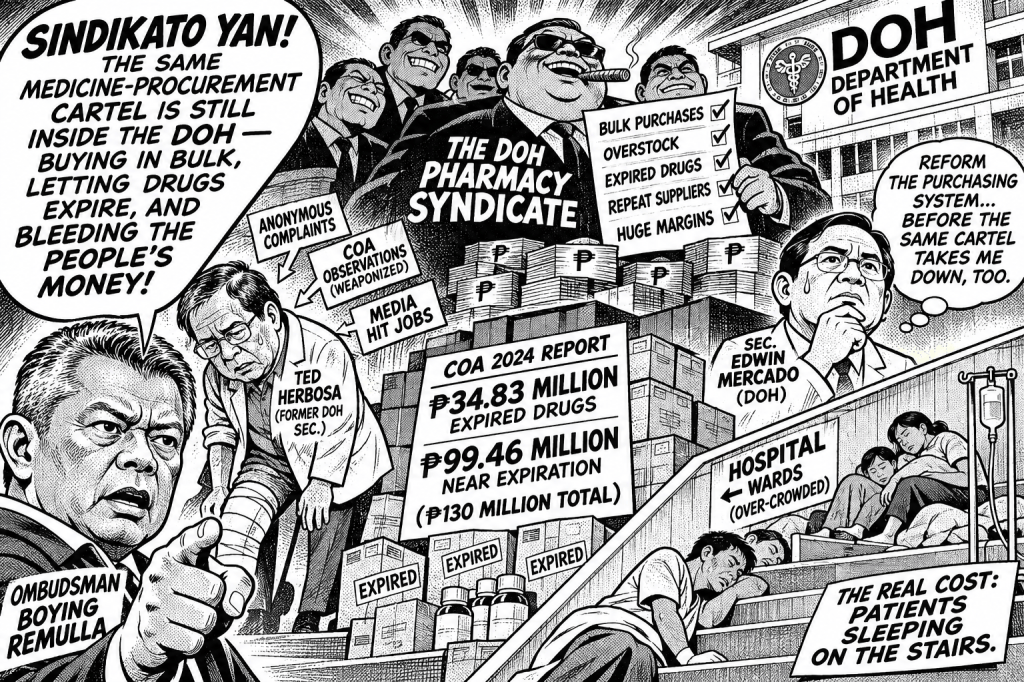
OMBUDSMAN Jesus Crispin “Boying” Remulla just said the quiet part out loud. When he was Cavite governor, the first thing he dismantled was the medicine-buying racket. “Sindikato yan,” he declared. The same syndicate, he now suggests, still thrives inside the national Department of Health (DOH)—preferring bulk purchases that expire on shelves over the unglamorous work of building hospitals where patients currently sleep on stairways.
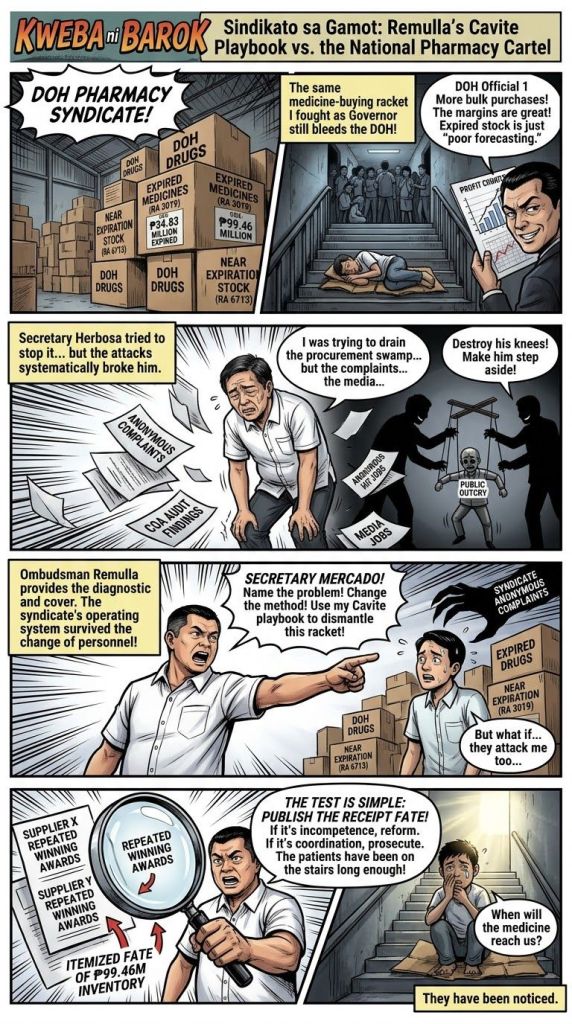
This is not the rambling of a retired politician. It is the country’s chief graft-buster, speaking from both institutional authority and personal experience, pointing at the exact pressure point that cost Teodoro “Ted” Herbosa his job. Herbosa, the only secretary in recent memory who actually tried to drain the procurement swamp, was systematically attacked with anonymous complaints, weaponized Commission on Audit (COA) observations, and media hit jobs until his knees gave out and he stepped aside for surgery. The mafia that tried to bury him never left. Remulla is simply refusing to pretend otherwise.
The COA’s 2024 annual audit report supplies the receipts Remulla does not need to invent: ₱34.83 million in already-expired drugs and medicines, plus another ₱99.46 million sitting near expiration. These are not abstract accounting footnotes. They are the measurable result of a system designed to move volume rather than medicine. Procurement officials, Bids and Awards Committee (BAC) members, and their preferred suppliers generate activity, paperwork, and margins. Patients generate nothing but demand. When the inventory ages out, the taxpayer absorbs the loss and the hospital administrator shrugs. Remulla’s proposed fix—hospital accounts with licensed retailers, buying as needed—attacks the inventory mountain that makes expiration profitable for everyone except the patient.
Critics will instantly reach for the procurement statutes. Republic Act No. 12009 (New Government Procurement Act) and its predecessor demand competitive bidding, transparency, and proportionality. Fine. Nothing in Remulla’s suggestion requires abandoning those principles. Framework agreements, prequalified multi-source suppliers, real-time inventory systems, and first-expiry-first-out protocols can be written into lawfully structured contracts. What cannot be written into law is the continued pretense that ₱130 million in expired or nearly expired stock is merely “poor forecasting.” Poor forecasting that repeatedly benefits the same suppliers is a business model.
Herbosa understood this. When he walked into the DOH in 2023, he inherited a decade of Health Facilities Enhancement Program (HFEP) delays, idle centers, and the same medicine-procurement culture Remulla is now describing. He issued administrative orders tightening HFEP rules, terminated walkaway contractors, and disclosed the rot to Congress. The response was not gratitude. It was a cascade of Ombudsman complaints alleging everything from Zuellig fraternization to mobile-clinic bid-rigging to precisely the expired-stock problem COA later documented. The National DOH Employees Association, representing the actual 53,000 workers who face the overcrowded wards, backed him. The anonymous “concerned employees” and their media amplifiers did not. Herbosa’s resignation for bilateral knee-replacement rehabilitation was the cleanest exit available once the political assassination campaign had done its work. The problems he tried to fix remained exactly where he found them.
Remulla’s intervention is therefore not an attack on the current secretary so much as a public notice that the syndicate’s operating system survived the change of personnel. Secretary Edwin Mercado has been in office only a few months. He inherited both the COA findings and the institutional memory of what happened to the last man who tried to rewrite the rules. Remulla is offering him cover: name the problem, change the purchasing method, and stop treating expired medicines as an unavoidable cost of doing business. If Mercado treats the Ombudsman’s remarks as political interference rather than a usable diagnostic, he will discover that the same networks that produced the COA numbers are still capable of producing the next set of anonymous complaints.
The legal architecture already exists for accountability. Section 3(e) of Republic Act No. 3019 (Anti-Graft and Corrupt Practices Act) reaches public officers who cause undue injury or confer unwarranted benefits through manifest partiality, evident bad faith, or gross inexcusable negligence. The Arias v. Sandiganbayan doctrine protects senior officials who reasonably rely on subordinates, but it is not a cloak once repeated audit findings put them on notice. Republic Act No. 6713 (Code of Conduct and Ethical Standards for Public Officials and Employees)’s ethical standards require the efficient use of resources and prohibit wastage. The Republic Act No. 11036 (Mental Health Act) and Republic Act No. 11223 (Universal Health Care Act) impose affirmative duties that cannot be satisfied by warehouse stock that never reaches a patient. Remulla, as Ombudsman, possesses both the constitutional mandate and the statutory tools under Republic Act No. 6770 (Ombudsman Act of 1989) to investigate rather than merely lecture. His public characterization of the system as a syndicate now creates an obligation to test that characterization against documents, not just against his memory of Cavite.
The real test is simple. Publish the itemized fate of the ₱99.46 million nearly-expired inventory. Identify which suppliers repeatedly win awards for products that later expire. Compare government unit prices against legitimate institutional benchmarks after adjusting for volume, formulation, and delivery. Determine whether the same beneficial owners appear across supposedly competing bidders. If those inquiries show only incompetence, reform the system. If they show coordination, prosecute it. Either outcome is preferable to the current equilibrium in which medicines expire, patients queue on stairs, and everyone involved can claim the problem is too complex for anyone to own.
Herbosa tried. The syndicate and its media auxiliaries made the attempt expensive. Remulla is now saying the same thing from a different institutional perch, with COA numbers in one hand and a governor’s old scorecard in the other. The DOH can treat this as an unwelcome intrusion, or it can treat it as the last clear warning before the next set of expired-stock headlines arrives with a new secretary’s name attached. The patients already know which choice has been made for the last several years. They have been sleeping on the stairs long enough to notice.
Key Citations
A. Legal & Official Sources
- The 1987 Constitution of the Republic of the Philippines. Official Gazette of the Republic of the Philippines, 1987, http://www.officialgazette.gov.ph/constitutions/1987-constitution/.
- Arias v. Sandiganbayan. G.R. No. 81563, 19 Dec. 1989. Supreme Court of the Philippines. Lawphil, lawphil.net/judjuris/juri1989/dec1989/gr_81563_1989.html.
- Republic Act No. 3019: Anti-Graft and Corrupt Practices Act. 17 Aug. 1960. Supreme Court E-Library, elibrary.judiciary.gov.ph/thebookshelf/showdocs/2/22050.
- Republic Act No. 6713: Code of Conduct and Ethical Standards for Public Officials and Employees. 20 Feb. 1989. Lawphil, lawphil.net/statutes/repacts/ra1989/ra_6713_1989.html.
- Republic Act No. 6770: Ombudsman Act of 1989. 17 Nov. 1989. Supreme Court E-Library, elibrary.judiciary.gov.ph/thebookshelf/showdocs/2/2100.
- Republic Act No. 11036: Mental Health Act. 20 June 2018. Lawphil, lawphil.net/statutes/repacts/ra2018/ra_11036_2018.html.
- Republic Act No. 11223: Universal Health Care Act. 20 Feb. 2019. Lawphil, lawphil.net/statutes/repacts/ra2019/ra_11223_2019.html.
- Republic Act No. 12009: New Government Procurement Act. 20 July 2024. Lawphil, lawphil.net/statutes/repacts/ra2024/ra_12009_2024.html.
B. News Reports
- Gatchalian, Ched. “Remulla Urges DOH to Address Alleged Corruption in Medicine Procurement.” Bilyonaryo News Channel, 13 Nov. 2026, bnc.bilyonaryo.com/remulla-urges-doh-to-address-alleged-corruption-in-medicine-procurement/news/.
- GMA Integrated News. “COA Flags DOH for More Than P30M Worth of Expired Medicines.” GMA News Online, 4 Dec. 2025, http://www.gmanetwork.com/news/topstories/nation/968520/coa-flags-doh-for-more-than-p30m-worth-of-expired-medicines/story/.
- Flores, Helen. “Herbosa Steps Down as Health Secretary.” The Philippine Star, 14 July 2026, http://www.philstar.com/headlines/2026/07/14/2542002/herbosa-steps-down-health-secretary.
- Reyes, Dempsey. “COA Flags DOH over Expired, Expiring Drugs Worth Millions.” Philippine Daily Inquirer, 11 Dec. 2025, newsinfo.inquirer.net/2153605/coa-flags-doh-over-expired-expiring-drugs-worth-millions.
- Reyes, Dempsey. “COA Flags DOH over Expired, Expiring Drugs Worth Millions.” Philippine Daily Inquirer, 11 Dec. 2025 (secondary corroboration of the same COA 2024 figures already linked via the GMA report; no distinct unmatched phrase remains in the body).

- “Ang Hirap Maging Mahirap”: The PAO Scandal That Proves Government Contempt Is Nothing New

- “Far-Off” My Axx: Malacañang’s Claire Castro Drowns in Her Own Legal Gaslighting
- “Forthwith” to Farce: How the Senate is Killing Impeachment—And Why Enrile’s Right (Even If You Can’t Trust Him)
- “HINDI AKO NAG-RESIGN!”

- “I Know Nothing”: Baste Duterte’s Amnesia Defense Meets ₱33M in GenCorp Contracts

- “I’m calling you from my new Globe SIM. Send load!”

- “Mahiya Naman Kayo!” Marcos’ Anti-Corruption Vow Faces a Flood of Doubt

- “Manageable” Debt, Unmanageable Corruption: The ₱19.66-Trillion Lie
- “Manageable” Debt, Unmanageable Lies: DBM’s ₱21 Trillion Fairy Tale
- “Meow, I’m calling you from my new Globe SIM!”

- “Natrabaho”: One Word, One Ombudsman, and a Judiciary on Trial

- “No Special Jail for Crooks!” Boying Remulla Slams VIP Perks for Flood Scammers





Leave a Reply